Asian-Americans Fight Back Against School Discrimination

Anonymous
Anonymous wrote:
Anonymous wrote:
Anonymous wrote:
Anonymous wrote:
Anonymous wrote:
Anonymous wrote:
Anonymous wrote:
Anonymous wrote:
Anonymous wrote:
Anonymous wrote:
Anonymous wrote:As an ivy-league educated African-American, I'd said that admissions to elite high schools are the least of our concerns...or at least should be.

Most of us are much more focused on getting black and brown kids to read and perform math at somewhere close to grade level...the numbers are abysmal (though quite mediocre for white kids as well). A world where 50% of black kids read and perform math at grade level is a world transformed---more meaningfully transformed than a world with a few more black kids at TJ, Lowell, or Stuyvesant.

Once we get a critical mass of our kids to grade level, we can then work on cultivating an advanced crew that operates 2-3 years above grade level (which seems to be about avg among Asians or at least certain sub-categories thereof).

At that point, we can begin to have a discussion about elite school admissions and putting in place the requisite prep systems -- which really need to start around 3rd grade...right? My understanding is that Asian parents are working toward schools like TJ for years before taking the test.

To the extent Asian kids are "privileged", it's because they have parents and a community that are truly committed to academic excellence BEYOND what the public school is offering, and they seem to have developed an academic acceleration eco-system to support it. That is a real privilege for kids with access to those (often ethnic) eco-systems, but one that "we" should seek to emulate, not punish.

Funny thing is, most normal black folks (i.e., black folks you'd meet in the barbershop) would agree with all of the above. These school boards need to spend more time on "the street" vs. carousing with white liberals and activists black folks with agendas far removed from the people for whom they purport to speak.


Do you think that your race factored into your admission to an Ivy League school? Do you think Ivy League universities shouldn’t push to increase enrollment of URMs until after we had a critical mass of "Ivy-League-caliber", URM high school students?

There already is a small cohort of black students who are 2-3 years ahead in math. They were being admitted to TJ at 1/3rd of the rate of other kids in the same classes. Something in the old admissions process was broken.

I do agree that we should push hard to get kids on grade level - that is a huge issue. BUT, in parallel, we should also be revamping the admissions policy to be more inclusive of ED, URM, and broader FCPS community (not just a pocket of wealthy middle schools).


I'm not talking about what the schools should do. They do whatever suits them (for the most part). I'm talking about what "we" in the black community should do to the extent we care about things like admission to TJ and the like (and I'm not saying we should). Asian "over"-representation at TJ and co. is the result of certain processes, structures, and practices in place within that community. So the obvious thing -- to me at least -- would be for us to emulate those processes, structures, and practices within the black community, or at least encourage our motivated students to avail themselves of those processes, structures, and practices where accessible. I question whether intra-Asia community structures would be practically accessible given certain ethnic realities, which is why replication is probably the more viable approach. We cannot rely on public beneficence or largesse to do the job of prepping our children for elite academic spaces--- I mean, is there any community that has ever done that?


And -- yes -- I'm almost certain that my race was a factor. How could it not be in an explicitly race-conscious admissions process? Was it decisive? I don't know. Did I deserve to be admitted based on demonstrated merit? I reason so. But I'd also reason that was also true with many (most?) of the rejectees. The point is, my odds of admission were simply greater from the start versus a similarly situated white or Asian applicant. That's not necessarily a (policy) argument against Affirmative Action, but a simple reality. I oppose race-conscious admissions, but I wasn't exactly in a position to reject whatever preference I may have enjoyed. At any rate, if the Supreme Court does what I think it will, it will all be academic as far as my kids are concerned. No matter to me, as they are privileged enough such that an ivy-league credential won't be the game-changer it was for me, with my decidedly MUCH more modest background. To be honest, I can't even relate to my kids' experiences most of the time.


So pull that ladder up behind you.


Like Clarence Thomas


There it is. The old pulling up the ladder trope. Shocked it wasn’t deployed earlier. I forgot that I’m estopped from having any independent views on the issue of racial preference policies because such policies may have been in place when I applied to school. That’s fine I guess, since very few people attend selective institutions where affirmative action is even a factor, meaning that the population of folks entitled to have views on the matter (which doesn’t include me apparently) remains large. So I’ll just keep my mouth shut like a good little…. At any rate, and more importantly, MOST black oppose the use of race preference in school admissions. As very few of them ascended a ladder to a selective institution, I gather they (unlike me) retain the right to express independent views of the matter. And they have indeed spoken: 62% of black folks oppose the use of race as a factor in college admissions.

https://www.pewresearch.org/fact-tank/2019/02/25/most-americans-say-colleges-should-not-consider-race-or-ethnicity-in-admissions/

But you know, it’s not like those folks know what good for ‘em.


As you know, people respond to these topics differently, depending on how they are asked. There are a lot of different ways people could interpret "should race be a factor".
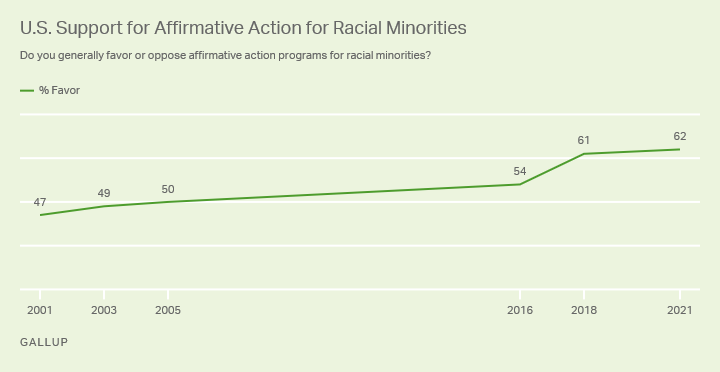
https://news.gallup.com/poll/352832/americans-confidence-racial-fairness-waning.aspx

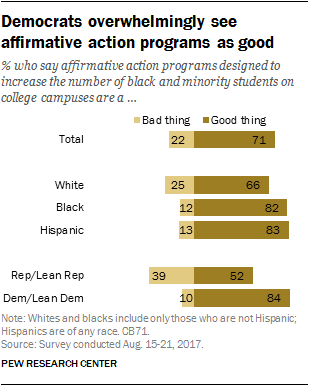
When asked DIRECTLY about affirmative action, most people in the US do support it:


82% of black people think affirmative action is a good thing:


I'm very pragmatic when it comes to life/fairness/opportunity. There is no way we can level the playing field anytime soon. Representation matters.


I take your point on the salience of how a question is phrased. But most people view affirmative action as a "thumb on the scale," rather than certain racial groups being held to significantly higher standards for admission than others, which is what affirmative action is in practice. That's not an argument against affirmative action, per se. I mean, you can construct credible arguments that the diversity and representational trade-offs outweigh whatever unfairness there is, which I gather is your take.

But let's just acknowledge that the term "affirmative action" does way more to obscure what happens in practice, which makes asking "directly" about affirmative action anything by direct.


If white people are willing to take their admitted students out from Ivy league schools and give the spots to black, brown or green people, I will support it 100%. Unfotunately, that isnt the case. The white zuMC discovered that their snowflakes cannot compete with Asian kids academically and the Asian kids may get better education or even better jobs than their snow flakes, they started to push the Asian kids back and want to eliminate their opportunities. They use black and brown as their chess pieces to protect their own interests.


I don't think this is true, although culturally I would say that the groups look at education differently and allocate their time differently. Please don't fight racism by being racist.

DP.. the starting point is different. UMC legacy white families have connections that most of the Asian American families (legacy or not) do not have.

This goes back to the point about the bamboo ceiling and low representation in politics for Asian Americans. For the most part, Asian Americans as a group just don't have that network that UMC white families have which was built through years of dominance of wealthy white families in the boardroom and politics.

This is why legacy still benefits wealthy white families more than all other groups combined.
Anonymous
Anonymous wrote:The truth is that my kid is indeed very fortunate. He comes from a loving family with biological heterosexual parents who are college educated and married to each other. Not only we (parents) know how to cook delicious food from scratch, we also can tutor him in Math. This is a very high bar for most students.
Anonymous
Anonymous wrote:
Anonymous wrote:
Anonymous wrote:
Anonymous wrote:
Anonymous wrote:
Anonymous wrote:
Anonymous wrote:
Anonymous wrote:
Anonymous wrote:
Anonymous wrote:
Anonymous wrote:
Anonymous wrote:As an ivy-league educated African-American, I'd said that admissions to elite high schools are the least of our concerns...or at least should be.

Most of us are much more focused on getting black and brown kids to read and perform math at somewhere close to grade level...the numbers are abysmal (though quite mediocre for white kids as well). A world where 50% of black kids read and perform math at grade level is a world transformed---more meaningfully transformed than a world with a few more black kids at TJ, Lowell, or Stuyvesant.

Once we get a critical mass of our kids to grade level, we can then work on cultivating an advanced crew that operates 2-3 years above grade level (which seems to be about avg among Asians or at least certain sub-categories thereof).

At that point, we can begin to have a discussion about elite school admissions and putting in place the requisite prep systems -- which really need to start around 3rd grade...right? My understanding is that Asian parents are working toward schools like TJ for years before taking the test.

To the extent Asian kids are "privileged", it's because they have parents and a community that are truly committed to academic excellence BEYOND what the public school is offering, and they seem to have developed an academic acceleration eco-system to support it. That is a real privilege for kids with access to those (often ethnic) eco-systems, but one that "we" should seek to emulate, not punish.

Funny thing is, most normal black folks (i.e., black folks you'd meet in the barbershop) would agree with all of the above. These school boards need to spend more time on "the street" vs. carousing with white liberals and activists black folks with agendas far removed from the people for whom they purport to speak.


Do you think that your race factored into your admission to an Ivy League school? Do you think Ivy League universities shouldn’t push to increase enrollment of URMs until after we had a critical mass of "Ivy-League-caliber", URM high school students?

There already is a small cohort of black students who are 2-3 years ahead in math. They were being admitted to TJ at 1/3rd of the rate of other kids in the same classes. Something in the old admissions process was broken.

I do agree that we should push hard to get kids on grade level - that is a huge issue. BUT, in parallel, we should also be revamping the admissions policy to be more inclusive of ED, URM, and broader FCPS community (not just a pocket of wealthy middle schools).


I'm not talking about what the schools should do. They do whatever suits them (for the most part). I'm talking about what "we" in the black community should do to the extent we care about things like admission to TJ and the like (and I'm not saying we should). Asian "over"-representation at TJ and co. is the result of certain processes, structures, and practices in place within that community. So the obvious thing -- to me at least -- would be for us to emulate those processes, structures, and practices within the black community, or at least encourage our motivated students to avail themselves of those processes, structures, and practices where accessible. I question whether intra-Asia community structures would be practically accessible given certain ethnic realities, which is why replication is probably the more viable approach. We cannot rely on public beneficence or largesse to do the job of prepping our children for elite academic spaces--- I mean, is there any community that has ever done that?


And -- yes -- I'm almost certain that my race was a factor. How could it not be in an explicitly race-conscious admissions process? Was it decisive? I don't know. Did I deserve to be admitted based on demonstrated merit? I reason so. But I'd also reason that was also true with many (most?) of the rejectees. The point is, my odds of admission were simply greater from the start versus a similarly situated white or Asian applicant. That's not necessarily a (policy) argument against Affirmative Action, but a simple reality. I oppose race-conscious admissions, but I wasn't exactly in a position to reject whatever preference I may have enjoyed. At any rate, if the Supreme Court does what I think it will, it will all be academic as far as my kids are concerned. No matter to me, as they are privileged enough such that an ivy-league credential won't be the game-changer it was for me, with my decidedly MUCH more modest background. To be honest, I can't even relate to my kids' experiences most of the time.


So pull that ladder up behind you.


Like Clarence Thomas


There it is. The old pulling up the ladder trope. Shocked it wasn’t deployed earlier. I forgot that I’m estopped from having any independent views on the issue of racial preference policies because such policies may have been in place when I applied to school. That’s fine I guess, since very few people attend selective institutions where affirmative action is even a factor, meaning that the population of folks entitled to have views on the matter (which doesn’t include me apparently) remains large. So I’ll just keep my mouth shut like a good little…. At any rate, and more importantly, MOST black oppose the use of race preference in school admissions. As very few of them ascended a ladder to a selective institution, I gather they (unlike me) retain the right to express independent views of the matter. And they have indeed spoken: 62% of black folks oppose the use of race as a factor in college admissions.

https://www.pewresearch.org/fact-tank/2019/02/25/most-americans-say-colleges-should-not-consider-race-or-ethnicity-in-admissions/

But you know, it’s not like those folks know what good for ‘em.


As you know, people respond to these topics differently, depending on how they are asked. There are a lot of different ways people could interpret "should race be a factor".
https://news.gallup.com/poll/352832/americans-confidence-racial-fairness-waning.aspx

When asked DIRECTLY about affirmative action, most people in the US do support it:


82% of black people think affirmative action is a good thing:


I'm very pragmatic when it comes to life/fairness/opportunity. There is no way we can level the playing field anytime soon. Representation matters.


I take your point on the salience of how a question is phrased. But most people view affirmative action as a "thumb on the scale," rather than certain racial groups being held to significantly higher standards for admission than others, which is what affirmative action is in practice. That's not an argument against affirmative action, per se. I mean, you can construct credible arguments that the diversity and representational trade-offs outweigh whatever unfairness there is, which I gather is your take.

But let's just acknowledge that the term "affirmative action" does way more to obscure what happens in practice, which makes asking "directly" about affirmative action anything by direct.


If white people are willing to take their admitted students out from Ivy league schools and give the spots to black, brown or green people, I will support it 100%. Unfotunately, that isnt the case. The white zuMC discovered that their snowflakes cannot compete with Asian kids academically and the Asian kids may get better education or even better jobs than their snow flakes, they started to push the Asian kids back and want to eliminate their opportunities. They use black and brown as their chess pieces to protect their own interests.


I don't think this is true, although culturally I would say that the groups look at education differently and allocate their time differently. Please don't fight racism by being racist.

DP.. the starting point is different. UMC legacy white families have connections that most of the Asian American families (legacy or not) do not have.

This goes back to the point about the bamboo ceiling and low representation in politics for Asian Americans. For the most part, Asian Americans as a group just don't have that network that UMC white families have which was built through years of dominance of wealthy white families in the boardroom and politics.

This is why legacy still benefits wealthy white families more than all other groups combined.


So what? They can put in the time and effort that all the other waves of immigrants put in before them to get where they are. Seems awfully entitled to expect otherwise. Everyone has to start from somewhere.
Anonymous
Anonymous wrote:
Anonymous wrote:
Anonymous wrote:
Anonymous wrote:
Anonymous wrote:
Anonymous wrote:
Anonymous wrote:
Anonymous wrote:
Anonymous wrote:
Anonymous wrote:
Anonymous wrote:
Anonymous wrote:
Anonymous wrote:As an ivy-league educated African-American, I'd said that admissions to elite high schools are the least of our concerns...or at least should be.

Most of us are much more focused on getting black and brown kids to read and perform math at somewhere close to grade level...the numbers are abysmal (though quite mediocre for white kids as well). A world where 50% of black kids read and perform math at grade level is a world transformed---more meaningfully transformed than a world with a few more black kids at TJ, Lowell, or Stuyvesant.

Once we get a critical mass of our kids to grade level, we can then work on cultivating an advanced crew that operates 2-3 years above grade level (which seems to be about avg among Asians or at least certain sub-categories thereof).

At that point, we can begin to have a discussion about elite school admissions and putting in place the requisite prep systems -- which really need to start around 3rd grade...right? My understanding is that Asian parents are working toward schools like TJ for years before taking the test.

To the extent Asian kids are "privileged", it's because they have parents and a community that are truly committed to academic excellence BEYOND what the public school is offering, and they seem to have developed an academic acceleration eco-system to support it. That is a real privilege for kids with access to those (often ethnic) eco-systems, but one that "we" should seek to emulate, not punish.

Funny thing is, most normal black folks (i.e., black folks you'd meet in the barbershop) would agree with all of the above. These school boards need to spend more time on "the street" vs. carousing with white liberals and activists black folks with agendas far removed from the people for whom they purport to speak.


Do you think that your race factored into your admission to an Ivy League school? Do you think Ivy League universities shouldn’t push to increase enrollment of URMs until after we had a critical mass of "Ivy-League-caliber", URM high school students?

There already is a small cohort of black students who are 2-3 years ahead in math. They were being admitted to TJ at 1/3rd of the rate of other kids in the same classes. Something in the old admissions process was broken.

I do agree that we should push hard to get kids on grade level - that is a huge issue. BUT, in parallel, we should also be revamping the admissions policy to be more inclusive of ED, URM, and broader FCPS community (not just a pocket of wealthy middle schools).


I'm not talking about what the schools should do. They do whatever suits them (for the most part). I'm talking about what "we" in the black community should do to the extent we care about things like admission to TJ and the like (and I'm not saying we should). Asian "over"-representation at TJ and co. is the result of certain processes, structures, and practices in place within that community. So the obvious thing -- to me at least -- would be for us to emulate those processes, structures, and practices within the black community, or at least encourage our motivated students to avail themselves of those processes, structures, and practices where accessible. I question whether intra-Asia community structures would be practically accessible given certain ethnic realities, which is why replication is probably the more viable approach. We cannot rely on public beneficence or largesse to do the job of prepping our children for elite academic spaces--- I mean, is there any community that has ever done that?


And -- yes -- I'm almost certain that my race was a factor. How could it not be in an explicitly race-conscious admissions process? Was it decisive? I don't know. Did I deserve to be admitted based on demonstrated merit? I reason so. But I'd also reason that was also true with many (most?) of the rejectees. The point is, my odds of admission were simply greater from the start versus a similarly situated white or Asian applicant. That's not necessarily a (policy) argument against Affirmative Action, but a simple reality. I oppose race-conscious admissions, but I wasn't exactly in a position to reject whatever preference I may have enjoyed. At any rate, if the Supreme Court does what I think it will, it will all be academic as far as my kids are concerned. No matter to me, as they are privileged enough such that an ivy-league credential won't be the game-changer it was for me, with my decidedly MUCH more modest background. To be honest, I can't even relate to my kids' experiences most of the time.


So pull that ladder up behind you.


Like Clarence Thomas


There it is. The old pulling up the ladder trope. Shocked it wasn’t deployed earlier. I forgot that I’m estopped from having any independent views on the issue of racial preference policies because such policies may have been in place when I applied to school. That’s fine I guess, since very few people attend selective institutions where affirmative action is even a factor, meaning that the population of folks entitled to have views on the matter (which doesn’t include me apparently) remains large. So I’ll just keep my mouth shut like a good little…. At any rate, and more importantly, MOST black oppose the use of race preference in school admissions. As very few of them ascended a ladder to a selective institution, I gather they (unlike me) retain the right to express independent views of the matter. And they have indeed spoken: 62% of black folks oppose the use of race as a factor in college admissions.

https://www.pewresearch.org/fact-tank/2019/02/25/most-americans-say-colleges-should-not-consider-race-or-ethnicity-in-admissions/

But you know, it’s not like those folks know what good for ‘em.


As you know, people respond to these topics differently, depending on how they are asked. There are a lot of different ways people could interpret "should race be a factor".
https://news.gallup.com/poll/352832/americans-confidence-racial-fairness-waning.aspx

When asked DIRECTLY about affirmative action, most people in the US do support it:


82% of black people think affirmative action is a good thing:


I'm very pragmatic when it comes to life/fairness/opportunity. There is no way we can level the playing field anytime soon. Representation matters.


I take your point on the salience of how a question is phrased. But most people view affirmative action as a "thumb on the scale," rather than certain racial groups being held to significantly higher standards for admission than others, which is what affirmative action is in practice. That's not an argument against affirmative action, per se. I mean, you can construct credible arguments that the diversity and representational trade-offs outweigh whatever unfairness there is, which I gather is your take.

But let's just acknowledge that the term "affirmative action" does way more to obscure what happens in practice, which makes asking "directly" about affirmative action anything by direct.


If white people are willing to take their admitted students out from Ivy league schools and give the spots to black, brown or green people, I will support it 100%. Unfotunately, that isnt the case. The white zuMC discovered that their snowflakes cannot compete with Asian kids academically and the Asian kids may get better education or even better jobs than their snow flakes, they started to push the Asian kids back and want to eliminate their opportunities. They use black and brown as their chess pieces to protect their own interests.


I don't think this is true, although culturally I would say that the groups look at education differently and allocate their time differently. Please don't fight racism by being racist.

DP.. the starting point is different. UMC legacy white families have connections that most of the Asian American families (legacy or not) do not have.

This goes back to the point about the bamboo ceiling and low representation in politics for Asian Americans. For the most part, Asian Americans as a group just don't have that network that UMC white families have which was built through years of dominance of wealthy white families in the boardroom and politics.

This is why legacy still benefits wealthy white families more than all other groups combined.


So what? They can put in the time and effort that all the other waves of immigrants put in before them to get where they are. Seems awfully entitled to expect otherwise. Everyone has to start from somewhere.

Someone needs a history lessons.

Did you know that Asian Americans have been here since the early 1800s, but that like, black people, they were discriminated against? No, clearly you didn't know that.

And how do Asian Americans create that vast network when there is such a thing as a bamboo ceiling? Someone needs a lesson in logic and critical thinking skills.

How much "effort" do you think slave owning families put in, like Mitch McConnells' family, which inherited the legacy status from the slave owning days. I guess his Asian American wife figured out a way to parlay her husband's family legacy status.

https://www.nbcnews.com/news/nbcblk/mcconnell-s-family-shows-legacy-slavery-persists-most-american-lives-n1028031
Anonymous
Anonymous wrote:
Anonymous wrote:
Anonymous wrote:
Anonymous wrote:
Anonymous wrote:
Anonymous wrote:
Anonymous wrote:
Anonymous wrote:
Anonymous wrote:
Anonymous wrote:
Anonymous wrote:
Anonymous wrote:
Anonymous wrote:As an ivy-league educated African-American, I'd said that admissions to elite high schools are the least of our concerns...or at least should be.

Most of us are much more focused on getting black and brown kids to read and perform math at somewhere close to grade level...the numbers are abysmal (though quite mediocre for white kids as well). A world where 50% of black kids read and perform math at grade level is a world transformed---more meaningfully transformed than a world with a few more black kids at TJ, Lowell, or Stuyvesant.

Once we get a critical mass of our kids to grade level, we can then work on cultivating an advanced crew that operates 2-3 years above grade level (which seems to be about avg among Asians or at least certain sub-categories thereof).

At that point, we can begin to have a discussion about elite school admissions and putting in place the requisite prep systems -- which really need to start around 3rd grade...right? My understanding is that Asian parents are working toward schools like TJ for years before taking the test.

To the extent Asian kids are "privileged", it's because they have parents and a community that are truly committed to academic excellence BEYOND what the public school is offering, and they seem to have developed an academic acceleration eco-system to support it. That is a real privilege for kids with access to those (often ethnic) eco-systems, but one that "we" should seek to emulate, not punish.

Funny thing is, most normal black folks (i.e., black folks you'd meet in the barbershop) would agree with all of the above. These school boards need to spend more time on "the street" vs. carousing with white liberals and activists black folks with agendas far removed from the people for whom they purport to speak.


Do you think that your race factored into your admission to an Ivy League school? Do you think Ivy League universities shouldn’t push to increase enrollment of URMs until after we had a critical mass of "Ivy-League-caliber", URM high school students?

There already is a small cohort of black students who are 2-3 years ahead in math. They were being admitted to TJ at 1/3rd of the rate of other kids in the same classes. Something in the old admissions process was broken.

I do agree that we should push hard to get kids on grade level - that is a huge issue. BUT, in parallel, we should also be revamping the admissions policy to be more inclusive of ED, URM, and broader FCPS community (not just a pocket of wealthy middle schools).


I'm not talking about what the schools should do. They do whatever suits them (for the most part). I'm talking about what "we" in the black community should do to the extent we care about things like admission to TJ and the like (and I'm not saying we should). Asian "over"-representation at TJ and co. is the result of certain processes, structures, and practices in place within that community. So the obvious thing -- to me at least -- would be for us to emulate those processes, structures, and practices within the black community, or at least encourage our motivated students to avail themselves of those processes, structures, and practices where accessible. I question whether intra-Asia community structures would be practically accessible given certain ethnic realities, which is why replication is probably the more viable approach. We cannot rely on public beneficence or largesse to do the job of prepping our children for elite academic spaces--- I mean, is there any community that has ever done that?


And -- yes -- I'm almost certain that my race was a factor. How could it not be in an explicitly race-conscious admissions process? Was it decisive? I don't know. Did I deserve to be admitted based on demonstrated merit? I reason so. But I'd also reason that was also true with many (most?) of the rejectees. The point is, my odds of admission were simply greater from the start versus a similarly situated white or Asian applicant. That's not necessarily a (policy) argument against Affirmative Action, but a simple reality. I oppose race-conscious admissions, but I wasn't exactly in a position to reject whatever preference I may have enjoyed. At any rate, if the Supreme Court does what I think it will, it will all be academic as far as my kids are concerned. No matter to me, as they are privileged enough such that an ivy-league credential won't be the game-changer it was for me, with my decidedly MUCH more modest background. To be honest, I can't even relate to my kids' experiences most of the time.


So pull that ladder up behind you.


Like Clarence Thomas


There it is. The old pulling up the ladder trope. Shocked it wasn’t deployed earlier. I forgot that I’m estopped from having any independent views on the issue of racial preference policies because such policies may have been in place when I applied to school. That’s fine I guess, since very few people attend selective institutions where affirmative action is even a factor, meaning that the population of folks entitled to have views on the matter (which doesn’t include me apparently) remains large. So I’ll just keep my mouth shut like a good little…. At any rate, and more importantly, MOST black oppose the use of race preference in school admissions. As very few of them ascended a ladder to a selective institution, I gather they (unlike me) retain the right to express independent views of the matter. And they have indeed spoken: 62% of black folks oppose the use of race as a factor in college admissions.

https://www.pewresearch.org/fact-tank/2019/02/25/most-americans-say-colleges-should-not-consider-race-or-ethnicity-in-admissions/

But you know, it’s not like those folks know what good for ‘em.


As you know, people respond to these topics differently, depending on how they are asked. There are a lot of different ways people could interpret "should race be a factor".
https://news.gallup.com/poll/352832/americans-confidence-racial-fairness-waning.aspx

When asked DIRECTLY about affirmative action, most people in the US do support it:


82% of black people think affirmative action is a good thing:


I'm very pragmatic when it comes to life/fairness/opportunity. There is no way we can level the playing field anytime soon. Representation matters.


I take your point on the salience of how a question is phrased. But most people view affirmative action as a "thumb on the scale," rather than certain racial groups being held to significantly higher standards for admission than others, which is what affirmative action is in practice. That's not an argument against affirmative action, per se. I mean, you can construct credible arguments that the diversity and representational trade-offs outweigh whatever unfairness there is, which I gather is your take.

But let's just acknowledge that the term "affirmative action" does way more to obscure what happens in practice, which makes asking "directly" about affirmative action anything by direct.


If white people are willing to take their admitted students out from Ivy league schools and give the spots to black, brown or green people, I will support it 100%. Unfotunately, that isnt the case. The white zuMC discovered that their snowflakes cannot compete with Asian kids academically and the Asian kids may get better education or even better jobs than their snow flakes, they started to push the Asian kids back and want to eliminate their opportunities. They use black and brown as their chess pieces to protect their own interests.


I don't think this is true, although culturally I would say that the groups look at education differently and allocate their time differently. Please don't fight racism by being racist.

DP.. the starting point is different. UMC legacy white families have connections that most of the Asian American families (legacy or not) do not have.

This goes back to the point about the bamboo ceiling and low representation in politics for Asian Americans. For the most part, Asian Americans as a group just don't have that network that UMC white families have which was built through years of dominance of wealthy white families in the boardroom and politics.

This is why legacy still benefits wealthy white families more than all other groups combined.


So what? They can put in the time and effort that all the other waves of immigrants put in before them to get where they are. Seems awfully entitled to expect otherwise. Everyone has to start from somewhere.

Maybe you should say the same to black families.. "so what? they should put in the time and effort that those [privileged] white families put in, or they should study more and harder like those Asian American kids " Say that in public. I dare you.
Anonymous
Anonymous wrote:
Anonymous wrote:
Anonymous wrote:
Anonymous wrote:
Anonymous wrote:
Anonymous wrote:
Anonymous wrote:
Anonymous wrote:
Anonymous wrote:
Anonymous wrote:
Anonymous wrote:
Anonymous wrote:
Anonymous wrote:
Anonymous wrote:As an ivy-league educated African-American, I'd said that admissions to elite high schools are the least of our concerns...or at least should be.

Most of us are much more focused on getting black and brown kids to read and perform math at somewhere close to grade level...the numbers are abysmal (though quite mediocre for white kids as well). A world where 50% of black kids read and perform math at grade level is a world transformed---more meaningfully transformed than a world with a few more black kids at TJ, Lowell, or Stuyvesant.

Once we get a critical mass of our kids to grade level, we can then work on cultivating an advanced crew that operates 2-3 years above grade level (which seems to be about avg among Asians or at least certain sub-categories thereof).

At that point, we can begin to have a discussion about elite school admissions and putting in place the requisite prep systems -- which really need to start around 3rd grade...right? My understanding is that Asian parents are working toward schools like TJ for years before taking the test.

To the extent Asian kids are "privileged", it's because they have parents and a community that are truly committed to academic excellence BEYOND what the public school is offering, and they seem to have developed an academic acceleration eco-system to support it. That is a real privilege for kids with access to those (often ethnic) eco-systems, but one that "we" should seek to emulate, not punish.

Funny thing is, most normal black folks (i.e., black folks you'd meet in the barbershop) would agree with all of the above. These school boards need to spend more time on "the street" vs. carousing with white liberals and activists black folks with agendas far removed from the people for whom they purport to speak.


Do you think that your race factored into your admission to an Ivy League school? Do you think Ivy League universities shouldn’t push to increase enrollment of URMs until after we had a critical mass of "Ivy-League-caliber", URM high school students?

There already is a small cohort of black students who are 2-3 years ahead in math. They were being admitted to TJ at 1/3rd of the rate of other kids in the same classes. Something in the old admissions process was broken.

I do agree that we should push hard to get kids on grade level - that is a huge issue. BUT, in parallel, we should also be revamping the admissions policy to be more inclusive of ED, URM, and broader FCPS community (not just a pocket of wealthy middle schools).


I'm not talking about what the schools should do. They do whatever suits them (for the most part). I'm talking about what "we" in the black community should do to the extent we care about things like admission to TJ and the like (and I'm not saying we should). Asian "over"-representation at TJ and co. is the result of certain processes, structures, and practices in place within that community. So the obvious thing -- to me at least -- would be for us to emulate those processes, structures, and practices within the black community, or at least encourage our motivated students to avail themselves of those processes, structures, and practices where accessible. I question whether intra-Asia community structures would be practically accessible given certain ethnic realities, which is why replication is probably the more viable approach. We cannot rely on public beneficence or largesse to do the job of prepping our children for elite academic spaces--- I mean, is there any community that has ever done that?


And -- yes -- I'm almost certain that my race was a factor. How could it not be in an explicitly race-conscious admissions process? Was it decisive? I don't know. Did I deserve to be admitted based on demonstrated merit? I reason so. But I'd also reason that was also true with many (most?) of the rejectees. The point is, my odds of admission were simply greater from the start versus a similarly situated white or Asian applicant. That's not necessarily a (policy) argument against Affirmative Action, but a simple reality. I oppose race-conscious admissions, but I wasn't exactly in a position to reject whatever preference I may have enjoyed. At any rate, if the Supreme Court does what I think it will, it will all be academic as far as my kids are concerned. No matter to me, as they are privileged enough such that an ivy-league credential won't be the game-changer it was for me, with my decidedly MUCH more modest background. To be honest, I can't even relate to my kids' experiences most of the time.


So pull that ladder up behind you.


Like Clarence Thomas


There it is. The old pulling up the ladder trope. Shocked it wasn’t deployed earlier. I forgot that I’m estopped from having any independent views on the issue of racial preference policies because such policies may have been in place when I applied to school. That’s fine I guess, since very few people attend selective institutions where affirmative action is even a factor, meaning that the population of folks entitled to have views on the matter (which doesn’t include me apparently) remains large. So I’ll just keep my mouth shut like a good little…. At any rate, and more importantly, MOST black oppose the use of race preference in school admissions. As very few of them ascended a ladder to a selective institution, I gather they (unlike me) retain the right to express independent views of the matter. And they have indeed spoken: 62% of black folks oppose the use of race as a factor in college admissions.

https://www.pewresearch.org/fact-tank/2019/02/25/most-americans-say-colleges-should-not-consider-race-or-ethnicity-in-admissions/

But you know, it’s not like those folks know what good for ‘em.


As you know, people respond to these topics differently, depending on how they are asked. There are a lot of different ways people could interpret "should race be a factor".
https://news.gallup.com/poll/352832/americans-confidence-racial-fairness-waning.aspx

When asked DIRECTLY about affirmative action, most people in the US do support it:


82% of black people think affirmative action is a good thing:


I'm very pragmatic when it comes to life/fairness/opportunity. There is no way we can level the playing field anytime soon. Representation matters.


I take your point on the salience of how a question is phrased. But most people view affirmative action as a "thumb on the scale," rather than certain racial groups being held to significantly higher standards for admission than others, which is what affirmative action is in practice. That's not an argument against affirmative action, per se. I mean, you can construct credible arguments that the diversity and representational trade-offs outweigh whatever unfairness there is, which I gather is your take.

But let's just acknowledge that the term "affirmative action" does way more to obscure what happens in practice, which makes asking "directly" about affirmative action anything by direct.


If white people are willing to take their admitted students out from Ivy league schools and give the spots to black, brown or green people, I will support it 100%. Unfotunately, that isnt the case. The white zuMC discovered that their snowflakes cannot compete with Asian kids academically and the Asian kids may get better education or even better jobs than their snow flakes, they started to push the Asian kids back and want to eliminate their opportunities. They use black and brown as their chess pieces to protect their own interests.


I don't think this is true, although culturally I would say that the groups look at education differently and allocate their time differently. Please don't fight racism by being racist.

DP.. the starting point is different. UMC legacy white families have connections that most of the Asian American families (legacy or not) do not have.

This goes back to the point about the bamboo ceiling and low representation in politics for Asian Americans. For the most part, Asian Americans as a group just don't have that network that UMC white families have which was built through years of dominance of wealthy white families in the boardroom and politics.

This is why legacy still benefits wealthy white families more than all other groups combined.


So what? They can put in the time and effort that all the other waves of immigrants put in before them to get where they are. Seems awfully entitled to expect otherwise. Everyone has to start from somewhere.

Someone needs a history lessons.

Did you know that Asian Americans have been here since the early 1800s, but that like, black people, they were discriminated against? No, clearly you didn't know that.

And how do Asian Americans create that vast network when there is such a thing as a bamboo ceiling? Someone needs a lesson in logic and critical thinking skills.

How much "effort" do you think slave owning families put in, like Mitch McConnells' family, which inherited the legacy status from the slave owning days. I guess his Asian American wife figured out a way to parlay her husband's family legacy status.

https://www.nbcnews.com/news/nbcblk/mcconnell-s-family-shows-legacy-slavery-persists-most-american-lives-n1028031


The reality is that while there were small numbers of Asians here since the 1800s, the vast, vast majority of Asians in America arrived since 1980 or are their children. Easy to find in Census data.

And give me a break about history... all but a small handful of slave owning families lost their wealth in the Civil War. The south was impoverished until after WWII.
Anonymous
Anonymous wrote:
Anonymous wrote:
Anonymous wrote:
Anonymous wrote:
Anonymous wrote:
Anonymous wrote:
Anonymous wrote:
Anonymous wrote:
Anonymous wrote:
Anonymous wrote:
Anonymous wrote:
Anonymous wrote:
Anonymous wrote:
Anonymous wrote:As an ivy-league educated African-American, I'd said that admissions to elite high schools are the least of our concerns...or at least should be.

Most of us are much more focused on getting black and brown kids to read and perform math at somewhere close to grade level...the numbers are abysmal (though quite mediocre for white kids as well). A world where 50% of black kids read and perform math at grade level is a world transformed---more meaningfully transformed than a world with a few more black kids at TJ, Lowell, or Stuyvesant.

Once we get a critical mass of our kids to grade level, we can then work on cultivating an advanced crew that operates 2-3 years above grade level (which seems to be about avg among Asians or at least certain sub-categories thereof).

At that point, we can begin to have a discussion about elite school admissions and putting in place the requisite prep systems -- which really need to start around 3rd grade...right? My understanding is that Asian parents are working toward schools like TJ for years before taking the test.

To the extent Asian kids are "privileged", it's because they have parents and a community that are truly committed to academic excellence BEYOND what the public school is offering, and they seem to have developed an academic acceleration eco-system to support it. That is a real privilege for kids with access to those (often ethnic) eco-systems, but one that "we" should seek to emulate, not punish.

Funny thing is, most normal black folks (i.e., black folks you'd meet in the barbershop) would agree with all of the above. These school boards need to spend more time on "the street" vs. carousing with white liberals and activists black folks with agendas far removed from the people for whom they purport to speak.


Do you think that your race factored into your admission to an Ivy League school? Do you think Ivy League universities shouldn’t push to increase enrollment of URMs until after we had a critical mass of "Ivy-League-caliber", URM high school students?

There already is a small cohort of black students who are 2-3 years ahead in math. They were being admitted to TJ at 1/3rd of the rate of other kids in the same classes. Something in the old admissions process was broken.

I do agree that we should push hard to get kids on grade level - that is a huge issue. BUT, in parallel, we should also be revamping the admissions policy to be more inclusive of ED, URM, and broader FCPS community (not just a pocket of wealthy middle schools).


I'm not talking about what the schools should do. They do whatever suits them (for the most part). I'm talking about what "we" in the black community should do to the extent we care about things like admission to TJ and the like (and I'm not saying we should). Asian "over"-representation at TJ and co. is the result of certain processes, structures, and practices in place within that community. So the obvious thing -- to me at least -- would be for us to emulate those processes, structures, and practices within the black community, or at least encourage our motivated students to avail themselves of those processes, structures, and practices where accessible. I question whether intra-Asia community structures would be practically accessible given certain ethnic realities, which is why replication is probably the more viable approach. We cannot rely on public beneficence or largesse to do the job of prepping our children for elite academic spaces--- I mean, is there any community that has ever done that?


And -- yes -- I'm almost certain that my race was a factor. How could it not be in an explicitly race-conscious admissions process? Was it decisive? I don't know. Did I deserve to be admitted based on demonstrated merit? I reason so. But I'd also reason that was also true with many (most?) of the rejectees. The point is, my odds of admission were simply greater from the start versus a similarly situated white or Asian applicant. That's not necessarily a (policy) argument against Affirmative Action, but a simple reality. I oppose race-conscious admissions, but I wasn't exactly in a position to reject whatever preference I may have enjoyed. At any rate, if the Supreme Court does what I think it will, it will all be academic as far as my kids are concerned. No matter to me, as they are privileged enough such that an ivy-league credential won't be the game-changer it was for me, with my decidedly MUCH more modest background. To be honest, I can't even relate to my kids' experiences most of the time.


So pull that ladder up behind you.


Like Clarence Thomas


There it is. The old pulling up the ladder trope. Shocked it wasn’t deployed earlier. I forgot that I’m estopped from having any independent views on the issue of racial preference policies because such policies may have been in place when I applied to school. That’s fine I guess, since very few people attend selective institutions where affirmative action is even a factor, meaning that the population of folks entitled to have views on the matter (which doesn’t include me apparently) remains large. So I’ll just keep my mouth shut like a good little…. At any rate, and more importantly, MOST black oppose the use of race preference in school admissions. As very few of them ascended a ladder to a selective institution, I gather they (unlike me) retain the right to express independent views of the matter. And they have indeed spoken: 62% of black folks oppose the use of race as a factor in college admissions.

https://www.pewresearch.org/fact-tank/2019/02/25/most-americans-say-colleges-should-not-consider-race-or-ethnicity-in-admissions/

But you know, it’s not like those folks know what good for ‘em.


As you know, people respond to these topics differently, depending on how they are asked. There are a lot of different ways people could interpret "should race be a factor".
https://news.gallup.com/poll/352832/americans-confidence-racial-fairness-waning.aspx

When asked DIRECTLY about affirmative action, most people in the US do support it:


82% of black people think affirmative action is a good thing:


I'm very pragmatic when it comes to life/fairness/opportunity. There is no way we can level the playing field anytime soon. Representation matters.


I take your point on the salience of how a question is phrased. But most people view affirmative action as a "thumb on the scale," rather than certain racial groups being held to significantly higher standards for admission than others, which is what affirmative action is in practice. That's not an argument against affirmative action, per se. I mean, you can construct credible arguments that the diversity and representational trade-offs outweigh whatever unfairness there is, which I gather is your take.

But let's just acknowledge that the term "affirmative action" does way more to obscure what happens in practice, which makes asking "directly" about affirmative action anything by direct.


If white people are willing to take their admitted students out from Ivy league schools and give the spots to black, brown or green people, I will support it 100%. Unfotunately, that isnt the case. The white zuMC discovered that their snowflakes cannot compete with Asian kids academically and the Asian kids may get better education or even better jobs than their snow flakes, they started to push the Asian kids back and want to eliminate their opportunities. They use black and brown as their chess pieces to protect their own interests.


I don't think this is true, although culturally I would say that the groups look at education differently and allocate their time differently. Please don't fight racism by being racist.

DP.. the starting point is different. UMC legacy white families have connections that most of the Asian American families (legacy or not) do not have.

This goes back to the point about the bamboo ceiling and low representation in politics for Asian Americans. For the most part, Asian Americans as a group just don't have that network that UMC white families have which was built through years of dominance of wealthy white families in the boardroom and politics.

This is why legacy still benefits wealthy white families more than all other groups combined.


So what? They can put in the time and effort that all the other waves of immigrants put in before them to get where they are. Seems awfully entitled to expect otherwise. Everyone has to start from somewhere.

Maybe you should say the same to black families.. "so what? they should put in the time and effort that those [privileged] white families put in, or they should study more and harder like those Asian American kids " Say that in public. I dare you.


Why would I? Are you saying your situations are remotely the same? That's laughable. I dare you to say that in public. Go on.
Anonymous
Anonymous wrote:
Anonymous wrote:
Anonymous wrote:
Anonymous wrote:
Anonymous wrote:
Anonymous wrote:
Anonymous wrote:
Anonymous wrote:
Anonymous wrote:
Anonymous wrote:
Anonymous wrote:
Anonymous wrote:
Anonymous wrote:
Anonymous wrote:
Anonymous wrote:As an ivy-league educated African-American, I'd said that admissions to elite high schools are the least of our concerns...or at least should be.

Most of us are much more focused on getting black and brown kids to read and perform math at somewhere close to grade level...the numbers are abysmal (though quite mediocre for white kids as well). A world where 50% of black kids read and perform math at grade level is a world transformed---more meaningfully transformed than a world with a few more black kids at TJ, Lowell, or Stuyvesant.

Once we get a critical mass of our kids to grade level, we can then work on cultivating an advanced crew that operates 2-3 years above grade level (which seems to be about avg among Asians or at least certain sub-categories thereof).

At that point, we can begin to have a discussion about elite school admissions and putting in place the requisite prep systems -- which really need to start around 3rd grade...right? My understanding is that Asian parents are working toward schools like TJ for years before taking the test.

To the extent Asian kids are "privileged", it's because they have parents and a community that are truly committed to academic excellence BEYOND what the public school is offering, and they seem to have developed an academic acceleration eco-system to support it. That is a real privilege for kids with access to those (often ethnic) eco-systems, but one that "we" should seek to emulate, not punish.

Funny thing is, most normal black folks (i.e., black folks you'd meet in the barbershop) would agree with all of the above. These school boards need to spend more time on "the street" vs. carousing with white liberals and activists black folks with agendas far removed from the people for whom they purport to speak.


Do you think that your race factored into your admission to an Ivy League school? Do you think Ivy League universities shouldn’t push to increase enrollment of URMs until after we had a critical mass of "Ivy-League-caliber", URM high school students?

There already is a small cohort of black students who are 2-3 years ahead in math. They were being admitted to TJ at 1/3rd of the rate of other kids in the same classes. Something in the old admissions process was broken.

I do agree that we should push hard to get kids on grade level - that is a huge issue. BUT, in parallel, we should also be revamping the admissions policy to be more inclusive of ED, URM, and broader FCPS community (not just a pocket of wealthy middle schools).


I'm not talking about what the schools should do. They do whatever suits them (for the most part). I'm talking about what "we" in the black community should do to the extent we care about things like admission to TJ and the like (and I'm not saying we should). Asian "over"-representation at TJ and co. is the result of certain processes, structures, and practices in place within that community. So the obvious thing -- to me at least -- would be for us to emulate those processes, structures, and practices within the black community, or at least encourage our motivated students to avail themselves of those processes, structures, and practices where accessible. I question whether intra-Asia community structures would be practically accessible given certain ethnic realities, which is why replication is probably the more viable approach. We cannot rely on public beneficence or largesse to do the job of prepping our children for elite academic spaces--- I mean, is there any community that has ever done that?


And -- yes -- I'm almost certain that my race was a factor. How could it not be in an explicitly race-conscious admissions process? Was it decisive? I don't know. Did I deserve to be admitted based on demonstrated merit? I reason so. But I'd also reason that was also true with many (most?) of the rejectees. The point is, my odds of admission were simply greater from the start versus a similarly situated white or Asian applicant. That's not necessarily a (policy) argument against Affirmative Action, but a simple reality. I oppose race-conscious admissions, but I wasn't exactly in a position to reject whatever preference I may have enjoyed. At any rate, if the Supreme Court does what I think it will, it will all be academic as far as my kids are concerned. No matter to me, as they are privileged enough such that an ivy-league credential won't be the game-changer it was for me, with my decidedly MUCH more modest background. To be honest, I can't even relate to my kids' experiences most of the time.


So pull that ladder up behind you.


Like Clarence Thomas


There it is. The old pulling up the ladder trope. Shocked it wasn’t deployed earlier. I forgot that I’m estopped from having any independent views on the issue of racial preference policies because such policies may have been in place when I applied to school. That’s fine I guess, since very few people attend selective institutions where affirmative action is even a factor, meaning that the population of folks entitled to have views on the matter (which doesn’t include me apparently) remains large. So I’ll just keep my mouth shut like a good little…. At any rate, and more importantly, MOST black oppose the use of race preference in school admissions. As very few of them ascended a ladder to a selective institution, I gather they (unlike me) retain the right to express independent views of the matter. And they have indeed spoken: 62% of black folks oppose the use of race as a factor in college admissions.

https://www.pewresearch.org/fact-tank/2019/02/25/most-americans-say-colleges-should-not-consider-race-or-ethnicity-in-admissions/

But you know, it’s not like those folks know what good for ‘em.


As you know, people respond to these topics differently, depending on how they are asked. There are a lot of different ways people could interpret "should race be a factor".
https://news.gallup.com/poll/352832/americans-confidence-racial-fairness-waning.aspx

When asked DIRECTLY about affirmative action, most people in the US do support it:


82% of black people think affirmative action is a good thing:


I'm very pragmatic when it comes to life/fairness/opportunity. There is no way we can level the playing field anytime soon. Representation matters.


I take your point on the salience of how a question is phrased. But most people view affirmative action as a "thumb on the scale," rather than certain racial groups being held to significantly higher standards for admission than others, which is what affirmative action is in practice. That's not an argument against affirmative action, per se. I mean, you can construct credible arguments that the diversity and representational trade-offs outweigh whatever unfairness there is, which I gather is your take.

But let's just acknowledge that the term "affirmative action" does way more to obscure what happens in practice, which makes asking "directly" about affirmative action anything by direct.


If white people are willing to take their admitted students out from Ivy league schools and give the spots to black, brown or green people, I will support it 100%. Unfotunately, that isnt the case. The white zuMC discovered that their snowflakes cannot compete with Asian kids academically and the Asian kids may get better education or even better jobs than their snow flakes, they started to push the Asian kids back and want to eliminate their opportunities. They use black and brown as their chess pieces to protect their own interests.


I don't think this is true, although culturally I would say that the groups look at education differently and allocate their time differently. Please don't fight racism by being racist.

DP.. the starting point is different. UMC legacy white families have connections that most of the Asian American families (legacy or not) do not have.

This goes back to the point about the bamboo ceiling and low representation in politics for Asian Americans. For the most part, Asian Americans as a group just don't have that network that UMC white families have which was built through years of dominance of wealthy white families in the boardroom and politics.

This is why legacy still benefits wealthy white families more than all other groups combined.


So what? They can put in the time and effort that all the other waves of immigrants put in before them to get where they are. Seems awfully entitled to expect otherwise. Everyone has to start from somewhere.

Maybe you should say the same to black families.. "so what? they should put in the time and effort that those [privileged] white families put in, or they should study more and harder like those Asian American kids " Say that in public. I dare you.


Why would I? Are you saying your situations are remotely the same? That's laughable. I dare you to say that in public. Go on.


Are we back to the oppression Olympics? I think most Asian Americans realize change won't happen overnight, but lots of people seem unwilling to admit that Asian Americans face their own forms of racism. Then they get surprised when they find out no one likes to be discriminated against.
Anonymous
Anonymous wrote:
Anonymous wrote:
Anonymous wrote:
Anonymous wrote:
Anonymous wrote:
Anonymous wrote:
Anonymous wrote:
Anonymous wrote:
Anonymous wrote:
Anonymous wrote:
Anonymous wrote:
Anonymous wrote:
Anonymous wrote:
Anonymous wrote:
Anonymous wrote:
Anonymous wrote:As an ivy-league educated African-American, I'd said that admissions to elite high schools are the least of our concerns...or at least should be.

Most of us are much more focused on getting black and brown kids to read and perform math at somewhere close to grade level...the numbers are abysmal (though quite mediocre for white kids as well). A world where 50% of black kids read and perform math at grade level is a world transformed---more meaningfully transformed than a world with a few more black kids at TJ, Lowell, or Stuyvesant.

Once we get a critical mass of our kids to grade level, we can then work on cultivating an advanced crew that operates 2-3 years above grade level (which seems to be about avg among Asians or at least certain sub-categories thereof).

At that point, we can begin to have a discussion about elite school admissions and putting in place the requisite prep systems -- which really need to start around 3rd grade...right? My understanding is that Asian parents are working toward schools like TJ for years before taking the test.

To the extent Asian kids are "privileged", it's because they have parents and a community that are truly committed to academic excellence BEYOND what the public school is offering, and they seem to have developed an academic acceleration eco-system to support it. That is a real privilege for kids with access to those (often ethnic) eco-systems, but one that "we" should seek to emulate, not punish.

Funny thing is, most normal black folks (i.e., black folks you'd meet in the barbershop) would agree with all of the above. These school boards need to spend more time on "the street" vs. carousing with white liberals and activists black folks with agendas far removed from the people for whom they purport to speak.


Do you think that your race factored into your admission to an Ivy League school? Do you think Ivy League universities shouldn’t push to increase enrollment of URMs until after we had a critical mass of "Ivy-League-caliber", URM high school students?

There already is a small cohort of black students who are 2-3 years ahead in math. They were being admitted to TJ at 1/3rd of the rate of other kids in the same classes. Something in the old admissions process was broken.

I do agree that we should push hard to get kids on grade level - that is a huge issue. BUT, in parallel, we should also be revamping the admissions policy to be more inclusive of ED, URM, and broader FCPS community (not just a pocket of wealthy middle schools).


I'm not talking about what the schools should do. They do whatever suits them (for the most part). I'm talking about what "we" in the black community should do to the extent we care about things like admission to TJ and the like (and I'm not saying we should). Asian "over"-representation at TJ and co. is the result of certain processes, structures, and practices in place within that community. So the obvious thing -- to me at least -- would be for us to emulate those processes, structures, and practices within the black community, or at least encourage our motivated students to avail themselves of those processes, structures, and practices where accessible. I question whether intra-Asia community structures would be practically accessible given certain ethnic realities, which is why replication is probably the more viable approach. We cannot rely on public beneficence or largesse to do the job of prepping our children for elite academic spaces--- I mean, is there any community that has ever done that?


And -- yes -- I'm almost certain that my race was a factor. How could it not be in an explicitly race-conscious admissions process? Was it decisive? I don't know. Did I deserve to be admitted based on demonstrated merit? I reason so. But I'd also reason that was also true with many (most?) of the rejectees. The point is, my odds of admission were simply greater from the start versus a similarly situated white or Asian applicant. That's not necessarily a (policy) argument against Affirmative Action, but a simple reality. I oppose race-conscious admissions, but I wasn't exactly in a position to reject whatever preference I may have enjoyed. At any rate, if the Supreme Court does what I think it will, it will all be academic as far as my kids are concerned. No matter to me, as they are privileged enough such that an ivy-league credential won't be the game-changer it was for me, with my decidedly MUCH more modest background. To be honest, I can't even relate to my kids' experiences most of the time.


So pull that ladder up behind you.


Like Clarence Thomas


There it is. The old pulling up the ladder trope. Shocked it wasn’t deployed earlier. I forgot that I’m estopped from having any independent views on the issue of racial preference policies because such policies may have been in place when I applied to school. That’s fine I guess, since very few people attend selective institutions where affirmative action is even a factor, meaning that the population of folks entitled to have views on the matter (which doesn’t include me apparently) remains large. So I’ll just keep my mouth shut like a good little…. At any rate, and more importantly, MOST black oppose the use of race preference in school admissions. As very few of them ascended a ladder to a selective institution, I gather they (unlike me) retain the right to express independent views of the matter. And they have indeed spoken: 62% of black folks oppose the use of race as a factor in college admissions.

https://www.pewresearch.org/fact-tank/2019/02/25/most-americans-say-colleges-should-not-consider-race-or-ethnicity-in-admissions/

But you know, it’s not like those folks know what good for ‘em.


As you know, people respond to these topics differently, depending on how they are asked. There are a lot of different ways people could interpret "should race be a factor".
https://news.gallup.com/poll/352832/americans-confidence-racial-fairness-waning.aspx

When asked DIRECTLY about affirmative action, most people in the US do support it:


82% of black people think affirmative action is a good thing:


I'm very pragmatic when it comes to life/fairness/opportunity. There is no way we can level the playing field anytime soon. Representation matters.


I take your point on the salience of how a question is phrased. But most people view affirmative action as a "thumb on the scale," rather than certain racial groups being held to significantly higher standards for admission than others, which is what affirmative action is in practice. That's not an argument against affirmative action, per se. I mean, you can construct credible arguments that the diversity and representational trade-offs outweigh whatever unfairness there is, which I gather is your take.

But let's just acknowledge that the term "affirmative action" does way more to obscure what happens in practice, which makes asking "directly" about affirmative action anything by direct.


If white people are willing to take their admitted students out from Ivy league schools and give the spots to black, brown or green people, I will support it 100%. Unfotunately, that isnt the case. The white zuMC discovered that their snowflakes cannot compete with Asian kids academically and the Asian kids may get better education or even better jobs than their snow flakes, they started to push the Asian kids back and want to eliminate their opportunities. They use black and brown as their chess pieces to protect their own interests.


I don't think this is true, although culturally I would say that the groups look at education differently and allocate their time differently. Please don't fight racism by being racist.

DP.. the starting point is different. UMC legacy white families have connections that most of the Asian American families (legacy or not) do not have.

This goes back to the point about the bamboo ceiling and low representation in politics for Asian Americans. For the most part, Asian Americans as a group just don't have that network that UMC white families have which was built through years of dominance of wealthy white families in the boardroom and politics.

This is why legacy still benefits wealthy white families more than all other groups combined.


So what? They can put in the time and effort that all the other waves of immigrants put in before them to get where they are. Seems awfully entitled to expect otherwise. Everyone has to start from somewhere.

Maybe you should say the same to black families.. "so what? they should put in the time and effort that those [privileged] white families put in, or they should study more and harder like those Asian American kids " Say that in public. I dare you.


Why would I? Are you saying your situations are remotely the same? That's laughable. I dare you to say that in public. Go on.


Are we back to the oppression Olympics? I think most Asian Americans realize change won't happen overnight, but lots of people seem unwilling to admit that Asian Americans face their own forms of racism. Then they get surprised when they find out no one likes to be discriminated against.

exactly.. the largest lynching incident in the US didn't involve Black people. It was Asians.

https://www.nbcnews.com/news/asian-america/l-groups-commemorate-1871-massacre-killed-10-citys-chinese-community-rcna3617

Asians couldn't own property; they were segregated into nonwhite schools. I bet most Americans don't even realize this.

And while the vast majority of Asian Amerians immigrated in the 20th century, the fact is that they have been here for generations, but they were discriminated against and couldn't develop the legacy status (which is the point of the discussion) that whites did. Anti-discrimination towards Asians in our culture didn't really take center stage until the very last half of the 20th century, going into the 21st century.

Legacy builds upon legacy.
Anonymous
Anonymous wrote:
Anonymous wrote:
Anonymous wrote:
Anonymous wrote:
Anonymous wrote:
Anonymous wrote:
Anonymous wrote:
Anonymous wrote:
Anonymous wrote:
Anonymous wrote:
Anonymous wrote:
Anonymous wrote:
Anonymous wrote:
Anonymous wrote:
Anonymous wrote:As an ivy-league educated African-American, I'd said that admissions to elite high schools are the least of our concerns...or at least should be.

Most of us are much more focused on getting black and brown kids to read and perform math at somewhere close to grade level...the numbers are abysmal (though quite mediocre for white kids as well). A world where 50% of black kids read and perform math at grade level is a world transformed---more meaningfully transformed than a world with a few more black kids at TJ, Lowell, or Stuyvesant.

Once we get a critical mass of our kids to grade level, we can then work on cultivating an advanced crew that operates 2-3 years above grade level (which seems to be about avg among Asians or at least certain sub-categories thereof).

At that point, we can begin to have a discussion about elite school admissions and putting in place the requisite prep systems -- which really need to start around 3rd grade...right? My understanding is that Asian parents are working toward schools like TJ for years before taking the test.

To the extent Asian kids are "privileged", it's because they have parents and a community that are truly committed to academic excellence BEYOND what the public school is offering, and they seem to have developed an academic acceleration eco-system to support it. That is a real privilege for kids with access to those (often ethnic) eco-systems, but one that "we" should seek to emulate, not punish.

Funny thing is, most normal black folks (i.e., black folks you'd meet in the barbershop) would agree with all of the above. These school boards need to spend more time on "the street" vs. carousing with white liberals and activists black folks with agendas far removed from the people for whom they purport to speak.


Do you think that your race factored into your admission to an Ivy League school? Do you think Ivy League universities shouldn’t push to increase enrollment of URMs until after we had a critical mass of "Ivy-League-caliber", URM high school students?

There already is a small cohort of black students who are 2-3 years ahead in math. They were being admitted to TJ at 1/3rd of the rate of other kids in the same classes. Something in the old admissions process was broken.

I do agree that we should push hard to get kids on grade level - that is a huge issue. BUT, in parallel, we should also be revamping the admissions policy to be more inclusive of ED, URM, and broader FCPS community (not just a pocket of wealthy middle schools).


I'm not talking about what the schools should do. They do whatever suits them (for the most part). I'm talking about what "we" in the black community should do to the extent we care about things like admission to TJ and the like (and I'm not saying we should). Asian "over"-representation at TJ and co. is the result of certain processes, structures, and practices in place within that community. So the obvious thing -- to me at least -- would be for us to emulate those processes, structures, and practices within the black community, or at least encourage our motivated students to avail themselves of those processes, structures, and practices where accessible. I question whether intra-Asia community structures would be practically accessible given certain ethnic realities, which is why replication is probably the more viable approach. We cannot rely on public beneficence or largesse to do the job of prepping our children for elite academic spaces--- I mean, is there any community that has ever done that?


And -- yes -- I'm almost certain that my race was a factor. How could it not be in an explicitly race-conscious admissions process? Was it decisive? I don't know. Did I deserve to be admitted based on demonstrated merit? I reason so. But I'd also reason that was also true with many (most?) of the rejectees. The point is, my odds of admission were simply greater from the start versus a similarly situated white or Asian applicant. That's not necessarily a (policy) argument against Affirmative Action, but a simple reality. I oppose race-conscious admissions, but I wasn't exactly in a position to reject whatever preference I may have enjoyed. At any rate, if the Supreme Court does what I think it will, it will all be academic as far as my kids are concerned. No matter to me, as they are privileged enough such that an ivy-league credential won't be the game-changer it was for me, with my decidedly MUCH more modest background. To be honest, I can't even relate to my kids' experiences most of the time.


So pull that ladder up behind you.


Like Clarence Thomas


There it is. The old pulling up the ladder trope. Shocked it wasn’t deployed earlier. I forgot that I’m estopped from having any independent views on the issue of racial preference policies because such policies may have been in place when I applied to school. That’s fine I guess, since very few people attend selective institutions where affirmative action is even a factor, meaning that the population of folks entitled to have views on the matter (which doesn’t include me apparently) remains large. So I’ll just keep my mouth shut like a good little…. At any rate, and more importantly, MOST black oppose the use of race preference in school admissions. As very few of them ascended a ladder to a selective institution, I gather they (unlike me) retain the right to express independent views of the matter. And they have indeed spoken: 62% of black folks oppose the use of race as a factor in college admissions.

https://www.pewresearch.org/fact-tank/2019/02/25/most-americans-say-colleges-should-not-consider-race-or-ethnicity-in-admissions/

But you know, it’s not like those folks know what good for ‘em.


As you know, people respond to these topics differently, depending on how they are asked. There are a lot of different ways people could interpret "should race be a factor".
https://news.gallup.com/poll/352832/americans-confidence-racial-fairness-waning.aspx

When asked DIRECTLY about affirmative action, most people in the US do support it:


82% of black people think affirmative action is a good thing:


I'm very pragmatic when it comes to life/fairness/opportunity. There is no way we can level the playing field anytime soon. Representation matters.


I take your point on the salience of how a question is phrased. But most people view affirmative action as a "thumb on the scale," rather than certain racial groups being held to significantly higher standards for admission than others, which is what affirmative action is in practice. That's not an argument against affirmative action, per se. I mean, you can construct credible arguments that the diversity and representational trade-offs outweigh whatever unfairness there is, which I gather is your take.

But let's just acknowledge that the term "affirmative action" does way more to obscure what happens in practice, which makes asking "directly" about affirmative action anything by direct.


If white people are willing to take their admitted students out from Ivy league schools and give the spots to black, brown or green people, I will support it 100%. Unfotunately, that isnt the case. The white zuMC discovered that their snowflakes cannot compete with Asian kids academically and the Asian kids may get better education or even better jobs than their snow flakes, they started to push the Asian kids back and want to eliminate their opportunities. They use black and brown as their chess pieces to protect their own interests.


I don't think this is true, although culturally I would say that the groups look at education differently and allocate their time differently. Please don't fight racism by being racist.

DP.. the starting point is different. UMC legacy white families have connections that most of the Asian American families (legacy or not) do not have.

This goes back to the point about the bamboo ceiling and low representation in politics for Asian Americans. For the most part, Asian Americans as a group just don't have that network that UMC white families have which was built through years of dominance of wealthy white families in the boardroom and politics.

This is why legacy still benefits wealthy white families more than all other groups combined.


So what? They can put in the time and effort that all the other waves of immigrants put in before them to get where they are. Seems awfully entitled to expect otherwise. Everyone has to start from somewhere.

Maybe you should say the same to black families.. "so what? they should put in the time and effort that those [privileged] white families put in, or they should study more and harder like those Asian American kids " Say that in public. I dare you.


Why would I? Are you saying your situations are remotely the same? That's laughable. I dare you to say that in public. Go on.

Well, of course you wouldn't because you know you'd get slapped. But, I did not say that the two situations were the same, so why would I say that in public. You, oth, claim that people should "put in the time and effort" to achieve legacy status. Doesn't matter how their ancestors came here. Be it Native Americans, indentured white servants, African slaves, or Asian immigrants, if you think groups should "put in the time and effort", that would apply to black people too since slavery ended over a hundred years ago. And if you claim "Jim Crow" laws, segregation, etc.. then again, I remind you that those segregation laws also applied to Asian people.

It doens't matter how those people came here. The point is, all non white groups were pushed down such that they could not obtain the deep legacy status that white people could for the past few hundred years.

It's time for legacy status to be removed. If you think people should put time and effort into building something, then let each person do so without standing on their legacy.
Anonymous
Anonymous wrote:
Anonymous wrote:
Anonymous wrote:
Anonymous wrote:
Anonymous wrote:
Anonymous wrote:
Anonymous wrote:
Anonymous wrote:
Anonymous wrote:
Anonymous wrote:
Anonymous wrote:
Anonymous wrote:
Anonymous wrote:
Anonymous wrote:
Anonymous wrote:
Anonymous wrote:
Anonymous wrote:As an ivy-league educated African-American, I'd said that admissions to elite high schools are the least of our concerns...or at least should be.

Most of us are much more focused on getting black and brown kids to read and perform math at somewhere close to grade level...the numbers are abysmal (though quite mediocre for white kids as well). A world where 50% of black kids read and perform math at grade level is a world transformed---more meaningfully transformed than a world with a few more black kids at TJ, Lowell, or Stuyvesant.

Once we get a critical mass of our kids to grade level, we can then work on cultivating an advanced crew that operates 2-3 years above grade level (which seems to be about avg among Asians or at least certain sub-categories thereof).

At that point, we can begin to have a discussion about elite school admissions and putting in place the requisite prep systems -- which really need to start around 3rd grade...right? My understanding is that Asian parents are working toward schools like TJ for years before taking the test.

To the extent Asian kids are "privileged", it's because they have parents and a community that are truly committed to academic excellence BEYOND what the public school is offering, and they seem to have developed an academic acceleration eco-system to support it. That is a real privilege for kids with access to those (often ethnic) eco-systems, but one that "we" should seek to emulate, not punish.

Funny thing is, most normal black folks (i.e., black folks you'd meet in the barbershop) would agree with all of the above. These school boards need to spend more time on "the street" vs. carousing with white liberals and activists black folks with agendas far removed from the people for whom they purport to speak.


Do you think that your race factored into your admission to an Ivy League school? Do you think Ivy League universities shouldn’t push to increase enrollment of URMs until after we had a critical mass of "Ivy-League-caliber", URM high school students?

There already is a small cohort of black students who are 2-3 years ahead in math. They were being admitted to TJ at 1/3rd of the rate of other kids in the same classes. Something in the old admissions process was broken.

I do agree that we should push hard to get kids on grade level - that is a huge issue. BUT, in parallel, we should also be revamping the admissions policy to be more inclusive of ED, URM, and broader FCPS community (not just a pocket of wealthy middle schools).


I'm not talking about what the schools should do. They do whatever suits them (for the most part). I'm talking about what "we" in the black community should do to the extent we care about things like admission to TJ and the like (and I'm not saying we should). Asian "over"-representation at TJ and co. is the result of certain processes, structures, and practices in place within that community. So the obvious thing -- to me at least -- would be for us to emulate those processes, structures, and practices within the black community, or at least encourage our motivated students to avail themselves of those processes, structures, and practices where accessible. I question whether intra-Asia community structures would be practically accessible given certain ethnic realities, which is why replication is probably the more viable approach. We cannot rely on public beneficence or largesse to do the job of prepping our children for elite academic spaces--- I mean, is there any community that has ever done that?


And -- yes -- I'm almost certain that my race was a factor. How could it not be in an explicitly race-conscious admissions process? Was it decisive? I don't know. Did I deserve to be admitted based on demonstrated merit? I reason so. But I'd also reason that was also true with many (most?) of the rejectees. The point is, my odds of admission were simply greater from the start versus a similarly situated white or Asian applicant. That's not necessarily a (policy) argument against Affirmative Action, but a simple reality. I oppose race-conscious admissions, but I wasn't exactly in a position to reject whatever preference I may have enjoyed. At any rate, if the Supreme Court does what I think it will, it will all be academic as far as my kids are concerned. No matter to me, as they are privileged enough such that an ivy-league credential won't be the game-changer it was for me, with my decidedly MUCH more modest background. To be honest, I can't even relate to my kids' experiences most of the time.


So pull that ladder up behind you.


Like Clarence Thomas


There it is. The old pulling up the ladder trope. Shocked it wasn’t deployed earlier. I forgot that I’m estopped from having any independent views on the issue of racial preference policies because such policies may have been in place when I applied to school. That’s fine I guess, since very few people attend selective institutions where affirmative action is even a factor, meaning that the population of folks entitled to have views on the matter (which doesn’t include me apparently) remains large. So I’ll just keep my mouth shut like a good little…. At any rate, and more importantly, MOST black oppose the use of race preference in school admissions. As very few of them ascended a ladder to a selective institution, I gather they (unlike me) retain the right to express independent views of the matter. And they have indeed spoken: 62% of black folks oppose the use of race as a factor in college admissions.

https://www.pewresearch.org/fact-tank/2019/02/25/most-americans-say-colleges-should-not-consider-race-or-ethnicity-in-admissions/

But you know, it’s not like those folks know what good for ‘em.


As you know, people respond to these topics differently, depending on how they are asked. There are a lot of different ways people could interpret "should race be a factor".
https://news.gallup.com/poll/352832/americans-confidence-racial-fairness-waning.aspx

When asked DIRECTLY about affirmative action, most people in the US do support it:


82% of black people think affirmative action is a good thing:


I'm very pragmatic when it comes to life/fairness/opportunity. There is no way we can level the playing field anytime soon. Representation matters.


I take your point on the salience of how a question is phrased. But most people view affirmative action as a "thumb on the scale," rather than certain racial groups being held to significantly higher standards for admission than others, which is what affirmative action is in practice. That's not an argument against affirmative action, per se. I mean, you can construct credible arguments that the diversity and representational trade-offs outweigh whatever unfairness there is, which I gather is your take.

But let's just acknowledge that the term "affirmative action" does way more to obscure what happens in practice, which makes asking "directly" about affirmative action anything by direct.


If white people are willing to take their admitted students out from Ivy league schools and give the spots to black, brown or green people, I will support it 100%. Unfotunately, that isnt the case. The white zuMC discovered that their snowflakes cannot compete with Asian kids academically and the Asian kids may get better education or even better jobs than their snow flakes, they started to push the Asian kids back and want to eliminate their opportunities. They use black and brown as their chess pieces to protect their own interests.


I don't think this is true, although culturally I would say that the groups look at education differently and allocate their time differently. Please don't fight racism by being racist.

DP.. the starting point is different. UMC legacy white families have connections that most of the Asian American families (legacy or not) do not have.

This goes back to the point about the bamboo ceiling and low representation in politics for Asian Americans. For the most part, Asian Americans as a group just don't have that network that UMC white families have which was built through years of dominance of wealthy white families in the boardroom and politics.

This is why legacy still benefits wealthy white families more than all other groups combined.


So what? They can put in the time and effort that all the other waves of immigrants put in before them to get where they are. Seems awfully entitled to expect otherwise. Everyone has to start from somewhere.

Maybe you should say the same to black families.. "so what? they should put in the time and effort that those [privileged] white families put in, or they should study more and harder like those Asian American kids " Say that in public. I dare you.


Why would I? Are you saying your situations are remotely the same? That's laughable. I dare you to say that in public. Go on.


Are we back to the oppression Olympics? I think most Asian Americans realize change won't happen overnight, but lots of people seem unwilling to admit that Asian Americans face their own forms of racism. Then they get surprised when they find out no one likes to be discriminated against.

exactly.. the largest lynching incident in the US didn't involve Black people. It was Asians.

https://www.nbcnews.com/news/asian-america/l-groups-commemorate-1871-massacre-killed-10-citys-chinese-community-rcna3617

Asians couldn't own property; they were segregated into nonwhite schools. I bet most Americans don't even realize this.

And while the vast majority of Asian Amerians immigrated in the 20th century, the fact is that they have been here for generations, but they were discriminated against and couldn't develop the legacy status (which is the point of the discussion) that whites did. Anti-discrimination towards Asians in our culture didn't really take center stage until the very last half of the 20th century, going into the 21st century.

Legacy builds upon legacy.


No, it really doesn't. For the last 40 years, elite schools have been trying to diversify their classes by admitting minorities and First Gen candidates. These people do not have generations of legacies. Are there few families at each school who donate enough to maintain this tradition? Sure, but it is not many. If you want to be outraged, why should schools built up with American donations and tax breaks be providing elite educations to international students?
Anonymous
Anonymous wrote:
Anonymous wrote:
Anonymous wrote:
Anonymous wrote:
Anonymous wrote:
Anonymous wrote:
Anonymous wrote:
Anonymous wrote:
Anonymous wrote:
Anonymous wrote:
Anonymous wrote:
Anonymous wrote:
Anonymous wrote:
Anonymous wrote:
Anonymous wrote:
Anonymous wrote:
Anonymous wrote:
Anonymous wrote:As an ivy-league educated African-American, I'd said that admissions to elite high schools are the least of our concerns...or at least should be.

Most of us are much more focused on getting black and brown kids to read and perform math at somewhere close to grade level...the numbers are abysmal (though quite mediocre for white kids as well). A world where 50% of black kids read and perform math at grade level is a world transformed---more meaningfully transformed than a world with a few more black kids at TJ, Lowell, or Stuyvesant.

Once we get a critical mass of our kids to grade level, we can then work on cultivating an advanced crew that operates 2-3 years above grade level (which seems to be about avg among Asians or at least certain sub-categories thereof).

At that point, we can begin to have a discussion about elite school admissions and putting in place the requisite prep systems -- which really need to start around 3rd grade...right? My understanding is that Asian parents are working toward schools like TJ for years before taking the test.

To the extent Asian kids are "privileged", it's because they have parents and a community that are truly committed to academic excellence BEYOND what the public school is offering, and they seem to have developed an academic acceleration eco-system to support it. That is a real privilege for kids with access to those (often ethnic) eco-systems, but one that "we" should seek to emulate, not punish.

Funny thing is, most normal black folks (i.e., black folks you'd meet in the barbershop) would agree with all of the above. These school boards need to spend more time on "the street" vs. carousing with white liberals and activists black folks with agendas far removed from the people for whom they purport to speak.


Do you think that your race factored into your admission to an Ivy League school? Do you think Ivy League universities shouldn’t push to increase enrollment of URMs until after we had a critical mass of "Ivy-League-caliber", URM high school students?

There already is a small cohort of black students who are 2-3 years ahead in math. They were being admitted to TJ at 1/3rd of the rate of other kids in the same classes. Something in the old admissions process was broken.

I do agree that we should push hard to get kids on grade level - that is a huge issue. BUT, in parallel, we should also be revamping the admissions policy to be more inclusive of ED, URM, and broader FCPS community (not just a pocket of wealthy middle schools).


I'm not talking about what the schools should do. They do whatever suits them (for the most part). I'm talking about what "we" in the black community should do to the extent we care about things like admission to TJ and the like (and I'm not saying we should). Asian "over"-representation at TJ and co. is the result of certain processes, structures, and practices in place within that community. So the obvious thing -- to me at least -- would be for us to emulate those processes, structures, and practices within the black community, or at least encourage our motivated students to avail themselves of those processes, structures, and practices where accessible. I question whether intra-Asia community structures would be practically accessible given certain ethnic realities, which is why replication is probably the more viable approach. We cannot rely on public beneficence or largesse to do the job of prepping our children for elite academic spaces--- I mean, is there any community that has ever done that?


And -- yes -- I'm almost certain that my race was a factor. How could it not be in an explicitly race-conscious admissions process? Was it decisive? I don't know. Did I deserve to be admitted based on demonstrated merit? I reason so. But I'd also reason that was also true with many (most?) of the rejectees. The point is, my odds of admission were simply greater from the start versus a similarly situated white or Asian applicant. That's not necessarily a (policy) argument against Affirmative Action, but a simple reality. I oppose race-conscious admissions, but I wasn't exactly in a position to reject whatever preference I may have enjoyed. At any rate, if the Supreme Court does what I think it will, it will all be academic as far as my kids are concerned. No matter to me, as they are privileged enough such that an ivy-league credential won't be the game-changer it was for me, with my decidedly MUCH more modest background. To be honest, I can't even relate to my kids' experiences most of the time.


So pull that ladder up behind you.


Like Clarence Thomas


There it is. The old pulling up the ladder trope. Shocked it wasn’t deployed earlier. I forgot that I’m estopped from having any independent views on the issue of racial preference policies because such policies may have been in place when I applied to school. That’s fine I guess, since very few people attend selective institutions where affirmative action is even a factor, meaning that the population of folks entitled to have views on the matter (which doesn’t include me apparently) remains large. So I’ll just keep my mouth shut like a good little…. At any rate, and more importantly, MOST black oppose the use of race preference in school admissions. As very few of them ascended a ladder to a selective institution, I gather they (unlike me) retain the right to express independent views of the matter. And they have indeed spoken: 62% of black folks oppose the use of race as a factor in college admissions.

https://www.pewresearch.org/fact-tank/2019/02/25/most-americans-say-colleges-should-not-consider-race-or-ethnicity-in-admissions/

But you know, it’s not like those folks know what good for ‘em.


As you know, people respond to these topics differently, depending on how they are asked. There are a lot of different ways people could interpret "should race be a factor".
https://news.gallup.com/poll/352832/americans-confidence-racial-fairness-waning.aspx

When asked DIRECTLY about affirmative action, most people in the US do support it:


82% of black people think affirmative action is a good thing:


I'm very pragmatic when it comes to life/fairness/opportunity. There is no way we can level the playing field anytime soon. Representation matters.


I take your point on the salience of how a question is phrased. But most people view affirmative action as a "thumb on the scale," rather than certain racial groups being held to significantly higher standards for admission than others, which is what affirmative action is in practice. That's not an argument against affirmative action, per se. I mean, you can construct credible arguments that the diversity and representational trade-offs outweigh whatever unfairness there is, which I gather is your take.

But let's just acknowledge that the term "affirmative action" does way more to obscure what happens in practice, which makes asking "directly" about affirmative action anything by direct.


If white people are willing to take their admitted students out from Ivy league schools and give the spots to black, brown or green people, I will support it 100%. Unfotunately, that isnt the case. The white zuMC discovered that their snowflakes cannot compete with Asian kids academically and the Asian kids may get better education or even better jobs than their snow flakes, they started to push the Asian kids back and want to eliminate their opportunities. They use black and brown as their chess pieces to protect their own interests.


I don't think this is true, although culturally I would say that the groups look at education differently and allocate their time differently. Please don't fight racism by being racist.

DP.. the starting point is different. UMC legacy white families have connections that most of the Asian American families (legacy or not) do not have.

This goes back to the point about the bamboo ceiling and low representation in politics for Asian Americans. For the most part, Asian Americans as a group just don't have that network that UMC white families have which was built through years of dominance of wealthy white families in the boardroom and politics.

This is why legacy still benefits wealthy white families more than all other groups combined.


So what? They can put in the time and effort that all the other waves of immigrants put in before them to get where they are. Seems awfully entitled to expect otherwise. Everyone has to start from somewhere.

Maybe you should say the same to black families.. "so what? they should put in the time and effort that those [privileged] white families put in, or they should study more and harder like those Asian American kids " Say that in public. I dare you.


Why would I? Are you saying your situations are remotely the same? That's laughable. I dare you to say that in public. Go on.


Are we back to the oppression Olympics? I think most Asian Americans realize change won't happen overnight, but lots of people seem unwilling to admit that Asian Americans face their own forms of racism. Then they get surprised when they find out no one likes to be discriminated against.

exactly.. the largest lynching incident in the US didn't involve Black people. It was Asians.

https://www.nbcnews.com/news/asian-america/l-groups-commemorate-1871-massacre-killed-10-citys-chinese-community-rcna3617

Asians couldn't own property; they were segregated into nonwhite schools. I bet most Americans don't even realize this.

And while the vast majority of Asian Amerians immigrated in the 20th century, the fact is that they have been here for generations, but they were discriminated against and couldn't develop the legacy status (which is the point of the discussion) that whites did. Anti-discrimination towards Asians in our culture didn't really take center stage until the very last half of the 20th century, going into the 21st century.

Legacy builds upon legacy.


No, it really doesn't. For the last 40 years, elite schools have been trying to diversify their classes by admitting minorities and First Gen candidates. These people do not have generations of legacies. Are there few families at each school who donate enough to maintain this tradition? Sure, but it is not many. If you want to be outraged, why should schools built up with American donations and tax breaks be providing elite educations to international students?


NP 
I'm no expert on this but probably because the international students pay more in tuition than US citizens and these elite institutions that you are outraged at needs the money?
It's not like they are admitting international students on the basis of charity or some correctional agenda..
Anonymous
Anonymous wrote:
Anonymous wrote:
Anonymous wrote:
Anonymous wrote:
Anonymous wrote:
Anonymous wrote:
Anonymous wrote:
Anonymous wrote:
Anonymous wrote:
Anonymous wrote:
Anonymous wrote:
Anonymous wrote:
Anonymous wrote:
Anonymous wrote:
Anonymous wrote:
Anonymous wrote:
Anonymous wrote:
Anonymous wrote:
Anonymous wrote:As an ivy-league educated African-American, I'd said that admissions to elite high schools are the least of our concerns...or at least should be.

Most of us are much more focused on getting black and brown kids to read and perform math at somewhere close to grade level...the numbers are abysmal (though quite mediocre for white kids as well). A world where 50% of black kids read and perform math at grade level is a world transformed---more meaningfully transformed than a world with a few more black kids at TJ, Lowell, or Stuyvesant.

Once we get a critical mass of our kids to grade level, we can then work on cultivating an advanced crew that operates 2-3 years above grade level (which seems to be about avg among Asians or at least certain sub-categories thereof).

At that point, we can begin to have a discussion about elite school admissions and putting in place the requisite prep systems -- which really need to start around 3rd grade...right? My understanding is that Asian parents are working toward schools like TJ for years before taking the test.

To the extent Asian kids are "privileged", it's because they have parents and a community that are truly committed to academic excellence BEYOND what the public school is offering, and they seem to have developed an academic acceleration eco-system to support it. That is a real privilege for kids with access to those (often ethnic) eco-systems, but one that "we" should seek to emulate, not punish.

Funny thing is, most normal black folks (i.e., black folks you'd meet in the barbershop) would agree with all of the above. These school boards need to spend more time on "the street" vs. carousing with white liberals and activists black folks with agendas far removed from the people for whom they purport to speak.


Do you think that your race factored into your admission to an Ivy League school? Do you think Ivy League universities shouldn’t push to increase enrollment of URMs until after we had a critical mass of "Ivy-League-caliber", URM high school students?

There already is a small cohort of black students who are 2-3 years ahead in math. They were being admitted to TJ at 1/3rd of the rate of other kids in the same classes. Something in the old admissions process was broken.

I do agree that we should push hard to get kids on grade level - that is a huge issue. BUT, in parallel, we should also be revamping the admissions policy to be more inclusive of ED, URM, and broader FCPS community (not just a pocket of wealthy middle schools).


I'm not talking about what the schools should do. They do whatever suits them (for the most part). I'm talking about what "we" in the black community should do to the extent we care about things like admission to TJ and the like (and I'm not saying we should). Asian "over"-representation at TJ and co. is the result of certain processes, structures, and practices in place within that community. So the obvious thing -- to me at least -- would be for us to emulate those processes, structures, and practices within the black community, or at least encourage our motivated students to avail themselves of those processes, structures, and practices where accessible. I question whether intra-Asia community structures would be practically accessible given certain ethnic realities, which is why replication is probably the more viable approach. We cannot rely on public beneficence or largesse to do the job of prepping our children for elite academic spaces--- I mean, is there any community that has ever done that?


And -- yes -- I'm almost certain that my race was a factor. How could it not be in an explicitly race-conscious admissions process? Was it decisive? I don't know. Did I deserve to be admitted based on demonstrated merit? I reason so. But I'd also reason that was also true with many (most?) of the rejectees. The point is, my odds of admission were simply greater from the start versus a similarly situated white or Asian applicant. That's not necessarily a (policy) argument against Affirmative Action, but a simple reality. I oppose race-conscious admissions, but I wasn't exactly in a position to reject whatever preference I may have enjoyed. At any rate, if the Supreme Court does what I think it will, it will all be academic as far as my kids are concerned. No matter to me, as they are privileged enough such that an ivy-league credential won't be the game-changer it was for me, with my decidedly MUCH more modest background. To be honest, I can't even relate to my kids' experiences most of the time.


So pull that ladder up behind you.


Like Clarence Thomas


There it is. The old pulling up the ladder trope. Shocked it wasn’t deployed earlier. I forgot that I’m estopped from having any independent views on the issue of racial preference policies because such policies may have been in place when I applied to school. That’s fine I guess, since very few people attend selective institutions where affirmative action is even a factor, meaning that the population of folks entitled to have views on the matter (which doesn’t include me apparently) remains large. So I’ll just keep my mouth shut like a good little…. At any rate, and more importantly, MOST black oppose the use of race preference in school admissions. As very few of them ascended a ladder to a selective institution, I gather they (unlike me) retain the right to express independent views of the matter. And they have indeed spoken: 62% of black folks oppose the use of race as a factor in college admissions.

https://www.pewresearch.org/fact-tank/2019/02/25/most-americans-say-colleges-should-not-consider-race-or-ethnicity-in-admissions/

But you know, it’s not like those folks know what good for ‘em.


As you know, people respond to these topics differently, depending on how they are asked. There are a lot of different ways people could interpret "should race be a factor".
https://news.gallup.com/poll/352832/americans-confidence-racial-fairness-waning.aspx

When asked DIRECTLY about affirmative action, most people in the US do support it:


82% of black people think affirmative action is a good thing:


I'm very pragmatic when it comes to life/fairness/opportunity. There is no way we can level the playing field anytime soon. Representation matters.


I take your point on the salience of how a question is phrased. But most people view affirmative action as a "thumb on the scale," rather than certain racial groups being held to significantly higher standards for admission than others, which is what affirmative action is in practice. That's not an argument against affirmative action, per se. I mean, you can construct credible arguments that the diversity and representational trade-offs outweigh whatever unfairness there is, which I gather is your take.

But let's just acknowledge that the term "affirmative action" does way more to obscure what happens in practice, which makes asking "directly" about affirmative action anything by direct.


If white people are willing to take their admitted students out from Ivy league schools and give the spots to black, brown or green people, I will support it 100%. Unfotunately, that isnt the case. The white zuMC discovered that their snowflakes cannot compete with Asian kids academically and the Asian kids may get better education or even better jobs than their snow flakes, they started to push the Asian kids back and want to eliminate their opportunities. They use black and brown as their chess pieces to protect their own interests.


I don't think this is true, although culturally I would say that the groups look at education differently and allocate their time differently. Please don't fight racism by being racist.

DP.. the starting point is different. UMC legacy white families have connections that most of the Asian American families (legacy or not) do not have.

This goes back to the point about the bamboo ceiling and low representation in politics for Asian Americans. For the most part, Asian Americans as a group just don't have that network that UMC white families have which was built through years of dominance of wealthy white families in the boardroom and politics.

This is why legacy still benefits wealthy white families more than all other groups combined.


So what? They can put in the time and effort that all the other waves of immigrants put in before them to get where they are. Seems awfully entitled to expect otherwise. Everyone has to start from somewhere.

Maybe you should say the same to black families.. "so what? they should put in the time and effort that those [privileged] white families put in, or they should study more and harder like those Asian American kids " Say that in public. I dare you.


Why would I? Are you saying your situations are remotely the same? That's laughable. I dare you to say that in public. Go on.


Are we back to the oppression Olympics? I think most Asian Americans realize change won't happen overnight, but lots of people seem unwilling to admit that Asian Americans face their own forms of racism. Then they get surprised when they find out no one likes to be discriminated against.

exactly.. the largest lynching incident in the US didn't involve Black people. It was Asians.

https://www.nbcnews.com/news/asian-america/l-groups-commemorate-1871-massacre-killed-10-citys-chinese-community-rcna3617

Asians couldn't own property; they were segregated into nonwhite schools. I bet most Americans don't even realize this.

And while the vast majority of Asian Amerians immigrated in the 20th century, the fact is that they have been here for generations, but they were discriminated against and couldn't develop the legacy status (which is the point of the discussion) that whites did. Anti-discrimination towards Asians in our culture didn't really take center stage until the very last half of the 20th century, going into the 21st century.

Legacy builds upon legacy.


No, it really doesn't. For the last 40 years, elite schools have been trying to diversify their classes by admitting minorities and First Gen candidates. These people do not have generations of legacies. Are there few families at each school who donate enough to maintain this tradition? Sure, but it is not many. If you want to be outraged, why should schools built up with American donations and tax breaks be providing elite educations to international students?


NP 
I'm no expert on this but probably because the international students pay more in tuition than US citizens and these elite institutions that you are outraged at needs the money?
It's not like they are admitting international students on the basis of charity or some correctional agenda..


No, there are plenty of Americans willing to pay full tuition, and many of the elite schools actually provide institutional financial aid to foreign students. They admit international students so they can prop up their diversity credentials by saying that each class "has students from 130 countries." They do court donations from some foreign governments, which is creepy on its own. No, America's elite institutions do not "need" this money.
https://www.insidehighered.com/news/2022/02/18/college-endowments-boomed-fiscal-year-2021-study-shows


Anonymous
Anonymous wrote:
Anonymous wrote:
Anonymous wrote:
Anonymous wrote:
Anonymous wrote:
Anonymous wrote:
Anonymous wrote:
Anonymous wrote:
Anonymous wrote:
Anonymous wrote:
Anonymous wrote:
Anonymous wrote:
Anonymous wrote:
Anonymous wrote:
Anonymous wrote:
Anonymous wrote:
Anonymous wrote:
Anonymous wrote:
Anonymous wrote:
Anonymous wrote:As an ivy-league educated African-American, I'd said that admissions to elite high schools are the least of our concerns...or at least should be.

Most of us are much more focused on getting black and brown kids to read and perform math at somewhere close to grade level...the numbers are abysmal (though quite mediocre for white kids as well). A world where 50% of black kids read and perform math at grade level is a world transformed---more meaningfully transformed than a world with a few more black kids at TJ, Lowell, or Stuyvesant.

Once we get a critical mass of our kids to grade level, we can then work on cultivating an advanced crew that operates 2-3 years above grade level (which seems to be about avg among Asians or at least certain sub-categories thereof).

At that point, we can begin to have a discussion about elite school admissions and putting in place the requisite prep systems -- which really need to start around 3rd grade...right? My understanding is that Asian parents are working toward schools like TJ for years before taking the test.

To the extent Asian kids are "privileged", it's because they have parents and a community that are truly committed to academic excellence BEYOND what the public school is offering, and they seem to have developed an academic acceleration eco-system to support it. That is a real privilege for kids with access to those (often ethnic) eco-systems, but one that "we" should seek to emulate, not punish.

Funny thing is, most normal black folks (i.e., black folks you'd meet in the barbershop) would agree with all of the above. These school boards need to spend more time on "the street" vs. carousing with white liberals and activists black folks with agendas far removed from the people for whom they purport to speak.


Do you think that your race factored into your admission to an Ivy League school? Do you think Ivy League universities shouldn’t push to increase enrollment of URMs until after we had a critical mass of "Ivy-League-caliber", URM high school students?

There already is a small cohort of black students who are 2-3 years ahead in math. They were being admitted to TJ at 1/3rd of the rate of other kids in the same classes. Something in the old admissions process was broken.

I do agree that we should push hard to get kids on grade level - that is a huge issue. BUT, in parallel, we should also be revamping the admissions policy to be more inclusive of ED, URM, and broader FCPS community (not just a pocket of wealthy middle schools).


I'm not talking about what the schools should do. They do whatever suits them (for the most part). I'm talking about what "we" in the black community should do to the extent we care about things like admission to TJ and the like (and I'm not saying we should). Asian "over"-representation at TJ and co. is the result of certain processes, structures, and practices in place within that community. So the obvious thing -- to me at least -- would be for us to emulate those processes, structures, and practices within the black community, or at least encourage our motivated students to avail themselves of those processes, structures, and practices where accessible. I question whether intra-Asia community structures would be practically accessible given certain ethnic realities, which is why replication is probably the more viable approach. We cannot rely on public beneficence or largesse to do the job of prepping our children for elite academic spaces--- I mean, is there any community that has ever done that?


And -- yes -- I'm almost certain that my race was a factor. How could it not be in an explicitly race-conscious admissions process? Was it decisive? I don't know. Did I deserve to be admitted based on demonstrated merit? I reason so. But I'd also reason that was also true with many (most?) of the rejectees. The point is, my odds of admission were simply greater from the start versus a similarly situated white or Asian applicant. That's not necessarily a (policy) argument against Affirmative Action, but a simple reality. I oppose race-conscious admissions, but I wasn't exactly in a position to reject whatever preference I may have enjoyed. At any rate, if the Supreme Court does what I think it will, it will all be academic as far as my kids are concerned. No matter to me, as they are privileged enough such that an ivy-league credential won't be the game-changer it was for me, with my decidedly MUCH more modest background. To be honest, I can't even relate to my kids' experiences most of the time.


So pull that ladder up behind you.


Like Clarence Thomas


There it is. The old pulling up the ladder trope. Shocked it wasn’t deployed earlier. I forgot that I’m estopped from having any independent views on the issue of racial preference policies because such policies may have been in place when I applied to school. That’s fine I guess, since very few people attend selective institutions where affirmative action is even a factor, meaning that the population of folks entitled to have views on the matter (which doesn’t include me apparently) remains large. So I’ll just keep my mouth shut like a good little…. At any rate, and more importantly, MOST black oppose the use of race preference in school admissions. As very few of them ascended a ladder to a selective institution, I gather they (unlike me) retain the right to express independent views of the matter. And they have indeed spoken: 62% of black folks oppose the use of race as a factor in college admissions.

https://www.pewresearch.org/fact-tank/2019/02/25/most-americans-say-colleges-should-not-consider-race-or-ethnicity-in-admissions/

But you know, it’s not like those folks know what good for ‘em.


As you know, people respond to these topics differently, depending on how they are asked. There are a lot of different ways people could interpret "should race be a factor".
https://news.gallup.com/poll/352832/americans-confidence-racial-fairness-waning.aspx

When asked DIRECTLY about affirmative action, most people in the US do support it:


82% of black people think affirmative action is a good thing:


I'm very pragmatic when it comes to life/fairness/opportunity. There is no way we can level the playing field anytime soon. Representation matters.


I take your point on the salience of how a question is phrased. But most people view affirmative action as a "thumb on the scale," rather than certain racial groups being held to significantly higher standards for admission than others, which is what affirmative action is in practice. That's not an argument against affirmative action, per se. I mean, you can construct credible arguments that the diversity and representational trade-offs outweigh whatever unfairness there is, which I gather is your take.

But let's just acknowledge that the term "affirmative action" does way more to obscure what happens in practice, which makes asking "directly" about affirmative action anything by direct.


If white people are willing to take their admitted students out from Ivy league schools and give the spots to black, brown or green people, I will support it 100%. Unfotunately, that isnt the case. The white zuMC discovered that their snowflakes cannot compete with Asian kids academically and the Asian kids may get better education or even better jobs than their snow flakes, they started to push the Asian kids back and want to eliminate their opportunities. They use black and brown as their chess pieces to protect their own interests.


I don't think this is true, although culturally I would say that the groups look at education differently and allocate their time differently. Please don't fight racism by being racist.

DP.. the starting point is different. UMC legacy white families have connections that most of the Asian American families (legacy or not) do not have.

This goes back to the point about the bamboo ceiling and low representation in politics for Asian Americans. For the most part, Asian Americans as a group just don't have that network that UMC white families have which was built through years of dominance of wealthy white families in the boardroom and politics.

This is why legacy still benefits wealthy white families more than all other groups combined.


So what? They can put in the time and effort that all the other waves of immigrants put in before them to get where they are. Seems awfully entitled to expect otherwise. Everyone has to start from somewhere.

Maybe you should say the same to black families.. "so what? they should put in the time and effort that those [privileged] white families put in, or they should study more and harder like those Asian American kids " Say that in public. I dare you.


Why would I? Are you saying your situations are remotely the same? That's laughable. I dare you to say that in public. Go on.


Are we back to the oppression Olympics? I think most Asian Americans realize change won't happen overnight, but lots of people seem unwilling to admit that Asian Americans face their own forms of racism. Then they get surprised when they find out no one likes to be discriminated against.

exactly.. the largest lynching incident in the US didn't involve Black people. It was Asians.

https://www.nbcnews.com/news/asian-america/l-groups-commemorate-1871-massacre-killed-10-citys-chinese-community-rcna3617

Asians couldn't own property; they were segregated into nonwhite schools. I bet most Americans don't even realize this.

And while the vast majority of Asian Amerians immigrated in the 20th century, the fact is that they have been here for generations, but they were discriminated against and couldn't develop the legacy status (which is the point of the discussion) that whites did. Anti-discrimination towards Asians in our culture didn't really take center stage until the very last half of the 20th century, going into the 21st century.

Legacy builds upon legacy.


No, it really doesn't. For the last 40 years, elite schools have been trying to diversify their classes by admitting minorities and First Gen candidates. These people do not have generations of legacies. Are there few families at each school who donate enough to maintain this tradition? Sure, but it is not many. If you want to be outraged, why should schools built up with American donations and tax breaks be providing elite educations to international students?


NP 
I'm no expert on this but probably because the international students pay more in tuition than US citizens and these elite institutions that you are outraged at needs the money?
It's not like they are admitting international students on the basis of charity or some correctional agenda..


No, there are plenty of Americans willing to pay full tuition, and many of the elite schools actually provide institutional financial aid to foreign students. They admit international students so they can prop up their diversity credentials by saying that each class "has students from 130 countries." They do court donations from some foreign governments, which is creepy on its own. No, America's elite institutions do not "need" this money.
https://www.insidehighered.com/news/2022/02/18/college-endowments-boomed-fiscal-year-2021-study-shows


The schools also want to increase their reach and publicity across the globe. Some of those students will go back to their home countries and become successful politicians or businessmen, and they don't often hide the fact they went to Harvard, Yale, or whatever elite institution. More people from those countries hear about the school, and that gives the school more clout.
Anonymous
Anonymous wrote:
Anonymous wrote:
Anonymous wrote:
Anonymous wrote:
Anonymous wrote:
Anonymous wrote:
Anonymous wrote:
Anonymous wrote:
Anonymous wrote:
Anonymous wrote:
Anonymous wrote:
Anonymous wrote:
Anonymous wrote:
Anonymous wrote:
Anonymous wrote:
Anonymous wrote:
Anonymous wrote:
Anonymous wrote:
Anonymous wrote:
Anonymous wrote:As an ivy-league educated African-American, I'd said that admissions to elite high schools are the least of our concerns...or at least should be.

Most of us are much more focused on getting black and brown kids to read and perform math at somewhere close to grade level...the numbers are abysmal (though quite mediocre for white kids as well). A world where 50% of black kids read and perform math at grade level is a world transformed---more meaningfully transformed than a world with a few more black kids at TJ, Lowell, or Stuyvesant.

Once we get a critical mass of our kids to grade level, we can then work on cultivating an advanced crew that operates 2-3 years above grade level (which seems to be about avg among Asians or at least certain sub-categories thereof).

At that point, we can begin to have a discussion about elite school admissions and putting in place the requisite prep systems -- which really need to start around 3rd grade...right? My understanding is that Asian parents are working toward schools like TJ for years before taking the test.

To the extent Asian kids are "privileged", it's because they have parents and a community that are truly committed to academic excellence BEYOND what the public school is offering, and they seem to have developed an academic acceleration eco-system to support it. That is a real privilege for kids with access to those (often ethnic) eco-systems, but one that "we" should seek to emulate, not punish.

Funny thing is, most normal black folks (i.e., black folks you'd meet in the barbershop) would agree with all of the above. These school boards need to spend more time on "the street" vs. carousing with white liberals and activists black folks with agendas far removed from the people for whom they purport to speak.


Do you think that your race factored into your admission to an Ivy League school? Do you think Ivy League universities shouldn’t push to increase enrollment of URMs until after we had a critical mass of "Ivy-League-caliber", URM high school students?

There already is a small cohort of black students who are 2-3 years ahead in math. They were being admitted to TJ at 1/3rd of the rate of other kids in the same classes. Something in the old admissions process was broken.

I do agree that we should push hard to get kids on grade level - that is a huge issue. BUT, in parallel, we should also be revamping the admissions policy to be more inclusive of ED, URM, and broader FCPS community (not just a pocket of wealthy middle schools).


I'm not talking about what the schools should do. They do whatever suits them (for the most part). I'm talking about what "we" in the black community should do to the extent we care about things like admission to TJ and the like (and I'm not saying we should). Asian "over"-representation at TJ and co. is the result of certain processes, structures, and practices in place within that community. So the obvious thing -- to me at least -- would be for us to emulate those processes, structures, and practices within the black community, or at least encourage our motivated students to avail themselves of those processes, structures, and practices where accessible. I question whether intra-Asia community structures would be practically accessible given certain ethnic realities, which is why replication is probably the more viable approach. We cannot rely on public beneficence or largesse to do the job of prepping our children for elite academic spaces--- I mean, is there any community that has ever done that?


And -- yes -- I'm almost certain that my race was a factor. How could it not be in an explicitly race-conscious admissions process? Was it decisive? I don't know. Did I deserve to be admitted based on demonstrated merit? I reason so. But I'd also reason that was also true with many (most?) of the rejectees. The point is, my odds of admission were simply greater from the start versus a similarly situated white or Asian applicant. That's not necessarily a (policy) argument against Affirmative Action, but a simple reality. I oppose race-conscious admissions, but I wasn't exactly in a position to reject whatever preference I may have enjoyed. At any rate, if the Supreme Court does what I think it will, it will all be academic as far as my kids are concerned. No matter to me, as they are privileged enough such that an ivy-league credential won't be the game-changer it was for me, with my decidedly MUCH more modest background. To be honest, I can't even relate to my kids' experiences most of the time.


So pull that ladder up behind you.


Like Clarence Thomas


There it is. The old pulling up the ladder trope. Shocked it wasn’t deployed earlier. I forgot that I’m estopped from having any independent views on the issue of racial preference policies because such policies may have been in place when I applied to school. That’s fine I guess, since very few people attend selective institutions where affirmative action is even a factor, meaning that the population of folks entitled to have views on the matter (which doesn’t include me apparently) remains large. So I’ll just keep my mouth shut like a good little…. At any rate, and more importantly, MOST black oppose the use of race preference in school admissions. As very few of them ascended a ladder to a selective institution, I gather they (unlike me) retain the right to express independent views of the matter. And they have indeed spoken: 62% of black folks oppose the use of race as a factor in college admissions.

https://www.pewresearch.org/fact-tank/2019/02/25/most-americans-say-colleges-should-not-consider-race-or-ethnicity-in-admissions/

But you know, it’s not like those folks know what good for ‘em.


As you know, people respond to these topics differently, depending on how they are asked. There are a lot of different ways people could interpret "should race be a factor".
https://news.gallup.com/poll/352832/americans-confidence-racial-fairness-waning.aspx

When asked DIRECTLY about affirmative action, most people in the US do support it:


82% of black people think affirmative action is a good thing:


I'm very pragmatic when it comes to life/fairness/opportunity. There is no way we can level the playing field anytime soon. Representation matters.


I take your point on the salience of how a question is phrased. But most people view affirmative action as a "thumb on the scale," rather than certain racial groups being held to significantly higher standards for admission than others, which is what affirmative action is in practice. That's not an argument against affirmative action, per se. I mean, you can construct credible arguments that the diversity and representational trade-offs outweigh whatever unfairness there is, which I gather is your take.

But let's just acknowledge that the term "affirmative action" does way more to obscure what happens in practice, which makes asking "directly" about affirmative action anything by direct.


If white people are willing to take their admitted students out from Ivy league schools and give the spots to black, brown or green people, I will support it 100%. Unfotunately, that isnt the case. The white zuMC discovered that their snowflakes cannot compete with Asian kids academically and the Asian kids may get better education or even better jobs than their snow flakes, they started to push the Asian kids back and want to eliminate their opportunities. They use black and brown as their chess pieces to protect their own interests.


I don't think this is true, although culturally I would say that the groups look at education differently and allocate their time differently. Please don't fight racism by being racist.

DP.. the starting point is different. UMC legacy white families have connections that most of the Asian American families (legacy or not) do not have.

This goes back to the point about the bamboo ceiling and low representation in politics for Asian Americans. For the most part, Asian Americans as a group just don't have that network that UMC white families have which was built through years of dominance of wealthy white families in the boardroom and politics.

This is why legacy still benefits wealthy white families more than all other groups combined.


So what? They can put in the time and effort that all the other waves of immigrants put in before them to get where they are. Seems awfully entitled to expect otherwise. Everyone has to start from somewhere.

Maybe you should say the same to black families.. "so what? they should put in the time and effort that those [privileged] white families put in, or they should study more and harder like those Asian American kids " Say that in public. I dare you.


Why would I? Are you saying your situations are remotely the same? That's laughable. I dare you to say that in public. Go on.


Are we back to the oppression Olympics? I think most Asian Americans realize change won't happen overnight, but lots of people seem unwilling to admit that Asian Americans face their own forms of racism. Then they get surprised when they find out no one likes to be discriminated against.

exactly.. the largest lynching incident in the US didn't involve Black people. It was Asians.

https://www.nbcnews.com/news/asian-america/l-groups-commemorate-1871-massacre-killed-10-citys-chinese-community-rcna3617

Asians couldn't own property; they were segregated into nonwhite schools. I bet most Americans don't even realize this.

And while the vast majority of Asian Amerians immigrated in the 20th century, the fact is that they have been here for generations, but they were discriminated against and couldn't develop the legacy status (which is the point of the discussion) that whites did. Anti-discrimination towards Asians in our culture didn't really take center stage until the very last half of the 20th century, going into the 21st century.

Legacy builds upon legacy.


No, it really doesn't. For the last 40 years, elite schools have been trying to diversify their classes by admitting minorities and First Gen candidates. These people do not have generations of legacies. Are there few families at each school who donate enough to maintain this tradition? Sure, but it is not many. If you want to be outraged, why should schools built up with American donations and tax breaks be providing elite educations to international students?


NP 
I'm no expert on this but probably because the international students pay more in tuition than US citizens and these elite institutions that you are outraged at needs the money?
It's not like they are admitting international students on the basis of charity or some correctional agenda..


No, there are plenty of Americans willing to pay full tuition, and many of the elite schools actually provide institutional financial aid to foreign students. They admit international students so they can prop up their diversity credentials by saying that each class "has students from 130 countries." They do court donations from some foreign governments, which is creepy on its own. No, America's elite institutions do not "need" this money.
https://www.insidehighered.com/news/2022/02/18/college-endowments-boomed-fiscal-year-2021-study-shows


International students pay more than full tuition for American students, and somehow I doubt that the majority of foreign students in US colleges are here via financial aid. Is there a source for this? Also, you may think these colleges don't "need" more money or that they don't "need" students from various countries around the world, but that doesn't seem to reflect the thinking of whoever heads these institutions of higher learning. So you can take up your claim with them and their policies, not with the students who apply.
post reply Forum Index » Schools and Education General Discussion
Message Quick Reply
Go to: