
Asian-Americans Fight Back Against School Discrimination

Anonymous
Anonymous wrote:
Anonymous wrote:
Anonymous wrote:
Anonymous wrote:
Anonymous wrote:
Anonymous wrote:
Anonymous wrote:As an ivy-league educated African-American, I'd said that admissions to elite high schools are the least of our concerns...or at least should be.

Most of us are much more focused on getting black and brown kids to read and perform math at somewhere close to grade level...the numbers are abysmal (though quite mediocre for white kids as well). A world where 50% of black kids read and perform math at grade level is a world transformed---more meaningfully transformed than a world with a few more black kids at TJ, Lowell, or Stuyvesant.

Once we get a critical mass of our kids to grade level, we can then work on cultivating an advanced crew that operates 2-3 years above grade level (which seems to be about avg among Asians or at least certain sub-categories thereof).

At that point, we can begin to have a discussion about elite school admissions and putting in place the requisite prep systems -- which really need to start around 3rd grade...right? My understanding is that Asian parents are working toward schools like TJ for years before taking the test.

To the extent Asian kids are "privileged", it's because they have parents and a community that are truly committed to academic excellence BEYOND what the public school is offering, and they seem to have developed an academic acceleration eco-system to support it. That is a real privilege for kids with access to those (often ethnic) eco-systems, but one that "we" should seek to emulate, not punish.

Funny thing is, most normal black folks (i.e., black folks you'd meet in the barbershop) would agree with all of the above. These school boards need to spend more time on "the street" vs. carousing with white liberals and activists black folks with agendas far removed from the people for whom they purport to speak.


Do you think that your race factored into your admission to an Ivy League school? Do you think Ivy League universities shouldn’t push to increase enrollment of URMs until after we had a critical mass of "Ivy-League-caliber", URM high school students?

There already is a small cohort of black students who are 2-3 years ahead in math. They were being admitted to TJ at 1/3rd of the rate of other kids in the same classes. Something in the old admissions process was broken.

I do agree that we should push hard to get kids on grade level - that is a huge issue. BUT, in parallel, we should also be revamping the admissions policy to be more inclusive of ED, URM, and broader FCPS community (not just a pocket of wealthy middle schools).


I'm not talking about what the schools should do. They do whatever suits them (for the most part). I'm talking about what "we" in the black community should do to the extent we care about things like admission to TJ and the like (and I'm not saying we should). Asian "over"-representation at TJ and co. is the result of certain processes, structures, and practices in place within that community. So the obvious thing -- to me at least -- would be for us to emulate those processes, structures, and practices within the black community, or at least encourage our motivated students to avail themselves of those processes, structures, and practices where accessible. I question whether intra-Asia community structures would be practically accessible given certain ethnic realities, which is why replication is probably the more viable approach. We cannot rely on public beneficence or largesse to do the job of prepping our children for elite academic spaces--- I mean, is there any community that has ever done that?


And -- yes -- I'm almost certain that my race was a factor. How could it not be in an explicitly race-conscious admissions process? Was it decisive? I don't know. Did I deserve to be admitted based on demonstrated merit? I reason so. But I'd also reason that was also true with many (most?) of the rejectees. The point is, my odds of admission were simply greater from the start versus a similarly situated white or Asian applicant. That's not necessarily a (policy) argument against Affirmative Action, but a simple reality. I oppose race-conscious admissions, but I wasn't exactly in a position to reject whatever preference I may have enjoyed. At any rate, if the Supreme Court does what I think it will, it will all be academic as far as my kids are concerned. No matter to me, as they are privileged enough such that an ivy-league credential won't be the game-changer it was for me, with my decidedly MUCH more modest background. To be honest, I can't even relate to my kids' experiences most of the time.


So pull that ladder up behind you.


Like Clarence Thomas


There it is. The old pulling up the ladder trope. Shocked it wasn’t deployed earlier. I forgot that I’m estopped from having any independent views on the issue of racial preference policies because such policies may have been in place when I applied to school. That’s fine I guess, since very few people attend selective institutions where affirmative action is even a factor, meaning that the population of folks entitled to have views on the matter (which doesn’t include me apparently) remains large. So I’ll just keep my mouth shut like a good little…. At any rate, and more importantly, MOST black oppose the use of race preference in school admissions. As very few of them ascended a ladder to a selective institution, I gather they (unlike me) retain the right to express independent views of the matter. And they have indeed spoken: 62% of black folks oppose the use of race as a factor in college admissions.

https://www.pewresearch.org/fact-tank/2019/02/25/most-americans-say-colleges-should-not-consider-race-or-ethnicity-in-admissions/

But you know, it’s not like those folks know what good for ‘em.


As you know, people respond to these topics differently, depending on how they are asked. There are a lot of different ways people could interpret "should race be a factor".
https://news.gallup.com/poll/352832/americans-confidence-racial-fairness-waning.aspx

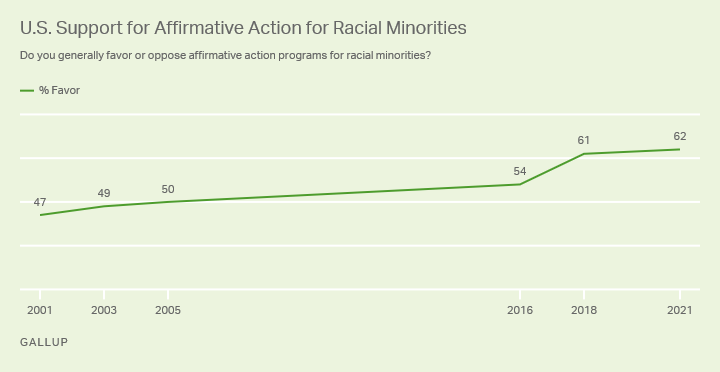
When asked DIRECTLY about affirmative action, most people in the US do support it:

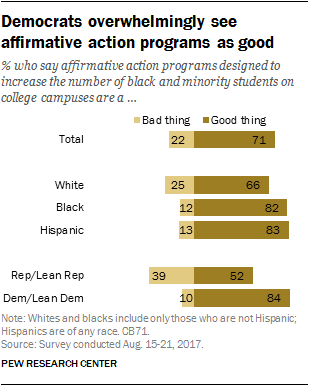
82% of black people think affirmative action is a good thing:


I'm very pragmatic when it comes to life/fairness/opportunity. There is no way we can level the playing field anytime soon. Representation matters.

Anonymous
Anonymous wrote:
Anonymous wrote:
Anonymous wrote:
Anonymous wrote:
Anonymous wrote:
Anonymous wrote:
Anonymous wrote:
Anonymous wrote:As an ivy-league educated African-American, I'd said that admissions to elite high schools are the least of our concerns...or at least should be.

Most of us are much more focused on getting black and brown kids to read and perform math at somewhere close to grade level...the numbers are abysmal (though quite mediocre for white kids as well). A world where 50% of black kids read and perform math at grade level is a world transformed---more meaningfully transformed than a world with a few more black kids at TJ, Lowell, or Stuyvesant.

Once we get a critical mass of our kids to grade level, we can then work on cultivating an advanced crew that operates 2-3 years above grade level (which seems to be about avg among Asians or at least certain sub-categories thereof).

At that point, we can begin to have a discussion about elite school admissions and putting in place the requisite prep systems -- which really need to start around 3rd grade...right? My understanding is that Asian parents are working toward schools like TJ for years before taking the test.

To the extent Asian kids are "privileged", it's because they have parents and a community that are truly committed to academic excellence BEYOND what the public school is offering, and they seem to have developed an academic acceleration eco-system to support it. That is a real privilege for kids with access to those (often ethnic) eco-systems, but one that "we" should seek to emulate, not punish.

Funny thing is, most normal black folks (i.e., black folks you'd meet in the barbershop) would agree with all of the above. These school boards need to spend more time on "the street" vs. carousing with white liberals and activists black folks with agendas far removed from the people for whom they purport to speak.


Do you think that your race factored into your admission to an Ivy League school? Do you think Ivy League universities shouldn’t push to increase enrollment of URMs until after we had a critical mass of "Ivy-League-caliber", URM high school students?

There already is a small cohort of black students who are 2-3 years ahead in math. They were being admitted to TJ at 1/3rd of the rate of other kids in the same classes. Something in the old admissions process was broken.

I do agree that we should push hard to get kids on grade level - that is a huge issue. BUT, in parallel, we should also be revamping the admissions policy to be more inclusive of ED, URM, and broader FCPS community (not just a pocket of wealthy middle schools).


I'm not talking about what the schools should do. They do whatever suits them (for the most part). I'm talking about what "we" in the black community should do to the extent we care about things like admission to TJ and the like (and I'm not saying we should). Asian "over"-representation at TJ and co. is the result of certain processes, structures, and practices in place within that community. So the obvious thing -- to me at least -- would be for us to emulate those processes, structures, and practices within the black community, or at least encourage our motivated students to avail themselves of those processes, structures, and practices where accessible. I question whether intra-Asia community structures would be practically accessible given certain ethnic realities, which is why replication is probably the more viable approach. We cannot rely on public beneficence or largesse to do the job of prepping our children for elite academic spaces--- I mean, is there any community that has ever done that?


And -- yes -- I'm almost certain that my race was a factor. How could it not be in an explicitly race-conscious admissions process? Was it decisive? I don't know. Did I deserve to be admitted based on demonstrated merit? I reason so. But I'd also reason that was also true with many (most?) of the rejectees. The point is, my odds of admission were simply greater from the start versus a similarly situated white or Asian applicant. That's not necessarily a (policy) argument against Affirmative Action, but a simple reality. I oppose race-conscious admissions, but I wasn't exactly in a position to reject whatever preference I may have enjoyed. At any rate, if the Supreme Court does what I think it will, it will all be academic as far as my kids are concerned. No matter to me, as they are privileged enough such that an ivy-league credential won't be the game-changer it was for me, with my decidedly MUCH more modest background. To be honest, I can't even relate to my kids' experiences most of the time.


So pull that ladder up behind you.


Like Clarence Thomas


There it is. The old pulling up the ladder trope. Shocked it wasn’t deployed earlier. I forgot that I’m estopped from having any independent views on the issue of racial preference policies because such policies may have been in place when I applied to school. That’s fine I guess, since very few people attend selective institutions where affirmative action is even a factor, meaning that the population of folks entitled to have views on the matter (which doesn’t include me apparently) remains large. So I’ll just keep my mouth shut like a good little…. At any rate, and more importantly, MOST black oppose the use of race preference in school admissions. As very few of them ascended a ladder to a selective institution, I gather they (unlike me) retain the right to express independent views of the matter. And they have indeed spoken: 62% of black folks oppose the use of race as a factor in college admissions.

https://www.pewresearch.org/fact-tank/2019/02/25/most-americans-say-colleges-should-not-consider-race-or-ethnicity-in-admissions/

But you know, it’s not like those folks know what good for ‘em.


As you know, people respond to these topics differently, depending on how they are asked. There are a lot of different ways people could interpret "should race be a factor".
https://news.gallup.com/poll/352832/americans-confidence-racial-fairness-waning.aspx

When asked DIRECTLY about affirmative action, most people in the US do support it:


82% of black people think affirmative action is a good thing:


I'm very pragmatic when it comes to life/fairness/opportunity. There is no way we can level the playing field anytime soon. Representation matters.


I take your point on the salience of how a question is phrased. But most people view affirmative action as a "thumb on the scale," rather than certain racial groups being held to significantly higher standards for admission than others, which is what affirmative action is in practice. That's not an argument against affirmative action, per se. I mean, you can construct credible arguments that the diversity and representational trade-offs outweigh whatever unfairness there is, which I gather is your take.

But let's just acknowledge that the term "affirmative action" does way more to obscure what happens in practice, which makes asking "directly" about affirmative action anything by direct.
Anonymous
Anonymous wrote:

I dont understand Asian Americans obsession with being "discriminated" against for schools or college. Bias against Asian Americans is that you are smarter than other people, better at math, etc. Asian Americans also make more than any other race for the same job with the same education in the same location.


This is only true at the white collar level. If you get outside the office into blue collar, retail and anywhere under the median income, Asians make about 70-85% of comparable white incomes. And even so, it's not like it's a huge advantage. In the white collar jobs, Asian Americans make about 104-112% by comparison. So they make a small amount more at the white collar level, but a lot less at the lower levels.

Additionally, while white collar professionals may make slightly more than their white equivalents, the real distinction is that there is a glass ceiling. Asian Americans are frequently discriminated against in leadership positions. There are far fewer API in supervisory or management positions and there is virtually no representation at the C-suite level. Outside of historically Asian areas like Hawaii and certain parts of California, there are extremely low levels in elected offices. They are underrepresented in media, including news media. Hollywood continues to whitewash movies and even cast characters written as Asian with white actors (see Last Airbender, Dr. Strange and a host of others). If there is a part specifically written for an Asian, it is less than 50-50 that it will actually be cast with an Asian actor.

So, as it typical, white posters cherry pick what they view when considering whether a minority is discriminated against. Things have been better since the civil rights era when many of the anti-Asian laws on the books across the nation were struck down, but there is still a huge amount of anti-Asian discrimination in this country.
Anonymous
Anonymous wrote:
Anonymous wrote:

I dont understand Asian Americans obsession with being "discriminated" against for schools or college. Bias against Asian Americans is that you are smarter than other people, better at math, etc. Asian Americans also make more than any other race for the same job with the same education in the same location.


This is only true at the white collar level. If you get outside the office into blue collar, retail and anywhere under the median income, Asians make about 70-85% of comparable white incomes. And even so, it's not like it's a huge advantage. In the white collar jobs, Asian Americans make about 104-112% by comparison. So they make a small amount more at the white collar level, but a lot less at the lower levels.

Additionally, while white collar professionals may make slightly more than their white equivalents, the real distinction is that there is a glass ceiling. Asian Americans are frequently discriminated against in leadership positions. There are far fewer API in supervisory or management positions and there is virtually no representation at the C-suite level. Outside of historically Asian areas like Hawaii and certain parts of California, there are extremely low levels in elected offices. They are underrepresented in media, including news media. Hollywood continues to whitewash movies and even cast characters written as Asian with white actors (see Last Airbender, Dr. Strange and a host of others). If there is a part specifically written for an Asian, it is less than 50-50 that it will actually be cast with an Asian actor.

So, as it typical, white posters cherry pick what they view when considering whether a minority is discriminated against. Things have been better since the civil rights era when many of the anti-Asian laws on the books across the nation were struck down, but there is still a huge amount of anti-Asian discrimination in this country.


It's really sad that you had to explain why Asians might dislike being discriminated against, but thank you for doing so. Signed a black person.
Anonymous
Just because they denied cert does not mean the fight is over.

We will take the fight to the states now.

End racism against Asian people!
Anonymous
Anonymous wrote:
Anonymous wrote:
Anonymous wrote:
Anonymous wrote:We already have a few threads about this. I don't think the Harvard case will go anywhere.

The legacy hook is more of an issue because legacy admits mostly benefits white UMC, and it's a fairly large chunk of the admits.

-Asian American


You should check this out. It will open your eyes:

https://defendinged.org/incidents/tjpapers/

I saw this already. But I stand by what I wrote: legacy admit is more of an issue for elite institutions than the Harvard lawsuit discriminating against Asian Americans. The slice of pie that non legacy admits have to fight for is a lot smaller than the legacy admit portion. If they do away with legacy admit (which again, benefits UMC white people the most), the slice of pie for ALL non-legacy admits would increase, which would help *everyone*.


They will never get rid of legacy. Why would they? It benefits UC-UMC whites mostly.


Why not? MIT has. Oxford and Cambridge did many years ago and they’re the oldest universities in the world in a country which still has royalty. The US is backwards on this issue.
Anonymous
Anonymous wrote:Just because they denied cert does not mean the fight is over.

We will take the fight to the states now.

End racism against Asian people!


I’m black and I totally agree! I’m involved in efforts improve the math and ELA performance of primarily low-income/black elementary school kids. We can worry about Harvard later!
Anonymous
Anonymous wrote:
Anonymous wrote:
Anonymous wrote:We already have a few threads about this. I don't think the Harvard case will go anywhere.

The legacy hook is more of an issue because legacy admits mostly benefits white UMC, and it's a fairly large chunk of the admits.

-Asian American


You should check this out. It will open your eyes:

https://defendinged.org/incidents/tjpapers/

I saw this already. But I stand by what I wrote: legacy admit is more of an issue for elite institutions than the Harvard lawsuit discriminating against Asian Americans. The slice of pie that non legacy admits have to fight for is a lot smaller than the legacy admit portion. If they do away with legacy admit (which again, benefits UMC white people the most), the slice of pie for ALL non-legacy admits would increase, which would help *everyone*.


This seems true and the OP's assertions are just their assumptions which seem sketchy at best.
Anonymous
Asian and Blacks fighting for scraps while legacies applying ED are getting in with sub-par stats. Know thy enemy. It’s not the few black kids getting in.
Anonymous
Anonymous wrote:From Harvard to a Virginia high school, courts take up racial preferences’ harm to this minority population.

"Despite all the happy talk on the left about the benefits of diversity, America’s real strength has been its ability to transcend problems that have crippled other multiethnic, multireligious and multilingual societies. We’re at our best when the focus is on what unites us as Americans. And what seems to be uniting a growing number of Americans today is opposition to a Democratic equity agenda that effectively plays racial and ethnic groups against one another.

The Supreme Court is poised to strike a blow for colorblind college admissions later this year when it considers a case involving alleged anti-Asian discrimination at Harvard. But the fight continues at the K-12 level as well. Two years ago, the school board in Fairfax County, Va., altered the admissions standards at Thomas Jefferson High School for Science and Technology, one of the top-ranked public schools in the country. Among other things, standardized testing requirements were eliminated, and subjective admission criteria were added in an effort to deny slots to Asian-Americans and boost enrollment among blacks and Hispanics."

https://www.wsj.com/articles/asian-american-fight-school-discrimination-affirmative-action-racial-justice-admissions-standards-testing-charter-schools-achievement-gap-harvard-supreme-court-11646172518?mod=flipboard


Well, that's crazy. Our giftred program is mostly Asian. I think they're better represented than anyone so this talk of discrimination seems out of touch.
Anonymous
Anonymous wrote:Asian and Blacks fighting for scraps while legacies applying ED are getting in with sub-par stats. Know thy enemy. It’s not the few black kids getting in.


OK - but as the alumni base gets more racially diverse, which it is, doesn’t the composition of legacies also diversify? Full disclosure, I’m a black alumnus of HYP, but neither of my parents attended accredited colleges and both grew up in Jim Crow south, so we’re not talking about some long line of HYP graduates here…far from it. Just want to push back on the idea of getting rid of legacy admits BECAUSE they trend white. Plenty of other reasons to drop legacy admits tho’. And my kids seem to have plenty going for them then to need a leg up into the ivies.
Anonymous
Anonymous wrote:
Anonymous wrote:Asian and Blacks fighting for scraps while legacies applying ED are getting in with sub-par stats. Know thy enemy. It’s not the few black kids getting in.


OK - but as the alumni base gets more racially diverse, which it is, doesn’t the composition of legacies also diversify? Full disclosure, I’m a black alumnus of HYP, but neither of my parents attended accredited colleges and both grew up in Jim Crow south, so we’re not talking about some long line of HYP graduates here…far from it. Just want to push back on the idea of getting rid of legacy admits BECAUSE they trend white. Plenty of other reasons to drop legacy admits tho’. And my kids seem to have plenty going for them then to need a leg up into the ivies.


PP here - just want to add that attending a HYP was as absolute game-changer for me, but wouldn’t be for my kids, who occupy a world that would have been completely foreign to me growing up.
Anonymous
Anonymous wrote:
Anonymous wrote:
Anonymous wrote:
Anonymous wrote:
Anonymous wrote:
Anonymous wrote:
Anonymous wrote:
Anonymous wrote:
Anonymous wrote:As an ivy-league educated African-American, I'd said that admissions to elite high schools are the least of our concerns...or at least should be.

Most of us are much more focused on getting black and brown kids to read and perform math at somewhere close to grade level...the numbers are abysmal (though quite mediocre for white kids as well). A world where 50% of black kids read and perform math at grade level is a world transformed---more meaningfully transformed than a world with a few more black kids at TJ, Lowell, or Stuyvesant.

Once we get a critical mass of our kids to grade level, we can then work on cultivating an advanced crew that operates 2-3 years above grade level (which seems to be about avg among Asians or at least certain sub-categories thereof).

At that point, we can begin to have a discussion about elite school admissions and putting in place the requisite prep systems -- which really need to start around 3rd grade...right? My understanding is that Asian parents are working toward schools like TJ for years before taking the test.

To the extent Asian kids are "privileged", it's because they have parents and a community that are truly committed to academic excellence BEYOND what the public school is offering, and they seem to have developed an academic acceleration eco-system to support it. That is a real privilege for kids with access to those (often ethnic) eco-systems, but one that "we" should seek to emulate, not punish.

Funny thing is, most normal black folks (i.e., black folks you'd meet in the barbershop) would agree with all of the above. These school boards need to spend more time on "the street" vs. carousing with white liberals and activists black folks with agendas far removed from the people for whom they purport to speak.


Do you think that your race factored into your admission to an Ivy League school? Do you think Ivy League universities shouldn’t push to increase enrollment of URMs until after we had a critical mass of "Ivy-League-caliber", URM high school students?

There already is a small cohort of black students who are 2-3 years ahead in math. They were being admitted to TJ at 1/3rd of the rate of other kids in the same classes. Something in the old admissions process was broken.

I do agree that we should push hard to get kids on grade level - that is a huge issue. BUT, in parallel, we should also be revamping the admissions policy to be more inclusive of ED, URM, and broader FCPS community (not just a pocket of wealthy middle schools).


I'm not talking about what the schools should do. They do whatever suits them (for the most part). I'm talking about what "we" in the black community should do to the extent we care about things like admission to TJ and the like (and I'm not saying we should). Asian "over"-representation at TJ and co. is the result of certain processes, structures, and practices in place within that community. So the obvious thing -- to me at least -- would be for us to emulate those processes, structures, and practices within the black community, or at least encourage our motivated students to avail themselves of those processes, structures, and practices where accessible. I question whether intra-Asia community structures would be practically accessible given certain ethnic realities, which is why replication is probably the more viable approach. We cannot rely on public beneficence or largesse to do the job of prepping our children for elite academic spaces--- I mean, is there any community that has ever done that?


And -- yes -- I'm almost certain that my race was a factor. How could it not be in an explicitly race-conscious admissions process? Was it decisive? I don't know. Did I deserve to be admitted based on demonstrated merit? I reason so. But I'd also reason that was also true with many (most?) of the rejectees. The point is, my odds of admission were simply greater from the start versus a similarly situated white or Asian applicant. That's not necessarily a (policy) argument against Affirmative Action, but a simple reality. I oppose race-conscious admissions, but I wasn't exactly in a position to reject whatever preference I may have enjoyed. At any rate, if the Supreme Court does what I think it will, it will all be academic as far as my kids are concerned. No matter to me, as they are privileged enough such that an ivy-league credential won't be the game-changer it was for me, with my decidedly MUCH more modest background. To be honest, I can't even relate to my kids' experiences most of the time.


So pull that ladder up behind you.


Like Clarence Thomas


There it is. The old pulling up the ladder trope. Shocked it wasn’t deployed earlier. I forgot that I’m estopped from having any independent views on the issue of racial preference policies because such policies may have been in place when I applied to school. That’s fine I guess, since very few people attend selective institutions where affirmative action is even a factor, meaning that the population of folks entitled to have views on the matter (which doesn’t include me apparently) remains large. So I’ll just keep my mouth shut like a good little…. At any rate, and more importantly, MOST black oppose the use of race preference in school admissions. As very few of them ascended a ladder to a selective institution, I gather they (unlike me) retain the right to express independent views of the matter. And they have indeed spoken: 62% of black folks oppose the use of race as a factor in college admissions.

https://www.pewresearch.org/fact-tank/2019/02/25/most-americans-say-colleges-should-not-consider-race-or-ethnicity-in-admissions/

But you know, it’s not like those folks know what good for ‘em.


As you know, people respond to these topics differently, depending on how they are asked. There are a lot of different ways people could interpret "should race be a factor".
https://news.gallup.com/poll/352832/americans-confidence-racial-fairness-waning.aspx

When asked DIRECTLY about affirmative action, most people in the US do support it:


82% of black people think affirmative action is a good thing:


I'm very pragmatic when it comes to life/fairness/opportunity. There is no way we can level the playing field anytime soon. Representation matters.


I take your point on the salience of how a question is phrased. But most people view affirmative action as a "thumb on the scale," rather than certain racial groups being held to significantly higher standards for admission than others, which is what affirmative action is in practice. That's not an argument against affirmative action, per se. I mean, you can construct credible arguments that the diversity and representational trade-offs outweigh whatever unfairness there is, which I gather is your take.

But let's just acknowledge that the term "affirmative action" does way more to obscure what happens in practice, which makes asking "directly" about affirmative action anything by direct.


If white people are willing to take their admitted students out from Ivy league schools and give the spots to black, brown or green people, I will support it 100%. Unfotunately, that isnt the case. The white zuMC discovered that their snowflakes cannot compete with Asian kids academically and the Asian kids may get better education or even better jobs than their snow flakes, they started to push the Asian kids back and want to eliminate their opportunities. They use black and brown as their chess pieces to protect their own interests.
Anonymous
Anonymous wrote:Asian and Blacks fighting for scraps while legacies applying ED are getting in with sub-par stats. Know thy enemy. It’s not the few black kids getting in.


This is not true at most elite schools. Legacies are expected to meet the same standards. Where are you getting your information? Not to mention that elite schools have admitted large numbers of minorities since the 1980s, so a good chunk of those kids are not white.
Anonymous
Anonymous wrote:
Anonymous wrote:
Anonymous wrote:
Anonymous wrote:
Anonymous wrote:
Anonymous wrote:
Anonymous wrote:
Anonymous wrote:
Anonymous wrote:
Anonymous wrote:As an ivy-league educated African-American, I'd said that admissions to elite high schools are the least of our concerns...or at least should be.

Most of us are much more focused on getting black and brown kids to read and perform math at somewhere close to grade level...the numbers are abysmal (though quite mediocre for white kids as well). A world where 50% of black kids read and perform math at grade level is a world transformed---more meaningfully transformed than a world with a few more black kids at TJ, Lowell, or Stuyvesant.

Once we get a critical mass of our kids to grade level, we can then work on cultivating an advanced crew that operates 2-3 years above grade level (which seems to be about avg among Asians or at least certain sub-categories thereof).

At that point, we can begin to have a discussion about elite school admissions and putting in place the requisite prep systems -- which really need to start around 3rd grade...right? My understanding is that Asian parents are working toward schools like TJ for years before taking the test.

To the extent Asian kids are "privileged", it's because they have parents and a community that are truly committed to academic excellence BEYOND what the public school is offering, and they seem to have developed an academic acceleration eco-system to support it. That is a real privilege for kids with access to those (often ethnic) eco-systems, but one that "we" should seek to emulate, not punish.

Funny thing is, most normal black folks (i.e., black folks you'd meet in the barbershop) would agree with all of the above. These school boards need to spend more time on "the street" vs. carousing with white liberals and activists black folks with agendas far removed from the people for whom they purport to speak.


Do you think that your race factored into your admission to an Ivy League school? Do you think Ivy League universities shouldn’t push to increase enrollment of URMs until after we had a critical mass of "Ivy-League-caliber", URM high school students?

There already is a small cohort of black students who are 2-3 years ahead in math. They were being admitted to TJ at 1/3rd of the rate of other kids in the same classes. Something in the old admissions process was broken.

I do agree that we should push hard to get kids on grade level - that is a huge issue. BUT, in parallel, we should also be revamping the admissions policy to be more inclusive of ED, URM, and broader FCPS community (not just a pocket of wealthy middle schools).


I'm not talking about what the schools should do. They do whatever suits them (for the most part). I'm talking about what "we" in the black community should do to the extent we care about things like admission to TJ and the like (and I'm not saying we should). Asian "over"-representation at TJ and co. is the result of certain processes, structures, and practices in place within that community. So the obvious thing -- to me at least -- would be for us to emulate those processes, structures, and practices within the black community, or at least encourage our motivated students to avail themselves of those processes, structures, and practices where accessible. I question whether intra-Asia community structures would be practically accessible given certain ethnic realities, which is why replication is probably the more viable approach. We cannot rely on public beneficence or largesse to do the job of prepping our children for elite academic spaces--- I mean, is there any community that has ever done that?


And -- yes -- I'm almost certain that my race was a factor. How could it not be in an explicitly race-conscious admissions process? Was it decisive? I don't know. Did I deserve to be admitted based on demonstrated merit? I reason so. But I'd also reason that was also true with many (most?) of the rejectees. The point is, my odds of admission were simply greater from the start versus a similarly situated white or Asian applicant. That's not necessarily a (policy) argument against Affirmative Action, but a simple reality. I oppose race-conscious admissions, but I wasn't exactly in a position to reject whatever preference I may have enjoyed. At any rate, if the Supreme Court does what I think it will, it will all be academic as far as my kids are concerned. No matter to me, as they are privileged enough such that an ivy-league credential won't be the game-changer it was for me, with my decidedly MUCH more modest background. To be honest, I can't even relate to my kids' experiences most of the time.


So pull that ladder up behind you.


Like Clarence Thomas


There it is. The old pulling up the ladder trope. Shocked it wasn’t deployed earlier. I forgot that I’m estopped from having any independent views on the issue of racial preference policies because such policies may have been in place when I applied to school. That’s fine I guess, since very few people attend selective institutions where affirmative action is even a factor, meaning that the population of folks entitled to have views on the matter (which doesn’t include me apparently) remains large. So I’ll just keep my mouth shut like a good little…. At any rate, and more importantly, MOST black oppose the use of race preference in school admissions. As very few of them ascended a ladder to a selective institution, I gather they (unlike me) retain the right to express independent views of the matter. And they have indeed spoken: 62% of black folks oppose the use of race as a factor in college admissions.

https://www.pewresearch.org/fact-tank/2019/02/25/most-americans-say-colleges-should-not-consider-race-or-ethnicity-in-admissions/

But you know, it’s not like those folks know what good for ‘em.


As you know, people respond to these topics differently, depending on how they are asked. There are a lot of different ways people could interpret "should race be a factor".
https://news.gallup.com/poll/352832/americans-confidence-racial-fairness-waning.aspx

When asked DIRECTLY about affirmative action, most people in the US do support it:


82% of black people think affirmative action is a good thing:


I'm very pragmatic when it comes to life/fairness/opportunity. There is no way we can level the playing field anytime soon. Representation matters.


I take your point on the salience of how a question is phrased. But most people view affirmative action as a "thumb on the scale," rather than certain racial groups being held to significantly higher standards for admission than others, which is what affirmative action is in practice. That's not an argument against affirmative action, per se. I mean, you can construct credible arguments that the diversity and representational trade-offs outweigh whatever unfairness there is, which I gather is your take.

But let's just acknowledge that the term "affirmative action" does way more to obscure what happens in practice, which makes asking "directly" about affirmative action anything by direct.


If white people are willing to take their admitted students out from Ivy league schools and give the spots to black, brown or green people, I will support it 100%. Unfotunately, that isnt the case. The white zuMC discovered that their snowflakes cannot compete with Asian kids academically and the Asian kids may get better education or even better jobs than their snow flakes, they started to push the Asian kids back and want to eliminate their opportunities. They use black and brown as their chess pieces to protect their own interests.


I don't think this is true, although culturally I would say that the groups look at education differently and allocate their time differently. Please don't fight racism by being racist.
post reply Forum Index » Schools and Education General Discussion
Message Quick Reply
Go to: