Talking about Santa

Anonymous
Anonymous wrote:
Anonymous wrote:
Anonymous wrote:
Anonymous wrote:
Anonymous wrote:
Anonymous wrote:
Anonymous wrote:
Anonymous wrote:We're Jewish and Santa comes to our house every year. Santa is not really a Christian figure, just one appropriated by Christianity a long time ago, so we don't see any relationship between Santa and other religions. I taught my child from an early age not to taunt other kids and to remember that not everyone celebrates holidays so it's best not to talk a lot about it at school.

It concerns me that OP thinks Santa is only for Christians, and makes sense that her kid might taunt other kids.

If your family enjoys the Santa tradition, I’m glad he visits you. Nobody else gets to dictate your household celebrations. However, your view on Santa is not widely shared. Santa is definitely associated with Christmas, and Christmas with Christianity.


I disagree. The majority of educated folks know that Santa has nothing to do with Christianity and don't feel any obligation to be Christian while celebrating a secular Christmas. Only Christians constantly whine about how everyone needs to put Jesus back into Christmas and how materialistic and secular it all is today, without realizing the irony of all of that being much older than Christianity itself.

I mean, he's been pretty secularized, but it's just wrong to say he has "nothing" to do with Christianity. Christmas is a Christian holiday, celebrating the birth of Christ. Santa is based on a Christian saint. Even if he's been turned into a secular cartoon, his origins are pretty clearly based in Christianity, and not everyone agrees that there are no religious aspects to either Santa or Christmas. Not all Jews celebrate Christmas or "do" Santa, for example.


I'm guessing if non Jews started celebrating Hanukkah because 8 days of gifts is better than one some Jewish people would find that offensive. Choosing to celebrate one of the holiest days for a different faith because it's "secularized" even though the name of it has the name of their Savior IN the name of the holiday is a bit of appropriation. I'm an atheist but I can see why some Christians would not be happy with folks and yes I celebrate. I was raised a Christian and it is part of my family culture. Don't care what anyone else does but the inability of people to consider the other side of anything is disheartening.


You have it the wrong way around. Christmas traditions like trees, gifts, lights, and a guy on a flying sleigh who gives gifts to good children are all traditions that pre-date Christianity. Many are part of the celebrations of pre-Christian religions. They were deliberately and consciously appropriated by the Christian church, with a kind of "if you can't beat 'em, make them join you" mentality, as a way to combat what it saw as pagan tradition in a population it was actively trying to convert. By not recognizing that appropriation, we simply take back what was always ours.


Who was the guy flying on a sleigh giving out gifts, before Santa?


Good point. No One. that story started with the poem "A night before Xmas"

Before that, supposedly a good Slavic king, named Nicholas, gave out gifts at Xmas and he became "Saint Nick"

The original gift giving idea supposedly came from the 3 wise men in the Bible, who came from afar, guided by a star, to bring gifts to the baby Jesus


Sorry, that's incorrect. A whole host of gods and folk figures from Greek to Slavic to Norse and Germanic mythologies flew across the sky and left gifts for children. From Odin to Father Frost, there is no shortage of them. There were even plenty of reindeer around in pre-Santa mythology. The poem referenced above came much, much later, and merely repeated and expanded on those folk beliefs, plus actually gave names to the reindeer. It did not invent the idea. Likewise, St. Nicholas (he was not Slavic, he was a Greek bishop in the 4th century, hundreds of years before the Slavs became Christian) was not the origin of most of Santa Claus - Santa has only his name (deliberately given to him by the early church in order to appropriate existing beliefs they saw as pagan) and the red clothing, which resembles a bishop.

In fact, almost nothing is known of the original St. Nicholas - all the stories of his gift-giving were written long after his death. The conflation of a popular folk character with the saint was strategic. As for the Slavs, they had their own stories about a guy with a sleigh full of gifts, and still do.
Anonymous
Anonymous wrote:
Anonymous wrote:
Anonymous wrote:
Anonymous wrote:
Anonymous wrote:
Anonymous wrote:
Anonymous wrote:
Anonymous wrote:We're Jewish and Santa comes to our house every year. Santa is not really a Christian figure, just one appropriated by Christianity a long time ago, so we don't see any relationship between Santa and other religions. I taught my child from an early age not to taunt other kids and to remember that not everyone celebrates holidays so it's best not to talk a lot about it at school.

It concerns me that OP thinks Santa is only for Christians, and makes sense that her kid might taunt other kids.

If your family enjoys the Santa tradition, I’m glad he visits you. Nobody else gets to dictate your household celebrations. However, your view on Santa is not widely shared. Santa is definitely associated with Christmas, and Christmas with Christianity.


I disagree. The majority of educated folks know that Santa has nothing to do with Christianity and don't feel any obligation to be Christian while celebrating a secular Christmas. Only Christians constantly whine about how everyone needs to put Jesus back into Christmas and how materialistic and secular it all is today, without realizing the irony of all of that being much older than Christianity itself.

I mean, he's been pretty secularized, but it's just wrong to say he has "nothing" to do with Christianity. Christmas is a Christian holiday, celebrating the birth of Christ. Santa is based on a Christian saint. Even if he's been turned into a secular cartoon, his origins are pretty clearly based in Christianity, and not everyone agrees that there are no religious aspects to either Santa or Christmas. Not all Jews celebrate Christmas or "do" Santa, for example.


I'm guessing if non Jews started celebrating Hanukkah because 8 days of gifts is better than one some Jewish people would find that offensive. Choosing to celebrate one of the holiest days for a different faith because it's "secularized" even though the name of it has the name of their Savior IN the name of the holiday is a bit of appropriation. I'm an atheist but I can see why some Christians would not be happy with folks and yes I celebrate. I was raised a Christian and it is part of my family culture. Don't care what anyone else does but the inability of people to consider the other side of anything is disheartening.


You have it the wrong way around. Christmas traditions like trees, gifts, lights, and a guy on a flying sleigh who gives gifts to good children are all traditions that pre-date Christianity. Many are part of the celebrations of pre-Christian religions. They were deliberately and consciously appropriated by the Christian church, with a kind of "if you can't beat 'em, make them join you" mentality, as a way to combat what it saw as pagan tradition in a population it was actively trying to convert. By not recognizing that appropriation, we simply take back what was always ours.


Well, that’s pretty ahistorical, but if we went with your flawed logic….when were pagan traditions Jewish or celebrated by the population which became Jewish? We’re Santa and the Easter Bunny hanging out in the Land of Canaan? FFS.


Ha, this. Pagan or whatever the origins may be, they indisputably aren’t Jewish, so to proclaim Jews should celebrate the non-religious aspects of Christmas misses the mark.


The point is that the traditions themselves aren't Christian, so I guess by your logic Christians shouldn't celebrate with them either. You all should just go to church and say some prayers or something. Or, you can myob and understand that people like to celebrate the things they celebrated growing up, whether it's Santa or a Purim carnival, or both. It's normal and natural for holiday celebrations to be shared among people living in the same communities - things get borrowed and make their way into a person's holiday tradition. Christians don't get to have a monopoly on people's celebrations.
Anonymous
Anonymous wrote:
Anonymous wrote:
Anonymous wrote:
Anonymous wrote:
Anonymous wrote:
Anonymous wrote:
Anonymous wrote:
Anonymous wrote:
Anonymous wrote:We're Jewish and Santa comes to our house every year. Santa is not really a Christian figure, just one appropriated by Christianity a long time ago, so we don't see any relationship between Santa and other religions. I taught my child from an early age not to taunt other kids and to remember that not everyone celebrates holidays so it's best not to talk a lot about it at school.

It concerns me that OP thinks Santa is only for Christians, and makes sense that her kid might taunt other kids.

If your family enjoys the Santa tradition, I’m glad he visits you. Nobody else gets to dictate your household celebrations. However, your view on Santa is not widely shared. Santa is definitely associated with Christmas, and Christmas with Christianity.


I disagree. The majority of educated folks know that Santa has nothing to do with Christianity and don't feel any obligation to be Christian while celebrating a secular Christmas. Only Christians constantly whine about how everyone needs to put Jesus back into Christmas and how materialistic and secular it all is today, without realizing the irony of all of that being much older than Christianity itself.

I mean, he's been pretty secularized, but it's just wrong to say he has "nothing" to do with Christianity. Christmas is a Christian holiday, celebrating the birth of Christ. Santa is based on a Christian saint. Even if he's been turned into a secular cartoon, his origins are pretty clearly based in Christianity, and not everyone agrees that there are no religious aspects to either Santa or Christmas. Not all Jews celebrate Christmas or "do" Santa, for example.


I'm guessing if non Jews started celebrating Hanukkah because 8 days of gifts is better than one some Jewish people would find that offensive. Choosing to celebrate one of the holiest days for a different faith because it's "secularized" even though the name of it has the name of their Savior IN the name of the holiday is a bit of appropriation. I'm an atheist but I can see why some Christians would not be happy with folks and yes I celebrate. I was raised a Christian and it is part of my family culture. Don't care what anyone else does but the inability of people to consider the other side of anything is disheartening.


You have it the wrong way around. Christmas traditions like trees, gifts, lights, and a guy on a flying sleigh who gives gifts to good children are all traditions that pre-date Christianity. Many are part of the celebrations of pre-Christian religions. They were deliberately and consciously appropriated by the Christian church, with a kind of "if you can't beat 'em, make them join you" mentality, as a way to combat what it saw as pagan tradition in a population it was actively trying to convert. By not recognizing that appropriation, we simply take back what was always ours.


Who was the guy flying on a sleigh giving out gifts, before Santa?


Good point. No One. that story started with the poem "A night before Xmas"

Before that, supposedly a good Slavic king, named Nicholas, gave out gifts at Xmas and he became "Saint Nick"

The original gift giving idea supposedly came from the 3 wise men in the Bible, who came from afar, guided by a star, to bring gifts to the baby Jesus


Sorry, that's incorrect. A whole host of gods and folk figures from Greek to Slavic to Norse and Germanic mythologies flew across the sky and left gifts for children. From Odin to Father Frost, there is no shortage of them. There were even plenty of reindeer around in pre-Santa mythology. The poem referenced above came much, much later, and merely repeated and expanded on those folk beliefs, plus actually gave names to the reindeer. It did not invent the idea. Likewise, St. Nicholas (he was not Slavic, he was a Greek bishop in the 4th century, hundreds of years before the Slavs became Christian) was not the origin of most of Santa Claus - Santa has only his name (deliberately given to him by the early church in order to appropriate existing beliefs they saw as pagan) and the red clothing, which resembles a bishop.

In fact, almost nothing is known of the original St. Nicholas - all the stories of his gift-giving were written long after his death. The conflation of a popular folk character with the saint was strategic. As for the Slavs, they had their own stories about a guy with a sleigh full of gifts, and still do.


Sorry, it's not incorrect, it's just another story -- like the many stories told above.
Anonymous
Anonymous wrote:
Anonymous wrote:
Anonymous wrote:
Anonymous wrote:
Anonymous wrote:
Anonymous wrote:
Anonymous wrote:
Anonymous wrote:
Anonymous wrote:We're Jewish and Santa comes to our house every year. Santa is not really a Christian figure, just one appropriated by Christianity a long time ago, so we don't see any relationship between Santa and other religions. I taught my child from an early age not to taunt other kids and to remember that not everyone celebrates holidays so it's best not to talk a lot about it at school.

It concerns me that OP thinks Santa is only for Christians, and makes sense that her kid might taunt other kids.

If your family enjoys the Santa tradition, I’m glad he visits you. Nobody else gets to dictate your household celebrations. However, your view on Santa is not widely shared. Santa is definitely associated with Christmas, and Christmas with Christianity.


I disagree. The majority of educated folks know that Santa has nothing to do with Christianity and don't feel any obligation to be Christian while celebrating a secular Christmas. Only Christians constantly whine about how everyone needs to put Jesus back into Christmas and how materialistic and secular it all is today, without realizing the irony of all of that being much older than Christianity itself.

I mean, he's been pretty secularized, but it's just wrong to say he has "nothing" to do with Christianity. Christmas is a Christian holiday, celebrating the birth of Christ. Santa is based on a Christian saint. Even if he's been turned into a secular cartoon, his origins are pretty clearly based in Christianity, and not everyone agrees that there are no religious aspects to either Santa or Christmas. Not all Jews celebrate Christmas or "do" Santa, for example.


I'm guessing if non Jews started celebrating Hanukkah because 8 days of gifts is better than one some Jewish people would find that offensive. Choosing to celebrate one of the holiest days for a different faith because it's "secularized" even though the name of it has the name of their Savior IN the name of the holiday is a bit of appropriation. I'm an atheist but I can see why some Christians would not be happy with folks and yes I celebrate. I was raised a Christian and it is part of my family culture. Don't care what anyone else does but the inability of people to consider the other side of anything is disheartening.


You have it the wrong way around. Christmas traditions like trees, gifts, lights, and a guy on a flying sleigh who gives gifts to good children are all traditions that pre-date Christianity. Many are part of the celebrations of pre-Christian religions. They were deliberately and consciously appropriated by the Christian church, with a kind of "if you can't beat 'em, make them join you" mentality, as a way to combat what it saw as pagan tradition in a population it was actively trying to convert. By not recognizing that appropriation, we simply take back what was always ours.


Who was the guy flying on a sleigh giving out gifts, before Santa?


Good point. No One. that story started with the poem "A night before Xmas"

Before that, supposedly a good Slavic king, named Nicholas, gave out gifts at Xmas and he became "Saint Nick"

The original gift giving idea supposedly came from the 3 wise men in the Bible, who came from afar, guided by a star, to bring gifts to the baby Jesus


Sorry, that's incorrect. A whole host of gods and folk figures from Greek to Slavic to Norse and Germanic mythologies flew across the sky and left gifts for children. From Odin to Father Frost, there is no shortage of them. There were even plenty of reindeer around in pre-Santa mythology. The poem referenced above came much, much later, and merely repeated and expanded on those folk beliefs, plus actually gave names to the reindeer. It did not invent the idea. Likewise, St. Nicholas (he was not Slavic, he was a Greek bishop in the 4th century, hundreds of years before the Slavs became Christian) was not the origin of most of Santa Claus - Santa has only his name (deliberately given to him by the early church in order to appropriate existing beliefs they saw as pagan) and the red clothing, which resembles a bishop.

In fact, almost nothing is known of the original St. Nicholas - all the stories of his gift-giving were written long after his death. The conflation of a popular folk character with the saint was strategic. As for the Slavs, they had their own stories about a guy with a sleigh full of gifts, and still do.


The Norse would celebrate the Wild Hunt, where the God Odin (or the All-Father) would hunt down trolls and other creatures as he gave gifts to children across settlements during Mid-Winter.

The winters in Northern Europe were dark and foreboding, and so it lent itself to the idea that Odin and his gang would ride across the winds, amid much howling and shrieking of the trolls and other creatures as they were hunted down by the party. Along the way, Odin – similar to and pre-dating Santa Claus – would send little gifts to the children he passed through the villages and towns during the Viking Age.

Odin could be seen riding on the winds, with his horse Sleipnir, the eight-legged child of the God Loki. He was the fastest and strongest horse in the world. Every year when the Midwinter sun came over the lands, it was said to be Odin and his party hunting down trolls and other nasty creatures. On this night in particular, Odin would leave gifts out for the children, and they in turn would leave a small parcel of food for Odin and of course a carrot or bits of hay for the horse Sleipnir.

Odin would hunt trolls on a 8 legged horse.

Father Frost (Russian: Морозко, Morozko) is a Russian fairy tale collected by Alexander Afanasyev in Narodnye russkie skazki (1855-63). Andrew Lang included it, as "The Story of King Frost", in The Yellow Fairy Book (1894).

A woman has a daughter, whom she loves, and a step-daughter, whom she hates. One day, the woman orders her husband to take her stepdaughter out into the winter wilderness and to leave her there to die, and he obeys, leaving her at the foot of a tree in the forest. Father Frost finds her there, and because the girl is polite and kind to him, he gives her a chest full of beautiful jewels and fine garments. Some time later, the stepmother sends the girl's father to retrieve her body for burial, and is enraged when he instead brings the girl back alive and happy and dressed in finery. Consumed by greed and envy, the woman orders her husband to take her own daughter to the same place, but when found by Father Frost the woman's daughter is rude and unkind to him, and he is inclined to punish rather than reward her. The father finds her frozen to death at the foot of the tree and carries her body back to her grief-stricken mother.

In the Grimm version, the girl is covered with gold and silver coins while the rude child is covered with cement, mud, flour, and pitch.

The origins of the character of Ded Moroz predates Christianity as a Slavic wizard of winter. According to some sources in Slavic mythology, Ded Moroz, back then also called Morozko or Ded, is a snow demon.

Ded Moroz is a legendary figure similar to Santa. Under the influence of Orthodox traditions, the character of Ded Moroz was transformed into Russian Santa. Since the 19th century the attributes and legend of Ded Moroz have been shaped by literary influences. The play Snegurochka by Aleksandr Ostrovsky was influential in this respect, as was Rimsky-Korsakov's Snegurochka with libretto based on the play. By the end of the 19th century Ded Moroz became a popular character.

I don’t know any greek or roman gods who rode sleighs across the sky, pulled by reindeer, who gave gifts to kids. What were their names? Yes, reindeer have existed… but flying reindeer seem uniquely attributed to Santa.

Anonymous
Anonymous
Anonymous wrote:


The Greeks created gods in the image of humans; that is, their gods had many human qualities even though they were gods. The gods constantly fought among themselves, behaved irrationally and unfairly, and were often jealous of each other. Zeus, the king of the gods, was rarely faithful to his wife Hera. Hera plotted against Zeus and punished his mistresses.

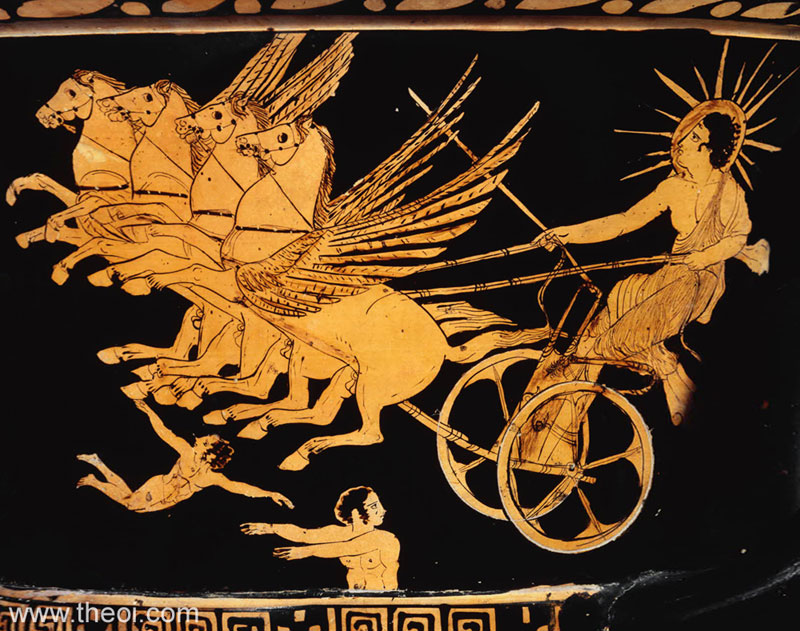
The Greek gods were highly emotional and behaved inconsistently and sometimes immorally. Greek religion did not have a standard set of morals, there were no Judaic Ten Commandments. The gods, heroes, and humans of Greek mythology were n ancient Greek religion and mythology, Helios (/ˈhiːliəs, -ɒs/; Ancient Greek: Ἥλιος pronounced [hɛ̌ːlios], lit. 'Sun'; Homeric Greek: Ἠέλιος) is the god and personification of the Sun (Solar deity). His name is also Latinized as Helius, and he is often given the epithets Hyperion ("the one above") and Phaethon ("the shining").[a] Helios is often depicted in art with a radiant crown and driving a horse-drawn chariot through the sky. He was a guardian of oaths and also the god of sight.

Helios figures prominently in several works of Greek mythology, poetry, and literature, in which he is often described as the son of the Titans Hyperion and Theia and brother of the goddesses Selene (the Moon) and Eos (the Dawn). Helios' most notable role in Greek mythology is the story of his mortal son Phaethon who asked his father for a favour; Helios agreed, but then Phaethon asked for the privilege to drive his four-horse fiery chariot across the skies for a single day. Although Helios warned his son again and again against this choice, explaining to him the dangers of such a journey that no other god but him was capable to bring about, Phaethon was hard to deter, and thus Helios was forced to hand him the reins. As expected, the ride was disastrous and Zeus struck the youth with one of his lightning bolts to stop him from burning or freezing the earth beyond salvation. Other than this myth, Helios occasionally appears in myths of other characters, witnessing oaths or interacting with other gods and mortals.

Due to his position as the sun, he was believed to be an all-seeing witness, and thus was often invoked in oaths. He also played a significant part in ancient magic and spells. In art he is usually depicted as a beardless youth in a chiton holding a whip and driving his quadriga, accompanied by various other celestial gods such as Selene, Eos, or the stars.

Helios is usually depicted as a handsome young man crowned with the shining aureole of the Sun who drove the chariot of the Sun across the sky each day to Earth-circling Oceanus and through the world-ocean returned to the East at night. Beyond his Homeric Hymn, not many texts describe his physical appearance; Euripides describes him as χρυσωπός (khrysо̄pós) meaning "golden-eyed/faced" or "beaming like gold",[40] Mesomedes of Crete writes that he has golden hair,[41] and Apollonius Rhodius that he has light-emitting, golden eyes.[42] According to Augustan poet Ovid, he dressed in tyrian purple robes and sat on a throne of bright emeralds.[43] In ancient artefacts (such as coins, vases, or reliefs) he is presented as a beautiful youth with wavy hair,[44] a strong god in the bloom of youth, with a crown of rays upon his head.[45] His solar crown traditionally had twelve rays, symbolising the twelve months of the year.[46] He was usually represented clothed, his face somewhat full.[47] In the Homeric Hymn to Helios, Helios is said to drive the golden chariot drawn by steeds;[48] and Pindar speaks of Helios's "fire-darting steeds".[49] Still later, the horses were given fire related names: Pyrois ("The Fiery One"), Aeos ("he of the dawn"[50]), Aethon ("Blazing"), and Phlegon ("Burning"). In a Mithraic invocation, Helios's appearance is given as thus:

A god is then summoned. He is described as "a youth, fair to behold, with fiery hair, clothed in a white tunic and a scarlet cloak and wearing a fiery crown." He is named as "Helios, lord of heaven and earth, god of gods."[51]

https://en.m.wikipedia.org/wiki/Helios

Helios didn’t have anything to do with kids or gifts. Why are you using him as an example?
Anonymous
The original Russian gift-giver was Saint Nicholas, the country's Patron Saint, whose Feast Day is celebrated on December 6th.

In 1917, with the Bolshevik Revolution, Ded Moroz was banished into exile. He was considered a kind of a kids’ god, which was impermissible during Soviet times when Russian leaders were flatly against any manifestations of religiousness.
Anonymous
I will never understand why some Christian’s care so much that some Christian’s decorate a tree, enjoy a family dinner, and give each other gifts. Like how do my house plants affect you?
Anonymous
Nicholas is greatly revered in Russia as the protector of the weak from the strong, the oppressed from the oppressor, and the poor from the rich— he is the Russian champion of the disadvantaged.

St. Nicholas is prominent in Russian Orthodox liturgy as Thursday prayers are dedicated to him as representative of all the saints. Nicholas is the only saint shown in three-dimensional statuary in the Russian Orthodox Church.

Saint Nicholas is the Orthodox tradition's Wonder or Miracle Worker. As such he is Russia's most beloved—the most venerated—saint; his icon often appearing on triptychs with Jesus and the Blessed Virgin Mary. Numerous Russian cathedrals, monasteries, and churches have been dedicated to St. Nicholas. In villages, St. Nicholas was revered as merciful intercessor for working people. Merchants and others revere St. Nicholas the Miracle-worker as the patron of all who travel on land or sea, and have dedicated marketplace churches to him. Ship captains carry St. Nicholas icons on board ship. Long-haul truck drivers keep his icon on the dashboard, hoping for protection from accident. Metropolitan Hilario has noted that St. Nicholas unites the West and the East, coming to the aid of all those who turn to him in sincere and ardent prayer. His icons have been prized gifts for weddings and birthdays. The beloved saint's name is also very popular for Russian boys.

Russian cosmonaut Sergey Volkov installed an icon of Saint Nicholas on the ISS (International Space Station) in November 2011. The ISS is a joint project of US NASA with the space agencies in Japan, Russia, Canada and Europe.

Christmas came to be celebrated late in Russia, as Easter was the primary festival in the Orthodox calendar. Tsar Nicolas I's Prussian princess wife, brought German customs along with her in 1817. She introduced Christmas trees and gifts were brought by St. Nicholas. Father Frost was gaining ground by the end of the 19th century and Communist rule saw him totally supplanted as gift giver by Ded Moroz (Grandfather Frost) who came at the New Year. Grandfather Frost often came with the Snow Maiden and the New Year's Boy. Christmas itself was banned, people selling Christmas trees arrested and others supporting Christmas programs punished.

As Communism spread in Eastern Europe their traditional gift-givers, the Christ Child, St. Nicholas and angels, were also discouraged. Christmas has made a comeback since 1991 and is celebrated by religious Russians. New Year's is still the primary festival.

When St. Nicholas relic visited Russia in 2017 many regarded it as a miracle worth witnessing. Two and a half million venerated the relic in Moscow and St. Petersburg. As one pilgrim said, "It's important to be close to the grace of St. Nicholas. All saints are special, but this is the one most dear to us." As the head of the Russian Orthodox Church media center for special events said, "For 930 years, no one has seen them. This is as though Saint Nicholas himself has come to Moscow."

https://www.stnicholascenter.org/around-the-world/customs/russia
Anonymous
Anonymous wrote:I will never understand why some Christian’s care so much that some Christian’s decorate a tree, enjoy a family dinner, and give each other gifts. Like how do my house plants affect you?

I will never understand why you care
Anonymous
Helios didn’t have anything to do with kids or gifts. Why are you using him as an example?


He’s a Greek god flying across the sky, pulled by several animals.

The visual goes way back.
Anonymous
Anonymous wrote:
Helios didn’t have anything to do with kids or gifts. Why are you using him as an example?


He’s a Greek god flying across the sky, pulled by several animals.

The visual goes way back.


I can’t find any Greek or Roman gods that fly across the sky with reindeer or deer, who bring gifts to children.

Helios was the sun god. The sun is in the sky. How does Helios relate to Santa?

HELIOS (Helius) was the Titan god of the sun, a guardian of oaths, and the god of sight. He dwelt in a golden palace in the River Okeanos (Oceanus) at the far ends of the earth from which he emerged each dawn, crowned with the aureole of the sun, driving a chariot drawn by four winged steeds. When he reached the the land of the Hesperides in the far West he descended into a golden cup which bore him through the northern streams of Okeanos back to his rising place in the East.

Once his son Phaethon tried to drive the chariot of the sun, but he lost control and set the earth ablaze. Zeus struck the boy down with a thunderbolt.


Anonymous
Anonymous wrote:
Anonymous wrote:
Helios didn’t have anything to do with kids or gifts. Why are you using him as an example?


He’s a Greek god flying across the sky, pulled by several animals.

The visual goes way back.


I can’t find any Greek or Roman gods that fly across the sky with reindeer or deer, who bring gifts to children.

Helios was the sun god. The sun is in the sky. How does Helios relate to Santa?

HELIOS (Helius) was the Titan god of the sun, a guardian of oaths, and the god of sight. He dwelt in a golden palace in the River Okeanos (Oceanus) at the far ends of the earth from which he emerged each dawn, crowned with the aureole of the sun, driving a chariot drawn by four winged steeds. When he reached the the land of the Hesperides in the far West he descended into a golden cup which bore him through the northern streams of Okeanos back to his rising place in the East.

Once his son Phaethon tried to drive the chariot of the sun, but he lost control and set the earth ablaze. Zeus struck the boy down with a thunderbolt.


Ok. No one said Santa is an exact replica of a previous god. ??

Certain themes carry over across the years. Dude flying across the sky pulled by animals isn’t new.
Anonymous
What's the point, though? Maybe or maybe not Santa is a blend of a real man (Saint Nicholas) and some ideas about flying reindeer.

Celebrations belong to everybody. It's not like pagans have a monopoly on anything.
Anonymous
Anonymous wrote:What's the point, though? Maybe or maybe not Santa is a blend of a real man (Saint Nicholas) and some ideas about flying reindeer.

Celebrations belong to everybody. It's not like pagans have a monopoly on anything.


Right. People can celebrate however they want. No one “owns” Santa.
post reply Forum Index » Religion
Message Quick Reply
Go to: