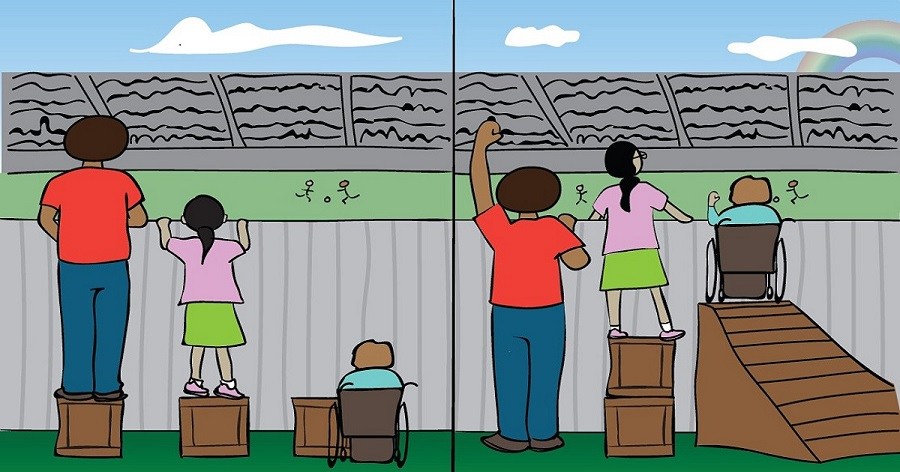
Equality vs Equity

Anonymous
Anonymous wrote:
Anonymous wrote:
Anonymous wrote:
Anonymous wrote:
Anonymous wrote:


Except this isn’t how equity plays out in real life. The person on the left would be standing in a hole so he couldn’t see just like the others. When we can’t figure out how to bring others up, we hold people back to close the gap, particularly in public education.


Just stop. You keep trying to push this false narrative. No, the person on the left does not and is not really in a hole. This is just your paranoid narrative of “Those people are taking something from me so they can get a decent life.”

Yeah, no.


When a wealthy black person with strong family ties and community support is given a specific material advantage over a poor white person from a broken home and without any community support then how else would you describe it? Why is skin color more worthy of “equity” than economic class, education level or family circumstances?


Does the poor white person get frightened that they might be murdered when they’re pulled over on the side of the road by the police? Yeah, I didn’t think so. That wealthy black person does. Doesn’t matter how much money or community support they have. They’re still followed in the store, still live in fear for being brutalized by the police, and still looked at as being lesser than by many.


Yes actually they do. Ask me how I know. White people are shot more by cops than any other racial group. Poor white people are constantly profiled while shipping etc. And on top of it all they also have people like you minimizing their struggles with half baked statistics. A poor white person faces many challenges in life that a wealthy black person does not. Why is that so hard to admit?
Anonymous
Anonymous wrote:
Anonymous wrote:
Anonymous wrote:
Anonymous wrote:
Anonymous wrote:
Anonymous wrote:
Anonymous wrote:


Except this isn’t how equity plays out in real life. The person on the left would be standing in a hole so he couldn’t see just like the others. When we can’t figure out how to bring others up, we hold people back to close the gap, particularly in public education.


Just stop. You keep trying to push this false narrative. No, the person on the left does not and is not really in a hole. This is just your paranoid narrative of “Those people are taking something from me so they can get a decent life.”

Yeah, no.


When a wealthy black person with strong family ties and community support is given a specific material advantage over a poor white person from a broken home and without any community support then how else would you describe it? Why is skin color more worthy of “equity” than economic class, education level or family circumstances?


Does the poor white person get frightened that they might be murdered when they’re pulled over on the side of the road by the police? Yeah, I didn’t think so. That wealthy black person does. Doesn’t matter how much money or community support they have. They’re still followed in the store, still live in fear for being brutalized by the police, and still looked at as being lesser than by many.


This is all political theater because the cops run the plate first and will know the black one is not a criminal but the one white might ht be because poverty has rap sheets


Sure. Whatever you need to tell yourself. The fear that every Black person in this country has when pulled over is just all in their heads. If they just keep their hands on the steering wheel and follow the police officer’s directions, nothing bad will happen. Right?


Just because black people face fear that doesn’t somehow negate the reality of others who are also fearful. WTF
Anonymous
Anonymous wrote:
Anonymous wrote:
Anonymous wrote:
Anonymous wrote:
Anonymous wrote:
Except that this cartoon always, always is used in the wrong circumstances.
Should children behind in reading (or math or handwriting, etc.) have extra help? Yes, absolutely. But should children already performing ahead of expectations be left to their own devices? No. They also need help to continue on their path, to the best of their abilities.
And that’s why I dislike this cartoon.


At my school at least, our CLTs include segments where we address both remediation and enrichment. Our differentiation is required to address learners below, on, and above target. We have a specialized enrichment program and kids stay after school for several hours to participate (while other kids receive remediation). I'm sorry that wasn't your experience, because it is happening in plenty of schools.


Not any that I’m aware of. All of our focus is on getting as many students as possible to pass standardized tests. Anyone we already know will pass receives nothing extra.

-public school teacher in VA


So true. My son always scored above the benchmark for his grade when tested at the beginning of the year. His teacher didn't need to worry about him and they didn't. He spent a lot of time reading books in his desk. I switched him to private school where his teachers found many ways he could improve. He was actually challenged there.


You are the problem.


How is addressing her son's needs a problem? The problem is the system that caused her to need this change.


This. I decided to make a change because nothing exists for kids like this. They used to have GT classes for math and reading in his district. They got rid of them when Common Core began. Instead of being instructed at his grade level, his teacher would meet with his reading group once a week for 15 minutes. They were instructed one grade level above even though the kids in that group were multiple grade levels above. The other groups met with the teacher every day for most of the reading block. His group would've been a separate class prior to CC. Their teacher would've had the entire class time to work with them. It's a shame the direction the schools are going in.
Anonymous
Anonymous wrote:Either is fine with me but the way I’d like it implemented is that women have as many bathrooms as needed at concert and stadiums.

I don’t know if it as many stalls as men have stalls and urinals (equality) or women need more (equity) to have smaller lines.

We know there are not more women at football games but the lines are longer for the bathroom.


I think that's a good example. Having the same number of stalls for men and as there are stalls for women, plus additional urinals for men is unequal and inequitable. Equal numbers of facilities for both genders are generally inequitable for women because women take more time to go to the bathroom because they use stalls. Designing facilities so women don't spend more time waiting in line than men requires unequal facilities to produce a more equitable result.

Equity recognizes differences in groups so that adjustments can be made to give fair access. Equal bathroom facilities are not fair to women, because women have to spend more time waiting in line. Equitable solutions acknowledge inherent differences that allow women to have similar access to events as men.
Anonymous
Anonymous wrote:
Anonymous wrote:
Anonymous wrote:
Anonymous wrote:Equality means everyone has the same opportunity but outcomes are different.

Equity means outcomes are the same. It will never be, and it sets everyone up for failure .


No. It doesn’t mean that every individual has equal outcomes. It means achieving more aggregate equal outcomes, I.e. women get paid the same as men, blacks have equal levels of home ownership, there is less income inequality across races, etc.

People who say it means equal outcomes for everyone have a narrow understanding of the concept. But they are tend to be the type of people who are frequently wrong but rarely in doubt.


Except the outcomes that you are citing are based almost entirely on people's choices. The differential in wages between men and women is almost entirely based on choice of profession, time taken out from the workforce to raise children, willingness to risk physical injury or death on the job, etc. Individual women working the same job as a man, with these factors the same make nearly the same. So your outcome means that as a society, we have to artificially boost the wages of certain professions, mandate state-funded childcare, etc. I don't think these policies (which have other negative consequences) are worth the "equity" that you desire.

Our society will address many inequalities with better K-12 education and more aggressive child welfare policies, not by artificially boosting people's income after they are miseducated.


How do you explain women and men in the same job making different wages?


If that is happening without a valid differentiator, then it is a violation of federal law, and a complaint should be made to the EEOC. That is not what the wage difference statistics PP mentions are addressing or aggregating.
Anonymous
Anonymous wrote:
Anonymous wrote:
Anonymous wrote:
Anonymous wrote:
Anonymous wrote:
Anonymous wrote:
Except that this cartoon always, always is used in the wrong circumstances.
Should children behind in reading (or math or handwriting, etc.) have extra help? Yes, absolutely. But should children already performing ahead of expectations be left to their own devices? No. They also need help to continue on their path, to the best of their abilities.
And that’s why I dislike this cartoon.


At my school at least, our CLTs include segments where we address both remediation and enrichment. Our differentiation is required to address learners below, on, and above target. We have a specialized enrichment program and kids stay after school for several hours to participate (while other kids receive remediation). I'm sorry that wasn't your experience, because it is happening in plenty of schools.


Not any that I’m aware of. All of our focus is on getting as many students as possible to pass standardized tests. Anyone we already know will pass receives nothing extra.

-public school teacher in VA


So true. My son always scored above the benchmark for his grade when tested at the beginning of the year. His teacher didn't need to worry about him and they didn't. He spent a lot of time reading books in his desk. I switched him to private school where his teachers found many ways he could improve. He was actually challenged there.


You are the problem.


How is addressing her son's needs a problem? The problem is the system that caused her to need this change.


This. I decided to make a change because nothing exists for kids like this. They used to have GT classes for math and reading in his district. They got rid of them when Common Core began. Instead of being instructed at his grade level, his teacher would meet with his reading group once a week for 15 minutes. They were instructed one grade level above even though the kids in that group were multiple grade levels above. The other groups met with the teacher every day for most of the reading block. His group would've been a separate class prior to CC. Their teacher would've had the entire class time to work with them. It's a shame the direction the schools are going in.


I'm with you on the differences, but this has nothing at all to do with CC, and if you don't get that part right, people are going to stop listening to you.
Anonymous
Anonymous wrote:
Anonymous wrote:
Anonymous wrote:
Anonymous wrote:
Except that this cartoon always, always is used in the wrong circumstances.
Should children behind in reading (or math or handwriting, etc.) have extra help? Yes, absolutely. But should children already performing ahead of expectations be left to their own devices? No. They also need help to continue on their path, to the best of their abilities.
And that’s why I dislike this cartoon.


At my school at least, our CLTs include segments where we address both remediation and enrichment. Our differentiation is required to address learners below, on, and above target. We have a specialized enrichment program and kids stay after school for several hours to participate (while other kids receive remediation). I'm sorry that wasn't your experience, because it is happening in plenty of schools.


Not any that I’m aware of. All of our focus is on getting as many students as possible to pass standardized tests. Anyone we already know will pass receives nothing extra.

-public school teacher in VA


So true. My son always scored above the benchmark for his grade when tested at the beginning of the year. His teacher didn't need to worry about him and they didn't. He spent a lot of time reading books in his desk. I switched him to private school where his teachers found many ways he could improve. He was actually challenged there.


You are the problem.


Can you explain how? What is your expectation if you want parents to be part of the solution? What does equity require for parents whose kids are not being served in public schools?
Anonymous
Anonymous wrote:
Anonymous wrote:
Anonymous wrote:
Anonymous wrote:Equality means everyone has the same opportunity but outcomes are different.

Equity means outcomes are the same. It will never be, and it sets everyone up for failure .


No. It doesn’t mean that every individual has equal outcomes. It means achieving more aggregate equal outcomes, I.e. women get paid the same as men, blacks have equal levels of home ownership, there is less income inequality across races, etc.

People who say it means equal outcomes for everyone have a narrow understanding of the concept. But they are tend to be the type of people who are frequently wrong but rarely in doubt.


Except the outcomes that you are citing are based almost entirely on people's choices. The differential in wages between men and women is almost entirely based on choice of profession, time taken out from the workforce to raise children, willingness to risk physical injury or death on the job, etc. Individual women working the same job as a man, with these factors the same make nearly the same. So your outcome means that as a society, we have to artificially boost the wages of certain professions, mandate state-funded childcare, etc. I don't think these policies (which have other negative consequences) are worth the "equity" that you desire.

Our society will address many inequalities with better K-12 education and more aggressive child welfare policies, not by artificially boosting people's income after they are miseducated.


How do you explain women and men in the same job making different wages?


Not that poster, but men's and women's salaries are relatively equal until women reach the age of carrying the family caregiving burden. Usually they take more time off, or have fewer personal hours to devote to work, because of kids. But many are also taking care of sick parents, etc. Until the cultural caregiving practices change, women will make less than men in aggregate.
Anonymous
Anonymous wrote:
Anonymous wrote:
Anonymous wrote:
Anonymous wrote:Equality means everyone has the same opportunity but outcomes are different.

Equity means outcomes are the same. It will never be, and it sets everyone up for failure .


No. It doesn’t mean that every individual has equal outcomes. It means achieving more aggregate equal outcomes, I.e. women get paid the same as men, blacks have equal levels of home ownership, there is less income inequality across races, etc.

People who say it means equal outcomes for everyone have a narrow understanding of the concept. But they are tend to be the type of people who are frequently wrong but rarely in doubt.


Except the outcomes that you are citing are based almost entirely on people's choices. The differential in wages between men and women is almost entirely based on choice of profession, time taken out from the workforce to raise children, willingness to risk physical injury or death on the job, etc. Individual women working the same job as a man, with these factors the same make nearly the same. So your outcome means that as a society, we have to artificially boost the wages of certain professions, mandate state-funded childcare, etc. I don't think these policies (which have other negative consequences) are worth the "equity" that you desire.

Our society will address many inequalities with better K-12 education and more aggressive child welfare policies, not by artificially boosting people's income after they are miseducated.


How do you explain women and men in the same job making different wages?


You mean like supermodels?
Anonymous
Anonymous wrote:
Anonymous wrote:
Anonymous wrote:
Anonymous wrote:
Anonymous wrote:Equality means everyone has the same opportunity but outcomes are different.

Equity means outcomes are the same. It will never be, and it sets everyone up for failure .


No. It doesn’t mean that every individual has equal outcomes. It means achieving more aggregate equal outcomes, I.e. women get paid the same as men, blacks have equal levels of home ownership, there is less income inequality across races, etc.

People who say it means equal outcomes for everyone have a narrow understanding of the concept. But they are tend to be the type of people who are frequently wrong but rarely in doubt.


Except the outcomes that you are citing are based almost entirely on people's choices. The differential in wages between men and women is almost entirely based on choice of profession, time taken out from the workforce to raise children, willingness to risk physical injury or death on the job, etc. Individual women working the same job as a man, with these factors the same make nearly the same. So your outcome means that as a society, we have to artificially boost the wages of certain professions, mandate state-funded childcare, etc. I don't think these policies (which have other negative consequences) are worth the "equity" that you desire.

Our society will address many inequalities with better K-12 education and more aggressive child welfare policies, not by artificially boosting people's income after they are miseducated.


How do you explain women and men in the same job making different wages?


Not that poster, but men's and women's salaries are relatively equal until women reach the age of carrying the family caregiving burden. Usually they take more time off, or have fewer personal hours to devote to work, because of kids. But many are also taking care of sick parents, etc. Until the cultural caregiving practices change, women will make less than men in aggregate.


Yes, lots of research shows that women favor jobs with more flexibility in working hours and/or more time off in order to spend more time with children. People act like spending time raising a family vs. working is some horrible burden; lots of people would disagree.
Anonymous
Anonymous wrote:
Anonymous wrote:
Anonymous wrote:
Anonymous wrote:
Anonymous wrote:


Except this isn’t how equity plays out in real life. The person on the left would be standing in a hole so he couldn’t see just like the others. When we can’t figure out how to bring others up, we hold people back to close the gap, particularly in public education.


Just stop. You keep trying to push this false narrative. No, the person on the left does not and is not really in a hole. This is just your paranoid narrative of “Those people are taking something from me so they can get a decent life.”

Yeah, no.


When a wealthy black person with strong family ties and community support is given a specific material advantage over a poor white person from a broken home and without any community support then how else would you describe it? Why is skin color more worthy of “equity” than economic class, education level or family circumstances?


Does the poor white person get frightened that they might be murdered when they’re pulled over on the side of the road by the police? Yeah, I didn’t think so. That wealthy black person does. Doesn’t matter how much money or community support they have. They’re still followed in the store, still live in fear for being brutalized by the police, and still looked at as being lesser than by many.


Cops kill more whites than blacks.
Anonymous
Anonymous wrote:
Anonymous wrote:Virtually no one argues for equal outcomes— just a bogeyman.


Except for obscure, little-known figures like Ibram X. Kendi, who has no national platform of any sort, who explicitly argues for equal outcomes by racial group, to be enforced by whatever action is necessary. See, for instance, his proposed Department of Anti-Racism.

The concept of equal outcomes is precisely what distinguishes “equity” from “equality” in current usage, and the existence of different outcomes is the “evidence” that equality is just not good enough. That’s what it means; that’s all it means. To be sure, the unit by which equal outcomes is measured is a collective one—individuals don’t particularly matter to the equity advocates, they are just data points—but equal outcomes for racial groups in the aggregate is precisely what the “equity” concept is intended to achieve.


Exactly. It's right there in scripture, if you will.
Anonymous
Anonymous wrote:
Anonymous wrote:
Anonymous wrote:
Anonymous wrote:
Anonymous wrote:
Anonymous wrote:
Anonymous wrote:


Except this isn’t how equity plays out in real life. The person on the left would be standing in a hole so he couldn’t see just like the others. When we can’t figure out how to bring others up, we hold people back to close the gap, particularly in public education.


Just stop. You keep trying to push this false narrative. No, the person on the left does not and is not really in a hole. This is just your paranoid narrative of “Those people are taking something from me so they can get a decent life.”

Yeah, no.


When a wealthy black person with strong family ties and community support is given a specific material advantage over a poor white person from a broken home and without any community support then how else would you describe it? Why is skin color more worthy of “equity” than economic class, education level or family circumstances?


Does the poor white person get frightened that they might be murdered when they’re pulled over on the side of the road by the police? Yeah, I didn’t think so. That wealthy black person does. Doesn’t matter how much money or community support they have. They’re still followed in the store, still live in fear for being brutalized by the police, and still looked at as being lesser than by many.


This is all political theater because the cops run the plate first and will know the black one is not a criminal but the one white might ht be because poverty has rap sheets


Sure. Whatever you need to tell yourself. The fear that every Black person in this country has when pulled over is just all in their heads. If they just keep their hands on the steering wheel and follow the police officer’s directions, nothing bad will happen. Right?


Get over it.
Anonymous
Anonymous wrote:
Anonymous wrote:
Anonymous wrote:
Anonymous wrote:
Anonymous wrote:


Except this isn’t how equity plays out in real life. The person on the left would be standing in a hole so he couldn’t see just like the others. When we can’t figure out how to bring others up, we hold people back to close the gap, particularly in public education.


Just stop. You keep trying to push this false narrative. No, the person on the left does not and is not really in a hole. This is just your paranoid narrative of “Those people are taking something from me so they can get a decent life.”

Yeah, no.


When a wealthy black person with strong family ties and community support is given a specific material advantage over a poor white person from a broken home and without any community support then how else would you describe it? Why is skin color more worthy of “equity” than economic class, education level or family circumstances?


Does the poor white person get frightened that they might be murdered when they’re pulled over on the side of the road by the police? Yeah, I didn’t think so. That wealthy black person does. Doesn’t matter how much money or community support they have. They’re still followed in the store, still live in fear for being brutalized by the police, and still looked at as being lesser than by many.


That wealthy black person who fears the police is being irrational based on the statistics. Clay in the hands of propagandists.
Anonymous
Anonymous wrote:
Anonymous wrote:
Anonymous wrote:
Anonymous wrote:Equality means everyone has the same opportunity but outcomes are different.

Equity means outcomes are the same. It will never be, and it sets everyone up for failure .


No. It doesn’t mean that every individual has equal outcomes. It means achieving more aggregate equal outcomes, I.e. women get paid the same as men, blacks have equal levels of home ownership, there is less income inequality across races, etc.

People who say it means equal outcomes for everyone have a narrow understanding of the concept. But they are tend to be the type of people who are frequently wrong but rarely in doubt.


Except the outcomes that you are citing are based almost entirely on people's choices. The differential in wages between men and women is almost entirely based on choice of profession, time taken out from the workforce to raise children, willingness to risk physical injury or death on the job, etc. Individual women working the same job as a man, with these factors the same make nearly the same. So your outcome means that as a society, we have to artificially boost the wages of certain professions, mandate state-funded childcare, etc. I don't think these policies (which have other negative consequences) are worth the "equity" that you desire.

Our society will address many inequalities with better K-12 education and more aggressive child welfare policies, not by artificially boosting people's income after they are miseducated.


How do you explain women and men in the same job making different wages?


Read the research… very little difference.
post reply Forum Index » Off-Topic
Message Quick Reply
Go to: