Quake reveals day of Jesus' crucifixion, researchers believe

Anonymous
Anonymous wrote:
Anonymous wrote:
Anonymous wrote:
Anonymous wrote:
Anonymous wrote:
Anonymous wrote:
Anonymous wrote:
Anonymous wrote:
Anonymous wrote:If a scientist believes that a religious explanation supersedes a scientific explanation of events then that's bad science, not based on data.

If a scientist compartmentalizes and uses religion to fill the gaps in our scientific understanding then that's not bad science. Just a person who is uncomfortable with uncertainty and needs “answers” to the unknown.

Collins:
”the scientific method and the scientific worldview can't be allowed to get distorted by religious perspectives”


Who are you, and who is “Collins?” Why should anyone listen to either of you?


Collins was one of the scientists on the PP’s list. I’m an intelligent person with strong STEM background and critical thinking skills who enjoys discussing various topics.

Do you think a scientist in 2023 would accept a religious explanation for a natural phenomenon when a scientific explanation already exists?


What is your STEM background? Are you actively working as a scientist?


Multiple degrees in STEM. Not actively working as a scientist.

You missed my question:
Do you think a scientist in 2023 would accept a religious explanation for a natural phenomenon when a scientific explanation already exists?


What degrees in STEM? Did you ever do research? Are you published? Did you teach?


I have been answering your questions in good faith. You continue to ignore mine.

Is my question too difficult for you?
Do you think a scientist in 2023 would accept a religious explanation for a natural phenomenon when a scientific explanation already exists?


Answer: I cannot speak for a single scientist, much less every scientist, or any scientist, in the year 2023.

I cannot speak for any person but myself.

Pew does alot of polls about various issues, perhaps they have a poll about it.

You should ask scientists your question.

Are you a scientist?


We do know what Frances Collins, a religious scientist who gets copy-and-pasted on this forum frequently, said:
”the scientific method and the scientific worldview can't be allowed to get distorted by religious perspectives”


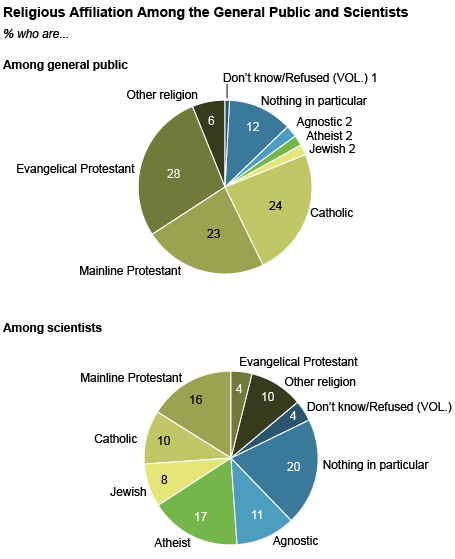
A little dated, but here is what Pew reported:


And, interestingly, very few scientists are evangelicals. Probably because they have a more difficult time compartmentalizing.


Bump for % of scientists who believe in god. ^^
Anonymous
Anonymous wrote:
Anonymous wrote:
Anonymous wrote:
Anonymous wrote:
Anonymous wrote:
Anonymous wrote:
Anonymous wrote:
Anonymous wrote:
Anonymous wrote:
Anonymous wrote:If a scientist believes that a religious explanation supersedes a scientific explanation of events then that's bad science, not based on data.

If a scientist compartmentalizes and uses religion to fill the gaps in our scientific understanding then that's not bad science. Just a person who is uncomfortable with uncertainty and needs “answers” to the unknown.

Collins:
”the scientific method and the scientific worldview can't be allowed to get distorted by religious perspectives”


Who are you, and who is “Collins?” Why should anyone listen to either of you?


Collins was one of the scientists on the PP’s list. I’m an intelligent person with strong STEM background and critical thinking skills who enjoys discussing various topics.

Do you think a scientist in 2023 would accept a religious explanation for a natural phenomenon when a scientific explanation already exists?


What is your STEM background? Are you actively working as a scientist?


Multiple degrees in STEM. Not actively working as a scientist.

You missed my question:
Do you think a scientist in 2023 would accept a religious explanation for a natural phenomenon when a scientific explanation already exists?


What degrees in STEM? Did you ever do research? Are you published? Did you teach?


I have been answering your questions in good faith. You continue to ignore mine.

Is my question too difficult for you?
Do you think a scientist in 2023 would accept a religious explanation for a natural phenomenon when a scientific explanation already exists?


Answer: I cannot speak for a single scientist, much less every scientist, or any scientist, in the year 2023.

I cannot speak for any person but myself.

Pew does alot of polls about various issues, perhaps they have a poll about it.

You should ask scientists your question.

Are you a scientist?


We do know what Frances Collins, a religious scientist who gets copy-and-pasted on this forum frequently, said:
”the scientific method and the scientific worldview can't be allowed to get distorted by religious perspectives”


A little dated, but here is what Pew reported:


And, interestingly, very few scientists are evangelicals. Probably because they have a more difficult time compartmentalizing.


Bump for % of scientists who believe in god. ^^


Which is low compared to the general public
Anonymous
Curious how they define scientist. I am in healthcare. Most people believe strongly in science, and most are religious ( to some extent).
Anonymous
Anonymous wrote:Curious how they define scientist. I am in healthcare. Most people believe strongly in science, and most are religious ( to some extent).


How do define “in healthcare”?

How do you know your coworkers religious beliefs?
Anonymous
Circling back to the science of the OP.

The geologist from the story concluded that there were three possible explanations for the earthquake story in the gospel:
- the recount was fairly accurate
- they embellished the story with details from an earthquake at a different time
- it was “allegorical fiction”

https://www.researchgate.net/publication/278942108_AnEarlyFirstCenturyEarthquakeInTheDeadSea_WilliamsSchwabBrauer_IntlGeologyReview
This leaves three possibilities for the cause of the
26-36 AD earthquake observed in the Ein Gedi section:
(1) the earthquake described in the Gospel of Matthew occurred more or less as reported;
(2) the earthquake described in the Gospel of Mathew was in effect 'borrowed from an earthquake that occurred sometime before or after the crucifixion, but during the reign of Pontius Pilate;
(3) the earthquake described in the Gospel of Matthew is allegorical fiction and the 26-36 AD seismite was caused by an earthquake that is not reported in the currently extant historical record.
Anonymous
Anonymous wrote:
Anonymous wrote:Curious how they define scientist. I am in healthcare. Most people believe strongly in science, and most are religious ( to some extent).


How do define “in healthcare”?

How do you know your coworkers religious beliefs?


DP

Many medical workers at our church and many medical workers I worked with openly talk about their faith communities or celebrating different religious holidays. Also many doctors and nurses further volunteer at faith based health service projects such as mobile mother and child wellness clinics or mobile dental clinics serving poor under serviced areas.
Anonymous
Anonymous wrote:
Anonymous wrote:
Anonymous wrote:Curious how they define scientist. I am in healthcare. Most people believe strongly in science, and most are religious ( to some extent).


How do define “in healthcare”?

How do you know your coworkers religious beliefs?


DP

Many medical workers at our church and many medical workers I worked with openly talk about their faith communities or celebrating different religious holidays. Also many doctors and nurses further volunteer at faith based health service projects such as mobile mother and child wellness clinics or mobile dental clinics serving poor under serviced areas.


You can belong to a faith community and not believe in God.
Anonymous
Anonymous wrote:
Anonymous wrote:
Anonymous wrote:
Anonymous wrote:Curious how they define scientist. I am in healthcare. Most people believe strongly in science, and most are religious ( to some extent).


How do define “in healthcare”?

How do you know your coworkers religious beliefs?


DP

Many medical workers at our church and many medical workers I worked with openly talk about their faith communities or celebrating different religious holidays. Also many doctors and nurses further volunteer at faith based health service projects such as mobile mother and child wellness clinics or mobile dental clinics serving poor under serviced areas.


You can belong to a faith community and not believe in God.


And you can volunteer at a clinic without believing in any gods.
Anonymous
Anonymous wrote:Circling back to the science of the OP.

The geologist from the story concluded that there were three possible explanations for the earthquake story in the gospel:
- the recount was fairly accurate
- they embellished the story with details from an earthquake at a different time
- it was “allegorical fiction”

https://www.researchgate.net/publication/278942108_AnEarlyFirstCenturyEarthquakeInTheDeadSea_WilliamsSchwabBrauer_IntlGeologyReview
This leaves three possibilities for the cause of the
26-36 AD earthquake observed in the Ein Gedi section:
(1) the earthquake described in the Gospel of Matthew occurred more or less as reported;
(2) the earthquake described in the Gospel of Mathew was in effect 'borrowed from an earthquake that occurred sometime before or after the crucifixion, but during the reign of Pontius Pilate;
(3) the earthquake described in the Gospel of Matthew is allegorical fiction and the 26-36 AD seismite was caused by an earthquake that is not reported in the currently extant historical record.


Present more detailed facts from OP's "research" and...nothing.
Anonymous
Anonymous wrote:
Anonymous wrote:
Anonymous wrote:
Anonymous wrote:
Anonymous wrote:Curious how they define scientist. I am in healthcare. Most people believe strongly in science, and most are religious ( to some extent).


How do define “in healthcare”?

How do you know your coworkers religious beliefs?


DP

Many medical workers at our church and many medical workers I worked with openly talk about their faith communities or celebrating different religious holidays. Also many doctors and nurses further volunteer at faith based health service projects such as mobile mother and child wellness clinics or mobile dental clinics serving poor under serviced areas.


You can belong to a faith community and not believe in God.


And you can volunteer at a clinic without believing in any gods.


Non-believers can be religiously active for a lot of reasons:

- they changed their minds about religion but still like the people and the religious community they've been a part of
- their mate wants them to be religiously active, irrespective of beliefs
- they are children, still being controlled by their parents.
- they feel they need to act religious to be socially accepted
- etc.
Anonymous
Anonymous wrote:
Anonymous wrote:
Anonymous wrote:
Anonymous wrote:
Anonymous wrote:
Anonymous wrote:Curious how they define scientist. I am in healthcare. Most people believe strongly in science, and most are religious ( to some extent).


How do define “in healthcare”?

How do you know your coworkers religious beliefs?


DP

Many medical workers at our church and many medical workers I worked with openly talk about their faith communities or celebrating different religious holidays. Also many doctors and nurses further volunteer at faith based health service projects such as mobile mother and child wellness clinics or mobile dental clinics serving poor under serviced areas.


You can belong to a faith community and not believe in God.


And you can volunteer at a clinic without believing in any gods.


Non-believers can be religiously active for a lot of reasons:

- they changed their minds about religion but still like the people and the religious community they've been a part of
- their mate wants them to be religiously active, irrespective of beliefs
- they are children, still being controlled by their parents.
- they feel they need to act religious to be socially accepted
- etc.


Or they want to help in a specific way that happens to be facilitated by a religious organization.
post reply Forum Index » Religion
Message Quick Reply
Go to: