
Two Sarahs: new motherhood in Sweden vs Seattle

Anonymous
Anonymous wrote:
Anonymous wrote:
Anonymous wrote:
Anonymous wrote:This article was a little annoying - it painted a VERY rosy picture of being a working mother in Sweden and a VERY dismal picture of being a working mother in the U.S.

For comparison - my friends in Europe (a few different countries, including one in Sweden) say that as a woman in your late 20s/early 30s, it's hard to get a job because people are worried that you'll get pregnant and leave for a year, meaning they'll have to find and hire a temporary replacement which is really hard.

And most working women that read the Harvard Business Review are not in the US woman's situation. A lot of professional women are eligible for FMLA and get 6-10 weeks paid through disability insurance (not everyone, that's why I said a lot). A lot of women (even those of us in this area where childcare is a nightmare) are able to figure something out (but yes, for many, it IS prohibitively expensive). And the weird dumping work on the new mom thing also doesn't happen t everyone. I"m not saying that the description for her was not realistic, I know there are a lot of people who have it that bad or worse, but it's also a worst case scenario, don't you think?


Eligible for a whole 10 paid weeks!!!!


Listen, I would MUCH prefer to live in Sweden than here, and have those maternity policies over our shitty ass ones, I'm just saying that the article went to the extreme on both sides.


I'm not sure what bubble you live in to think that the US Sarah's experience was "extreme" and a "worst case scenario". I've read DCUM long enough to know it's not, and that there's plenty of working women who save, plan, research in advance, and are still knocked flat by the lack of support due to pure circumstance. I got 10 weeks of paid leave with my first, 16 weeks paid leave with my second, we had a good experience with our daycare, and I returned to a decent work environment. It was still so hard, and between keeping up with work, not sleeping, catching constant illness, and just plain missing my babies - we were burnt out. Yet my company's policies are considered generous, and the (minimum humane) amount of flexibility and accommodation I was offered in returning to work is held up as a shining example. So if I'm representative of a relatively positive experience, it's easy to extrapolate how shitty it can get for those who didn't manage to align all the stars of career, company policy, money, partner, care, health, timing etc. And yet people in this thread seem to think that's a character flaw as opposed to a cultural and systemic problem. It's f*cked up.


So what? So you had a "hard" couple of weeks. Eff off with thinking that other people should pay you to be home. I guess you should have saved more.
Anonymous
Anonymous wrote:
Anonymous wrote:
Anonymous wrote:It's very hard to get hired as a woman in Sweden for this reason.


Exactly. Taxpayers don’t want to pay for that. People should pay for their own lifestyle choices.


+ 1

I would be embarrassed to be some of these other posters in here asking (no DEMANDING) other people to pay for my lifestyle. It's so tacky and low class. Get a better job. Go back to school. Don't have kids before you are financially prepared for them! Abortion exists so don't @me about unplanned pregnancies.


x 1000
Anonymous
Yes it’s absolutely impossible for any functioning country to provide maternity leave.

Anonymous
Anonymous wrote:
Anonymous wrote:Everyone is not an upper income family. Everyone will need hospital services at some time
Every pregnancy will end in a birth, parental leave is a necessity to recover from birth. Infant is not a lifestyle choice. They have to have a lot of care. Children are born into all kinds of circumstances. We are in this world together

A few weeks of parental leave is not much to ask for. You will work a lifetime, society provides your kid with 12 years of public schooling anyway.


+1 it’s amazing that people get so huffy about funding a few weeks of maternity leave and forget that we as a society fund an extensive system of free public school. Kids are at their most vulnerable and needy as infants.


+1.
Anonymous
Anonymous wrote:Yes it’s absolutely impossible for any functioning country to provide maternity leave.
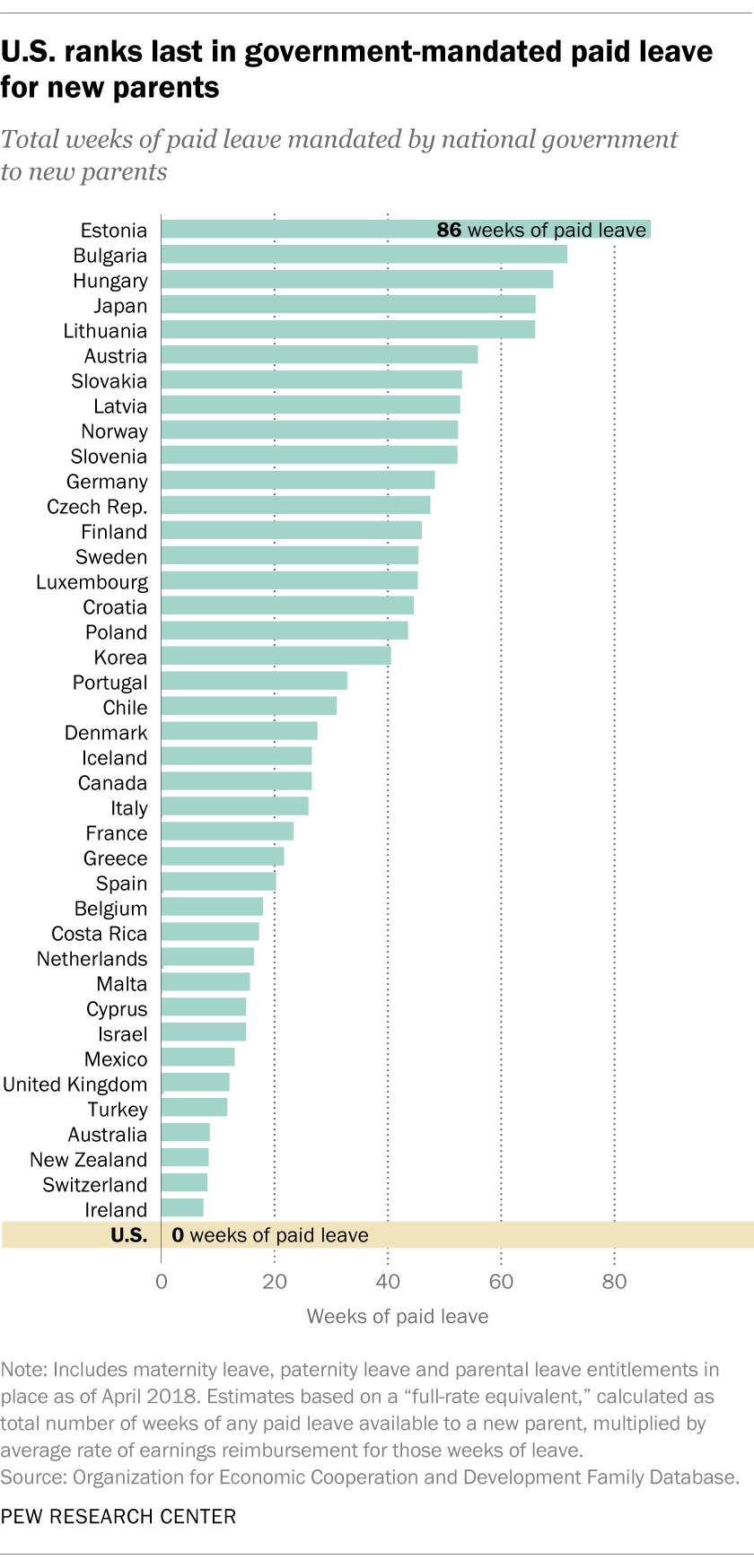


Wow. HBR needs to do a follow up on SArah from Estonia.
Anonymous
Anonymous wrote:
Anonymous wrote:Everyone is not an upper income family. Everyone will need hospital services at some time
Every pregnancy will end in a birth, parental leave is a necessity to recover from birth. Infant is not a lifestyle choice. They have to have a lot of care. Children are born into all kinds of circumstances. We are in this world together

A few weeks of parental leave is not much to ask for. You will work a lifetime, society provides your kid with 12 years of public schooling anyway.


Having kids is a choice. If you can’t afford to have kids and maintain the lifestyle you want, then don’t have kids. You don’t have the right to have everyone else pay for your choices. Grow up.


And who do you think will be paying YOUR social security? Not the kid who wasn't born.
Anonymous
About Canada: the "paid" maternity leave is actually a stipend that maxes out, and for professional women it maxes out well below their salaries--for these women, the US short-term disability would probably be a better deal. In addition, layoffs of women just returning from mat leave are reportedly common (no solid data here, but a friend in Canada faced this situation and fully anticipated it based on what she's observed before delivering.)

Also, paid family leave represents a step away from "equal pay for equal work". In the fed system (without paid family leave), family leave is taken as a combination of earned sick leave, earned annual leave, short-term disability if applicable depending on the type of delivery, and unpaid leave.
Anonymous
Anonymous wrote:About Canada: the "paid" maternity leave is actually a stipend that maxes out, and for professional women it maxes out well below their salaries--for these women, the US short-term disability would probably be a better deal. In addition, layoffs of women just returning from mat leave are reportedly common (no solid data here, but a friend in Canada faced this situation and fully anticipated it based on what she's observed before delivering.)

Also, paid family leave represents a step away from "equal pay for equal work". In the fed system (without paid family leave), family leave is taken as a combination of earned sick leave, earned annual leave, short-term disability if applicable depending on the type of delivery, and unpaid leave.


Yep in Canada it’s a fixed amount you get if you’ve worked and paid taxes long enough-kind of like unemployment benefits.
Anonymous
Pp here. You have to pay in through taxes and in most of Canada (Quebec is separate) the max is slightly over 500 a week.
Anonymous
Anonymous wrote:
Anonymous wrote:
Anonymous wrote:
Anonymous wrote:
Anonymous wrote:This article was a little annoying - it painted a VERY rosy picture of being a working mother in Sweden and a VERY dismal picture of being a working mother in the U.S.

For comparison - my friends in Europe (a few different countries, including one in Sweden) say that as a woman in your late 20s/early 30s, it's hard to get a job because people are worried that you'll get pregnant and leave for a year, meaning they'll have to find and hire a temporary replacement which is really hard.

And most working women that read the Harvard Business Review are not in the US woman's situation. A lot of professional women are eligible for FMLA and get 6-10 weeks paid through disability insurance (not everyone, that's why I said a lot). A lot of women (even those of us in this area where childcare is a nightmare) are able to figure something out (but yes, for many, it IS prohibitively expensive). And the weird dumping work on the new mom thing also doesn't happen t everyone. I"m not saying that the description for her was not realistic, I know there are a lot of people who have it that bad or worse, but it's also a worst case scenario, don't you think?


Eligible for a whole 10 paid weeks!!!!


Listen, I would MUCH prefer to live in Sweden than here, and have those maternity policies over our shitty ass ones, I'm just saying that the article went to the extreme on both sides.


I'm not sure what bubble you live in to think that the US Sarah's experience was "extreme" and a "worst case scenario". I've read DCUM long enough to know it's not, and that there's plenty of working women who save, plan, research in advance, and are still knocked flat by the lack of support due to pure circumstance. I got 10 weeks of paid leave with my first, 16 weeks paid leave with my second, we had a good experience with our daycare, and I returned to a decent work environment. It was still so hard, and between keeping up with work, not sleeping, catching constant illness, and just plain missing my babies - we were burnt out. Yet my company's policies are considered generous, and the (minimum humane) amount of flexibility and accommodation I was offered in returning to work is held up as a shining example. So if I'm representative of a relatively positive experience, it's easy to extrapolate how shitty it can get for those who didn't manage to align all the stars of career, company policy, money, partner, care, health, timing etc. And yet people in this thread seem to think that's a character flaw as opposed to a cultural and systemic problem. It's f*cked up.


So what? So you had a "hard" couple of weeks. Eff off with thinking that other people should pay you to be home. I guess you should have saved more.

Can we raise the wages and salary so that everyone can afford to be without salary?
People need their paycheck for living expenses. Only a very few select group can manage without it
Anonymous
Anonymous wrote:About Canada: the "paid" maternity leave is actually a stipend that maxes out, and for professional women it maxes out well below their salaries--for these women, the US short-term disability would probably be a better deal. In addition, layoffs of women just returning from mat leave are reportedly common (no solid data here, but a friend in Canada faced this situation and fully anticipated it based on what she's observed before delivering.)

Also, paid family leave represents a step away from "equal pay for equal work". In the fed system (without paid family leave), family leave is taken as a combination of earned sick leave, earned annual leave, short-term disability if applicable depending on the type of delivery, and unpaid leave.


It's this way in many countries. It is not "paid leave" at your regular rate. It is basically like unemployment insurance where it is a ceilinged amount based on your wage and how long/much you've paid in to the system. The ceilinged amount comes out to 500 something Canadian dollars a week for a woman at the max income level and with the max amount paid in, and that is only if you take the "shorter" maternity leave. If you take the "longer" max leave, it is much lower (300 something Canadian dollars a week).
Anonymous
High tax rates in Sweden are not just reserved for the few at the top. The highest rate kicks in at 1.5x average -- so, take a guess at maybe $80-$90k? Add in the VAT and it's really an enormous lifestyle difference. Yes you get long maternity leaves, but you give up a lot. I believe they also have national wealth from oil that allows them to spend more than their tax revenues. I wish, when we were having conversations comparing our lifestyles in the US to those in Scandinavia, that we could talk about real tax differences, not just billionaires' taxes. If I'm going to earn, say $110k, and lose $50k off the top, that's a huge change in how I think about work/earning.
Anonymous
^^^^^ you’re mixing up Sweden with Norway. No oil in Sweden.
Anonymous
Anonymous wrote:
Anonymous wrote:
Anonymous wrote:
Anonymous wrote:
Anonymous wrote:This article was a little annoying - it painted a VERY rosy picture of being a working mother in Sweden and a VERY dismal picture of being a working mother in the U.S.

For comparison - my friends in Europe (a few different countries, including one in Sweden) say that as a woman in your late 20s/early 30s, it's hard to get a job because people are worried that you'll get pregnant and leave for a year, meaning they'll have to find and hire a temporary replacement which is really hard.

And most working women that read the Harvard Business Review are not in the US woman's situation. A lot of professional women are eligible for FMLA and get 6-10 weeks paid through disability insurance (not everyone, that's why I said a lot). A lot of women (even those of us in this area where childcare is a nightmare) are able to figure something out (but yes, for many, it IS prohibitively expensive). And the weird dumping work on the new mom thing also doesn't happen t everyone. I"m not saying that the description for her was not realistic, I know there are a lot of people who have it that bad or worse, but it's also a worst case scenario, don't you think?


Eligible for a whole 10 paid weeks!!!!


Listen, I would MUCH prefer to live in Sweden than here, and have those maternity policies over our shitty ass ones, I'm just saying that the article went to the extreme on both sides.


I'm not sure what bubble you live in to think that the US Sarah's experience was "extreme" and a "worst case scenario". I've read DCUM long enough to know it's not, and that there's plenty of working women who save, plan, research in advance, and are still knocked flat by the lack of support due to pure circumstance. I got 10 weeks of paid leave with my first, 16 weeks paid leave with my second, we had a good experience with our daycare, and I returned to a decent work environment. It was still so hard, and between keeping up with work, not sleeping, catching constant illness, and just plain missing my babies - we were burnt out. Yet my company's policies are considered generous, and the (minimum humane) amount of flexibility and accommodation I was offered in returning to work is held up as a shining example. So if I'm representative of a relatively positive experience, it's easy to extrapolate how shitty it can get for those who didn't manage to align all the stars of career, company policy, money, partner, care, health, timing etc. And yet people in this thread seem to think that's a character flaw as opposed to a cultural and systemic problem. It's f*cked up.


So what? So you had a "hard" couple of weeks. Eff off with thinking that other people should pay you to be home. I guess you should have saved more.


Yes, to me the best thing about these United States is that other new parents' suffering allows me to feel smug and superior about my own life choices! God Bless America!
Anonymous
yeah, I think many people don't realize that paid maternity leave in many countries will not replace a full time professional salary. It is much more like unemployment benefits, very capped. And while some companies pay a top up, many similarly situated professional workers in the US receive similar paid leave through STD policies, as well as employer-paid leave. Canadian-style paid family leave would be great for lower income families. It would not come close to replacing the income of a white collar DCUM-type. If people think they are getting their 6 figure salaries on a year long leave, they are kidding themselves.
post reply Forum Index » Expectant and Postpartum Moms
Message Quick Reply
Go to: