Equitable access to advanced math

Anonymous
Anonymous wrote:
Anonymous wrote:
Anonymous wrote:
Anonymous wrote:
Anonymous wrote:
Anonymous wrote:

People may not realize this, but only 5 or 6 AAP centers allow kids to skip up to 6th grade AAP math while in 5th. If your kid doesn't attend one of those centers, you're out of luck.


Which AAP centers allow it, if you don't mind sharing?


Oops. It's actually more than 6.
This tool shows all of the schools that have had a 6th grader take the Algebra I SOL. Scroll to the bottom to see the results.
https://p1pe.doe.virginia.gov/apex/f?p=152:1:6962235569602:SHOW_REPORT::::

If your kid attends one of the listed schools, then your school participates in the FCPS 6th grade Algebra path. If it isn't listed, then either they haven't had a single student from 2018-2023 meet the criteria, or the school doesn't participate.

Settings for this: Select school years 2022-2023, 2021-2022, 2020-2021, 2018-2019.
Report level: School
Division: fairfax county
Grade: 6
Subject area: Mathematics
Test Algebra I

Leave everything else on default, and then hit submit. Eventually, the bottom of the page will show all of the schools that had a student take the Algebra I SOL in 6th.


Statewide data also shows that 6th graders who take Algebra 1, move on to enroll in Geometry in 7th, and Algebra 2 in 8th, have their 8th grade SOL pass rate for Algebra 2 well over 99% for all years (pre pandemic). Another data point showing advanced 8th graders are highly successful enrolling in Algebra 2.


You are making a case against those who sat acceleration is bad and all the math teachers agree kids are being accelerated too much. You are making a case that Fairfax could let some more kids into Algebra 1 earlier.
You are not making a case that all 6th graders or all black 6th graders, should be enrolled in algebra 1 or given the option to enroll.


DP. and I agree. The data suggests that due to the high success among the Algebra I in 6th grade cohort, they could allow another 30+ kids into the program without any real decline in performance. Since the CogAT Q and 4th grade SOL requirements are only the first hurdle toward acceleration, and the kids still need to pass the Gatehouse tests as well as the typical IAAT and SOL benchmarks for Algebra, I would propose that all kids who are relatively close to the CogAT Q and 4th grade SOL benchmarks be included in the Gatehouse testing pool. Kids who pass the Gatehouse tests, and then go on to meet the IAAT and 7th grade SOL benchmarks when in 5th grade should be given the chance to take Algebra in 6th. There's really no difference between a kid who scored a 143 CogAT Q and a kid who scored 145 in a test given in the 2nd grade.
Anonymous
Anonymous wrote:
Anonymous wrote:
Anonymous wrote:
Anonymous wrote:
Anonymous wrote:
Anonymous wrote:
Anonymous wrote:
Anonymous wrote:

People may not realize this, but only 5 or 6 AAP centers allow kids to skip up to 6th grade AAP math while in 5th. If your kid doesn't attend one of those centers, you're out of luck.


Which AAP centers allow it, if you don't mind sharing?


Oops. It's actually more than 6.
This tool shows all of the schools that have had a 6th grader take the Algebra I SOL. Scroll to the bottom to see the results.
https://p1pe.doe.virginia.gov/apex/f?p=152:1:6962235569602:SHOW_REPORT::::

If your kid attends one of the listed schools, then your school participates in the FCPS 6th grade Algebra path. If it isn't listed, then either they haven't had a single student from 2018-2023 meet the criteria, or the school doesn't participate.

Settings for this: Select school years 2022-2023, 2021-2022, 2020-2021, 2018-2019.
Report level: School
Division: fairfax county
Grade: 6
Subject area: Mathematics
Test Algebra I

Leave everything else on default, and then hit submit. Eventually, the bottom of the page will show all of the schools that had a student take the Algebra I SOL in 6th.


Statewide data also shows that 6th graders who take Algebra 1, move on to enroll in Geometry in 7th, and Algebra 2 in 8th, have their 8th grade SOL pass rate for Algebra 2 well over 99% for all years (pre pandemic). Another data point showing advanced 8th graders are highly successful enrolling in Algebra 2.


You are making a case against those who sat acceleration is bad and all the math teachers agree kids are being accelerated too much. You are making a case that Fairfax could let some more kids into Algebra 1 earlier.
You are not making a case that all 6th graders or all black 6th graders, should be enrolled in algebra 1 or given the option to enroll.


DP. Actually, I think those numbers show that FCPS does a good job of picking who should be eligible for Algebra in 6th grade and that there is no reason to expand those numbers. FCPS knows what it is doing and the small number of triple accelerated kids are successful - there is no reason to increase the number of triple accelerated kids so that teachers complaint about too-accelerated kids will be more evident. (I think teachers are mostly complaining about double-accelerated kids being too-accelerated in their high school math classes, fwiw, not the triple-accelerated kids.)


The kids who are allowed into Algebra 1 in 6th grade do well because the screening process works, yes. Too bad the screening process is not used across the County because there are kids who are not given the opportunity.

The SOL pass rate for Algebra 1 in 7th grade does show that the screening process works because the vast majrity of the kids pass the SOL, and a pretty high percentage are passing it with scores above 500. The same goes for Geometry in 7th and 8th grade and Algebra 2 in 8th grade. The kids who are in those classes are successful. It would be interesting to know how many kids in Algebra 1 drop back to 7th H because they are struggling with the class or who have the grade expunged because the kid struggled. We cannot look those numbers up but we know kids drop back to 7th H and we know kids have the grade expunged.


This. I posted the VDOE SOL tool earlier in the thread. Not all AAP centers and LLIV programs participate in the Algebra I in 6th program. There are probably another 20-30 kids in the county who meet all of the benchmarks, but can't even try for Algebra in 6th because their school does not participate.
Anonymous
Anonymous wrote:
Anonymous wrote:
Anonymous wrote:It’s ridiculous to extrapolate out that the entire state of VA would follow in the path of a single school district in CA.


They weren't following the school district. Both were following from common sources pushing detracking. They even had some of these sources on their website. And of course you support the same detracking.


Which is why the comparison is so misleading.

Alabama also followed the same source but didn’t implement tracking. Taking some recommendations from a source doesn’t mean following every single recommendation. Or forcing it so widely across a large, diverse state.

It was a low-priority topic of conversation. 98% of the discussion and 100% of the infographic was around expanding offerings/additional pathways and integrated math.

Alabama is one of the lowest performing states in math. Adopting NCTM proposals that reduce math rigor would not be as controversial against that backdrop.
Anonymous
Anonymous wrote:
Anonymous wrote:
Anonymous wrote:
Anonymous wrote:Even after the VA secretary of education clearly stated that school districts could continue to define their own classes (incl adv/accel) to meet the needs of their students, as they always have been able to do, RWNJs continued to push the boogeyman narrative.

VDOE told you they weren’t doing it. And it’s not something they could just sneak in there with such an open, public process that requires GA/gov approval.

Totally irrational.

getting tired of RWNJs, and LWNJs like yourself constantly yapping about each other. Why dont you all get in a cage and settle it with a spar?


The post is about equitable access to advanced math. This is what VMPI and similar proposals around the country are aboiut. OP is going the other way and saying minorities need to be placed in even more advanced classes, while most equity proposals involve reducing access for everyone. One of the links on VMPI's website, ""Eliminate tracking systems that sort children based on perceived ability and demographic profile."
Therefore, the goal of detracking will not be realized without working to dismantle the various social, political, and cultural reasons tracking persists. Those that have been privileged by the current system must be willing to
give up that privilege for more equitable schooling."


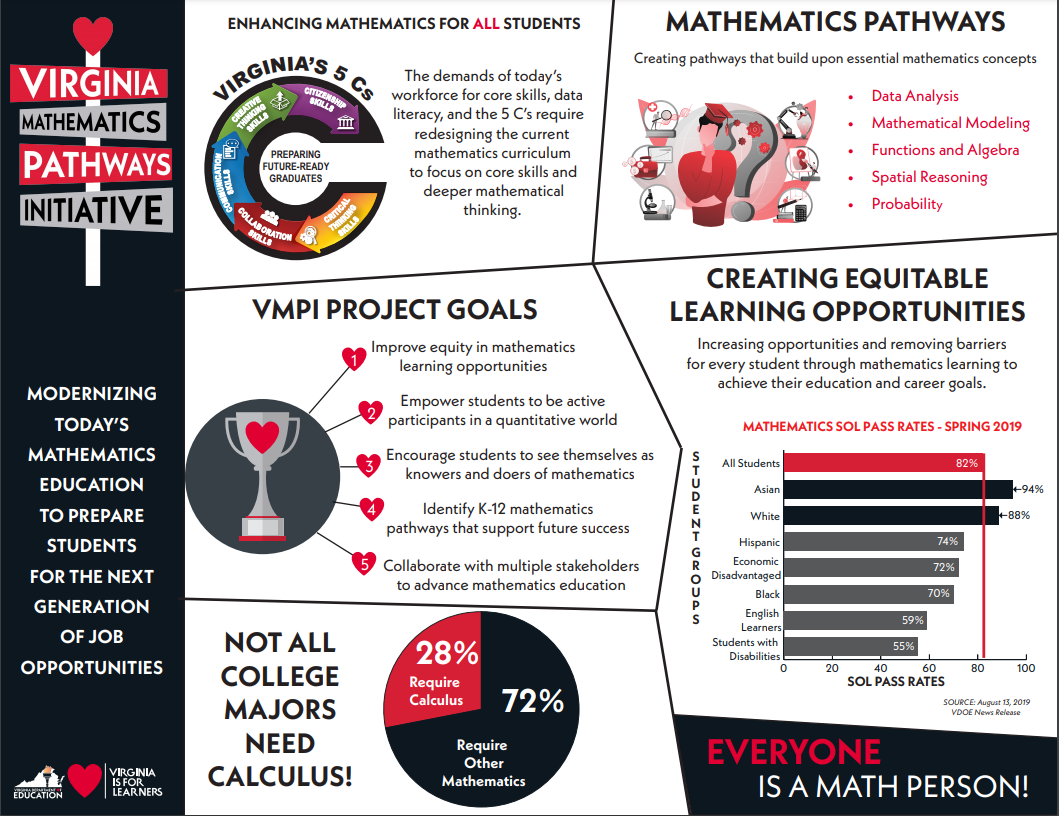
See the chart at this link to see what VMPI was REALLY about, including:

“Not all college majors need calculus !” (direct quote).

Obviously, calculus can and should be de-emphasized or mostly eliminated, through VMPI.


Here is the source: WTOP:


https://wtop.com/virginia/2021/04/virginia-plans-to-improve-equity-and-learning-opportunities-through-high-school-mathematics/


They wanted to ADD options that are more relevant for non-STEM majors. They weren’t eliminating calculus.


Anonymous
Calculus could always be offered. You can offer any course. The key question is whether students are prepared to do well in a course. By watering down content to only big ideas in VMPI's Grade 8-10 courses, most Algebra 2 and Precalculus content would have been compacted into one year. This would have undermined students' preparation for calculus.
Anonymous
Anonymous wrote:Calculus could always be offered. You can offer any course. The key question is whether students are prepared to do well in a course. By watering down content to only big ideas in VMPI's Grade 8-10 courses, most Algebra 2 and Precalculus content would have been compacted into one year. This would have undermined students' preparation for calculus.


They have pre-calculus broken out as a separate class.

And these are just examples, each school district would continue to define their own course offerings as they do today.

Today, there isn’t even a VA standard for precalculus and yet many districts offer it. The standards are the minimum skills that should be taught; they aren’t limiting.
Anonymous
Anonymous wrote:
Anonymous wrote:
Anonymous wrote:
Anonymous wrote:
Anonymous wrote:Even after the VA secretary of education clearly stated that school districts could continue to define their own classes (incl adv/accel) to meet the needs of their students, as they always have been able to do, RWNJs continued to push the boogeyman narrative.

VDOE told you they weren’t doing it. And it’s not something they could just sneak in there with such an open, public process that requires GA/gov approval.

Totally irrational.

getting tired of RWNJs, and LWNJs like yourself constantly yapping about each other. Why dont you all get in a cage and settle it with a spar?


The post is about equitable access to advanced math. This is what VMPI and similar proposals around the country are aboiut. OP is going the other way and saying minorities need to be placed in even more advanced classes, while most equity proposals involve reducing access for everyone. One of the links on VMPI's website, ""Eliminate tracking systems that sort children based on perceived ability and demographic profile."
Therefore, the goal of detracking will not be realized without working to dismantle the various social, political, and cultural reasons tracking persists. Those that have been privileged by the current system must be willing to
give up that privilege for more equitable schooling."


See the chart at this link to see what VMPI was REALLY about, including:

“Not all college majors need calculus !” (direct quote).

Obviously, calculus can and should be de-emphasized or mostly eliminated, through VMPI.


Here is the source: WTOP:


https://wtop.com/virginia/2021/04/virginia-plans-to-improve-equity-and-learning-opportunities-through-high-school-mathematics/


They wanted to ADD options that are more relevant for non-STEM majors. They weren’t eliminating calculus.


I am pretty sure that most schools had the classes that were being added.

What they were doing was blending courses, so there wouldn't be Algebra and Geometry but whatever they were calling the class. I guess Essential Math 1 and 2.

Nothing in their graphic explained that Essential Math 1 and 2 where this blended Algebra Geometry concept, which was confusing. I remember watching a video where the students spent a good amount of time complaining about how hard Tri, Precalculus and Calculus were. Then they had FCPS Alumni who were in college talking about how they never used those classes and how those classes had been a waste of time. All to introduce these "new" math classes that were more practical. All of which ignored that there were already stats classes and classes that were meant to be more practical math usage.

They were also removing the Advanced Math option in ES and the ability to take the grade 9 and 10 math, traditionally Algebra and Geometry, in 7th and 8th grade.

Essentially, they did a crap job of explaining that Algebra and Geometry were still being taught, just in a different manner. The videos I saw sure made it sound like the approach was being taken because 1) math was hard 2) higher level math was useless. Finally, they were clearly eliminating the Advanced Math path in ES which meant that kids who were already bored in Advanced Math would be even more bored in the new program.

I remember looking over the material that they had on the website, watching the videos they posted, and being shocked enough at how it was being presented that I wrote to all the candidates and said that I would not vote for anyone supporting this change. They did a lousey job with their marketing.
Anonymous
Anonymous wrote:
Anonymous wrote:Calculus could always be offered. You can offer any course. The key question is whether students are prepared to do well in a course. By watering down content to only big ideas in VMPI's Grade 8-10 courses, most Algebra 2 and Precalculus content would have been compacted into one year. This would have undermined students' preparation for calculus.


They have pre-calculus broken out as a separate class.

And these are just examples, each school district would continue to define their own course offerings as they do today.

Today, there isn’t even a VA standard for precalculus and yet many districts offer it. The standards are the minimum skills that should be taught; they aren’t limiting.

VMPI offered a one semester course on Trig and a one semester course Pre-Calculus: Focus on Functions that were to be taken the same year. That is where nearly all of Algebra 2 content (with its functions emphasis) would have been housed. In that regard, it would have been like San Francisco's compacted Algebra 2 and Precalculus course that failed so many kids.

In practice, VMPI's Grade 8-10 courses would have covered pared-down Prealgebra, Algebra 1, and Geometry content plus data analysis content, with just a pinch of Algebra 2 thrown in so they could claim Algebra 2 was included.
Anonymous
Anonymous wrote:The Title 1 and near Title 1 schools have more money spent on each kid then the UMC schools do because they have smaller class sizes and more resource specialists who push intot he classrooms. Why? To try and counter the fact that the kids show up at school not knowing their letters, sounds, numbrs, colors, and shapes. Fewer will qualify for Algebra 1 in 7th grade because they are starting school a year to two years behind MC and UMC kids.

Title 1 school in Loudoun has a 6th grader taking algebra. Administration is not particularly supportive. One student wanted to run a math club, and they wouldn't identify this student or notify about the club, or send home flyers to all the students.
Anonymous
Anonymous wrote:
Anonymous wrote:The Title 1 and near Title 1 schools have more money spent on each kid then the UMC schools do because they have smaller class sizes and more resource specialists who push intot he classrooms. Why? To try and counter the fact that the kids show up at school not knowing their letters, sounds, numbrs, colors, and shapes. Fewer will qualify for Algebra 1 in 7th grade because they are starting school a year to two years behind MC and UMC kids.

Title 1 school in Loudoun has a 6th grader taking algebra. Administration is not particularly supportive. One student wanted to run a math club, and they wouldn't identify this student or notify about the club, or send home flyers to all the students.


Normally there is a process for forming a club. I know that Loudoun treats 6th grade as MS, the student probably needs to figure out how to get a club started at the school and do that. I know kids who started clubs in MS in FCPS. I am sure that is a lot for a 6th grader to think about but it is probably possible.

Overall it sounds like the MS has made a path for the kid who needed Algebra 1 in 6th grade, even if they were not supportive. That is good. Only 30 6th graders were taking Algebra 1 in 6th grade in Loudoun so it is not a huge number. It sounds like the process is working better in Loudoun County then it does in FCPS.
Anonymous
Anonymous wrote:
Anonymous wrote:
Anonymous wrote:
Anonymous wrote:
Anonymous wrote:
Anonymous wrote:Even after the VA secretary of education clearly stated that school districts could continue to define their own classes (incl adv/accel) to meet the needs of their students, as they always have been able to do, RWNJs continued to push the boogeyman narrative.

VDOE told you they weren’t doing it. And it’s not something they could just sneak in there with such an open, public process that requires GA/gov approval.

Totally irrational.

getting tired of RWNJs, and LWNJs like yourself constantly yapping about each other. Why dont you all get in a cage and settle it with a spar?


The post is about equitable access to advanced math. This is what VMPI and similar proposals around the country are aboiut. OP is going the other way and saying minorities need to be placed in even more advanced classes, while most equity proposals involve reducing access for everyone. One of the links on VMPI's website, ""Eliminate tracking systems that sort children based on perceived ability and demographic profile."
Therefore, the goal of detracking will not be realized without working to dismantle the various social, political, and cultural reasons tracking persists. Those that have been privileged by the current system must be willing to
give up that privilege for more equitable schooling."


See the chart at this link to see what VMPI was REALLY about, including:

“Not all college majors need calculus !” (direct quote).

Obviously, calculus can and should be de-emphasized or mostly eliminated, through VMPI.


Here is the source: WTOP:


https://wtop.com/virginia/2021/04/virginia-plans-to-improve-equity-and-learning-opportunities-through-high-school-mathematics/


They wanted to ADD options that are more relevant for non-STEM majors. They weren’t eliminating calculus.


I am pretty sure that most schools had the classes that were being added.

What they were doing was blending courses, so there wouldn't be Algebra and Geometry but whatever they were calling the class. I guess Essential Math 1 and 2.

Nothing in their graphic explained that Essential Math 1 and 2 where this blended Algebra Geometry concept, which was confusing. I remember watching a video where the students spent a good amount of time complaining about how hard Tri, Precalculus and Calculus were. Then they had FCPS Alumni who were in college talking about how they never used those classes and how those classes had been a waste of time. All to introduce these "new" math classes that were more practical. All of which ignored that there were already stats classes and classes that were meant to be more practical math usage.

They were also removing the Advanced Math option in ES and the ability to take the grade 9 and 10 math, traditionally Algebra and Geometry, in 7th and 8th grade.

Essentially, they did a crap job of explaining that Algebra and Geometry were still being taught, just in a different manner. The videos I saw sure made it sound like the approach was being taken because 1) math was hard 2) higher level math was useless. Finally, they were clearly eliminating the Advanced Math path in ES which meant that kids who were already bored in Advanced Math would be even more bored in the new program.

I remember looking over the material that they had on the website, watching the videos they posted, and being shocked enough at how it was being presented that I wrote to all the candidates and said that I would not vote for anyone supporting this change. They did a lousey job with their marketing.


I guess so since you completely misunderstood/misrepresented it.

Anonymous
Anonymous wrote:
Anonymous wrote:
Anonymous wrote:
Anonymous wrote:
Anonymous wrote:
Anonymous wrote:
Anonymous wrote:
Anonymous wrote:
Anonymous wrote:
Anonymous wrote:
Anonymous wrote:

People may not realize this, but only 5 or 6 AAP centers allow kids to skip up to 6th grade AAP math while in 5th. If your kid doesn't attend one of those centers, you're out of luck.


Which AAP centers allow it, if you don't mind sharing?


Oops. It's actually more than 6.
This tool shows all of the schools that have had a 6th grader take the Algebra I SOL. Scroll to the bottom to see the results.
https://p1pe.doe.virginia.gov/apex/f?p=152:1:6962235569602:SHOW_REPORT::::

If your kid attends one of the listed schools, then your school participates in the FCPS 6th grade Algebra path. If it isn't listed, then either they haven't had a single student from 2018-2023 meet the criteria, or the school doesn't participate.

Settings for this: Select school years 2022-2023, 2021-2022, 2020-2021, 2018-2019.
Report level: School
Division: fairfax county
Grade: 6
Subject area: Mathematics
Test Algebra I

Leave everything else on default, and then hit submit. Eventually, the bottom of the page will show all of the schools that had a student take the Algebra I SOL in 6th.


Looking at the State-wide numbers, the pass rate for 6th graders in Algebra 1 is over 98.5% for all of past two decades, and 100% more than half of the those years. Clear evidence that the 6th graders allowed by their respective systems into the class are more than capable of taking on Algebra 1.

The same cannot be said of 8th grader who waited and then enrolled in Algebra 1, with 10 to 12% failing the basic SOL.


FTFY.

So the only argument you could possibly be legitimately making from this evidence is that FCPS should be only as restrictive as the least restrictive system in Virginia that allows 6th graders to take Algebra 1. Since no system is open enrollment, you cannot be making the OP's argument, which was a fallacious connection between an article about advanced math in Texas and open enrollment for 6th graders into Algebra 1 Honors.

The entire point of original article and the title of this discussion is URM kids are being excluded from advanced math options that have proven to be overwhelmingly successful with 98% pass rate everywhere (including VA according to above data. ). An open enrollment with an option to step down increases the opportunities in advanced math for URM kids.

from article:
"We have seen our advanced math enrollment numbers for all demographics increase," McDaniel said. "But specifically with students of poverty and students of color, we have seen an increase in the number of students in advanced math tracks."


For the very last time, advanced math != Algebra 1 Honors in 6th grade.

advanced math == Algebra 1 Honors in 8th grade

you appear to be on an equity crusade to lower everyone's level of math enrollment. It is not working.

Advanced math means Algebra 1 in 6th grades, and Algebra 2 in 8th grades, with very high success rate as statewide SOL data shows. For the very last time, URM kids are excluded from this advanced path.


At first I was frustrated by this thread because the OP was so preposterous. Then I thought OP was trolling.

Now I find it hilarious. So thanks for the entertainment, OP. Good job.

for the privileged it may be hilarious and entertainment, but for us URMs it's our advancement. You might prefer that URMs remain as needing remedial assistance forever, but many of us have the skills to take on advanced math too, if not for the barriers to access. Frankly, in that state-wide SOL data indicating successful pass rates of 6th graders in Algebra 1, how many students are URM? How many URMs are being presented with these advanced math options? It is judgemental to imply URM students cannot take on advanced math, by saying everyone should slow down. Work on removing barriers, make advanced math default enrollment, and let students opt out.


Because some other kids did well in 6th grade algebra does not mean black kids will do well in 6th grade algebra. You are talking about a group of 40 kids, some of whom might be black, and using those 40 datapoints to claim that 2000 black kids should be enrolled in algebra in 6th grade. You say parents are not being informed or are not as capable of finding this info, so everyone should be included by default. If they are so uneducated, then how would parents know to remove their less capable kid from this class?
Perhaps you should advocate a more serious method of determining who should take algebra in 6th grade, or prealgebra in 6th grade. This prealgebra would be the advanced math that was being talked about in the Texas article.

How about you show some evidence of capable black students denied algebra in 6th grade, or 7th grade? Who are these kids that have met criteria but were denied?
I'm not doubting it bappened, for reasons stated previously, but you are pointing to other kids who did well in the class as evidence. What is your proof that those kids who did well were equally qualified to take 6th grade algebra and not extreme outliers?
Anonymous
Anonymous wrote:
Anonymous wrote:
Anonymous wrote:Calculus could always be offered. You can offer any course. The key question is whether students are prepared to do well in a course. By watering down content to only big ideas in VMPI's Grade 8-10 courses, most Algebra 2 and Precalculus content would have been compacted into one year. This would have undermined students' preparation for calculus.


They have pre-calculus broken out as a separate class.

And these are just examples, each school district would continue to define their own course offerings as they do today.

Today, there isn’t even a VA standard for precalculus and yet many districts offer it. The standards are the minimum skills that should be taught; they aren’t limiting.

VMPI offered a one semester course on Trig and a one semester course Pre-Calculus: Focus on Functions that were to be taken the same year. That is where nearly all of Algebra 2 content (with its functions emphasis) would have been housed. In that regard, it would have been like San Francisco's compacted Algebra 2 and Precalculus course that failed so many kids.

In practice, VMPI's Grade 8-10 courses would have covered pared-down Prealgebra, Algebra 1, and Geometry content plus data analysis content, with just a pinch of Algebra 2 thrown in so they could claim Algebra 2 was included.


That all needed to be hashed out and reviewed. They never had the chance to put out a proposal so you’re speculating.
Anonymous
Anonymous wrote:
Anonymous wrote:
Anonymous wrote:
Anonymous wrote:It’s ridiculous to extrapolate out that the entire state of VA would follow in the path of a single school district in CA.


They weren't following the school district. Both were following from common sources pushing detracking. They even had some of these sources on their website. And of course you support the same detracking.


Which is why the comparison is so misleading.

Alabama also followed the same source but didn’t implement tracking. Taking some recommendations from a source doesn’t mean following every single recommendation. Or forcing it so widely across a large, diverse state.

It was a low-priority topic of conversation. 98% of the discussion and 100% of the infographic was around expanding offerings/additional pathways and integrated math.

Alabama is one of the lowest performing states in math. Adopting NCTM proposals that reduce math rigor would not be as controversial against that backdrop.


Space program in Huntsville should have generated pushback.
Anonymous
Anonymous wrote:
Anonymous wrote:
Anonymous wrote:
Anonymous wrote:
Anonymous wrote:
Anonymous wrote:Even after the VA secretary of education clearly stated that school districts could continue to define their own classes (incl adv/accel) to meet the needs of their students, as they always have been able to do, RWNJs continued to push the boogeyman narrative.

VDOE told you they weren’t doing it. And it’s not something they could just sneak in there with such an open, public process that requires GA/gov approval.

Totally irrational.

getting tired of RWNJs, and LWNJs like yourself constantly yapping about each other. Why dont you all get in a cage and settle it with a spar?


The post is about equitable access to advanced math. This is what VMPI and similar proposals around the country are aboiut. OP is going the other way and saying minorities need to be placed in even more advanced classes, while most equity proposals involve reducing access for everyone. One of the links on VMPI's website, ""Eliminate tracking systems that sort children based on perceived ability and demographic profile."
Therefore, the goal of detracking will not be realized without working to dismantle the various social, political, and cultural reasons tracking persists. Those that have been privileged by the current system must be willing to
give up that privilege for more equitable schooling."


See the chart at this link to see what VMPI was REALLY about, including:

“Not all college majors need calculus !” (direct quote).

Obviously, calculus can and should be de-emphasized or mostly eliminated, through VMPI.


Here is the source: WTOP:


https://wtop.com/virginia/2021/04/virginia-plans-to-improve-equity-and-learning-opportunities-through-high-school-mathematics/


They wanted to ADD options that are more relevant for non-STEM majors. They weren’t eliminating calculus.


I am pretty sure that most schools had the classes that were being added.

What they were doing was blending courses, so there wouldn't be Algebra and Geometry but whatever they were calling the class. I guess Essential Math 1 and 2.

Nothing in their graphic explained that Essential Math 1 and 2 where this blended Algebra Geometry concept, which was confusing. I remember watching a video where the students spent a good amount of time complaining about how hard Tri, Precalculus and Calculus were. Then they had FCPS Alumni who were in college talking about how they never used those classes and how those classes had been a waste of time. All to introduce these "new" math classes that were more practical. All of which ignored that there were already stats classes and classes that were meant to be more practical math usage.

They were also removing the Advanced Math option in ES and the ability to take the grade 9 and 10 math, traditionally Algebra and Geometry, in 7th and 8th grade.

Essentially, they did a crap job of explaining that Algebra and Geometry were still being taught, just in a different manner. The videos I saw sure made it sound like the approach was being taken because 1) math was hard 2) higher level math was useless. Finally, they were clearly eliminating the Advanced Math path in ES which meant that kids who were already bored in Advanced Math would be even more bored in the new program.

I remember looking over the material that they had on the website, watching the videos they posted, and being shocked enough at how it was being presented that I wrote to all the candidates and said that I would not vote for anyone supporting this change. They did a lousey job with their marketing.


They did a great job with the marketing. They managed to keep it a secret for over 6 months.
post reply Forum Index » Advanced Academic Programs (AAP)
Message Quick Reply
Go to: