
Florida bans AP African-American Studies course from schools
![[Post New]](/jforum/templates/default/images/icon_minipost_new.gif)
Anonymous
DP: well it is quite stupid to have a person like that involved in developing a course on AA Studies. Now, if the course was titled How To Destroy A Country, then sure she sounds as an expert. |
Anonymous
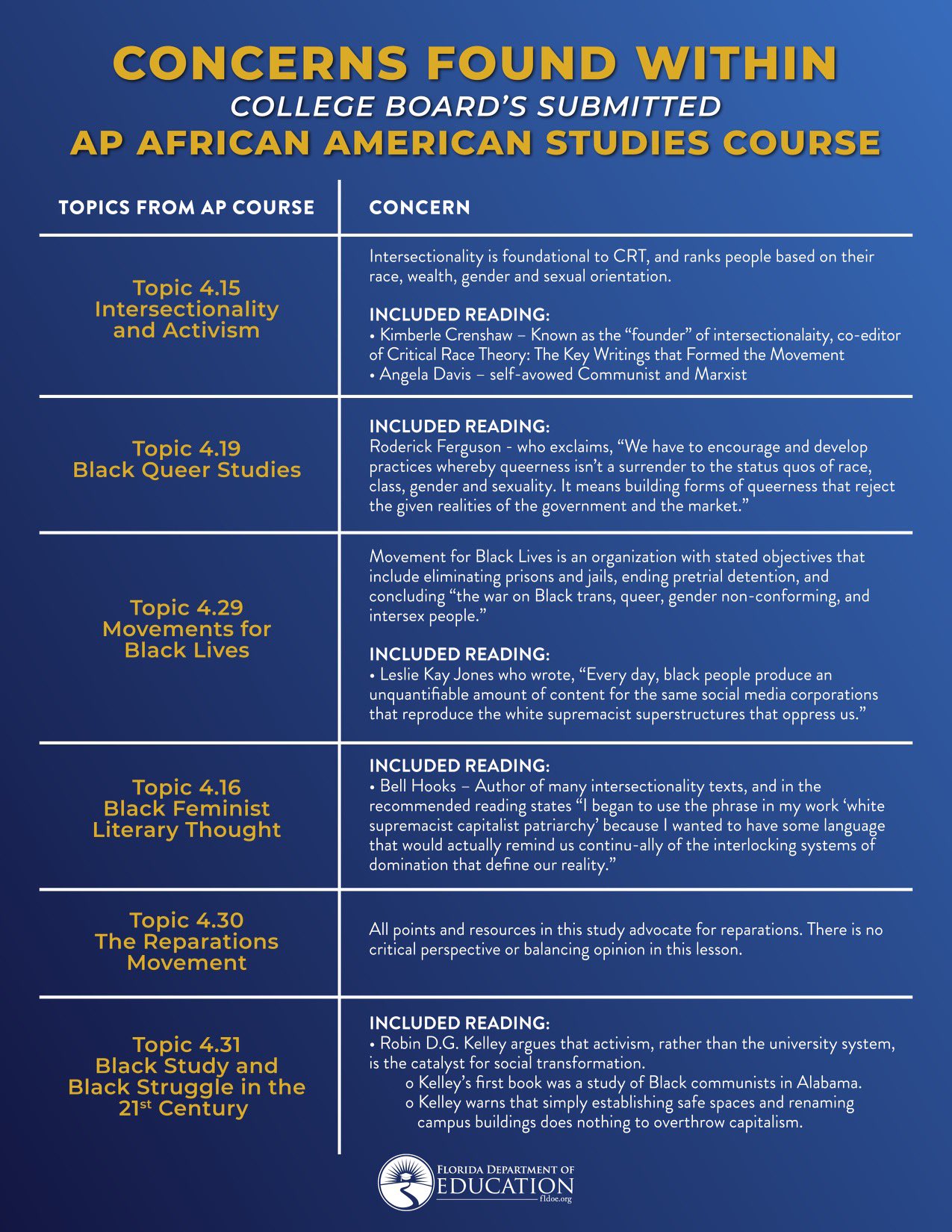
Where in the syllabus does it say there won’t be opposing views? |
Anonymous
She isn't involved, her material would be studied. As a PP mentioned, she is actually mentioned as worthy of study in Florida's own African American History standards. So I repeat the question. Are those topics to be banned from study now or what's your point? |
Anonymous
Not sure what your point is. A course that simply taught African history probably would have been fine. |
Anonymous
|
In high school in college in the late 1980s in the Midwest, the course titles included:
Western Civilization (known as Western Civ I and II) American History World History American Literature British Literature World Literature English Literature Starting freshman year, we read one Shakespeare play every year. We usually went to the Repertory theatre to see the play performed live. We read actual novels, instead of edited and sometimes censored versions from anthologies. I don't remember reading much African American literature except during American lit. For American lit, we usually started with Hawthorn. We read a lot of Steinbeck and Hemingway. As a woman, we also didn't read much written by women. Edgar Allen Poe was my favorite author. I wasn't traumatized by the fact that women authors didn't have much of a presence or voice. I really enjoyed the writing of Maya Angelou. I thought of her as a writer of young adult fiction. When choosing contemporary authors, I read Atwood, Bloom, Hinton. Plenty of contemporary women authors were in the young adult fiction genre. I also read huge historical bodice ripper novels by Rosemary Rogers. One of my favorite contemporary authors at the time was Sidney Sheldon. |
Anonymous
Lol Virginia comes in at #4. |
Anonymous
Not sure why that would seem odd. Virginia benefits from proximity to DC, the most educated big city in the country. |
Anonymous
My point was that a PP accused people on this thread of equating African American History with African History when no one on this thread was doing that. Sorry for being so cryptic. |
Anonymous
|
It’s official- DeSantis is the Klan governor.
We need the national guard to take over the Florida school system, and install professional educators. |
Anonymous
It isn't a matter of being traumatized, it is a matter of broadening the scope of the pantheon of experiences being offered to high school students. Not everything is a straight white male, so reading experiences from a variety of people, genders and perspectives opens eyes to the broader world we live in. Why is that a bad thing? |
Anonymous
| I always thought the purpose of school work and school courses and earning credit, is really to guide young adults to learn. Most teens won't pick up a Shakespeare play on their own. They can't or won't read Beowulf or Canterbury Tales on their own. What language are we using now to communicate? English language and literature is the standard. Call me old school. I would argue education robs children and young adults of competing on an even playing field when schools across the country aren't following a similar curriculum. That curriculum should be challenging. The books should be difficult for the students to read on their own. That's the point of being in school. |
Anonymous
Not following how this ties into the ap African American history course. |
Anonymous
It's official- you're a crazy and clueless clown. Thanks for making it so obvious. |
Anonymous
I would expect that to be a straight forward course of original text and novels based on historical facts. Frederick Douglas. Harriet Tubman. Richard Wright. Malcolm X. But that looks a lot American history and American literature, does it not? If it's for AP credit, it better be challenging and difficult. |
Anonymous
“Young adult fiction?” That’s…interesting. While I, personally, would like a more inclusive and diverse representation in American literature and history courses, there’s a danger, too, in exposing people to literature and expecting an age appropriate critical understanding and discussion - when the readers have had little exposure to the historical contexts that they’re reading about in literature. * I’m curious though. I’ve read quite a few of Angelou’s books, but somehow managed to miss reading any of her fiction. Would you be willing to mention exactly what book(s) your class read? |