
Christians are 'most persecuted group'

Anonymous
Anonymous wrote:I still don’t understand what atheists are doing in the religion forum. Their motives for being here are disingenuous at best.


They may have a lot of experience with Christians “martyrs” so “most persecuted group” catches their eye on recent topics...hypothetically.

IMO Jeff should remove Religion posts from Recent Topics.

Anonymous
Anonymous wrote:
Anonymous wrote:
Anonymous wrote:
Anonymous wrote:
Anonymous wrote:

So often, what's in the gospels is a matter of interpretation -- not knowledge. Different denominations see things different ways, or sometimes even within a denomination, there are different interpretations.or interpretations change over time (e.g., using the Bible to condone slavery). The survey wasn't measuring any of that -- it was measuring empirical knowledge -- e.g., the names of the 4 gospels, What is the ascension? the assumption?


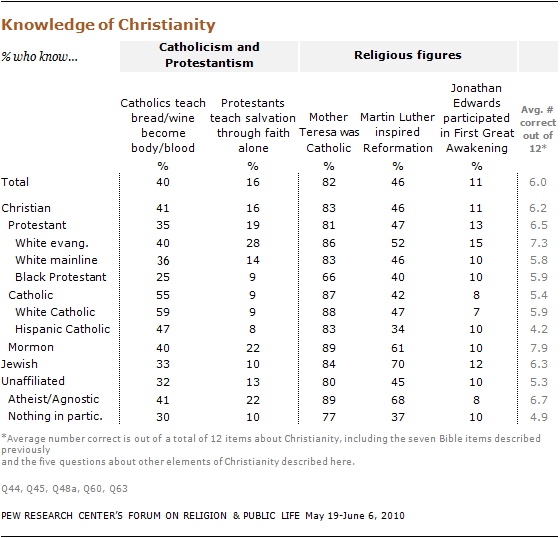
The Pew survey didn’t ask about the ascension or the assumption. It asked a total of 5 questions about Christianity, of which 3 concerned leading figures in the religion— Mother Theresa (was she Catholic, Protestant, Jewish, Buddhist, or Hindu?), Martin Luther (who inspired the Reformation?) and Jonathan Edwards (who preached during the Great Awakening?). Nothing, nada, zip, zilch asking what the Reformation or Great Awakening were all about.


In other words, it was measuring empirical knowledge, for example (e.g.,)-- only things that were facts, like the examples above (names attributed to the 4 gospels and names for the beliefs that Jesus and Mary went bodily into heavan.

What your above example tells me is that more atheists, Mormons and Jews knew who Christian figures were than Christians did.


Actually, the Pew write-up pp linked to says atheists, Mormons and Jews did better than Christians when asked the full range of questions about *all* religions. (Which religion aims at Nirvana? Is Ramadan Islam’s holy month, the Hindu festival of lights, or the Jewish day of atonement?)

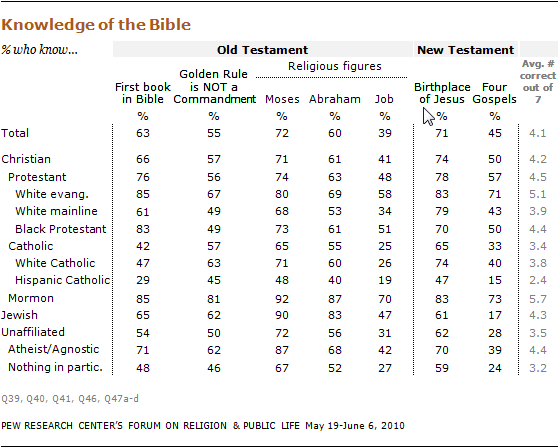
On the Christian questions specifically, the Mormons and Evangelicals knew the most. For example, 73% of Mormons and 71% of evangelicals could name all four gospels, compared to 39% of atheists and just 17% of Jews.

Your misunderstanding here is understandable, though. It’s a direct result of atheist pp’s suggestion that the survey “data” supposedly show atheists know more about Christianity than Christians do. No, the survey didn’t find that, and Pew’s write-up actually says the opposite.

But honestly, knowing who Martin Luther was is pretty insignificant compared to understanding his theology and how that translated into other Protestant theologies. Or the message in the four gospels. None of which was asked.


PP did NOT say that or suggest that. Despite your continued butthurt.

I find it pretty interesting how Christians fared on basic knowledge of other religions...


Stop lying. Atheist PPs DID say this. The poster at 16:10, right above, says EXACTLY this in her last paragraph.
Anonymous
Anonymous wrote:
Anonymous wrote:
Anonymous wrote:
Anonymous wrote:
Anonymous wrote:
Anonymous wrote:

So often, what's in the gospels is a matter of interpretation -- not knowledge. Different denominations see things different ways, or sometimes even within a denomination, there are different interpretations.or interpretations change over time (e.g., using the Bible to condone slavery). The survey wasn't measuring any of that -- it was measuring empirical knowledge -- e.g., the names of the 4 gospels, What is the ascension? the assumption?


The Pew survey didn’t ask about the ascension or the assumption. It asked a total of 5 questions about Christianity, of which 3 concerned leading figures in the religion— Mother Theresa (was she Catholic, Protestant, Jewish, Buddhist, or Hindu?), Martin Luther (who inspired the Reformation?) and Jonathan Edwards (who preached during the Great Awakening?). Nothing, nada, zip, zilch asking what the Reformation or Great Awakening were all about.


In other words, it was measuring empirical knowledge, for example (e.g.,)-- only things that were facts, like the examples above (names attributed to the 4 gospels and names for the beliefs that Jesus and Mary went bodily into heavan.

What your above example tells me is that more atheists, Mormons and Jews knew who Christian figures were than Christians did.


Actually, the Pew write-up pp linked to says atheists, Mormons and Jews did better than Christians when asked the full range of questions about *all* religions. (Which religion aims at Nirvana? Is Ramadan Islam’s holy month, the Hindu festival of lights, or the Jewish day of atonement?)

On the Christian questions specifically, the Mormons and Evangelicals knew the most. For example, 73% of Mormons and 71% of evangelicals could name all four gospels, compared to 39% of atheists and just 17% of Jews.

Your misunderstanding here is understandable, though. It’s a direct result of atheist pp’s suggestion that the survey “data” supposedly show atheists know more about Christianity than Christians do. No, the survey didn’t find that, and Pew’s write-up actually says the opposite.

But honestly, knowing who Martin Luther was is pretty insignificant compared to understanding his theology and how that translated into other Protestant theologies. Or the message in the four gospels. None of which was asked.


PP did NOT say that or suggest that. Despite your continued butthurt.

I find it pretty interesting how Christians fared on basic knowledge of other religions...


Stop lying. Atheist PPs DID say this. The poster at 16:10, right above, says EXACTLY this in her last paragraph.


I was referring to the PP who posted the survey.

Anonymous
Anonymous wrote:Let’s make your deception clear by truncating the long passages and getting right to the point.

Anonymous wrote:
pp DID not "misrepresent" the data.

Also the only arguments against that data have been unsupported generalizations.


Unsupported? PP provided actual questions from the survey asking, for example, where Jesus was born and when the Jewish sabbath starts.

This is hugely better than “pp” (aka you?) trying to claim this extremely general survey represents “actual data” (per 20:19) about how much atheists know about religion.

Do you have an honest bone in your body?


Atheists have no need to be dishonest about religion. They have rejected it, often after a lot of personal experience with it and a lot of study
Anonymous
Anonymous wrote:
Anonymous wrote:Let’s make your deception clear by truncating the long passages and getting right to the point.

Anonymous wrote:
pp DID not "misrepresent" the data.

Also the only arguments against that data have been unsupported generalizations.


Unsupported? PP provided actual questions from the survey asking, for example, where Jesus was born and when the Jewish sabbath starts.

This is hugely better than “pp” (aka you?) trying to claim this extremely general survey represents “actual data” (per 20:19) about how much atheists know about religion.

Do you have an honest bone in your body?


Atheists have no need to be dishonest about religion. They have rejected it, often after a lot of personal experience with it and a lot of study


And yet, as the Pew survey showed, less than half (40%) of atheists could even name the four gospels. This wasn’t even a test of what the gospels say. Sounds pretty ignorant to me.
Anonymous
Anonymous wrote:
Anonymous wrote:
Anonymous wrote:Let’s make your deception clear by truncating the long passages and getting right to the point.

Anonymous wrote:
pp DID not "misrepresent" the data.

Also the only arguments against that data have been unsupported generalizations.


Unsupported? PP provided actual questions from the survey asking, for example, where Jesus was born and when the Jewish sabbath starts.

This is hugely better than “pp” (aka you?) trying to claim this extremely general survey represents “actual data” (per 20:19) about how much atheists know about religion.

Do you have an honest bone in your body?


Atheists have no need to be dishonest about religion. They have rejected it, often after a lot of personal experience with it and a lot of study


And yet, as the Pew survey showed, less than half (40%) of atheists could even name the four gospels. This wasn’t even a test of what the gospels say. Sounds pretty ignorant to me.


But...atheists did better on the survey overall so...

Anonymous
Anonymous wrote:
Anonymous wrote:
Anonymous wrote:
Anonymous wrote:Let’s make your deception clear by truncating the long passages and getting right to the point.

Anonymous wrote:
pp DID not "misrepresent" the data.

Also the only arguments against that data have been unsupported generalizations.


Unsupported? PP provided actual questions from the survey asking, for example, where Jesus was born and when the Jewish sabbath starts.

This is hugely better than “pp” (aka you?) trying to claim this extremely general survey represents “actual data” (per 20:19) about how much atheists know about religion.

Do you have an honest bone in your body?


Atheists have no need to be dishonest about religion. They have rejected it, often after a lot of personal experience with it and a lot of study


And yet, as the Pew survey showed, less than half (40%) of atheists could even name the four gospels. This wasn’t even a test of what the gospels say. Sounds pretty ignorant to me.


But...atheists did better on the survey overall so...


Breadth over depth. Atheists told Pew they knew India is majority Hindu, Indonesia is majority Muslim, Mother Theresa was Catholic, and church and state are separate here in the US. This is middle school stuff. But when Pew asked atheists about the particulars of any given religion, like Christianity, then the atheists did much, much worse than actual adherents of that religion.

What’s your point, exactly? If you’re trying to build a case that atheists are qualified to debate theology with believers, and to tell believers what they’re “supposed” to believe (which you see atheists doing all the time here on DCUM), then the Pew results reject this hubris.

So....
Anonymous
Anonymous wrote:
Anonymous wrote:
Anonymous wrote:Let’s make your deception clear by truncating the long passages and getting right to the point.

Anonymous wrote:
pp DID not "misrepresent" the data.

Also the only arguments against that data have been unsupported generalizations.


Unsupported? PP provided actual questions from the survey asking, for example, where Jesus was born and when the Jewish sabbath starts.

This is hugely better than “pp” (aka you?) trying to claim this extremely general survey represents “actual data” (per 20:19) about how much atheists know about religion.

Do you have an honest bone in your body?


Atheists have no need to be dishonest about religion. They have rejected it, often after a lot of personal experience with it and a lot of study


And yet, as the Pew survey showed, less than half (40%) of atheists could even name the four gospels. This wasn’t even a test of what the gospels say. Sounds pretty ignorant to me.


More atheists (39) knew than Catholics (33).


Anonymous
Anonymous wrote:
Anonymous wrote:
Anonymous wrote:
Anonymous wrote:
Anonymous wrote:Let’s make your deception clear by truncating the long passages and getting right to the point.

Anonymous wrote:
pp DID not "misrepresent" the data.

Also the only arguments against that data have been unsupported generalizations.


Unsupported? PP provided actual questions from the survey asking, for example, where Jesus was born and when the Jewish sabbath starts.

This is hugely better than “pp” (aka you?) trying to claim this extremely general survey represents “actual data” (per 20:19) about how much atheists know about religion.

Do you have an honest bone in your body?


Atheists have no need to be dishonest about religion. They have rejected it, often after a lot of personal experience with it and a lot of study


And yet, as the Pew survey showed, less than half (40%) of atheists could even name the four gospels. This wasn’t even a test of what the gospels say. Sounds pretty ignorant to me.


But...atheists did better on the survey overall so...


Breadth over depth. Atheists told Pew they knew India is majority Hindu, Indonesia is majority Muslim, Mother Theresa was Catholic, and church and state are separate here in the US. This is middle school stuff. But when Pew asked atheists about the particulars of any given religion, like Christianity, then the atheists did much, much worse than actual adherents of that religion.

What’s your point, exactly? If you’re trying to build a case that atheists are qualified to debate theology with believers, and to tell believers what they’re “supposed” to believe (which you see atheists doing all the time here on DCUM), then the Pew results reject this hubris.

So....


Which question(s) did the atheists do “much, much worse” answering than Christians?

Anonymous
Anonymous wrote:
Anonymous wrote:
Anonymous wrote:
Anonymous wrote:Let’s make your deception clear by truncating the long passages and getting right to the point.

Anonymous wrote:
pp DID not "misrepresent" the data.

Also the only arguments against that data have been unsupported generalizations.


Unsupported? PP provided actual questions from the survey asking, for example, where Jesus was born and when the Jewish sabbath starts.

This is hugely better than “pp” (aka you?) trying to claim this extremely general survey represents “actual data” (per 20:19) about how much atheists know about religion.

Do you have an honest bone in your body?


Atheists have no need to be dishonest about religion. They have rejected it, often after a lot of personal experience with it and a lot of study


And yet, as the Pew survey showed, less than half (40%) of atheists could even name the four gospels. This wasn’t even a test of what the gospels say. Sounds pretty ignorant to me.


More atheists (39) knew than Catholics (33).


Why on earth are you limiting this to Catholics? Christians in general (50%) are better at naming the gospels than atheists (39%).
Anonymous
Anonymous wrote:
Anonymous wrote:
Anonymous wrote:
Anonymous wrote:
Anonymous wrote:Let’s make your deception clear by truncating the long passages and getting right to the point.

Anonymous wrote:
pp DID not "misrepresent" the data.

Also the only arguments against that data have been unsupported generalizations.


Unsupported? PP provided actual questions from the survey asking, for example, where Jesus was born and when the Jewish sabbath starts.

This is hugely better than “pp” (aka you?) trying to claim this extremely general survey represents “actual data” (per 20:19) about how much atheists know about religion.

Do you have an honest bone in your body?


Atheists have no need to be dishonest about religion. They have rejected it, often after a lot of personal experience with it and a lot of study


And yet, as the Pew survey showed, less than half (40%) of atheists could even name the four gospels. This wasn’t even a test of what the gospels say. Sounds pretty ignorant to me.


More atheists (39) knew than Catholics (33).


Why on earth are you limiting this to Catholics? Christians in general (50%) are better at naming the gospels than atheists (39%).

Atheists/agnostics had a higher number of correct answers than Christians overall. The last column on the right.
Anonymous
Anonymous wrote:I still don’t understand what atheists are doing in the religion forum. Their motives for being here are disingenuous at best.


No, you understand perfectly that atheism is a position on religion, and therefore completely appropriate for this forum.

What you won't admit is that you can't tolerate positions that differ from your own and would greatly prefer an echo chamber for your beliefs. That's not going to happen outside your church.
Anonymous
Anonymous wrote:
Anonymous wrote:I still don’t understand what atheists are doing in the religion forum. Their motives for being here are disingenuous at best.


No, you understand perfectly that atheism is a position on religion, and therefore completely appropriate for this forum.

What you won't admit is that you can't tolerate positions that differ from your own and would greatly prefer an echo chamber for your beliefs. That's not going to happen outside your church.


So you're saying it is now NOT a simple bit of info? I thought it was simply someone that held no belief or position on god? Isn't there page after page of that here? Are you telling me there is more to this?
Anonymous
Anonymous wrote:
Anonymous wrote:

Why on earth are you limiting this to Catholics? Christians in general (50%) are better at naming the gospels than atheists (39%).

Atheists/agnostics had a higher number of correct answers than Christians overall. The last column on the right.


Because atheists did better on Old Testament questions.

Atheists bombed the questions about the New Testament—the basis of Christian faith. Compare atheists’ score of 39% for naming the four gospels to 71% of evangelicals and 57% of Protestants. (I’m too am confused about why you’re choosing to cherry pick the subset of Catholics.)

You’ve also been told multiple times that this survey does not assess in-depth knowledge of any particular faith. The survey was never designed to do that, and you’re distorting it beyond recognition. These are extremely broad and shallow questions designed to assess broad knowledge of all faiths. The fact that 39% of atheists could name the four gospels says nothing about their knowledge of the message in the gospels. Some atheists may know that Ramadan is Islam’s holy month, but the survey never asked whether they know the five pillars of Islam. Some atheists may know that most South Indians are Hindu, but the survey didn’t ask if they know who Ganesh is. And so on and do on.

You’re distorting the survey beyond all recognition. You’re trying to make a general survey of broad knowledge into something it’s not, a survey of particular expertise in particular religions.
Anonymous
Anonymous wrote:
Anonymous wrote:
Anonymous wrote:

Why on earth are you limiting this to Catholics? Christians in general (50%) are better at naming the gospels than atheists (39%).

Atheists/agnostics had a higher number of correct answers than Christians overall. The last column on the right.


Because atheists did better on Old Testament questions.

Atheists bombed the questions about the New Testament—the basis of Christian faith. Compare atheists’ score of 39% for naming the four gospels to 71% of evangelicals and 57% of Protestants. (I’m too am confused about why you’re choosing to cherry pick the subset of Catholics.)

You’ve also been told multiple times that this survey does not assess in-depth knowledge of any particular faith. The survey was never designed to do that, and you’re distorting it beyond recognition. These are extremely broad and shallow questions designed to assess broad knowledge of all faiths. The fact that 39% of atheists could name the four gospels says nothing about their knowledge of the message in the gospels. Some atheists may know that Ramadan is Islam’s holy month, but the survey never asked whether they know the five pillars of Islam. Some atheists may know that most South Indians are Hindu, but the survey didn’t ask if they know who Ganesh is. And so on and do on.

You’re distorting the survey beyond all recognition. You’re trying to make a general survey of broad knowledge into something it’s not, a survey of particular expertise in particular religions.


There are multiple posters. I’m the PP who mentioned the Catholic’s score. Only because someone posted that the atheists/agnostics scored “much, much worse” than others which wasn’t true. Why are YOU cherry picking evangelicals and Protestants?

Yes, the survey looks at broad knowledge of religion. And atheists/agnostics scored well. Which was exactly how the survey was presented. Nothing more. Nothing is being distorted or misrepresented.

Here was quote from that survey PP again:
“Actually, research shows that on average, atheists know more about religion than religious people do. ”

And here is the first paragraph of the executive summary of the survey:
“Atheists and agnostics, Jews and Mormons are among the highest-scoring groups on a new survey of religious knowledge, outperforming evangelical Protestants, mainline Protestants and Catholics on questions about the core teachings, history and leading figures of major world religions.”


You seem very disturbed by the results of this survey. Why is that?


post reply Forum Index » Religion
Message Quick Reply
Go to: