Nate Silver: "Go to a state school"

Anonymous
Anonymous wrote:
Anonymous wrote:
Anonymous wrote:
Anonymous wrote:
Anonymous wrote:I can see people are upset because they have an investment, whether emotional, financial, or ideological, with the current modus operandi at most elite colleges so they are bitterly resistant to the changing realities surrounding elite higher education these days despite that Silver cites data showing significant shift in public perspectives on higher education and elite higher education.

This is what people thought of a freshly minted Harvard graduate in 1994: highly accomplished and brainy nerd.

This is what many people now think when they encounter a freshly minted Harvard graduate in 2024: Either a legacy admit from an extremely connected and / or wealthy family (nepotism) or a mollycoddled diversity admit benefiting from a system that rewards identity over merit. And both will bring the same increasingly annoying social justice warrior outlook largely divorced from reality.

Silver is not a right wing MAGAtard, he is a Democrat and sold his polling business to the NYT. But like a lot of very intelligent nerds, Silver doesn't shy away from frankness.


You are an idiot. The minority students at Harvard etc have near perfect test scores and/or grades. The average student now is miles ahead of the 1994 student in terms of academic indicators. Same with the wealthy kids; at the top schools everyone has the scores that's why they add other factors to select.

what no?


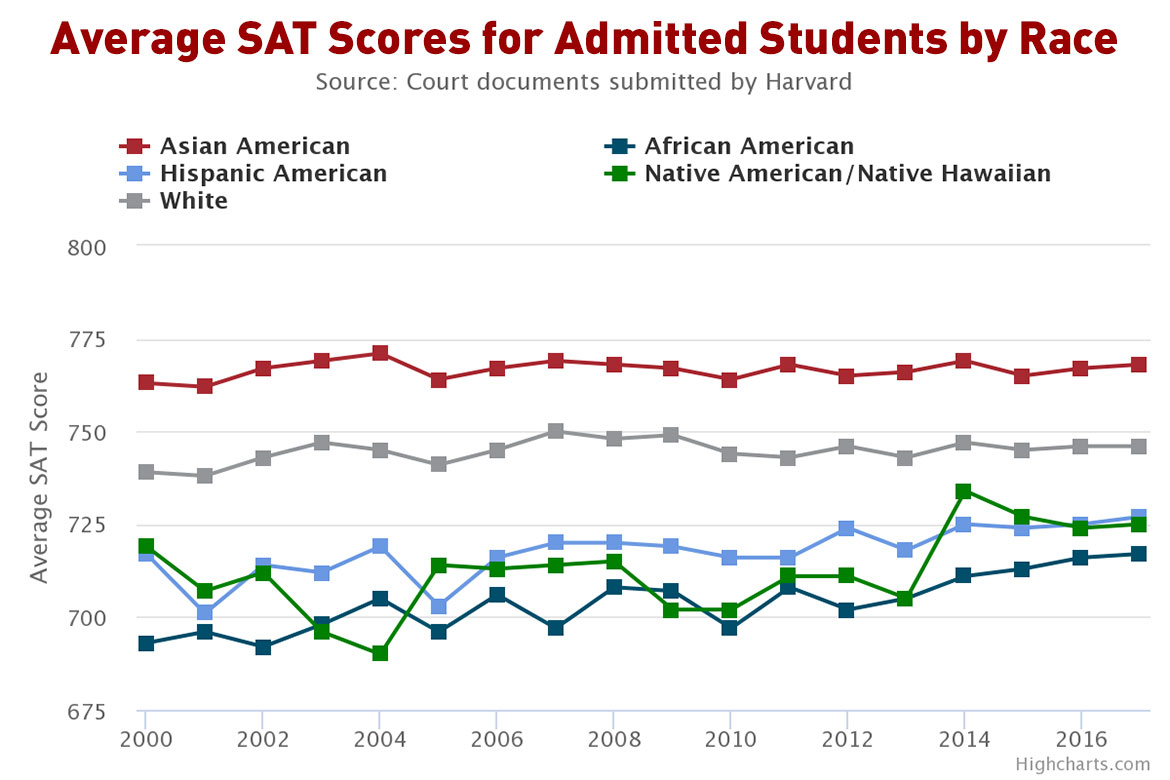
Let me school you a bit. Go to your chart. Check the X axis. The scale of the chart is designed to make it seem as if there are big differences amongst the scores, but the average score for all races is some form of 700. At Harvard, they taught us (even the minorities) how to discern lies backed by stats and charts.


NP--Exactly. The difference between the average score for those of Asian descent (around 770) and those of African descent (around 720) is the difference between the 99th percentile and the 98th percentile. Even Mensa takes the top 2%.

I bet if you show both sections of the SAT, the difference would be wider.
Anonymous
The University of Michigan's reputation is in part due to Detroit?

UIUC is over two hours from Chicago. UVA is over two hours from DC. For UNC, are you calling Raleigh/Durham a major metro area?
Anonymous
Anonymous wrote:The University of Michigan's reputation is in part due to Detroit?

UIUC is over two hours from Chicago. UVA is over two hours from DC. For UNC, are you calling Raleigh/Durham a major metro area?


Yes, Detroit is very famous for being a iconic college town and the home of the University of Michigan.
Anonymous
Anonymous wrote:
Anonymous wrote:
Anonymous wrote:
Anonymous wrote:
Anonymous wrote:
Anonymous wrote:I can see people are upset because they have an investment, whether emotional, financial, or ideological, with the current modus operandi at most elite colleges so they are bitterly resistant to the changing realities surrounding elite higher education these days despite that Silver cites data showing significant shift in public perspectives on higher education and elite higher education.

This is what people thought of a freshly minted Harvard graduate in 1994: highly accomplished and brainy nerd.

This is what many people now think when they encounter a freshly minted Harvard graduate in 2024: Either a legacy admit from an extremely connected and / or wealthy family (nepotism) or a mollycoddled diversity admit benefiting from a system that rewards identity over merit. And both will bring the same increasingly annoying social justice warrior outlook largely divorced from reality.

Silver is not a right wing MAGAtard, he is a Democrat and sold his polling business to the NYT. But like a lot of very intelligent nerds, Silver doesn't shy away from frankness.


You are an idiot. The minority students at Harvard etc have near perfect test scores and/or grades. The average student now is miles ahead of the 1994 student in terms of academic indicators. Same with the wealthy kids; at the top schools everyone has the scores that's why they add other factors to select.

what no?


Let me school you a bit. Go to your chart. Check the X axis. The scale of the chart is designed to make it seem as if there are big differences amongst the scores, but the average score for all races is some form of 700. At Harvard, they taught us (even the minorities) how to discern lies backed by stats and charts.


NP--Exactly. The difference between the average score for those of Asian descent (around 770) and those of African descent (around 720) is the difference between the 99th percentile and the 98th percentile. Even Mensa takes the top 2%.

I bet if you show both sections of the SAT, the difference would be wider.

Both would still be 95th percentile and above.
Anonymous
Anonymous wrote:
Anonymous wrote:
Anonymous wrote:Nate isn't saying "go to a top flight state school only when it's in-state and costs way less."


And nobody is saying that he did say that. He did say his argument against Ivies applies most to situations where a student has access to a strong public at a lower cost than the Ivy. That is what the word "especially" means

And what's unspoken in the article is the exact extent to which the argument applies where a student's only strong public option is out-of-state.


It sounds like you are looking for Nate Silver to tell you exactly where to send your child to college. I don't think that's the purpose of this blog post. I think he assumes you can think for yourself and he is offering his thoughts on factors to consider such as cost and the reputation of Ivies in specific industries.
Anonymous
Anonymous wrote:
Anonymous wrote:
Anonymous wrote:
Anonymous wrote:
Anonymous wrote:I can see people are upset because they have an investment, whether emotional, financial, or ideological, with the current modus operandi at most elite colleges so they are bitterly resistant to the changing realities surrounding elite higher education these days despite that Silver cites data showing significant shift in public perspectives on higher education and elite higher education.

This is what people thought of a freshly minted Harvard graduate in 1994: highly accomplished and brainy nerd.

This is what many people now think when they encounter a freshly minted Harvard graduate in 2024: Either a legacy admit from an extremely connected and / or wealthy family (nepotism) or a mollycoddled diversity admit benefiting from a system that rewards identity over merit. And both will bring the same increasingly annoying social justice warrior outlook largely divorced from reality.

Silver is not a right wing MAGAtard, he is a Democrat and sold his polling business to the NYT. But like a lot of very intelligent nerds, Silver doesn't shy away from frankness.


You are an idiot. The minority students at Harvard etc have near perfect test scores and/or grades. The average student now is miles ahead of the 1994 student in terms of academic indicators. Same with the wealthy kids; at the top schools everyone has the scores that's why they add other factors to select.

what no?


Let me school you a bit. Go to your chart. Check the X axis. The scale of the chart is designed to make it seem as if there are big differences amongst the scores, but the average score for all races is some form of 700. At Harvard, they taught us (even the minorities) how to discern lies backed by stats and charts.


NP--Exactly. The difference between the average score for those of Asian descent (around 770) and those of African descent (around 720) is the difference between the 99th percentile and the 98th percentile. Even Mensa takes the top 2%.


Citation needed for 98th percentile. The College Board’s most recent reporting has 1400 (two 700s) as being the top 7 percent of test takers, not the top 2. Top 7% is nowhere close to Harvard material IMO.
Anonymous
Anonymous wrote:
Anonymous wrote:
Anonymous wrote:DP Define "golden ticket"? Everyone wants different things. There certainly are fields where an Ivy league degree has a lot of cachet. But many people don't want to get into Big Law. For many people the "golden ticket" is interesting government work with a decent paycheck. Work life balance is so much more important than a lot of people realize until they have no time for their families.

You're telling us that statistically speaking "interesting government work with a decent paycheck" is desired by just as many people as BigLaw/management consulting/investment banking/quant firm/surgeon jobs?

Also it's way easier to downshift and obtain the rare jobs with good pay/work-life balance, than the other way around.


I don't know how many people desire one versus the other. Nobody I know wants any of the jobs you listed. I'm sure there are many people who do, but I think you are overestimating how many people want the. And it's actually not that easy to "downshift" when you have a lot of debt/don't have relevant experience. My interesting government job agency constantly turns down people trying to get out of law. We don't want people who are just trying to escape something else and have plenty of applicants that have a demonstrated interest and skills for what we do.


Maybe that is just your department or agency. My experience is that people put in time, pay down debt, and look forward to working in more interesting areas as opposed to serving clients. Lots of interest for folks with agency experience. Also know who did reverse: 5-15 in government, then flipped to private. Know folks who did both tracts.
Anonymous
Anonymous wrote:The College Board’s most recent reporting has 1400 (two 700s) as being the top 7 percent of test takers, not the top 2.

Why are you fixated on 1400 when the graph has every group above 700?
Anonymous
Anonymous wrote:
Anonymous wrote:
Anonymous wrote:
Anonymous wrote:DP Define "golden ticket"? Everyone wants different things. There certainly are fields where an Ivy league degree has a lot of cachet. But many people don't want to get into Big Law. For many people the "golden ticket" is interesting government work with a decent paycheck. Work life balance is so much more important than a lot of people realize until they have no time for their families.

You're telling us that statistically speaking "interesting government work with a decent paycheck" is desired by just as many people as BigLaw/management consulting/investment banking/quant firm/surgeon jobs?

Also it's way easier to downshift and obtain the rare jobs with good pay/work-life balance, than the other way around.


I don't know how many people desire one versus the other. Nobody I know wants any of the jobs you listed. I'm sure there are many people who do, but I think you are overestimating how many people want the. And it's actually not that easy to "downshift" when you have a lot of debt/don't have relevant experience. My interesting government job agency constantly turns down people trying to get out of law. We don't want people who are just trying to escape something else and have plenty of applicants that have a demonstrated interest and skills for what we do.


Maybe that is just your department or agency. My experience is that people put in time, pay down debt, and look forward to working in more interesting areas as opposed to serving clients. Lots of interest for folks with agency experience. Also know who did reverse: 5-15 in government, then flipped to private. Know folks who did both tracts.


Well the thing is there is a big wide world out there of different jobs. Working for Big Law or having a prestigious law degree opens some doors, but not all of them, and there is a cost. Not everyone wants to go into debt so they can work Big Law hours so they can pay down their debt so they can get the job they really want. And most people really don't need to do this.
Anonymous
Anonymous wrote:he is offering his thoughts on factors to consider such as cost and the reputation of Ivies in specific industries

Like these factors haven't already been discussed for years/decades on DCUM and every other college admissions message board?
Anonymous
Anonymous wrote:
Anonymous wrote:The College Board’s most recent reporting has 1400 (two 700s) as being the top 7 percent of test takers, not the top 2.

Why are you fixated on 1400 when the graph has every group above 700?


Because it looked to me like the chart presented was an average of both sub-tests; the percentiles at 700 are slightly different between math and verbal so I used the aggregate figure. Doesn’t matter much, in verbal 700 it’s top 7%, in math it’s top 9%. See generally:

https://reports.collegeboard.org/media/pdf/2023-total-group-sat-suite-of-assessments-annual-report%20ADA.pdf

Referenced figures on page 6.
Anonymous
Anonymous wrote:
Anonymous wrote:he is offering his thoughts on factors to consider such as cost and the reputation of Ivies in specific industries

Like these factors haven't already been discussed for years/decades on DCUM and every other college admissions message board?


I mean if it's not helpful to you that's fine but he isn't saying you should definitely send your child to the out of state public.
Anonymous
Anonymous wrote:The University of Michigan's reputation is in part due to Detroit?

UIUC is over two hours from Chicago. UVA is over two hours from DC. For UNC, are you calling Raleigh/Durham a major metro area?


The research triangle is absolutely a globally famous area. While UIUC is far, it is still the stage university of Chicago. Detroit, with GM, Ford, and Chrysler, absolutely is a global city. Really, Wisconsin is the only global state university to not have a real city in its state.
Anonymous
Anonymous wrote:Well the thing is there is a big wide world out there of different jobs. Working for Big Law or having a prestigious law degree opens some doors, but not all of them, and there is a cost. Not everyone wants to go into debt so they can work Big Law hours so they can pay down their debt so they can get the job they really want. And most people really don't need to do this.

You can also work at BigLaw long enough not just to pay down debt, but save enough money to be financially secure and then make the move (or even retire early).
Anonymous
Anonymous wrote:
Anonymous wrote:
Anonymous wrote:
Anonymous wrote:
Anonymous wrote:
Anonymous wrote:
Anonymous wrote:I can see people are upset because they have an investment, whether emotional, financial, or ideological, with the current modus operandi at most elite colleges so they are bitterly resistant to the changing realities surrounding elite higher education these days despite that Silver cites data showing significant shift in public perspectives on higher education and elite higher education.

This is what people thought of a freshly minted Harvard graduate in 1994: highly accomplished and brainy nerd.

This is what many people now think when they encounter a freshly minted Harvard graduate in 2024: Either a legacy admit from an extremely connected and / or wealthy family (nepotism) or a mollycoddled diversity admit benefiting from a system that rewards identity over merit. And both will bring the same increasingly annoying social justice warrior outlook largely divorced from reality.

Silver is not a right wing MAGAtard, he is a Democrat and sold his polling business to the NYT. But like a lot of very intelligent nerds, Silver doesn't shy away from frankness.


You are an idiot. The minority students at Harvard etc have near perfect test scores and/or grades. The average student now is miles ahead of the 1994 student in terms of academic indicators. Same with the wealthy kids; at the top schools everyone has the scores that's why they add other factors to select.

what no?


Let me school you a bit. Go to your chart. Check the X axis. The scale of the chart is designed to make it seem as if there are big differences amongst the scores, but the average score for all races is some form of 700. At Harvard, they taught us (even the minorities) how to discern lies backed by stats and charts.


NP--Exactly. The difference between the average score for those of Asian descent (around 770) and those of African descent (around 720) is the difference between the 99th percentile and the 98th percentile. Even Mensa takes the top 2%.

I bet if you show both sections of the SAT, the difference would be wider.

Both would still be 95th percentile and above.

1400 is very different than 1600
post reply Forum Index » College and University Discussion
Message Quick Reply
Go to: