
Why is ante bellum racist?

Anonymous
Anonymous wrote:This will be called trolling, but I'm trying to add to the conversation here. I grew up in CA and remember driving past the former internment camps in the 80s and wondering why they were ever "necessary" because I didn't see how the Asians around me could be harmful. They were (and continue to be) high achieving and hard working despite this history. What is it about Black culture still wears slavery as a mark of worthiness and value? That history only has relevance to an individual if they allow it to have relevance to who they are as a human today. It is a terrible period in history, but why does it continue to define individuals today in a way that Asians (or Irish, or Jewish or Egyptian or Greek...) don't?

It’s only trolling if people answer you thoughtfully and you shut down or mock in return.

The only other treatment of humans in America that rivals the way that Black people were treated in scope and depth is the Native American genocide, and for lots of Native Americans, that’s still an enormous part of their lives, too. But I’ll focus on Black people here.

It wasn’t just slavery. It was birthright slavery, slavery that people couldn’t get out of. Rarely people could save up to buy their own freedom or get freed via a will, but it wasn’t common. They were prevented from learning to read, they were prevented from worshipping freely. I just watched The Black Church: This is Our Story and in some places they weren’t even allowed to look skyward in prayer, lest they be checking the star position (and it was enforced by whipping). There were no protections for any enslaved person - no break from rape if that’s what the owner wanted, no break from anything, ever. They were used in medical experiments. If you’ve ever had gynecological surgery, thank the hapless Black victims of that doctor who operated on them without anesthesia under the belief that Black people were less than human and didn’t feel pain. Enslaved people literally built much of our nation, and they were definitely the engine that drove the economy, work for which they got nothing.

And it’s not like it quit with slaves being freed. The Ku Klux Klan terrorized Black people, torturing and murdering them, and it was frequently treated as a pleasant spectacle by white people who picnicked at lynchings - and stole “souvenirs” from the body. They were kept out of school, they were kept out of specific schools, they were kept in virtual slavery with the system of sharecropping. Redlining continued legally for decades. Systemic racism really does keep Black people in lower economic straits even to this day.

I’m not Black. I can read about this issue and understand it from that perspective, but I am not a descendant of slaves. It’s not personal for me. But it is still very much personal for those who are descended from enslaved people. It’s not the past. It’s the present.
Anonymous
Anonymous wrote:
Anonymous wrote:This will be called trolling, but I'm trying to add to the conversation here. I grew up in CA and remember driving past the former internment camps in the 80s and wondering why they were ever "necessary" because I didn't see how the Asians around me could be harmful. They were (and continue to be) high achieving and hard working despite this history. What is it about Black culture still wears slavery as a mark of worthiness and value? That history only has relevance to an individual if they allow it to have relevance to who they are as a human today. It is a terrible period in history, but why does it continue to define individuals today in a way that Asians (or Irish, or Jewish or Egyptian or Greek...) don't?

It’s only trolling if people answer you thoughtfully and you shut down or mock in return.

The only other treatment of humans in America that rivals the way that Black people were treated in scope and depth is the Native American genocide, and for lots of Native Americans, that’s still an enormous part of their lives, too. But I’ll focus on Black people here.

It wasn’t just slavery. It was birthright slavery, slavery that people couldn’t get out of. Rarely people could save up to buy their own freedom or get freed via a will, but it wasn’t common. They were prevented from learning to read, they were prevented from worshipping freely. I just watched The Black Church: This is Our Story and in some places they weren’t even allowed to look skyward in prayer, lest they be checking the star position (and it was enforced by whipping). There were no protections for any enslaved person - no break from rape if that’s what the owner wanted, no break from anything, ever. They were used in medical experiments. If you’ve ever had gynecological surgery, thank the hapless Black victims of that doctor who operated on them without anesthesia under the belief that Black people were less than human and didn’t feel pain. Enslaved people literally built much of our nation, and they were definitely the engine that drove the economy, work for which they got nothing.

And it’s not like it quit with slaves being freed. The Ku Klux Klan terrorized Black people, torturing and murdering them, and it was frequently treated as a pleasant spectacle by white people who picnicked at lynchings - and stole “souvenirs” from the body. They were kept out of school, they were kept out of specific schools, they were kept in virtual slavery with the system of sharecropping. Redlining continued legally for decades. Systemic racism really does keep Black people in lower economic straits even to this day.

I’m not Black. I can read about this issue and understand it from that perspective, but I am not a descendant of slaves. It’s not personal for me. But it is still very much personal for those who are descended from enslaved people. It’s not the past. It’s the present.


Black woman here. Excellent post.
Anonymous
Anonymous wrote:
Anonymous wrote:
Anonymous wrote:This will be called trolling, but I'm trying to add to the conversation here. I grew up in CA and remember driving past the former internment camps in the 80s and wondering why they were ever "necessary" because I didn't see how the Asians around me could be harmful. They were (and continue to be) high achieving and hard working despite this history. What is it about Black culture still wears slavery as a mark of worthiness and value? That history only has relevance to an individual if they allow it to have relevance to who they are as a human today. It is a terrible period in history, but why does it continue to define individuals today in a way that Asians (or Irish, or Jewish or Egyptian or Greek...) don't?

It’s only trolling if people answer you thoughtfully and you shut down or mock in return.

The only other treatment of humans in America that rivals the way that Black people were treated in scope and depth is the Native American genocide, and for lots of Native Americans, that’s still an enormous part of their lives, too. But I’ll focus on Black people here.

It wasn’t just slavery. It was birthright slavery, slavery that people couldn’t get out of. Rarely people could save up to buy their own freedom or get freed via a will, but it wasn’t common. They were prevented from learning to read, they were prevented from worshipping freely. I just watched The Black Church: This is Our Story and in some places they weren’t even allowed to look skyward in prayer, lest they be checking the star position (and it was enforced by whipping). There were no protections for any enslaved person - no break from rape if that’s what the owner wanted, no break from anything, ever. They were used in medical experiments. If you’ve ever had gynecological surgery, thank the hapless Black victims of that doctor who operated on them without anesthesia under the belief that Black people were less than human and didn’t feel pain. Enslaved people literally built much of our nation, and they were definitely the engine that drove the economy, work for which they got nothing.

And it’s not like it quit with slaves being freed. The Ku Klux Klan terrorized Black people, torturing and murdering them, and it was frequently treated as a pleasant spectacle by white people who picnicked at lynchings - and stole “souvenirs” from the body. They were kept out of school, they were kept out of specific schools, they were kept in virtual slavery with the system of sharecropping. Redlining continued legally for decades. Systemic racism really does keep Black people in lower economic straits even to this day.

I’m not Black. I can read about this issue and understand it from that perspective, but I am not a descendant of slaves. It’s not personal for me. But it is still very much personal for those who are descended from enslaved people. It’s not the past. It’s the present.


Black woman here. Excellent post.

Thanks. I really did spend the last almost year reading and watching and sitting with it.
- the White woman you’re replying to.
Anonymous
Anonymous wrote:
Anonymous wrote:
Anonymous wrote:I understand that asking this question invites all kinds of criticism. I am asking sincerely. Help me understand why wearing pretty dresses to a party is racist?

Thank you.


Because we (Americans) are still living with the fallout from that era. Your neighbors, your kids friends’ parents, your coworker you have coffee with - all these people’s lives (and yours) have been shaped by the “ideals” of that time. You cannot separate the pretty dresses and the parties from what the plantation was all about. It is not just a historical artifact. It affects the wounds in our country today.

If you wanted to romanticize medieval Europe or the Japanese empire or the Scottish-English wars, have at. Those periods shaped history (like all periods do) but not as viscerally for your fellow countrymen and women as the antebellum south does. To fetishize that period is to say that you ignore or don’t care about it’s effects on people around you today. Which makes you seem clueless and racist.


As a previous poster explained, antebellum South was not the first point in history where there was slavery. Yet you do not seem to share the vitriol for those periods -- Greek and Roman coming to mind. And Egyptian - we all know slaves built the Sphyinx and pyramids, but I bet you'd love to go visit them. Those, arguably, shaped the entire course of history since, including wealth collection and the use of humans to do that. The remains of those societies are held preciously preserved in publicly funded museums. Why THIS period and THESE costumes?


Because, as i explained above, the direct impacts from that time period is reverberating in our country today. This our very recent past. And because we never really came to terms with the history, and chose to glorify the time period rather than seriously examining ourselves (like post War Germany did), we cannot excise the wounds. We followed up slavery with jim crow, segregation, redlining, different treatment by authority, etc. Those in the affected group can draw a direct line from the pretty dresses to today's societal issues. The greeks and the romans do impact our daily life (we live in a democracy) but the impact is more cerebral and not a lived reality. Surely you can see how that is different?
Anonymous
Anonymous wrote:This will be called trolling, but I'm trying to add to the conversation here. I grew up in CA and remember driving past the former internment camps in the 80s and wondering why they were ever "necessary" because I didn't see how the Asians around me could be harmful. They were (and continue to be) high achieving and hard working despite this history. What is it about Black culture still wears slavery as a mark of worthiness and value? That history only has relevance to an individual if they allow it to have relevance to who they are as a human today. It is a terrible period in history, but why does it continue to define individuals today in a way that Asians (or Irish, or Jewish or Egyptian or Greek...) don't?


There are a lot of stereotypes embedded here that affect your conclusion.

First of all, not all Asians are the same. Some come with high levels of education, and others not. Some come with money and others not. The poverty rate among Hmong and Cambodians is very high, even though they came here in the 70s. https://www.brookings.edu/research/asian-american-success-and-the-pitfalls-of-generalization/

Second, most immigrant groups are better educated than we are. Take a close look at this chart. Sub Saharan African immigrants have a higher educational attainment than Americans. You might be surprised to find out how many African immigrants come here with a degree or an advanced degree. Or they come with a bachelor's and get a second degree when they get here.
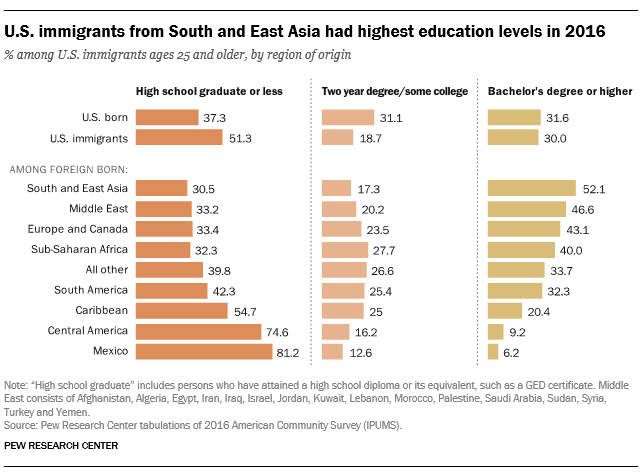


Third is that many immigrant groups, particularly asians, have access to better schools. (see also the brookings link)

Lastly, the Irish (and Italians and Germans) came here when almost half of the workforce was agrarian and few if anyone needed a college degree to get ahead. They are white so they faced only a brief period of discrimination (the years when Irish or Italians need not apply, for example). I'm half Italian and only the first generation in our family faced discrimination in the workplace or college.
Anonymous
Anonymous wrote:
Anonymous wrote:
Anonymous wrote:
Anonymous wrote:This will be called trolling, but I'm trying to add to the conversation here. I grew up in CA and remember driving past the former internment camps in the 80s and wondering why they were ever "necessary" because I didn't see how the Asians around me could be harmful. They were (and continue to be) high achieving and hard working despite this history. What is it about Black culture still wears slavery as a mark of worthiness and value? That history only has relevance to an individual if they allow it to have relevance to who they are as a human today. It is a terrible period in history, but why does it continue to define individuals today in a way that Asians (or Irish, or Jewish or Egyptian or Greek...) don't?

It’s only trolling if people answer you thoughtfully and you shut down or mock in return.

The only other treatment of humans in America that rivals the way that Black people were treated in scope and depth is the Native American genocide, and for lots of Native Americans, that’s still an enormous part of their lives, too. But I’ll focus on Black people here.

It wasn’t just slavery. It was birthright slavery, slavery that people couldn’t get out of. Rarely people could save up to buy their own freedom or get freed via a will, but it wasn’t common. They were prevented from learning to read, they were prevented from worshipping freely. I just watched The Black Church: This is Our Story and in some places they weren’t even allowed to look skyward in prayer, lest they be checking the star position (and it was enforced by whipping). There were no protections for any enslaved person - no break from rape if that’s what the owner wanted, no break from anything, ever. They were used in medical experiments. If you’ve ever had gynecological surgery, thank the hapless Black victims of that doctor who operated on them without anesthesia under the belief that Black people were less than human and didn’t feel pain. Enslaved people literally built much of our nation, and they were definitely the engine that drove the economy, work for which they got nothing.

And it’s not like it quit with slaves being freed. The Ku Klux Klan terrorized Black people, torturing and murdering them, and it was frequently treated as a pleasant spectacle by white people who picnicked at lynchings - and stole “souvenirs” from the body. They were kept out of school, they were kept out of specific schools, they were kept in virtual slavery with the system of sharecropping. Redlining continued legally for decades. Systemic racism really does keep Black people in lower economic straits even to this day.

I’m not Black. I can read about this issue and understand it from that perspective, but I am not a descendant of slaves. It’s not personal for me. But it is still very much personal for those who are descended from enslaved people. It’s not the past. It’s the present.


Black woman here. Excellent post.

Thanks. I really did spend the last almost year reading and watching and sitting with it.
- the White woman you’re replying to.


A different black women here and I agree! To expand a little further on your post, African slavery lasted hundreds of years. The transatlantic slave trade created a system where Africans and their descendants were legally, religiously, and corporately nonPEOPLE, nonHUMAN. In my studies of American history I have not found any other grouping of people to be legally determined as non people. That treatment did not end with the Civil War or Emancipation Proclamation. It has continued on, legally and psychologically until the present day. Generations of black folks have been raised under this system in America. A system that some perpetuate, ignore, or passively embrace. The loss of personhood and familial memories of tribes, native tongues etc cannot be overstated. The people that were legally kidnapped by the government and placed in those camps in California had connection to personhood, tribe, native tongue, culture and were likely able to maintain that after that experience. 400 years later, black people through the transatlantic slave trade have none of that.

I do not understand the comment about wearing slavery as a mark of worthiness and value but why does it define individuals in the way in which travesties do not for Greeks, Japanese people..the answer is in your statement. The slave trade completely removed the “Greek, Japanese, Irish” ie: Kenyan, Sudanese from black people. So history starts ...maybe in a geography with a plantation. AncestryDNA maybe can tell you generally where your people may have come from..Subsaharian African, hunter gather region,...but for millions of us, we will never know, Greek, Irish, Japanese. But we do know...slavery.
Anonymous
Anonymous wrote:
Anonymous wrote:
Anonymous wrote:
Anonymous wrote:
Anonymous wrote:This will be called trolling, but I'm trying to add to the conversation here. I grew up in CA and remember driving past the former internment camps in the 80s and wondering why they were ever "necessary" because I didn't see how the Asians around me could be harmful. They were (and continue to be) high achieving and hard working despite this history. What is it about Black culture still wears slavery as a mark of worthiness and value? That history only has relevance to an individual if they allow it to have relevance to who they are as a human today. It is a terrible period in history, but why does it continue to define individuals today in a way that Asians (or Irish, or Jewish or Egyptian or Greek...) don't?

It’s only trolling if people answer you thoughtfully and you shut down or mock in return.

The only other treatment of humans in America that rivals the way that Black people were treated in scope and depth is the Native American genocide, and for lots of Native Americans, that’s still an enormous part of their lives, too. But I’ll focus on Black people here.

It wasn’t just slavery. It was birthright slavery, slavery that people couldn’t get out of. Rarely people could save up to buy their own freedom or get freed via a will, but it wasn’t common. They were prevented from learning to read, they were prevented from worshipping freely. I just watched The Black Church: This is Our Story and in some places they weren’t even allowed to look skyward in prayer, lest they be checking the star position (and it was enforced by whipping). There were no protections for any enslaved person - no break from rape if that’s what the owner wanted, no break from anything, ever. They were used in medical experiments. If you’ve ever had gynecological surgery, thank the hapless Black victims of that doctor who operated on them without anesthesia under the belief that Black people were less than human and didn’t feel pain. Enslaved people literally built much of our nation, and they were definitely the engine that drove the economy, work for which they got nothing.

And it’s not like it quit with slaves being freed. The Ku Klux Klan terrorized Black people, torturing and murdering them, and it was frequently treated as a pleasant spectacle by white people who picnicked at lynchings - and stole “souvenirs” from the body. They were kept out of school, they were kept out of specific schools, they were kept in virtual slavery with the system of sharecropping. Redlining continued legally for decades. Systemic racism really does keep Black people in lower economic straits even to this day.

I’m not Black. I can read about this issue and understand it from that perspective, but I am not a descendant of slaves. It’s not personal for me. But it is still very much personal for those who are descended from enslaved people. It’s not the past. It’s the present.


Black woman here. Excellent post.

Thanks. I really did spend the last almost year reading and watching and sitting with it.
- the White woman you’re replying to.


A different black women here and I agree! To expand a little further on your post, African slavery lasted hundreds of years. The transatlantic slave trade created a system where Africans and their descendants were legally, religiously, and corporately nonPEOPLE, nonHUMAN. In my studies of American history I have not found any other grouping of people to be legally determined as non people. That treatment did not end with the Civil War or Emancipation Proclamation. It has continued on, legally and psychologically until the present day. Generations of black folks have been raised under this system in America. A system that some perpetuate, ignore, or passively embrace. The loss of personhood and familial memories of tribes, native tongues etc cannot be overstated. The people that were legally kidnapped by the government and placed in those camps in California had connection to personhood, tribe, native tongue, culture and were likely able to maintain that after that experience. 400 years later, black people through the transatlantic slave trade have none of that.

I do not understand the comment about wearing slavery as a mark of worthiness and value but why does it define individuals in the way in which travesties do not for Greeks, Japanese people..the answer is in your statement. The slave trade completely removed the “Greek, Japanese, Irish” ie: Kenyan, Sudanese from black people. So history starts ...maybe in a geography with a plantation. AncestryDNA maybe can tell you generally where your people may have come from..Subsaharian African, hunter gather region,...but for millions of us, we will never know, Greek, Irish, Japanese. But we do know...slavery.

Same person you’re replying to and I will add one thing: my great grandfather killed himself in front of my grandmother and the family basically broke to pieces after that. Orphanages, institutions, international adoptions, forced sterilizations, etc. I know my grandma spent her life doing the best she could, but three generations and a hundred years on, I can still see the marks on my aunts and uncles and even how that trauma was passed to us. That was one series of bad things that happened in one family and no one did it to them, there was no organized system of violence or oppression that kept them hurting. And so I find the gaslighting of Black people around this issue - “why don’t you get over it, it was a long time ago” to be ghoulish and abhorrent. Even disregarding all the discrimination and terror against Black people since 1865, it’s a really ridiculous expectation for generations burnt by repeated trauma and insane violence to just “get over it.” We haven’t even begun to examine it.

Hell we’ve got people defending celebrating the time because “it’s pretty.”
Anonymous
Anonymous wrote:
Anonymous wrote:
Anonymous wrote:
Anonymous wrote:
Anonymous wrote:
Anonymous wrote:This will be called trolling, but I'm trying to add to the conversation here. I grew up in CA and remember driving past the former internment camps in the 80s and wondering why they were ever "necessary" because I didn't see how the Asians around me could be harmful. They were (and continue to be) high achieving and hard working despite this history. What is it about Black culture still wears slavery as a mark of worthiness and value? That history only has relevance to an individual if they allow it to have relevance to who they are as a human today. It is a terrible period in history, but why does it continue to define individuals today in a way that Asians (or Irish, or Jewish or Egyptian or Greek...) don't?

It’s only trolling if people answer you thoughtfully and you shut down or mock in return.

The only other treatment of humans in America that rivals the way that Black people were treated in scope and depth is the Native American genocide, and for lots of Native Americans, that’s still an enormous part of their lives, too. But I’ll focus on Black people here.

It wasn’t just slavery. It was birthright slavery, slavery that people couldn’t get out of. Rarely people could save up to buy their own freedom or get freed via a will, but it wasn’t common. They were prevented from learning to read, they were prevented from worshipping freely. I just watched The Black Church: This is Our Story and in some places they weren’t even allowed to look skyward in prayer, lest they be checking the star position (and it was enforced by whipping). There were no protections for any enslaved person - no break from rape if that’s what the owner wanted, no break from anything, ever. They were used in medical experiments. If you’ve ever had gynecological surgery, thank the hapless Black victims of that doctor who operated on them without anesthesia under the belief that Black people were less than human and didn’t feel pain. Enslaved people literally built much of our nation, and they were definitely the engine that drove the economy, work for which they got nothing.

And it’s not like it quit with slaves being freed. The Ku Klux Klan terrorized Black people, torturing and murdering them, and it was frequently treated as a pleasant spectacle by white people who picnicked at lynchings - and stole “souvenirs” from the body. They were kept out of school, they were kept out of specific schools, they were kept in virtual slavery with the system of sharecropping. Redlining continued legally for decades. Systemic racism really does keep Black people in lower economic straits even to this day.

I’m not Black. I can read about this issue and understand it from that perspective, but I am not a descendant of slaves. It’s not personal for me. But it is still very much personal for those who are descended from enslaved people. It’s not the past. It’s the present.


Black woman here. Excellent post.

Thanks. I really did spend the last almost year reading and watching and sitting with it.
- the White woman you’re replying to.


A different black women here and I agree! To expand a little further on your post, African slavery lasted hundreds of years. The transatlantic slave trade created a system where Africans and their descendants were legally, religiously, and corporately nonPEOPLE, nonHUMAN. In my studies of American history I have not found any other grouping of people to be legally determined as non people. That treatment did not end with the Civil War or Emancipation Proclamation. It has continued on, legally and psychologically until the present day. Generations of black folks have been raised under this system in America. A system that some perpetuate, ignore, or passively embrace. The loss of personhood and familial memories of tribes, native tongues etc cannot be overstated. The people that were legally kidnapped by the government and placed in those camps in California had connection to personhood, tribe, native tongue, culture and were likely able to maintain that after that experience. 400 years later, black people through the transatlantic slave trade have none of that.

I do not understand the comment about wearing slavery as a mark of worthiness and value but why does it define individuals in the way in which travesties do not for Greeks, Japanese people..the answer is in your statement. The slave trade completely removed the “Greek, Japanese, Irish” ie: Kenyan, Sudanese from black people. So history starts ...maybe in a geography with a plantation. AncestryDNA maybe can tell you generally where your people may have come from..Subsaharian African, hunter gather region,...but for millions of us, we will never know, Greek, Irish, Japanese. But we do know...slavery.

Same person you’re replying to and I will add one thing: my great grandfather killed himself in front of my grandmother and the family basically broke to pieces after that. Orphanages, institutions, international adoptions, forced sterilizations, etc. I know my grandma spent her life doing the best she could, but three generations and a hundred years on, I can still see the marks on my aunts and uncles and even how that trauma was passed to us. That was one series of bad things that happened in one family and no one did it to them, there was no organized system of violence or oppression that kept them hurting. And so I find the gaslighting of Black people around this issue - “why don’t you get over it, it was a long time ago” to be ghoulish and abhorrent. Even disregarding all the discrimination and terror against Black people since 1865, it’s a really ridiculous expectation for generations burnt by repeated trauma and insane violence to just “get over it.” We haven’t even begun to examine it.

Hell we’ve got people defending celebrating the time because “it’s pretty.”


PP here, thank you for your understanding and consideration.
Anonymous
Anonymous wrote:
Anonymous wrote:This will be called trolling, but I'm trying to add to the conversation here. I grew up in CA and remember driving past the former internment camps in the 80s and wondering why they were ever "necessary" because I didn't see how the Asians around me could be harmful. They were (and continue to be) high achieving and hard working despite this history. What is it about Black culture still wears slavery as a mark of worthiness and value? That history only has relevance to an individual if they allow it to have relevance to who they are as a human today. It is a terrible period in history, but why does it continue to define individuals today in a way that Asians (or Irish, or Jewish or Egyptian or Greek...) don't?

It’s only trolling if people answer you thoughtfully and you shut down or mock in return.

The only other treatment of humans in America that rivals the way that Black people were treated in scope and depth is the Native American genocide, and for lots of Native Americans, that’s still an enormous part of their lives, too. But I’ll focus on Black people here.

It wasn’t just slavery. It was birthright slavery, slavery that people couldn’t get out of. Rarely people could save up to buy their own freedom or get freed via a will, but it wasn’t common. They were prevented from learning to read, they were prevented from worshipping freely. I just watched The Black Church: This is Our Story and in some places they weren’t even allowed to look skyward in prayer, lest they be checking the star position (and it was enforced by whipping). There were no protections for any enslaved person - no break from rape if that’s what the owner wanted, no break from anything, ever. They were used in medical experiments. If you’ve ever had gynecological surgery, thank the hapless Black victims of that doctor who operated on them without anesthesia under the belief that Black people were less than human and didn’t feel pain. Enslaved people literally built much of our nation, and they were definitely the engine that drove the economy, work for which they got nothing.

And it’s not like it quit with slaves being freed. The Ku Klux Klan terrorized Black people, torturing and murdering them, and it was frequently treated as a pleasant spectacle by white people who picnicked at lynchings - and stole “souvenirs” from the body. They were kept out of school, they were kept out of specific schools, they were kept in virtual slavery with the system of sharecropping. Redlining continued legally for decades. Systemic racism really does keep Black people in lower economic straits even to this day.

I’m not Black. I can read about this issue and understand it from that perspective, but I am not a descendant of slaves. It’s not personal for me. But it is still very much personal for those who are descended from enslaved people. It’s not the past. It’s the present.


Thank you for this. Can you (or someone) address the question of reliving the trauma daily as an aspect of culture in contrast to others who witnessed similar hatred (not slavery, but see the earlier Japanese poster with living examples of similar legalized discrimination) but who don’t seem to wear it as a badge? Their experience is still very real - see Georgia yesterday.
Anonymous
Anonymous wrote:
Anonymous wrote:
Anonymous wrote:This will be called trolling, but I'm trying to add to the conversation here. I grew up in CA and remember driving past the former internment camps in the 80s and wondering why they were ever "necessary" because I didn't see how the Asians around me could be harmful. They were (and continue to be) high achieving and hard working despite this history. What is it about Black culture still wears slavery as a mark of worthiness and value? That history only has relevance to an individual if they allow it to have relevance to who they are as a human today. It is a terrible period in history, but why does it continue to define individuals today in a way that Asians (or Irish, or Jewish or Egyptian or Greek...) don't?

It’s only trolling if people answer you thoughtfully and you shut down or mock in return.

The only other treatment of humans in America that rivals the way that Black people were treated in scope and depth is the Native American genocide, and for lots of Native Americans, that’s still an enormous part of their lives, too. But I’ll focus on Black people here.

It wasn’t just slavery. It was birthright slavery, slavery that people couldn’t get out of. Rarely people could save up to buy their own freedom or get freed via a will, but it wasn’t common. They were prevented from learning to read, they were prevented from worshipping freely. I just watched The Black Church: This is Our Story and in some places they weren’t even allowed to look skyward in prayer, lest they be checking the star position (and it was enforced by whipping). There were no protections for any enslaved person - no break from rape if that’s what the owner wanted, no break from anything, ever. They were used in medical experiments. If you’ve ever had gynecological surgery, thank the hapless Black victims of that doctor who operated on them without anesthesia under the belief that Black people were less than human and didn’t feel pain. Enslaved people literally built much of our nation, and they were definitely the engine that drove the economy, work for which they got nothing.

And it’s not like it quit with slaves being freed. The Ku Klux Klan terrorized Black people, torturing and murdering them, and it was frequently treated as a pleasant spectacle by white people who picnicked at lynchings - and stole “souvenirs” from the body. They were kept out of school, they were kept out of specific schools, they were kept in virtual slavery with the system of sharecropping. Redlining continued legally for decades. Systemic racism really does keep Black people in lower economic straits even to this day.

I’m not Black. I can read about this issue and understand it from that perspective, but I am not a descendant of slaves. It’s not personal for me. But it is still very much personal for those who are descended from enslaved people. It’s not the past. It’s the present.


Thank you for this. Can you (or someone) address the question of reliving the trauma daily as an aspect of culture in contrast to others who witnessed similar hatred (not slavery, but see the earlier Japanese poster with living examples of similar legalized discrimination) but who don’t seem to wear it as a badge? Their experience is still very real - see Georgia yesterday.


Japanese Americans have talked about it. It is not forgotten.
Anonymous
Anonymous wrote:
Anonymous wrote:
Anonymous wrote:
Anonymous wrote:This will be called trolling, but I'm trying to add to the conversation here. I grew up in CA and remember driving past the former internment camps in the 80s and wondering why they were ever "necessary" because I didn't see how the Asians around me could be harmful. They were (and continue to be) high achieving and hard working despite this history. What is it about Black culture still wears slavery as a mark of worthiness and value? That history only has relevance to an individual if they allow it to have relevance to who they are as a human today. It is a terrible period in history, but why does it continue to define individuals today in a way that Asians (or Irish, or Jewish or Egyptian or Greek...) don't?

It’s only trolling if people answer you thoughtfully and you shut down or mock in return.

The only other treatment of humans in America that rivals the way that Black people were treated in scope and depth is the Native American genocide, and for lots of Native Americans, that’s still an enormous part of their lives, too. But I’ll focus on Black people here.

It wasn’t just slavery. It was birthright slavery, slavery that people couldn’t get out of. Rarely people could save up to buy their own freedom or get freed via a will, but it wasn’t common. They were prevented from learning to read, they were prevented from worshipping freely. I just watched The Black Church: This is Our Story and in some places they weren’t even allowed to look skyward in prayer, lest they be checking the star position (and it was enforced by whipping). There were no protections for any enslaved person - no break from rape if that’s what the owner wanted, no break from anything, ever. They were used in medical experiments. If you’ve ever had gynecological surgery, thank the hapless Black victims of that doctor who operated on them without anesthesia under the belief that Black people were less than human and didn’t feel pain. Enslaved people literally built much of our nation, and they were definitely the engine that drove the economy, work for which they got nothing.

And it’s not like it quit with slaves being freed. The Ku Klux Klan terrorized Black people, torturing and murdering them, and it was frequently treated as a pleasant spectacle by white people who picnicked at lynchings - and stole “souvenirs” from the body. They were kept out of school, they were kept out of specific schools, they were kept in virtual slavery with the system of sharecropping. Redlining continued legally for decades. Systemic racism really does keep Black people in lower economic straits even to this day.

I’m not Black. I can read about this issue and understand it from that perspective, but I am not a descendant of slaves. It’s not personal for me. But it is still very much personal for those who are descended from enslaved people. It’s not the past. It’s the present.


Thank you for this. Can you (or someone) address the question of reliving the trauma daily as an aspect of culture in contrast to others who witnessed similar hatred (not slavery, but see the earlier Japanese poster with living examples of similar legalized discrimination) but who don’t seem to wear it as a badge? Their experience is still very real - see Georgia yesterday.


Japanese Americans have talked about it. It is not forgotten.


Yeah, the Japanese got an official apology from the US government and reparations.
Anonymous
Anonymous wrote:
Anonymous wrote:
Anonymous wrote:
Anonymous wrote:
Anonymous wrote:This will be called trolling, but I'm trying to add to the conversation here. I grew up in CA and remember driving past the former internment camps in the 80s and wondering why they were ever "necessary" because I didn't see how the Asians around me could be harmful. They were (and continue to be) high achieving and hard working despite this history. What is it about Black culture still wears slavery as a mark of worthiness and value? That history only has relevance to an individual if they allow it to have relevance to who they are as a human today. It is a terrible period in history, but why does it continue to define individuals today in a way that Asians (or Irish, or Jewish or Egyptian or Greek...) don't?

It’s only trolling if people answer you thoughtfully and you shut down or mock in return.

The only other treatment of humans in America that rivals the way that Black people were treated in scope and depth is the Native American genocide, and for lots of Native Americans, that’s still an enormous part of their lives, too. But I’ll focus on Black people here.

It wasn’t just slavery. It was birthright slavery, slavery that people couldn’t get out of. Rarely people could save up to buy their own freedom or get freed via a will, but it wasn’t common. They were prevented from learning to read, they were prevented from worshipping freely. I just watched The Black Church: This is Our Story and in some places they weren’t even allowed to look skyward in prayer, lest they be checking the star position (and it was enforced by whipping). There were no protections for any enslaved person - no break from rape if that’s what the owner wanted, no break from anything, ever. They were used in medical experiments. If you’ve ever had gynecological surgery, thank the hapless Black victims of that doctor who operated on them without anesthesia under the belief that Black people were less than human and didn’t feel pain. Enslaved people literally built much of our nation, and they were definitely the engine that drove the economy, work for which they got nothing.

And it’s not like it quit with slaves being freed. The Ku Klux Klan terrorized Black people, torturing and murdering them, and it was frequently treated as a pleasant spectacle by white people who picnicked at lynchings - and stole “souvenirs” from the body. They were kept out of school, they were kept out of specific schools, they were kept in virtual slavery with the system of sharecropping. Redlining continued legally for decades. Systemic racism really does keep Black people in lower economic straits even to this day.

I’m not Black. I can read about this issue and understand it from that perspective, but I am not a descendant of slaves. It’s not personal for me. But it is still very much personal for those who are descended from enslaved people. It’s not the past. It’s the present.


Thank you for this. Can you (or someone) address the question of reliving the trauma daily as an aspect of culture in contrast to others who witnessed similar hatred (not slavery, but see the earlier Japanese poster with living examples of similar legalized discrimination) but who don’t seem to wear it as a badge? Their experience is still very real - see Georgia yesterday.


Japanese Americans have talked about it. It is not forgotten.


Yeah, the Japanese got an official apology from the US government and reparations.


Not all of them.
Anonymous
Anonymous wrote:It is nostalgic for the Southern plantation culture that was built on slavery. "Gone With the Wind" has had a long-lasting terrible influence on Southern white people.


It made the poor white people nostalgic for things they never had.
Anonymous
Anonymous wrote:
Anonymous wrote:An antebellum party is racist because it is a celebration/replication of the lifestyle of the uber wealthy, slave owning, white people living on plantations in the pre Civil War south. These people owned and amassed their wealth, and were afforded this opulent lifestyle and their parties because they were slaveowners and amassed ridiculous wealth by owning other human beings.

Why would anyone have a party to celebrate this dark chapter in american history? Not a great choice for a theme for a party. Do you understand?


An antebellum party is about the clothes. I've never been to one, but I can tell you that is what I see. It also includes mint juleps. Lots of them.


Back then, nobody could afford to wash those dresses without free "help".
Anonymous
Anonymous wrote:People who romanticize that time period (myself included) do it because we enjoy the ambiance and aesthetics of it. The fate of slaves is usually the last thing on my mind. Actually, it’s not on my mind at all. I just wish i was born back then into a wealthy family.


You could also have born back into a poor family and been married off to a poor brute. Chances are 75-25 according to the PPs.
post reply Forum Index » Political Discussion
Message Quick Reply
Go to: