Nate Silver: "Go to a state school"

Anonymous
Anonymous wrote:
Anonymous wrote:
Anonymous wrote:
Anonymous wrote:
Anonymous wrote:I am getting from this that the white folks are mad at “DEI”. It cannot be that elite anymore now that the browns and the blacks are getting in. All that riff raff ! Let us hire our own folks from the top public universities!

🤦‍♀️


In your own way you did get straight to the heart of the matter, even if not necessarily in the way you intended.

The simple reality is many diversity admits at elite colleges are nowhere close to the white or Asian admits in terms of scores and accomplishments, it does devalue the overall perspectives of the degree.

I see a resume from an Asian graduate from Harvard, I know she is going to be among the absolutely tippety top of students given that they have the highest barriers to entry to Harvard. But I don't consider resumes from a black Harvard graduate in the same light. I know, as the Harvard data confirmed, they had much lower admissions standards.


Good thing this is anonymous because you racially discriminate in hiring.

dp.. unfortunately, that's the double edged sword of DEI.


No it isn’t. It’s only like that because people are racist.

Both applicants made it through Harvard in this case but you’re judging them on what they may or may not have done 4 years earlier based on nothing but their race. I kind of doubt someone who thinks like this would have some different opinion under other circumstances. You just use DEI as an excuse for your own bias.

Nah, it's not about racism, but the reality of knowing that some URM get into elite colleges due to DEI. Look at the Harvard case and the test scores that came out of the discovery.

When they graduate from that college, and the GPA is mediocre, the hiring manager will automatically assume DEI. If another URM had a high GPA, then they won't think that.

If an Asian student has a mediocre GPA in college, they won't assume that they only got into that elite college due to DEI. They can assume other things, but certainly not that they got in due to DEI.

That's what happens when you have an admissions policy that uses DEI. You may not like it, but that's just the reality.
Anonymous
it's funny to be that people want to bust on the Ivies just when they money is no longer a gate keeper.
Anonymous
Anonymous wrote:
Anonymous wrote:DP Define "golden ticket"? Everyone wants different things. There certainly are fields where an Ivy league degree has a lot of cachet. But many people don't want to get into Big Law. For many people the "golden ticket" is interesting government work with a decent paycheck. Work life balance is so much more important than a lot of people realize until they have no time for their families.

You're telling us that statistically speaking "interesting government work with a decent paycheck" is desired by just as many people as BigLaw/management consulting/investment banking/quant firm/surgeon jobs?

Also it's way easier to downshift and obtain the rare jobs with good pay/work-life balance, than the other way around.


I don't know how many people desire one versus the other. Nobody I know wants any of the jobs you listed. I'm sure there are many people who do, but I think you are overestimating how many people want the. And it's actually not that easy to "downshift" when you have a lot of debt/don't have relevant experience. My interesting government job agency constantly turns down people trying to get out of law. We don't want people who are just trying to escape something else and have plenty of applicants that have a demonstrated interest and skills for what we do.
Anonymous
Anonymous wrote:
Anonymous wrote:
Anonymous wrote:
Anonymous wrote:
Anonymous wrote:
Anonymous wrote:
Anonymous wrote:
Anonymous wrote:
Anonymous wrote:The only data he actually cites doesn’t really support his claim.

1. Public perception of higher education generally has slipped. This doesn’t support the claim that elite colleges are harmed more than state schools.

2. Polls that say private schools are not worth the cost of public. Again this doesn’t distinguish between “elite” and non elite public. Maybe people would say “yes, I wouldn’t pay for Elon but I think MIT is worth it”

3. Harvard perception. The division along political lines suggests that this is a political issue. Republicans voters have been told to hate those east coast liberal colleges and their students. But the average Republican voter isn’t hiring anyone. It would be more interesting to see a poll along socio economic and geographic lines. Do NYC republicans have the same view? That’s more relevant than people in Alabama.

Maybe the book will have more information but otherwise this seems like a whole lot of opinion and conjecture for now.


I'm a hiring manager who has definitely had opinions of elite colleges change over the last few years. Also a graduate of an elite college myself.

Should reread his post carefully instead of jumping to conclusions. Silver speaks to everything you raised.


+1 similarly situated hiring manager. I need people who work hard and listen to other people’s opinions, not people who feel entitled to a top spot because their parents rode them through high school and they prepped well for standardized tests.

Heard something similar from a research scientist. They said that state grads made better RA than ivy grads who felt cleaning equipment was beneath them, and kept touting how they went to "some elite" college.


This is some seriously stereotyped thinking. Some bosses don't like to feel threatened by their "underlings" too and purposefully hire for those who seem more subservient so they won't get shown up. Some have chips on their shoulders about schools too. Just judge people on their merits and don't make up some generalized stories about the "elite" or "state school grads."


I've met far more kids from Elite schools with "chip on their shoulder" than from state schools. If I'm running a Chem or Bio lab, the entry level positions for BA/BS degrees most likely includes cleaning and prepping equipment in the job description. Those jobs are well known for being grunt work jobs. I want to hire someone who is going to do that job and do it well, not someone who is going to spend their days complaining that they are not yet getting to do the "real work". Well if you want to "do the real work" you have to work your way up and most likely go get your MS/PHD. Otherwise you start doing the grunt work and not getting paid a lot (for having a Stem Degree).


Sounds like a crappy system that the "elite" students are right to challenge tbh. Why do you need a college grad for a "grunt work" job? Bio/chem research is notorious for keeping people in low-paying environments for way too long given how challenging the major is (e.g. having to do post-docs to get a research job). Sounds like it could use people to question the system and envision new opportunities and ways of working.


Because along with the "grunt level work" it does include lab work that requires the employee to have a BS/BA. It's not ALL "grunt level work" that could be done by someone with a HS diploma. It's well known that you need a MS/PHD to do the real research work in that area. So if you want to question the system and not do the work, then go directly and get an advanced degree. Or choose a different career path.
Because in reality, even with an MS, you will likely still work for someone with their PHD who is leading the research. You will not have your OWN lab typically until you have your PHD. I know, have a friend who has a BS in chemistry, worked for several years, then got their MS and got a better job with more interesting work, but ultimately even then, you are still under the guidance of the PHD in charge. So if you want to make your own decisions, you go get your PHD (they are).
Just because you went to Harvard does not mean you get to demand you are qualified to go directly to "only interesting work". But you knew going into that major (if you did any research) that this is the path to success.


Just saying that most of the Bio/Chem people I know think the current field is problematic and not producing sufficient rewards as other fields (unless Chem is chemical engineering or other industrial applications). So maybe you want people to shake up the system a bit and re-imagine new ways rather than just accepting it as is. Of course this can rub the old guard wrong--and sometimes recent grads from all sorts of schools are entitled, clueless brats. In college kids are getting to do real research, I don't really see why a BA/BS position has to be such grunt work. Maybe you can write a cleaning staff into the research grant and actually hire people for their experience/knowledge rather than do what sounds like a bit of a hazing ritual to me.

Also it seems your example really doesn't address the issue of this thread--you're saying state school grads are more willing to do the grunt work that kind of stalls you on your career path whereas Ivy kids are more likely to not want to put up with the grunt work and catch on to the fact that you quickly need an advanced degree or want to seek a better paying field. To my ears, it sounds like the latter may support greater confidence and ambition and give a better ROI for the individual from the elite school (even if you find them entitled and annoying). Tons of people are beloved workers by their bosses who are held down because they don't mind doing the grunt work for more years than they should.


Chem Eng is Definately the path to elect if you want only a bs and not be stuck working your way up. My own kid selected that major for that very reason. They don’t want to be forced to get a PhD to do interesting work, and also they d like to get paid a bit more
Anonymous
Anonymous wrote:
Anonymous wrote:
Anonymous wrote:
Anonymous wrote:Nate's whole argument hinges on the idea that these schools are more expensive than your good state university, which is not the case for many of us.

Would I pay more for Indiana than Penn? No, I would not.


As is typical on DCUM, people threatened by a particular assertion will simply blatantly misrepresent it in order to try to discredit it. Here is what Silver actually said:

"But if this student was just going to school to “find herself” — and she or her parents were footing most of the bill? Yeah, probably go with the top-flight state school — especially if she’s in a state with a very good in-state public school where the cost savings are much greater. Better that than to emerge with a mountain of debt and a degree from an institution that is likely to be viewed as highly polarizing. Public perceptions of higher education have declined rapidly, and I expect the problems to get worse."

How does the sentence above address situations where the out-of-state public option is more expensive?


He is saying IF you have a strong state school option that is cheaper than the Ivy that is probably your best choice. If you are looking at an Ivy and a state school that both cost the same amount of money, then the choice is less clear. Though you may consider that having the Ivy League degree may actually have some disadvantages in terms of perceptions by employers (and I'd argue a potential to make your child struggle in the workforce when their job prospects don't match up with the marketing that the Ivy bombard them with).


lol, he didn't say that
Anonymous
Anonymous wrote:
Anonymous wrote:
Anonymous wrote:DP Define "golden ticket"? Everyone wants different things. There certainly are fields where an Ivy league degree has a lot of cachet. But many people don't want to get into Big Law. For many people the "golden ticket" is interesting government work with a decent paycheck. Work life balance is so much more important than a lot of people realize until they have no time for their families.

You're telling us that statistically speaking "interesting government work with a decent paycheck" is desired by just as many people as BigLaw/management consulting/investment banking/quant firm/surgeon jobs?

Also it's way easier to downshift and obtain the rare jobs with good pay/work-life balance, than the other way around.


I don't know how many people desire one versus the other. Nobody I know wants any of the jobs you listed. I'm sure there are many people who do, but I think you are overestimating how many people want the. And it's actually not that easy to "downshift" when you have a lot of debt/don't have relevant experience. My interesting government job agency constantly turns down people trying to get out of law. We don't want people who are just trying to escape something else and have plenty of applicants that have a demonstrated interest and skills for what we do.

That's not the kind of downshifting I was talking about. In house legal jobs pay well and have way better hours than BigLaw for example. I have lots of government lawyer friends who make decent enough money too.
Anonymous
But you don't get to experience stuff like this at a random state school https://x.com/CollinRugg/status/1783167266882019690
Anonymous
Anonymous wrote:
Anonymous wrote:
Anonymous wrote:
Anonymous wrote:
Anonymous wrote:Nate's whole argument hinges on the idea that these schools are more expensive than your good state university, which is not the case for many of us.

Would I pay more for Indiana than Penn? No, I would not.


As is typical on DCUM, people threatened by a particular assertion will simply blatantly misrepresent it in order to try to discredit it. Here is what Silver actually said:

"But if this student was just going to school to “find herself” — and she or her parents were footing most of the bill? Yeah, probably go with the top-flight state school — especially if she’s in a state with a very good in-state public school where the cost savings are much greater. Better that than to emerge with a mountain of debt and a degree from an institution that is likely to be viewed as highly polarizing. Public perceptions of higher education have declined rapidly, and I expect the problems to get worse."

How does the sentence above address situations where the out-of-state public option is more expensive?


He is saying IF you have a strong state school option that is cheaper than the Ivy that is probably your best choice. If you are looking at an Ivy and a state school that both cost the same amount of money, then the choice is less clear. Though you may consider that having the Ivy League degree may actually have some disadvantages in terms of perceptions by employers (and I'd argue a potential to make your child struggle in the workforce when their job prospects don't match up with the marketing that the Ivy bombard them with).


lol, he didn't say that


"I got caught misrepresenting Nate Silver and now I am digging into my lie"
Anonymous
Nate isn't saying "go to a top flight state school only when it's in-state and costs way less."
Anonymous
Anonymous wrote:Nate isn't saying "go to a top flight state school only when it's in-state and costs way less."


And nobody is saying that he did say that. He did say his argument against Ivies applies most to situations where a student has access to a strong public at a lower cost than the Ivy. That is what the word "especially" means
Anonymous
Anonymous wrote:
Anonymous wrote:I can see people are upset because they have an investment, whether emotional, financial, or ideological, with the current modus operandi at most elite colleges so they are bitterly resistant to the changing realities surrounding elite higher education these days despite that Silver cites data showing significant shift in public perspectives on higher education and elite higher education.

This is what people thought of a freshly minted Harvard graduate in 1994: highly accomplished and brainy nerd.

This is what many people now think when they encounter a freshly minted Harvard graduate in 2024: Either a legacy admit from an extremely connected and / or wealthy family (nepotism) or a mollycoddled diversity admit benefiting from a system that rewards identity over merit. And both will bring the same increasingly annoying social justice warrior outlook largely divorced from reality.

Silver is not a right wing MAGAtard, he is a Democrat and sold his polling business to the NYT. But like a lot of very intelligent nerds, Silver doesn't shy away from frankness.


You are an idiot. The minority students at Harvard etc have near perfect test scores and/or grades. The average student now is miles ahead of the 1994 student in terms of academic indicators. Same with the wealthy kids; at the top schools everyone has the scores that's why they add other factors to select.

what no?

Anonymous
Anonymous wrote:
Anonymous wrote:
Anonymous wrote:I can see people are upset because they have an investment, whether emotional, financial, or ideological, with the current modus operandi at most elite colleges so they are bitterly resistant to the changing realities surrounding elite higher education these days despite that Silver cites data showing significant shift in public perspectives on higher education and elite higher education.

This is what people thought of a freshly minted Harvard graduate in 1994: highly accomplished and brainy nerd.

This is what many people now think when they encounter a freshly minted Harvard graduate in 2024: Either a legacy admit from an extremely connected and / or wealthy family (nepotism) or a mollycoddled diversity admit benefiting from a system that rewards identity over merit. And both will bring the same increasingly annoying social justice warrior outlook largely divorced from reality.

Silver is not a right wing MAGAtard, he is a Democrat and sold his polling business to the NYT. But like a lot of very intelligent nerds, Silver doesn't shy away from frankness.


You are an idiot. The minority students at Harvard etc have near perfect test scores and/or grades. The average student now is miles ahead of the 1994 student in terms of academic indicators. Same with the wealthy kids; at the top schools everyone has the scores that's why they add other factors to select.

what no?


We're supposed to pretend that doesn't exist
Anonymous
Anonymous wrote:
Anonymous wrote:
Anonymous wrote:
Anonymous wrote:I can see people are upset because they have an investment, whether emotional, financial, or ideological, with the current modus operandi at most elite colleges so they are bitterly resistant to the changing realities surrounding elite higher education these days despite that Silver cites data showing significant shift in public perspectives on higher education and elite higher education.

This is what people thought of a freshly minted Harvard graduate in 1994: highly accomplished and brainy nerd.

This is what many people now think when they encounter a freshly minted Harvard graduate in 2024: Either a legacy admit from an extremely connected and / or wealthy family (nepotism) or a mollycoddled diversity admit benefiting from a system that rewards identity over merit. And both will bring the same increasingly annoying social justice warrior outlook largely divorced from reality.

Silver is not a right wing MAGAtard, he is a Democrat and sold his polling business to the NYT. But like a lot of very intelligent nerds, Silver doesn't shy away from frankness.


You are an idiot. The minority students at Harvard etc have near perfect test scores and/or grades. The average student now is miles ahead of the 1994 student in terms of academic indicators. Same with the wealthy kids; at the top schools everyone has the scores that's why they add other factors to select.

what no?


We're supposed to pretend that doesn't exist


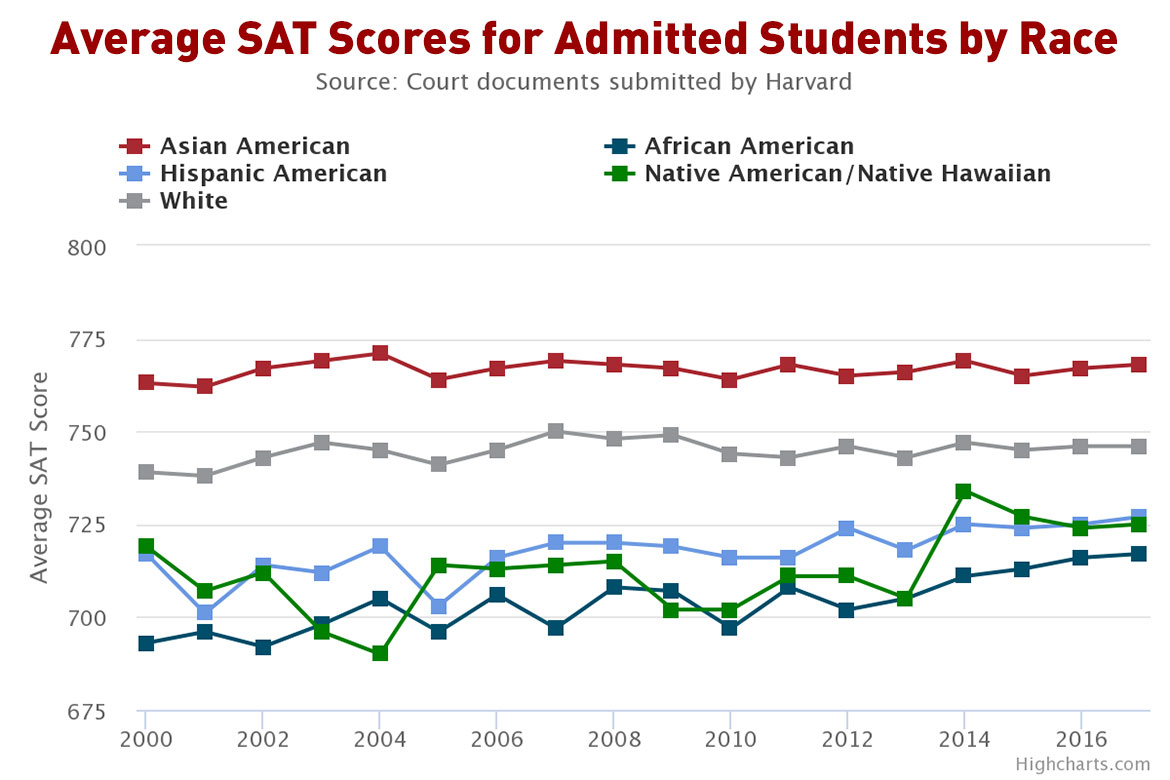
All the scores are above the 700 mark which represents the 95-97%. So this graph artificially makes the distinction look large. If you put the scores in terms of percentiles the lines would be tightly held together. What people argue is that once you're at the level of 95% other factors rather than maximizing a test score matter more.
Anonymous
Anonymous wrote:
Anonymous wrote:
Anonymous wrote:
Anonymous wrote:
Anonymous wrote:I can see people are upset because they have an investment, whether emotional, financial, or ideological, with the current modus operandi at most elite colleges so they are bitterly resistant to the changing realities surrounding elite higher education these days despite that Silver cites data showing significant shift in public perspectives on higher education and elite higher education.

This is what people thought of a freshly minted Harvard graduate in 1994: highly accomplished and brainy nerd.

This is what many people now think when they encounter a freshly minted Harvard graduate in 2024: Either a legacy admit from an extremely connected and / or wealthy family (nepotism) or a mollycoddled diversity admit benefiting from a system that rewards identity over merit. And both will bring the same increasingly annoying social justice warrior outlook largely divorced from reality.

Silver is not a right wing MAGAtard, he is a Democrat and sold his polling business to the NYT. But like a lot of very intelligent nerds, Silver doesn't shy away from frankness.


You are an idiot. The minority students at Harvard etc have near perfect test scores and/or grades. The average student now is miles ahead of the 1994 student in terms of academic indicators. Same with the wealthy kids; at the top schools everyone has the scores that's why they add other factors to select.

what no?


We're supposed to pretend that doesn't exist


All the scores are above the 700 mark which represents the 95-97%. So this graph artificially makes the distinction look large. If you put the scores in terms of percentiles the lines would be tightly held together. What people argue is that once you're at the level of 95% other factors rather than maximizing a test score matter more.


+1 this is a difference in access to tutoring
Anonymous
Anonymous wrote:
Anonymous wrote:If you like impacted courses of 250+ students taught by TAs, this advice is spot on.


Actually, one of my favorite classes at a big state school was a 250+ class, but it was taught by a full professor, and the sections were taught by TAs. I enjoyed the section and the main class. I later took a small seminar with that same professor as a junior. He later wrote a letter for me to get into grad school. He shared knowledge and reading lists and source recommendations with me as a grad student.

Classes are what you make of them. Connections are what you make of them. Opportunities are what you make of them. And as you progress into your college career, and as you declare your major or explore a minor or sign up for clubs or what have you, you make big experiences as small as you want to.


This. UNC grad here. Yes, lots of intro classes are huge and have discussion groups led by TAs. But as you advance in that field you have smaller classes taught by the professor and those classes and profs are awesome.

The other consideration is that state schools accept APs as credit and you can bypass the big intro lecture classes that way. I did it for Bio, Psych, Calculus, and English.
post reply Forum Index » College and University Discussion
Message Quick Reply
Go to: