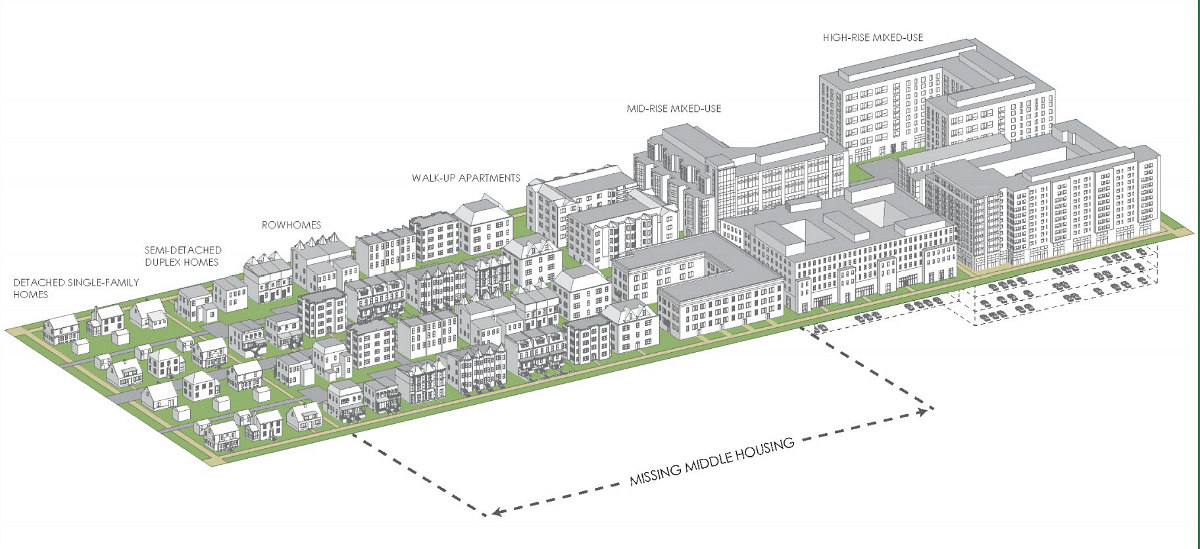
Soooo, how is high-density looking to everyone now?

Anonymous
Anonymous wrote:
Anonymous wrote:Aren't the majority of houses in, say, RF-1 zoned rowhouse neighborhoods still single-family homes? I mean, sure there are some condo conversions and some basement apartments. But we're not talking about huge apartment buildings on residential streets here, because the height and setback limits of R-1 and R-2 zoning will still be in place. This just means that someone can decide to split their house into two units or maybe add an ADU. Which some people will do, and most people won't.

Scary! /s


Setback limits are modified under the plan as well. That was a key component even in the Comp Plan.

At the end of the day, under the new Single Family Zoning proposal in the District of Columbia, you can raze your SFH if it is within that 'walkable' distance to public transportation and build in its stead a taller (would depend on how far you were from the transit route. Taller if you were closer to the road, lower if you were at the half mile point) and closer to the sidewalk (covering a greater percentage of lots size) multi family dwelling in the middle of a SFH zoned neighborhood under the 'gentle density' plan. You would NOT get a highrise bout you would have one lot with one house with one family, now be converted to one lot with eight units (two units per floor for four stories). Would there be anything inherently 'wrong' with this as a one of? No, absolutely not. Would this happening as a concerted effort to increase density change the character of a neighborhood? Absolutely.


Would there be anything inherently wrong with this if multiple property owners did it? Also no - except that it would be a change, and some of the people who currently live there don't want that.
Anonymous
Anonymous wrote:
Anonymous wrote:Aren't the majority of houses in, say, RF-1 zoned rowhouse neighborhoods still single-family homes? I mean, sure there are some condo conversions and some basement apartments. But we're not talking about huge apartment buildings on residential streets here, because the height and setback limits of R-1 and R-2 zoning will still be in place. This just means that someone can decide to split their house into two units or maybe add an ADU. Which some people will do, and most people won't.

Scary! /s


Setback limits are modified under the plan as well. That was a key component even in the Comp Plan.

At the end of the day, under the new Single Family Zoning proposal in the District of Columbia, you can raze your SFH if it is within that 'walkable' distance to public transportation and build in its stead a taller (would depend on how far you were from the transit route. Taller if you were closer to the road, lower if you were at the half mile point) and closer to the sidewalk (covering a greater percentage of lots size) multi family dwelling in the middle of a SFH zoned neighborhood under the 'gentle density' plan. You would NOT get a highrise bout you would have one lot with one house with one family, now be converted to one lot with eight units (two units per floor for four stories). Would there be anything inherently 'wrong' with this as a one of? No, absolutely not. Would this happening as a concerted effort to increase density change the character of a neighborhood? Absolutely.


What’s also interesting about Bowser’s diagram is the several levels of underground parking shown for the buildings closest to the major street. But the reality is that the mayor already has watered down DC off-street parking requirements for developments and her agencies like OP and DDOT have been supporting applications from developers for zoning waivers to exempt projects from even the remaining minimal parking requirements. So where do you think that all of the new residents in the densest projects and in the “missing middle” gentle density developments will park?

Oh wait. They won’t have cars. Everyone will take public transportation and Lyft. Especially after Covid-19.
Anonymous
Anonymous wrote:

What’s also interesting about Bowser’s diagram is the several levels of underground parking shown for the buildings closest to the major street. But the reality is that the mayor already has watered down DC off-street parking requirements for developments and her agencies like OP and DDOT have been supporting applications from developers for zoning waivers to exempt projects from even the remaining minimal parking requirements. So where do you think that all of the new residents in the densest projects and in the “missing middle” gentle density developments will park?

Oh wait. They won’t have cars. Everyone will take public transportation and Lyft. Especially after Covid-19.


Now we get into what all of these objections are really about: parking.
Anonymous
If much of AU Park were to look like this, DC would have to change the height limitation just so that Janney could be firther expanded into a high rise!
Anonymous
Anonymous wrote:
Anonymous wrote:

What’s also interesting about Bowser’s diagram is the several levels of underground parking shown for the buildings closest to the major street. But the reality is that the mayor already has watered down DC off-street parking requirements for developments and her agencies like OP and DDOT have been supporting applications from developers for zoning waivers to exempt projects from even the remaining minimal parking requirements. So where do you think that all of the new residents in the densest projects and in the “missing middle” gentle density developments will park?

Oh wait. They won’t have cars. Everyone will take public transportation and Lyft. Especially after Covid-19.


Now we get into what all of these objections are really about: parking.


So what’s your parking plan, Stan?
Anonymous
Anonymous wrote:Looking at the map, there are several neighborhoods that could be significantly affected by applying ‘gentle density’ to single family home zones. But the mayor must really have a thing about Cleveland Park because it’s like they’ve drawn a bullseye on it. The map shows that all the the SFH streets in CP could have apartment buildings added. When you also consider that the mayor proposes to increase building heights along Connecticut Ave to 12 - 13 floors, the change to CP could be fundamental and transformational.


It would be rather “transformational” if Highland Pl & Newark became like the diagram.
Anonymous
Anonymous wrote:
Anonymous wrote:
Anonymous wrote:

What’s also interesting about Bowser’s diagram is the several levels of underground parking shown for the buildings closest to the major street. But the reality is that the mayor already has watered down DC off-street parking requirements for developments and her agencies like OP and DDOT have been supporting applications from developers for zoning waivers to exempt projects from even the remaining minimal parking requirements. So where do you think that all of the new residents in the densest projects and in the “missing middle” gentle density developments will park?

Oh wait. They won’t have cars. Everyone will take public transportation and Lyft. Especially after Covid-19.


Now we get into what all of these objections are really about: parking.


So what’s your parking plan, Stan?


My parking plan? My parking plan is to require vehicle-owners to pay the market cost of storing their vehicles.
Anonymous
Anonymous wrote:
Anonymous wrote:
Anonymous wrote:
Anonymous wrote:

What’s also interesting about Bowser’s diagram is the several levels of underground parking shown for the buildings closest to the major street. But the reality is that the mayor already has watered down DC off-street parking requirements for developments and her agencies like OP and DDOT have been supporting applications from developers for zoning waivers to exempt projects from even the remaining minimal parking requirements. So where do you think that all of the new residents in the densest projects and in the “missing middle” gentle density developments will park?

Oh wait. They won’t have cars. Everyone will take public transportation and Lyft. Especially after Covid-19.


Now we get into what all of these objections are really about: parking.


So what’s your parking plan, Stan?


My parking plan? My parking plan is to require vehicle-owners to pay the market cost of storing their vehicles.


When buildings have off street parking, typically the tenants have market rate parking contracts.

A simple way is to prevent new developments without parking to be ineligible for residential permit parking (RPP) so as not to burden already burdened streets.
Anonymous
One bit of good news is that the new DC budget cuts the Office of Planning by 25 percent for the next year, so maybe Trueblood and many of his band of Density Bros (and their “upFLUMming” and “gentle density” will be packing soon.
Anonymous
Anonymous wrote:
Anonymous wrote:
Anonymous wrote:
Anonymous wrote:
Anonymous wrote:

What’s also interesting about Bowser’s diagram is the several levels of underground parking shown for the buildings closest to the major street. But the reality is that the mayor already has watered down DC off-street parking requirements for developments and her agencies like OP and DDOT have been supporting applications from developers for zoning waivers to exempt projects from even the remaining minimal parking requirements. So where do you think that all of the new residents in the densest projects and in the “missing middle” gentle density developments will park?

Oh wait. They won’t have cars. Everyone will take public transportation and Lyft. Especially after Covid-19.


Now we get into what all of these objections are really about: parking.


So what’s your parking plan, Stan?


My parking plan? My parking plan is to require vehicle-owners to pay the market cost of storing their vehicles.


When buildings have off street parking, typically the tenants have market rate parking contracts.

A simple way is to prevent new developments without parking to be ineligible for residential permit parking (RPP) so as not to burden already burdened streets.


The already-burdened streets wouldn't be burdened if people had to pay the market cost of storing their vehicles on public property.
Anonymous
Subdividing single family homes is a stated goal of the Mayors Single Family Housing review:

GOALS OF INCREASING THE
VARIETY OF HOUSING TYPES IN
SINGLE-FAMILY ZONES

• Accommodate the District’s projected population growth without displacing residents.
• Create more opportunities for affordable living in high-opportunity neighborhoods.
• Foster a diversity of housing options—across affordability levels, building types, and/or household types—in all parts of the city.
• Address discrimination and practices that have led to segregation by race and economic status.
Provide income streams and wealth-building opportunities for homeowners willing and able to subdivide their homes or lots to provide additional housing.
• Reduce the environmental burden of the built environment by locating more housing near transit.
• Create more walkable neighborhoods.
• Respect the character and scale of neighborhoods within a changing urban context.
• Promote good design and visual appeal of DC’s neighborhoods.
Anonymous
Anonymous wrote:Subdividing single family homes is a stated goal of the Mayors Single Family Housing review:

GOALS OF INCREASING THE
VARIETY OF HOUSING TYPES IN
SINGLE-FAMILY ZONES

• Accommodate the District’s projected population growth without displacing residents.
• Create more opportunities for affordable living in high-opportunity neighborhoods.
• Foster a diversity of housing options—across affordability levels, building types, and/or household types—in all parts of the city.
• Address discrimination and practices that have led to segregation by race and economic status.
Provide income streams and wealth-building opportunities for homeowners willing and able to subdivide their homes or lots to provide additional housing.
• Reduce the environmental burden of the built environment by locating more housing near transit.
• Create more walkable neighborhoods.
• Respect the character and scale of neighborhoods within a changing urban context.
• Promote good design and visual appeal of DC’s neighborhoods.


Pack ‘em in!!
Anonymous
Anonymous wrote:
Anonymous wrote:Subdividing single family homes is a stated goal of the Mayors Single Family Housing review:

GOALS OF INCREASING THE
VARIETY OF HOUSING TYPES IN
SINGLE-FAMILY ZONES

• Accommodate the District’s projected population growth without displacing residents.
• Create more opportunities for affordable living in high-opportunity neighborhoods.
• Foster a diversity of housing options—across affordability levels, building types, and/or household types—in all parts of the city.
• Address discrimination and practices that have led to segregation by race and economic status.
Provide income streams and wealth-building opportunities for homeowners willing and able to subdivide their homes or lots to provide additional housing.
• Reduce the environmental burden of the built environment by locating more housing near transit.
• Create more walkable neighborhoods.
• Respect the character and scale of neighborhoods within a changing urban context.
• Promote good design and visual appeal of DC’s neighborhoods.


Pack ‘em in!!


Won't somebody think of the empty basements!?
Anonymous
Mayors recommended 'gentle densification' single family home replacements:


Anonymous
Those look fine to me.
post reply Forum Index » Metropolitan DC Local Politics
Message Quick Reply
Go to: