
Soooo, how is high-density looking to everyone now?
![[Post New]](/jforum/templates/default/images/icon_minipost_new.gif)
Anonymous
They must be paying you by the word. |
Anonymous
I don't get this conspiracy-theory-mindedness. As though it were impossible for basic regular people to have an opinion that's different from yours. |
Anonymous
Mayor gets around single family housing zoning by introducing new rules that supersede single family zoning. IOW the Sing Family Housing zoning will still exist, however, these new rules will be a higher priority and allow building within these new parameters. So now take your highlighter and expand the FLUM map zoning that the density people keep sharing showing the traditional single family home zoning areas and expand that by the bolded areas below. That new map has not been published by the Mayor because it would not float. The proposal does admit that 72% of single family houses WOULD be impacted by this new ruling. But again, people are less comfortable with statistics as they are with pictures. As the PP seems to be persnickety with verbiage his use of the word exclusive allows the other poster to correctly say that this new proposal ENDS current EXCLUSIVE zoning and the zoning will no longer be exclusive as single family zoning will now be defined as single family with the addition of gentle density modifications (multifamily houses, town houses, row houses built in place of existing single family houses within the parameters below) The Mayor’s Comp Plan Proposal and its Future Land Use Map focus on increasing density along highcapacity transit corridors. Gentle density within singlefamily neighborhoods would be complemented by larger buildings on main streets and corridors. Gentle density in single-family zones can be prioritized in areas that are within access to a high-capacity transit corridor, which is defined as a half-mile from a Metro station and a quarter-mile from a stop on a priority bus corridor. Many single-family neighborhoods in the District abut high-capacity transit corridors, in fact, approximately 72 percent of lots within single-family zones are within walking distance from a Metro station or a bus stop on a priority corridor. |
Anonymous
Graphic below shows the SFH Zoned area eligible to be 'upzoned' under the Mayors new proposal.
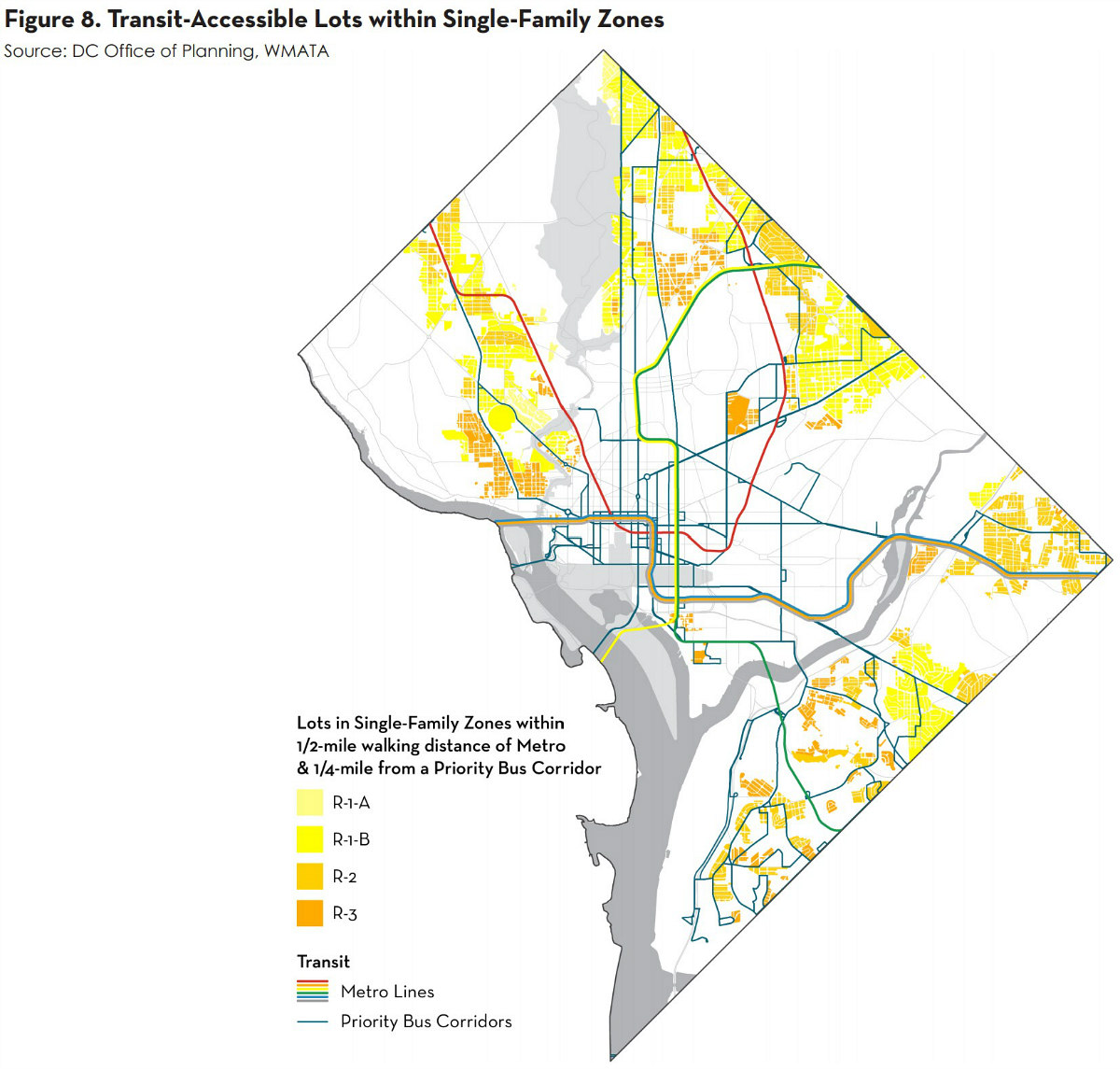
Gentle density in single-family zones can be prioritized in areas that are within access to a high-capacity transit corridor, which is defined as a half-mile from a Metro station and a quarter-mile from a stop on a priority bus corridor. So the Density Bros and Bras can chirp all they want about how single family housing zoning will not be changed because technically they are correct. That zoning area will still exist. However it will be superseded by this new 'gentle' densification 'upzoned' area within walking distance of public transportation corridors. |
Anonymous
Oh, the horror! |
Anonymous
Big Development and Bob take care of their basement bloggers. |
Anonymous
If the “gentle density” proposal changed nothing in SFH areas, why would Mayor Developer and OP propose it? Note that the transit corridor category for “gentle density” would cover 72 percent of the SFH lots in the District. The TBD “high-cost, high-opportunity” category presumably will include still more areas that are not within a quarter-mile of a bus stop. |
Anonymous
The purpose of zoning is to regulate more impactful uses to safeguard less impactful uses. Almost by definition, a less impactful use is allowed in a zone where more impactful uses are permitted. So you can build a SFH in a zone that permits apartment buildings and you could build an apartment building in an area zoned for industrial uses. But not the reverse, which is the point of zoning. |
Anonymous
It’s a Trojan horse. |
Anonymous
Mayor and the OP propose the 'gentle density' upzoning as tool to get around the SFH zoning which the COMP Plan largely left intact. It is a little similar to the city's observance of the Height of Buildings Act of 1910. The act still exists, however, the city has simply overstruck its mention at every point in the Comp Plan. So the Act is still there, we just won't mention it because it is 'hard'. Note that the Height of Buildings act does provide a mechanism to build taller buildings, but it is 'hard' and would not allow the mayor to profit today. Exceptions to the Height of Buildings Act: The Basilica of the National Shrine of the Immaculate Conception, completed in 1959, was granted an exemption to the law by the District Zoning Commission. Hughes Memorial Tower. Old Post Office Building was grandfathered in, and remains as the tallest high-rise federal building in the district. One Franklin Square is the tallest commercial building in District of Columbia and the fifth highest building overall. |
Anonymous
The purpose of zoning, as you explain it, is basically to put single-family-house land use in the most sheltered, most protected category. As though apartments were a danger to single-family houses - or maybe people who live in apartments are a danger to people who live in single-family houses. |
Anonymous
|
Aren't the majority of houses in, say, RF-1 zoned rowhouse neighborhoods still single-family homes? I mean, sure there are some condo conversions and some basement apartments. But we're not talking about huge apartment buildings on residential streets here, because the height and setback limits of R-1 and R-2 zoning will still be in place. This just means that someone can decide to split their house into two units or maybe add an ADU. Which some people will do, and most people won't.
Scary! /s |
Anonymous
Setback limits are modified under the plan as well. That was a key component even in the Comp Plan. At the end of the day, under the new Single Family Zoning proposal in the District of Columbia, you can raze your SFH if it is within that 'walkable' distance to public transportation and build in its stead a taller (would depend on how far you were from the transit route. Taller if you were closer to the road, lower if you were at the half mile point) and closer to the sidewalk (covering a greater percentage of lots size) multi family dwelling in the middle of a SFH zoned neighborhood under the 'gentle density' plan. You would NOT get a highrise bout you would have one lot with one house with one family, now be converted to one lot with eight units (two units per floor for four stories). Would there be anything inherently 'wrong' with this as a one of? No, absolutely not. Would this happening as a concerted effort to increase density change the character of a neighborhood? Absolutely. 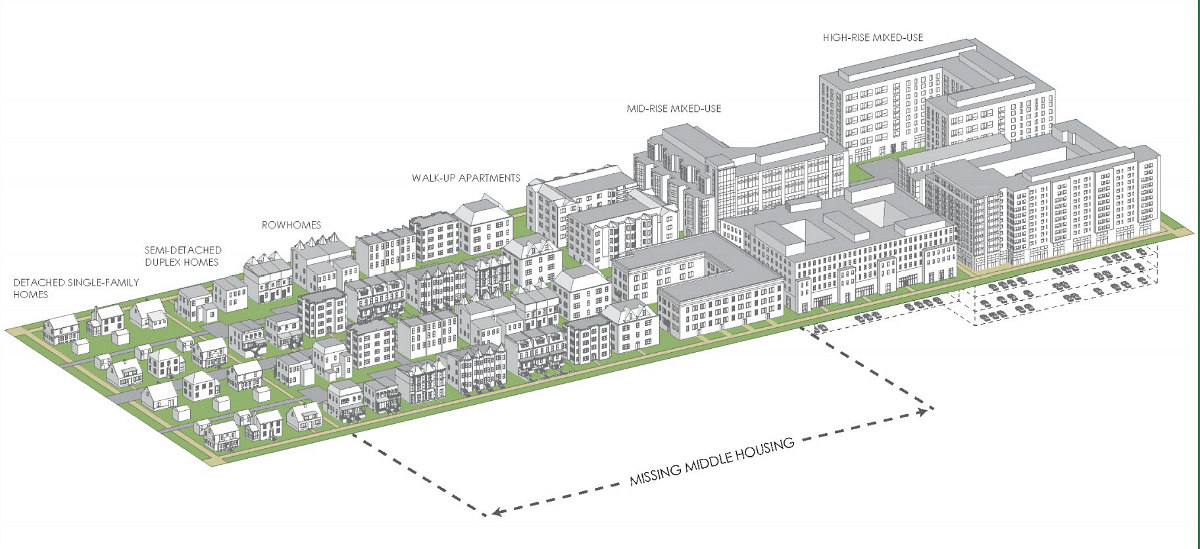
|
Anonymous
| Looking at the map, there are several neighborhoods that could be significantly affected by applying ‘gentle density’ to single family home zones. But the mayor must really have a thing about Cleveland Park because it’s like they’ve drawn a bullseye on it. The map shows that all the the SFH streets in CP could have apartment buildings added. When you also consider that the mayor proposes to increase building heights along Connecticut Ave to 12 - 13 floors, the change to CP could be fundamental and transformational. |
Anonymous
It’s also possible that even “small” apartment buildings built under gentle density would be able to add a habitable penthouse floor which would not be counted against the applicable height restrictions under zoning. So 4 story apartment buildings might be 5 story buildings in some cases. |