
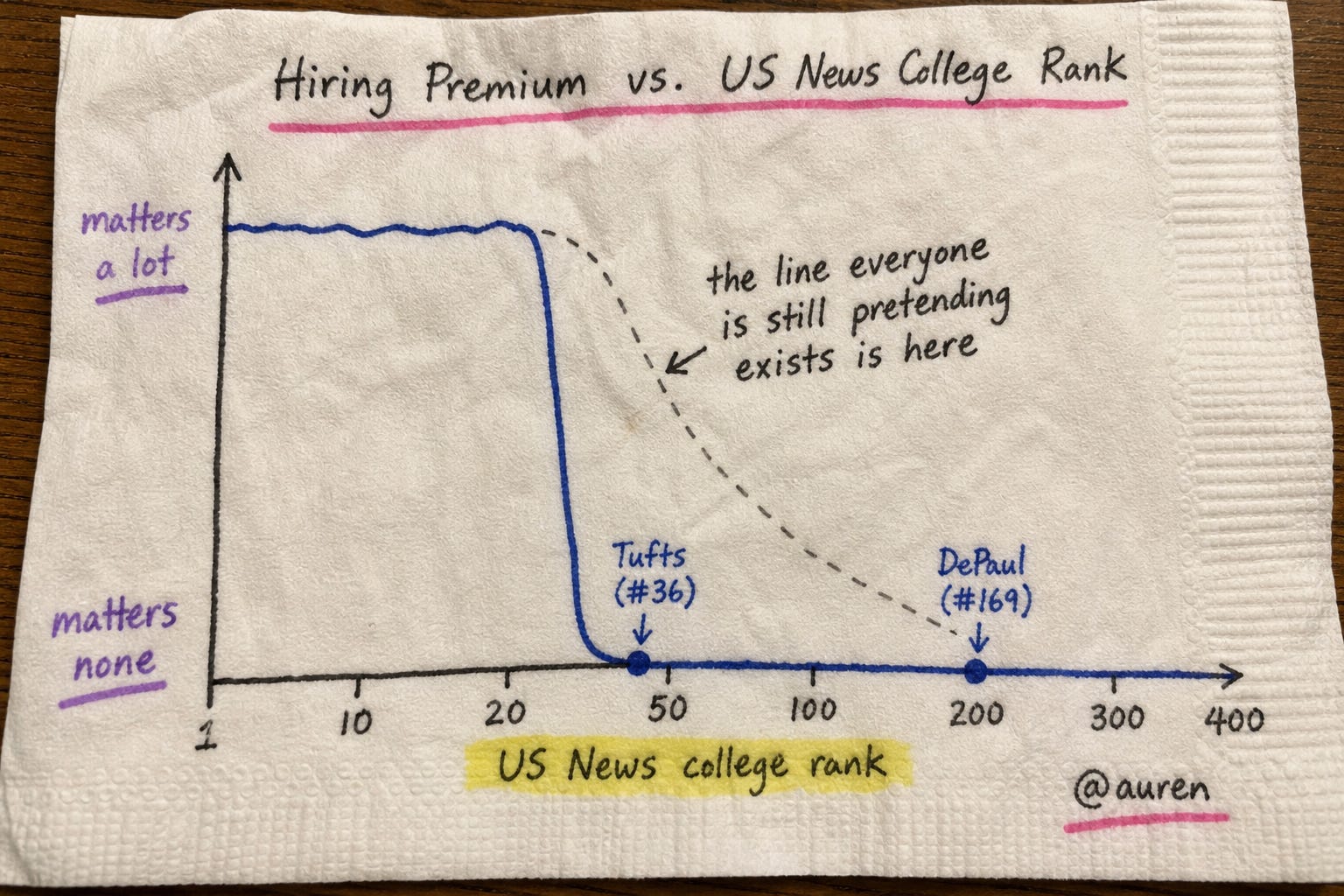
Auren Hoffman: the brand of your school stopped working
![[Post New]](/jforum/templates/default/images/icon_minipost_new.gif)
Anonymous
PP Not BSing a single bit. I never had a Mudd kid cross my desk but if they had I would have said “great school, smart kid” to myself and not have given it a second thought after that. A Waterloo kid would have a “ready to go” mental note because of their internships. If a Mudd kid got a spot in my team it would be because they were the best candidate, the school would have counted for zero in the process. |
Anonymous
Your treating your own personal anecdote as proof positive of how the industry works. Again, Harvey Mudd graduates factually make more on average than SJSU graduates, so the school clearly counts for someone. |
Anonymous
I’m pretty sure that it is a pretty desirable place to work. Tough, but desirable. |
Anonymous
They hire from US News rankings in the sense that they send recruiters to top schools but all other graduates have to email their resumes and hope for the best. |
Anonymous
| Newsflash: many people from HYP have very average careers and salaries. The same is true of other Ivies, “new Ivies,” and non elite schools. Top schools offer challenging academics and peers who were exceptional students between the ages of 14 and 18. That’s really it. |
Anonymous
Agree. Those peer groups have a lot of strengths, but life isn’t settled at 18. All schools have students that collectively form distribution curves. Academics. Privilege. Future professional success. The means vary but the curves overlap more than the DCUM crowd is capable of imagining. In my own experience, YLS classmates who are killing it professionally would have done just as well from any top 15 law school. |
Anonymous
is there something other than a graph on a napkin to back this up? |
Anonymous
That 300 point SAT difference is less meaningful in a test optional world. I think there is a brand dilution that has started to occur with test optional admissions when we started to see a critical mass of DePaul level student get into Tufts level schools. I have seen a lot of high-end employers expand their recruiting in the last few years and I think a lot of it has to do with the failure of these institutions to maintain their standards. Admission to these schools lose their signaling value. |
Anonymous
Do they? Major for major, experience for experience? I do not know, and frankly neither do you. Harvey Mudd is an outstanding college, absolutely top tier and its graduates are the same. I was not disparaging HMC or their graduates in the slightest. But, you've lost context. My post was in response to this post: "This list is for muggles. You need to consider the industries and audience unless the ranking's sole purpose is to impress your neighbors born before 1975. No one in Silicon Valley cares about Northwestern, a school known for journalism and radio. A hiring manager at FAANG will want a Harvey Mudd grad 10 out of 10 times over someone from Northwestern, Vanderbilt, Georgetown and at least 2 Ivies." A post that is nonsense, flat out not true. I know that it isn't true because I led good size teams in the group of companies mentioned and have interviewed hundreds, yes hundreds of candidates for SWE and engineering roles on the teams that I was a member of, adjacent too, or leading. It may be personal anecdote, but it is born out actual experience which seems to be quite rare in this forum. |
Anonymous
I think the impression is that sometimes the school name matters for the first job out of college and places like Harvey Mudd do better than a lot of other places. |
Anonymous
Sure "many" people have typical careers from ivies. But the average student at an ivy does on average better in life(measured by salary 10 yrs out, or by prestige of grad/professional school, or whether they end up CEO or VP at a top nonprofit or top company). The top 1/4 of ivy grads are far far more successful than the top 1/4 of average flagships. The chance to land "outlierish" opportunities that are popular DCUM and everywhere (T14 law, T20 med or phD, MBB or similar consulting, quant finance, fellowships such as Rhodes/Fulbright/Marshall) are much more likely from an ivy-level: they are all in reach for roughly the top 1/4 of these schools. The chances are slim to actually ZERO for schools a couple of tiers below, even for the very top students. |
Anonymous
Agree |