
Bathroom Humidity - Solutions Needed
![[Post New]](/jforum/templates/default/images/icon_minipost_new.gif)
Anonymous
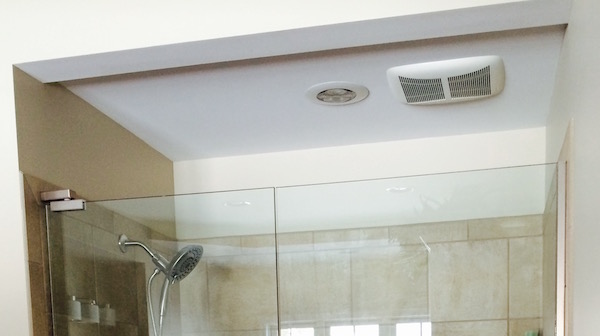
| feeling air and having it blow out 110cfm are two very different things. Try the smoke test. Does it exhaust the smoke? A dehumidifier is a turtle-paced solution to the problem. After a shower, the goal is to remove the moist air, not remove the moisture from the air. |
Anonymous
OK, let's do some science. You've got about 1000 cubic feet of air in that room. At room temperature air weighs about 0.075 pounds per cubic foot so that's about 75 pounds of air. Moisture content of air is measured in grains per pound, at saturation at 75F the moisture content of air is 131.7 grains per pound, so there's about 10,000 grains of water in the air. There are 7000 grains in a pound so that's about 1.5 pounds of water, which is about 24 ounces. You want to get the humidity down to around 50%, which means removing half of that humidity, or 12 ounces or 3/4 pint. Option 1 is to remove that humidity by replacing the air in the bathroom with air from somewhere else that contains less moisture. That's what the fan does, it exhausts the bathroom air and replacement air comes from either the rest of the house or outdoors. With 1000 cubic feet in the room and a fan that does 100 CFM ten minutes should replace all the air. Note that running the fan while the shower is running doesn't really do you any good, the shower can probably put humidity into the air faster than the fan can remove it. It's ten minutes after the shower stops that you need. And it has to be really exhausting the air. It's incredibly common for bath fans to be hooked up wrong, probably more common than not. Even if it's running and creating suction it could be just dumping the air back into the room. Option 2 would be to run a dehumidifier. A popular size is rated for 72 pints per day or 3 pints per hour, if you need to remove 3/4 that's 15 minutes worth of dehumidification. Again, it has to be after the shower stops. You can look at how much water is in the tank to see how much it's removing. If one or the other of those two steps -- removing all of the humidity in the air -- doesn't work, then you need to consider the possibility that something else other than the shower is your source of moisture. |
Anonymous
The HVAC vent will help bringing in dry air from the rest of the house and make the fan more effective. |
Anonymous
Wow! thank you for taking the time to fully explain this! Okay so we need a larger dehumidifier for sure instead of the punie one we purchased. One thing that I guess I should have mentioned but didn't is that this bathroom does not have an HVAC vent. When we did our whole house remodel two years ago we requested that the contractor put one in, he did not. That's another story for another day. I mentioned to DH yesterday that I thought not having an HVAC vent in there was not helping matters, and it seems like this is an accurate observation. So really our only option is option 2! Thank you again! |
Anonymous
| Well not having an hvac vent is a very important detail. Also, how much of a gap is underneath the door (where air from the rest of the house comes in). Bottom line, you still need to see if it's actually functioning anywhere close to the design of 110cfm. I stand by my suggestion that you want to remove the moist air with the fan, not waste the energy to remove the moisture from the air with a dehumidifier. |
Anonymous
Same. |
Anonymous
In the world of building science it's a highly controversial question whether venting or dehumidifying is more energy-efficient. It depends on the time of year, because the air that is vented needs to be replaced with air from outside, and that air needs to be conditioned. If it's a nice spring day and it's 72F outside, yeah bringing in outside air is more efficient. But if it's the middle of winter and it's 20F outside and that air needs to be heated, or if it's August and it's 90F outside and humid and the air needs to be cooled and dehumidified, then dehumidifying might be more efficient. In fact in August it's entirely possible that the outside air has a higher moisture content than the air being vented. The advantage of a vent fan is that it's a much simpler device than a dehumidifier. Energy nerds will use an energy recovery ventilator, where the exhaust vent is balanced with a makeup air vent and the exhaust air is run through a heat exchanger which transfers energy (or cooling, as appropriate) to the incoming air. |
Anonymous
I agree that the most likely situation -- Occam's Razor, if you will -- is that the fan just isn't working properly. And that the dehumidifier they brought in isn't working either. |
Anonymous
It didn't move the dial, at all. Unless you call collecting 1/2 cup of water over the course of 24 hours + 2 showers, "moving the dial". The ceiling is still dripping with water literally, with the humidifier running 24/7. But if you read my comments upthread you will see that I acknowledge that we need a more powerful one. |
Anonymous
OP here - yes the fan is always on. Always. The window stays open until the evening - 12 months out of the year. The temps here range from 50* at night to 80* during the day. The fan butts up against and exterior wall, I put my hand under the output vent outside while the fan was running and air was coming out. The attic is not involved here. We're going to put in a portable fan today to see if it helps. |
Anonymous
Get a 20" box fan from Amazon and put it in the window, blowing out. |
Anonymous
The window is not large enough, but more than anything the window is inside the shower so that's a big no-go. We put an oscillating fan in there this morning, let's see how it goes! |
Anonymous
Just how hot do the kids shower? 
|
Anonymous
| Yeah, this isn't going to get fixed until you run an HVAC vent through there. You need more ventilation with cooler air, which holds less moisture than warmer air. |
Anonymous
| NP. I'm on team box fan. Except, instead of putting it in the window (where it apparently doesn't fit), put it in the doorway facing inward. Blow lots of air into the bathroom after a shower. The drier house air will fill the room, and the humid air will rush out of the room above the fan. I do this sometimes with a pedestal fan to dry out the bathroom, and especially the shower. You'd be surprised how quickly it dries out the room. You might only need to do it for 20-30 minutes. |