U.S. Church Membership Falls Below Majority for First Time

Anonymous
Anonymous wrote:
Anonymous wrote:
Anonymous wrote:
Anonymous wrote:
Anonymous wrote:For the first time in U.S. history, more than 50% of Americans is Agnostic, Atheist, or Non-practicing.

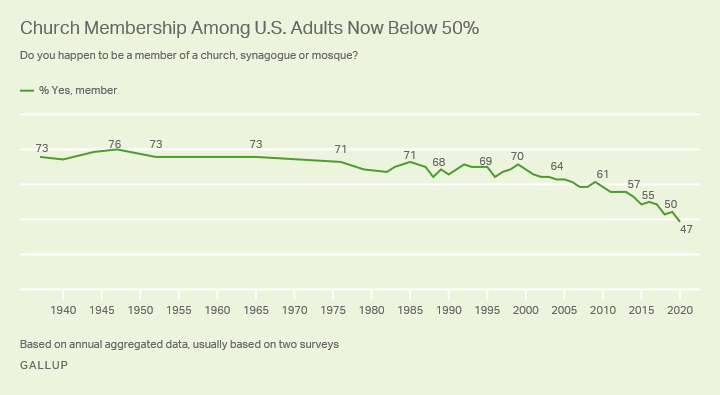
Americans' membership in houses of worship continued to decline last year, dropping below 50% for the first time in Gallup's eight-decade trend. In 2020, 47% of Americans said they belonged to a church, synagogue or mosque, down from 50% in 2018 and 70% in 1999.


https://news.gallup.com/poll/341963/church-membership-falls-below-majority-first-time.aspx


I do not think you are correct. Being a member of a church is different than attending church, you can attend church and not be a member. Also lots of religious ppl do not attend a traditional worship service weekly.


NP. Agreed. I think there's three things kind of being conflated here: membership in a church, regular attendance at a church, and religious belief. Obviously they overlap to some degree. Membership is an interesting thing to single out, because membership in civic organizations overall has been declining for years. It's not surprising to see church membership go the way of the Elk's Club, but I'm not sure you can draw any conclusions about religious belief from that.


Yeah, a lot of people who wouldn't dream of joining a church still pray when something terrible befalls them and all other attempts to fix it have failed.

When your options run out, might as well reach out to an invisible supernatural being, right?


Still better than mocking other people in need and pain while you sit at home and do absolutely nothing for your fellow man. As noted above, at least churches put their money and time where their mouth is and help their members. Meanwhile, the mockers and atheists wait for the government to force/mandate people to help people. So ridiculous.


Agree with the point about some atheists’ nastiness, as demonstrated every day on DCUM. But there is a role for government, houses of worship can’t do it alone.
Anonymous
Anonymous wrote:
Anonymous wrote:
Anonymous wrote:
Anonymous wrote:
Anonymous wrote:
Anonymous wrote:For the first time in U.S. history, more than 50% of Americans is Agnostic, Atheist, or Non-practicing.

Americans' membership in houses of worship continued to decline last year, dropping below 50% for the first time in Gallup's eight-decade trend. In 2020, 47% of Americans said they belonged to a church, synagogue or mosque, down from 50% in 2018 and 70% in 1999.


https://news.gallup.com/poll/341963/church-membership-falls-below-majority-first-time.aspx


I do not think you are correct. Being a member of a church is different than attending church, you can attend church and not be a member. Also lots of religious ppl do not attend a traditional worship service weekly.


NP. Agreed. I think there's three things kind of being conflated here: membership in a church, regular attendance at a church, and religious belief. Obviously they overlap to some degree. Membership is an interesting thing to single out, because membership in civic organizations overall has been declining for years. It's not surprising to see church membership go the way of the Elk's Club, but I'm not sure you can draw any conclusions about religious belief from that.


Yeah, a lot of people who wouldn't dream of joining a church still pray when something terrible befalls them and all other attempts to fix it have failed.

When your options run out, might as well reach out to an invisible supernatural being, right?


Still better than mocking other people in need and pain while you sit at home and do absolutely nothing for your fellow man. As noted above, at least churches put their money and time where their mouth is and help their members. Meanwhile, the mockers and atheists wait for the government to force/mandate people to help people. So ridiculous.


Agree with the point about some atheists’ nastiness, as demonstrated every day on DCUM. But there is a role for government, houses of worship can’t do it alone.


Yes, but attacking churches and religious people but then wanting to have what they do replicated by government is hypocritical.
Anonymous
Anonymous wrote:
Anonymous wrote:
Anonymous wrote:
Anonymous wrote:
Anonymous wrote:
Anonymous wrote:
Anonymous wrote:For the first time in U.S. history, more than 50% of Americans is Agnostic, Atheist, or Non-practicing.

Americans' membership in houses of worship continued to decline last year, dropping below 50% for the first time in Gallup's eight-decade trend. In 2020, 47% of Americans said they belonged to a church, synagogue or mosque, down from 50% in 2018 and 70% in 1999.


https://news.gallup.com/poll/341963/church-membership-falls-below-majority-first-time.aspx


I do not think you are correct. Being a member of a church is different than attending church, you can attend church and not be a member. Also lots of religious ppl do not attend a traditional worship service weekly.


NP. Agreed. I think there's three things kind of being conflated here: membership in a church, regular attendance at a church, and religious belief. Obviously they overlap to some degree. Membership is an interesting thing to single out, because membership in civic organizations overall has been declining for years. It's not surprising to see church membership go the way of the Elk's Club, but I'm not sure you can draw any conclusions about religious belief from that.


Yeah, a lot of people who wouldn't dream of joining a church still pray when something terrible befalls them and all other attempts to fix it have failed.

When your options run out, might as well reach out to an invisible supernatural being, right?


Still better than mocking other people in need and pain while you sit at home and do absolutely nothing for your fellow man. As noted above, at least churches put their money and time where their mouth is and help their members. Meanwhile, the mockers and atheists wait for the government to force/mandate people to help people. So ridiculous.


Agree with the point about some atheists’ nastiness, as demonstrated every day on DCUM. But there is a role for government, houses of worship can’t do it alone.


Yes, but attacking churches and religious people but then wanting to have what they do replicated by government is hypocritical.


Pp here. Why is it hypocritical? Are houses of worship building roads, and do you think they ever could? Do houses of worship have enough resources to support seniors AND every school kid AND small business loans AND day care? Especially with the results above, that membership is falling?
Anonymous
Anonymous wrote:
Makes sense!

I attended church for my entire life, had Billy Graham over for dinner, considered being a missing doc, etc., until an employee of a large United Methodist church in NoVa taught my preschool kids how sex works. Pastor supported the employee so we had no choice but to leave so that nothing else happened.

Never going to look at a church the same again.

I’m so glad to hear that church attendance is dropping!


What was Billy Graham like?
Anonymous
Anonymous wrote:
Anonymous wrote:
Anonymous wrote:
Anonymous wrote:
Anonymous wrote:
Anonymous wrote:
Anonymous wrote:
Anonymous wrote:For the first time in U.S. history, more than 50% of Americans is Agnostic, Atheist, or Non-practicing.

Americans' membership in houses of worship continued to decline last year, dropping below 50% for the first time in Gallup's eight-decade trend. In 2020, 47% of Americans said they belonged to a church, synagogue or mosque, down from 50% in 2018 and 70% in 1999.


https://news.gallup.com/poll/341963/church-membership-falls-below-majority-first-time.aspx


I do not think you are correct. Being a member of a church is different than attending church, you can attend church and not be a member. Also lots of religious ppl do not attend a traditional worship service weekly.


NP. Agreed. I think there's three things kind of being conflated here: membership in a church, regular attendance at a church, and religious belief. Obviously they overlap to some degree. Membership is an interesting thing to single out, because membership in civic organizations overall has been declining for years. It's not surprising to see church membership go the way of the Elk's Club, but I'm not sure you can draw any conclusions about religious belief from that.


Yeah, a lot of people who wouldn't dream of joining a church still pray when something terrible befalls them and all other attempts to fix it have failed.

When your options run out, might as well reach out to an invisible supernatural being, right?


Still better than mocking other people in need and pain while you sit at home and do absolutely nothing for your fellow man. As noted above, at least churches put their money and time where their mouth is and help their members. Meanwhile, the mockers and atheists wait for the government to force/mandate people to help people. So ridiculous.


Agree with the point about some atheists’ nastiness, as demonstrated every day on DCUM. But there is a role for government, houses of worship can’t do it alone.


Yes, but attacking churches and religious people but then wanting to have what they do replicated by government is hypocritical.


Pp here. Why is it hypocritical? Are houses of worship building roads, and do you think they ever could? Do houses of worship have enough resources to support seniors AND every school kid AND small business loans AND day care? Especially with the results above, that membership is falling?


I don’t understand this post tbh.
Anonymous
Anonymous wrote:
Anonymous wrote:
Anonymous wrote:
Anonymous wrote:I fear we'll very likely see increasing effects in the areas of charitable giving and volunteerism as religious affinity weakens. Our society is just not developing enough civic-mindedness in secular individuals to make up the difference and the government sure isn't either.

http://marripedia.org/effects_of_religious_practice_on_charity


Too bad that you think people's generosity is so tied to the hope for eternal life that people won't be generous with their time or money unless they believe it will assure them a place in heaven.


Well, church-going conservatives give more to charity than atheist liberals, so I'd say that's a fair assessment.

"Religious practice is the behavioral variable most consistently associated with generous giving. Charitable effort correlates strongly with the frequency with which a person attends religious services. Evangelical Protestants and Mormons in particular are strong givers. Compared to Protestant affiliation, both Catholic affiliation and Jewish affiliation reduce the scope of average giving, when other influences are held constant.

Finer-grain numbers from the PSID show that the faithful don’t just give to religious causes; they are also much more likely to give to secular causes than the non-religious. Among Americans who report that they “never” attend religious services, just less than half give any money at all to secular causes. People who attend services 27-52 times per year, though, give money to secular charities in two thirds of all cases. (See page 1138.)

Sociologist Robert Putnam has chronicled the many pro-social and philanthropic overflow effects of religious practice. Not only is half of all American personal philanthropy and half of all volunteering directly religious in character, but nearly half of all associational membership in the U.S. is church-related. Religious practice links us in webs of mutual knowledge, responsibility, and support like no other influence.

Indeed, faith is as important as basic financial success in increasing giving. And religious conviction is often what separates one sub-group from another when it comes to charitable practice. For instance, African Americans, who are generally more religious than whites, are consequently 18 percent bigger givers when households of the same income, region, education, and so forth are compared."
https://www.philanthropyroundtable.org/almanac/statistics/who-gives


Just raise taxes. You don’t need religion.


This is really a sad statement. Religious people feel that giving to charity changes your heart. It is making a sacrifice to place the needs of others above our own selfish desires. A choice that makes us better people.

Government coercion with the penalty of law only breeds resentment, as others can vote to steal what they have not earned. It doesn't make this a better place to live.

It is funny, though. If you wanted to give more to the needy, you already would be. Instead, you want to have taxes raised on other people.
Anonymous
Look at what the American evangelical and right wing Catholic taliban are doing to the US. No one wants to be a part of that, so younger people are giving up religion entirely.
Anonymous
Anonymous wrote:
Agree with the point about some atheists’ nastiness, as demonstrated every day on DCUM. But there is a role for government, houses of worship can’t do it alone.

Then leave. Create your own blog.
Anonymous
Anonymous wrote:Look at what the American evangelical and right wing Catholic taliban are doing to the US. No one wants to be a part of that, so younger people are giving up religion entirely.


That’s not what the link says. And please don’t share more surveys about attendance because we’ll just come back again about religiosity.

Why are DCUM’s atheists so poor at logic, besides being mean?
Anonymous
Anonymous wrote:
Anonymous wrote:
Agree with the point about some atheists’ nastiness, as demonstrated every day on DCUM. But there is a role for government, houses of worship can’t do it alone.

Then leave. Create your own blog.


QED, LOL
Anonymous
Anonymous wrote:
Anonymous wrote:
Anonymous wrote:
Anonymous wrote:
Anonymous wrote:I fear we'll very likely see increasing effects in the areas of charitable giving and volunteerism as religious affinity weakens. Our society is just not developing enough civic-mindedness in secular individuals to make up the difference and the government sure isn't either.

http://marripedia.org/effects_of_religious_practice_on_charity


Too bad that you think people's generosity is so tied to the hope for eternal life that people won't be generous with their time or money unless they believe it will assure them a place in heaven.


Well, church-going conservatives give more to charity than atheist liberals, so I'd say that's a fair assessment.

"Religious practice is the behavioral variable most consistently associated with generous giving. Charitable effort correlates strongly with the frequency with which a person attends religious services. Evangelical Protestants and Mormons in particular are strong givers. Compared to Protestant affiliation, both Catholic affiliation and Jewish affiliation reduce the scope of average giving, when other influences are held constant.

Finer-grain numbers from the PSID show that the faithful don’t just give to religious causes; they are also much more likely to give to secular causes than the non-religious. Among Americans who report that they “never” attend religious services, just less than half give any money at all to secular causes. People who attend services 27-52 times per year, though, give money to secular charities in two thirds of all cases. (See page 1138.)

Sociologist Robert Putnam has chronicled the many pro-social and philanthropic overflow effects of religious practice. Not only is half of all American personal philanthropy and half of all volunteering directly religious in character, but nearly half of all associational membership in the U.S. is church-related. Religious practice links us in webs of mutual knowledge, responsibility, and support like no other influence.

Indeed, faith is as important as basic financial success in increasing giving. And religious conviction is often what separates one sub-group from another when it comes to charitable practice. For instance, African Americans, who are generally more religious than whites, are consequently 18 percent bigger givers when households of the same income, region, education, and so forth are compared."
https://www.philanthropyroundtable.org/almanac/statistics/who-gives


Just raise taxes. You don’t need religion.


This is really a sad statement. Religious people feel that giving to charity changes your heart. It is making a sacrifice to place the needs of others above our own selfish desires. A choice that makes us better people.

Government coercion with the penalty of law only breeds resentment, as others can vote to steal what they have not earned. It doesn't make this a better place to live.

It is funny, though. If you wanted to give more to the needy, you already would be. Instead, you want to have taxes raised on other people.


This post is really good. Nothing is stopping anyone from helping the poor and needy people in our country right now. Nothing is stopping anyone from voluntarily paying more taxes to the government. Nothing is stopping atheists from starting their own network/group/organization to help poor and needy Americans. Atheist, agnostic, non-religious ppl could do what churches do without religion. Why don’t they? I’ve noticed on other forums on dcum when a poster is in desperate financial straits, they are often told here to seek various churches and religious orgs out for assistance. But then here churches are religious institutions are attacked terribly.
Anonymous
Anonymous wrote:
Anonymous wrote:Look at what the American evangelical and right wing Catholic taliban are doing to the US. No one wants to be a part of that, so younger people are giving up religion entirely.


That’s not what the link says. And please don’t share more surveys about attendance because we’ll just come back again about religiosity.

Why are DCUM’s atheists so poor at logic, besides being mean?


IDK, but they aren’t the big brains they think themselves to be. Also, I don’t think the “atheists” posting here are atheists. I think they are anti-theists using atheism as a cover. They are very nasty and mean and bitter people. I can’t imagine them doing a single thing for their fellow man/woman/child voluntarily; they seem to despise people. And I know some very nice and kind and caring atheists IRL.
Anonymous
Anonymous wrote:
Anonymous wrote:
Anonymous wrote:Look at what the American evangelical and right wing Catholic taliban are doing to the US. No one wants to be a part of that, so younger people are giving up religion entirely.


That’s not what the link says. And please don’t share more surveys about attendance because we’ll just come back again about religiosity.

Why are DCUM’s atheists so poor at logic, besides being mean?


IDK, but they aren’t the big brains they think themselves to be. Also, I don’t think the “atheists” posting here are atheists. I think they are anti-theists using atheism as a cover. They are very nasty and mean and bitter people. I can’t imagine them doing a single thing for their fellow man/woman/child voluntarily; they seem to despise people. And I know some very nice and kind and caring atheists IRL.


Well put, and I agree on all points.
Anonymous
Anonymous wrote:
Anonymous wrote:
Anonymous wrote:
Anonymous wrote:
Anonymous wrote:
Anonymous wrote:I fear we'll very likely see increasing effects in the areas of charitable giving and volunteerism as religious affinity weakens. Our society is just not developing enough civic-mindedness in secular individuals to make up the difference and the government sure isn't either.

http://marripedia.org/effects_of_religious_practice_on_charity


Too bad that you think people's generosity is so tied to the hope for eternal life that people won't be generous with their time or money unless they believe it will assure them a place in heaven.


Well, church-going conservatives give more to charity than atheist liberals, so I'd say that's a fair assessment.

"Religious practice is the behavioral variable most consistently associated with generous giving. Charitable effort correlates strongly with the frequency with which a person attends religious services. Evangelical Protestants and Mormons in particular are strong givers. Compared to Protestant affiliation, both Catholic affiliation and Jewish affiliation reduce the scope of average giving, when other influences are held constant.

Finer-grain numbers from the PSID show that the faithful don’t just give to religious causes; they are also much more likely to give to secular causes than the non-religious. Among Americans who report that they “never” attend religious services, just less than half give any money at all to secular causes. People who attend services 27-52 times per year, though, give money to secular charities in two thirds of all cases. (See page 1138.)

Sociologist Robert Putnam has chronicled the many pro-social and philanthropic overflow effects of religious practice. Not only is half of all American personal philanthropy and half of all volunteering directly religious in character, but nearly half of all associational membership in the U.S. is church-related. Religious practice links us in webs of mutual knowledge, responsibility, and support like no other influence.

Indeed, faith is as important as basic financial success in increasing giving. And religious conviction is often what separates one sub-group from another when it comes to charitable practice. For instance, African Americans, who are generally more religious than whites, are consequently 18 percent bigger givers when households of the same income, region, education, and so forth are compared."
https://www.philanthropyroundtable.org/almanac/statistics/who-gives


Just raise taxes. You don’t need religion.


This is really a sad statement. Religious people feel that giving to charity changes your heart. It is making a sacrifice to place the needs of others above our own selfish desires. A choice that makes us better people.

Government coercion with the penalty of law only breeds resentment, as others can vote to steal what they have not earned. It doesn't make this a better place to live.

It is funny, though. If you wanted to give more to the needy, you already would be. Instead, you want to have taxes raised on other people.


This post is really good. Nothing is stopping anyone from helping the poor and needy people in our country right now. Nothing is stopping anyone from voluntarily paying more taxes to the government. Nothing is stopping atheists from starting their own network/group/organization to help poor and needy Americans. Atheist, agnostic, non-religious ppl could do what churches do without religion. Why don’t they? I’ve noticed on other forums on dcum when a poster is in desperate financial straits, they are often told here to seek various churches and religious orgs out for assistance. But then here churches are religious institutions are attacked terribly.


They do though, don't they? The red cross, doctors without borders, planned parenthood, toys for tots, various food banks, and thousands and thousands of 501c3 charities across the US are secular. (Watch one of those have religious roots that I am ignorant of--the point stands that many don't). I donate and volunteer to several that are close to my heart that have zero religious affiliation.

Don't get me wrong, religious groups do plenty of good, charitable work too! But they don't have the market cornered on charity work.
Anonymous
Anonymous wrote:
Anonymous wrote:
Anonymous wrote:
Anonymous wrote:
Anonymous wrote:
Anonymous wrote:
Anonymous wrote:I fear we'll very likely see increasing effects in the areas of charitable giving and volunteerism as religious affinity weakens. Our society is just not developing enough civic-mindedness in secular individuals to make up the difference and the government sure isn't either.

http://marripedia.org/effects_of_religious_practice_on_charity


Too bad that you think people's generosity is so tied to the hope for eternal life that people won't be generous with their time or money unless they believe it will assure them a place in heaven.


Well, church-going conservatives give more to charity than atheist liberals, so I'd say that's a fair assessment.

"Religious practice is the behavioral variable most consistently associated with generous giving. Charitable effort correlates strongly with the frequency with which a person attends religious services. Evangelical Protestants and Mormons in particular are strong givers. Compared to Protestant affiliation, both Catholic affiliation and Jewish affiliation reduce the scope of average giving, when other influences are held constant.

Finer-grain numbers from the PSID show that the faithful don’t just give to religious causes; they are also much more likely to give to secular causes than the non-religious. Among Americans who report that they “never” attend religious services, just less than half give any money at all to secular causes. People who attend services 27-52 times per year, though, give money to secular charities in two thirds of all cases. (See page 1138.)

Sociologist Robert Putnam has chronicled the many pro-social and philanthropic overflow effects of religious practice. Not only is half of all American personal philanthropy and half of all volunteering directly religious in character, but nearly half of all associational membership in the U.S. is church-related. Religious practice links us in webs of mutual knowledge, responsibility, and support like no other influence.

Indeed, faith is as important as basic financial success in increasing giving. And religious conviction is often what separates one sub-group from another when it comes to charitable practice. For instance, African Americans, who are generally more religious than whites, are consequently 18 percent bigger givers when households of the same income, region, education, and so forth are compared."
https://www.philanthropyroundtable.org/almanac/statistics/who-gives


Just raise taxes. You don’t need religion.


This is really a sad statement. Religious people feel that giving to charity changes your heart. It is making a sacrifice to place the needs of others above our own selfish desires. A choice that makes us better people.

Government coercion with the penalty of law only breeds resentment, as others can vote to steal what they have not earned. It doesn't make this a better place to live.

It is funny, though. If you wanted to give more to the needy, you already would be. Instead, you want to have taxes raised on other people.


This post is really good. Nothing is stopping anyone from helping the poor and needy people in our country right now. Nothing is stopping anyone from voluntarily paying more taxes to the government. Nothing is stopping atheists from starting their own network/group/organization to help poor and needy Americans. Atheist, agnostic, non-religious ppl could do what churches do without religion. Why don’t they? I’ve noticed on other forums on dcum when a poster is in desperate financial straits, they are often told here to seek various churches and religious orgs out for assistance. But then here churches are religious institutions are attacked terribly.


They do though, don't they? The red cross, doctors without borders, planned parenthood, toys for tots, various food banks, and thousands and thousands of 501c3 charities across the US are secular. (Watch one of those have religious roots that I am ignorant of--the point stands that many don't). I donate and volunteer to several that are close to my heart that have zero religious affiliation.

Don't get me wrong, religious groups do plenty of good, charitable work too! But they don't have the market cornered on charity work.


DP. But neither religious nor secular groups can perform all the functions government does. That was the original question.
post reply Forum Index » Religion
Message Quick Reply
Go to: