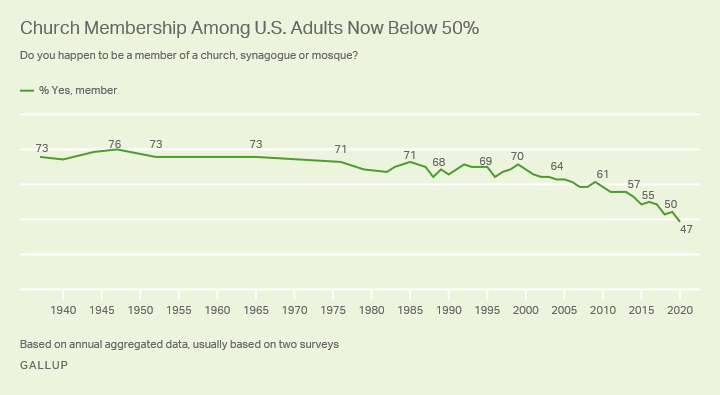
U.S. Church Membership Falls Below Majority for First Time

Anonymous
Anonymous wrote:Wokeness & covid extremism are the new religion for many.


covid "extremism" = getting vaccinated and wearing masks indoors
Anonymous
Anonymous wrote:For the first time in U.S. history, more than 50% of Americans is Agnostic, Atheist, or Non-practicing.

Americans' membership in houses of worship continued to decline last year, dropping below 50% for the first time in Gallup's eight-decade trend. In 2020, 47% of Americans said they belonged to a church, synagogue or mosque, down from 50% in 2018 and 70% in 1999.


https://news.gallup.com/poll/341963/church-membership-falls-below-majority-first-time.aspx


I do not think you are correct. Being a member of a church is different than attending church, you can attend church and not be a member. Also lots of religious ppl do not attend a traditional worship service weekly.
Anonymous
Anonymous wrote:
Anonymous wrote:
Anonymous wrote:There is hope after all.


I don't know. I am an atheist myself, but some of these churches do a lot of good: fostering social connections, helping the poor etc.
I think it is mainly the mainstream protestant and catholic churches that are losing members, the crazy anti-vaccine pro-Trump gospel of prosperity ones are doing fine...

And what are we replacing the church-going with? How do we form the social bonds that we need to stop polarization and isolation?


Like other nations do - with government safety nets. Subsidized daycares for everyone, not just piecemeal stuff for people connected to a church. Universal health care instead of Go-fund-mes and church meal trains. Parental leave for mothers and fathers instead of getting someone at church to watch your first kid while you're in the hospital giving birth to your second kid.

The USA is so backward in this social area.


You mean church people have been ultra forward in this area? Caring for others and helping with daycare, family emergencies, etc? So the government will be re-creating what churches do to help Americans? lol.
Anonymous
OP this 2017 article talks about how US evangelicals change when they wander away from a church. The picture it paints is positive on homophobia, but otherwise it's not so rosy: increased intolerance, less concern for community, the outcast, and the poor. I wish the researchers would do a follow-up study.

Breaking Faith: The culture war over religious morality has faded; in its place is something much worse.
https://www.theatlantic.com/magazine/archive/2017/04/breaking-faith/517785/

Personally I am for the government safety net *plus* having vibrant communities of faith, for many of the reasons listed on this thread already.
Anonymous
Anonymous wrote:OP this 2017 article talks about how US evangelicals change when they wander away from a church. The picture it paints is positive on homophobia, but otherwise it's not so rosy: increased intolerance, less concern for community, the outcast, and the poor. I wish the researchers would do a follow-up study.

Breaking Faith: The culture war over religious morality has faded; in its place is something much worse.
https://www.theatlantic.com/magazine/archive/2017/04/breaking-faith/517785/

Personally I am for the government safety net *plus* having vibrant communities of faith, for many of the reasons listed on this thread already.

PP to clarify in case someone doesn't click on the article. Positive on homophobia = the ex-churchgoers exhibited less of it, not more.
Anonymous
Anonymous wrote:
Anonymous wrote:For the first time in U.S. history, more than 50% of Americans is Agnostic, Atheist, or Non-practicing.

Americans' membership in houses of worship continued to decline last year, dropping below 50% for the first time in Gallup's eight-decade trend. In 2020, 47% of Americans said they belonged to a church, synagogue or mosque, down from 50% in 2018 and 70% in 1999.


https://news.gallup.com/poll/341963/church-membership-falls-below-majority-first-time.aspx


I do not think you are correct. Being a member of a church is different than attending church, you can attend church and not be a member. Also lots of religious ppl do not attend a traditional worship service weekly.


NP. Agreed. I think there's three things kind of being conflated here: membership in a church, regular attendance at a church, and religious belief. Obviously they overlap to some degree. Membership is an interesting thing to single out, because membership in civic organizations overall has been declining for years. It's not surprising to see church membership go the way of the Elk's Club, but I'm not sure you can draw any conclusions about religious belief from that.
Anonymous
Anonymous wrote:Wokeness & covid extremism are the new religion for many.


Get a dictionary you need it.

No the cult of the fat orange reality star criminal who tried to overthrow the government of the US is the new religion of America. That group is quite high in it's Catholic membership hey not like the Supreme court conservative members are not catholic cult members.
Anonymous
Anonymous wrote:
Anonymous wrote:
Anonymous wrote:For the first time in U.S. history, more than 50% of Americans is Agnostic, Atheist, or Non-practicing.

Americans' membership in houses of worship continued to decline last year, dropping below 50% for the first time in Gallup's eight-decade trend. In 2020, 47% of Americans said they belonged to a church, synagogue or mosque, down from 50% in 2018 and 70% in 1999.


https://news.gallup.com/poll/341963/church-membership-falls-below-majority-first-time.aspx


I do not think you are correct. Being a member of a church is different than attending church, you can attend church and not be a member. Also lots of religious ppl do not attend a traditional worship service weekly.


NP. Agreed. I think there's three things kind of being conflated here: membership in a church, regular attendance at a church, and religious belief. Obviously they overlap to some degree. Membership is an interesting thing to single out, because membership in civic organizations overall has been declining for years. It's not surprising to see church membership go the way of the Elk's Club, but I'm not sure you can draw any conclusions about religious belief from that.


Yeah, a lot of people who wouldn't dream of joining a church still pray when something terrible befalls them and all other attempts to fix it have failed.

When your options run out, might as well reach out to an invisible supernatural being, right?
Anonymous
Anonymous wrote:
Anonymous wrote:
Anonymous wrote:For the first time in U.S. history, more than 50% of Americans is Agnostic, Atheist, or Non-practicing.

Americans' membership in houses of worship continued to decline last year, dropping below 50% for the first time in Gallup's eight-decade trend. In 2020, 47% of Americans said they belonged to a church, synagogue or mosque, down from 50% in 2018 and 70% in 1999.


https://news.gallup.com/poll/341963/church-membership-falls-below-majority-first-time.aspx


I do not think you are correct. Being a member of a church is different than attending church, you can attend church and not be a member. Also lots of religious ppl do not attend a traditional worship service weekly.


NP. Agreed. I think there's three things kind of being conflated here: membership in a church, regular attendance at a church, and religious belief. Obviously they overlap to some degree. Membership is an interesting thing to single out, because membership in civic organizations overall has been declining for years. It's not surprising to see church membership go the way of the Elk's Club, but I'm not sure you can draw any conclusions about religious belief from that.


Third poster who was going to post the same thing but you guys beat me to it. When I went to church, 1/3 of the regular attendees weren’t actually “members” for whatever reason. A few years ago at a friend’s church, the pastor said they had some people who had been attending for 20 years or more and still weren’t members, and he said that was OK. Then there are the religious people who don’t like organized religion—lots of them. So it’s a little premature to agree with OP’s claim that half the country is now atheist or agnostic.
Anonymous
Anonymous wrote:
Anonymous wrote:
Anonymous wrote:
Anonymous wrote:For the first time in U.S. history, more than 50% of Americans is Agnostic, Atheist, or Non-practicing.

Americans' membership in houses of worship continued to decline last year, dropping below 50% for the first time in Gallup's eight-decade trend. In 2020, 47% of Americans said they belonged to a church, synagogue or mosque, down from 50% in 2018 and 70% in 1999.


https://news.gallup.com/poll/341963/church-membership-falls-below-majority-first-time.aspx


I do not think you are correct. Being a member of a church is different than attending church, you can attend church and not be a member. Also lots of religious ppl do not attend a traditional worship service weekly.


NP. Agreed. I think there's three things kind of being conflated here: membership in a church, regular attendance at a church, and religious belief. Obviously they overlap to some degree. Membership is an interesting thing to single out, because membership in civic organizations overall has been declining for years. It's not surprising to see church membership go the way of the Elk's Club, but I'm not sure you can draw any conclusions about religious belief from that.


Third poster who was going to post the same thing but you guys beat me to it. When I went to church, 1/3 of the regular attendees weren’t actually “members” for whatever reason. A few years ago at a friend’s church, the pastor said they had some people who had been attending for 20 years or more and still weren’t members, and he said that was OK. Then there are the religious people who don’t like organized religion—lots of them. So it’s a little premature to agree with OP’s claim that half the country is now atheist or agnostic.


Although belief in God is taught and reinforced by regular attendance at a "house of worship", it also comes naturally (just as non-belief comes naturally, despite being indoctrinated into religion.) Lots of people just sense that something is out there, looking over them and protecting them.
Anonymous
Anonymous wrote:
Anonymous wrote:
Anonymous wrote:
Anonymous wrote:For the first time in U.S. history, more than 50% of Americans is Agnostic, Atheist, or Non-practicing.

Americans' membership in houses of worship continued to decline last year, dropping below 50% for the first time in Gallup's eight-decade trend. In 2020, 47% of Americans said they belonged to a church, synagogue or mosque, down from 50% in 2018 and 70% in 1999.


https://news.gallup.com/poll/341963/church-membership-falls-below-majority-first-time.aspx


I do not think you are correct. Being a member of a church is different than attending church, you can attend church and not be a member. Also lots of religious ppl do not attend a traditional worship service weekly.


NP. Agreed. I think there's three things kind of being conflated here: membership in a church, regular attendance at a church, and religious belief. Obviously they overlap to some degree. Membership is an interesting thing to single out, because membership in civic organizations overall has been declining for years. It's not surprising to see church membership go the way of the Elk's Club, but I'm not sure you can draw any conclusions about religious belief from that.


Third poster who was going to post the same thing but you guys beat me to it. When I went to church, 1/3 of the regular attendees weren’t actually “members” for whatever reason. A few years ago at a friend’s church, the pastor said they had some people who had been attending for 20 years or more and still weren’t members, and he said that was OK. Then there are the religious people who don’t like organized religion—lots of them. So it’s a little premature to agree with OP’s claim that half the country is now atheist or agnostic.


Still, declining membership suggests that there is also declining attendance of people who are not members. It's unlikely that people who attended but never joined would be attending in the same or greater numbers, while members were dropping off.

In fact, I bet membership is used as a barometer of religiosity because it is easier to track than attendance.
Anonymous
Anonymous wrote:
Anonymous wrote:
Anonymous wrote:
Anonymous wrote:
Anonymous wrote:For the first time in U.S. history, more than 50% of Americans is Agnostic, Atheist, or Non-practicing.

Americans' membership in houses of worship continued to decline last year, dropping below 50% for the first time in Gallup's eight-decade trend. In 2020, 47% of Americans said they belonged to a church, synagogue or mosque, down from 50% in 2018 and 70% in 1999.


https://news.gallup.com/poll/341963/church-membership-falls-below-majority-first-time.aspx


I do not think you are correct. Being a member of a church is different than attending church, you can attend church and not be a member. Also lots of religious ppl do not attend a traditional worship service weekly.


NP. Agreed. I think there's three things kind of being conflated here: membership in a church, regular attendance at a church, and religious belief. Obviously they overlap to some degree. Membership is an interesting thing to single out, because membership in civic organizations overall has been declining for years. It's not surprising to see church membership go the way of the Elk's Club, but I'm not sure you can draw any conclusions about religious belief from that.


Third poster who was going to post the same thing but you guys beat me to it. When I went to church, 1/3 of the regular attendees weren’t actually “members” for whatever reason. A few years ago at a friend’s church, the pastor said they had some people who had been attending for 20 years or more and still weren’t members, and he said that was OK. Then there are the religious people who don’t like organized religion—lots of them. So it’s a little premature to agree with OP’s claim that half the country is now atheist or agnostic.


Still, declining membership suggests that there is also declining attendance of people who are not members. It's unlikely that people who attended but never joined would be attending in the same or greater numbers, while members were dropping off.

In fact, I bet membership is used as a barometer of religiosity because it is easier to track than attendance.


Attendance is super-easy to estimate and head-counting is done every week by lay members or clergy. What’s changed is that the stigma of not attending church has diminished, and millennials and gen X are less affiliated with any of the things their parents were. Neither of these is related to religiosity.
Anonymous
I’m a minister. I have no desire to ever step foot in a church again. I’ll continue to work as a hospice and hospital chaplain. But I’m done with organized religion. Watching the behavior of “Christians” over the last four -five years sealed it for me. I want no association with those nuts.
Anonymous
Anonymous wrote:
Anonymous wrote:
Anonymous wrote:
Anonymous wrote:For the first time in U.S. history, more than 50% of Americans is Agnostic, Atheist, or Non-practicing.

Americans' membership in houses of worship continued to decline last year, dropping below 50% for the first time in Gallup's eight-decade trend. In 2020, 47% of Americans said they belonged to a church, synagogue or mosque, down from 50% in 2018 and 70% in 1999.


https://news.gallup.com/poll/341963/church-membership-falls-below-majority-first-time.aspx


I do not think you are correct. Being a member of a church is different than attending church, you can attend church and not be a member. Also lots of religious ppl do not attend a traditional worship service weekly.


NP. Agreed. I think there's three things kind of being conflated here: membership in a church, regular attendance at a church, and religious belief. Obviously they overlap to some degree. Membership is an interesting thing to single out, because membership in civic organizations overall has been declining for years. It's not surprising to see church membership go the way of the Elk's Club, but I'm not sure you can draw any conclusions about religious belief from that.


Yeah, a lot of people who wouldn't dream of joining a church still pray when something terrible befalls them and all other attempts to fix it have failed.

When your options run out, might as well reach out to an invisible supernatural being, right?


Still better than mocking other people in need and pain while you sit at home and do absolutely nothing for your fellow man. As noted above, at least churches put their money and time where their mouth is and help their members. Meanwhile, the mockers and atheists wait for the government to force/mandate people to help people. So ridiculous.
Anonymous
Anonymous wrote:I’m a minister. I have no desire to ever step foot in a church again. I’ll continue to work as a hospice and hospital chaplain. But I’m done with organized religion. Watching the behavior of “Christians” over the last four -five years sealed it for me. I want no association with those nuts.


But there are plenty of charitable, loving churches. Not all are Trumpian evangelicals. Why not find a community you trust?
post reply Forum Index » Religion
Message Quick Reply
Go to: