
7 Math teachers are leaving Richard Montgomerry HS
![[Post New]](/jforum/templates/default/images/icon_minipost_new.gif)
Anonymous
The score doesn't carry the information BECAUSE of the 50% rule. If the 50% rule did not exist, then the score WOULD carry the information. |
Anonymous
So rather than teach our kids the value of grit and determination in the face of adversity, we lower the bar for them? How is that going to serve them well in life? |
Anonymous
|
"the meaningful scores are supposed to be a distribution between 50 and 100 with 75 as the median."
There's no mathematical rule that says this. "If scores bellow 50% are introduced it means more than one assessment is necessary to even hope to fight back to a mediocre grade" Not automatically true. "It's only when scoring is taken too literally, that there needs to be a rule" So you just unashamedly advocate for inflated grades. That's all you're doing here. "English teachers usually don't have a problem with this--there's no urge to put a 20% score on an essay that receiving an E" I know multiple English teachers. None of them think this way. |
Anonymous
Because 50 points isn't "no credit earned". A 0 is "no credit earned". |
Anonymous
50% is "no credit earned," it's "see you next year," it's failing, that's the *zero* of the course grading scale. If a student earns 50% on every assessment, they will fail the class. So where's this freebie? Whether talking about a course grade or an individual assignment grade, a value bellow 50% is out of range, just like a value over 100% is. Now the grading system may be set up to allow grades under 50%, but if there are no opportunities for extra credit to counterbalance, this does make it possible that badly failing a single test can do more harm to a grade than a perfect score can do good. |
Anonymous
It's ok. If we all keep voting democrat, everything will be free anyway! |
Anonymous
OK, so what were you taught about turning scoring rubrics into letter grades, because there's an issue there. If you look at a typical scoring rubric that assigns 0-5 points, and ask what sort of student (in terms of letter grade) gets this score, the tails are easy. All the points is an A, no points is an E. But typically 3 points sounds like C level work 4 points sounds like B work, and even 2 points doesn't sound like out right failure. So at the granular level, points are assigned on a different scale than the course grading scale, and they only agrees at the tails (roughly 0-30%=E 40%=D 60%=C, 80%=B, 100%=A). So then at the end of the course what is C level work? Is a "C" student someone who does "A" level work 70% of the time, or is a "C" student also someone who does "C" level work 100% of the time, or should it be both? Without some sort of correction, someone who does C level work 100% of the time, will only get 50% of the course points from every rubric and a 50% for the course. Is that actually someone who should fail the class? There needs to be some mechanism to bring the two systems into agreement. |
Anonymous
|
"If you look at a typical scoring rubric that assigns 0-5 points"
This is a false premise. A rubric that assigns 0-5 points is not even close to "typical". In fact, I don't know a single teacher that grades any major assignments out of only 5 points. "Without some sort of correction, someone who does C level work 100% of the time, will only get 50% of the course points from every rubric" No, someone who does C level work 100% of the time is getting between 70% and 79% of the course points. Kinda by definition. |
Anonymous
|
"50% is "no credit earned," it's "see you next year," it's failing, that's the *zero* of the course grading scale"
Wrong. A zero is the zero of the course grading scale. The 50% rule does not prevent a teacher from assigning a zero for any student that did not meet the basic requirements of the assignment/assessment. "If a student earns 50% on every assessment, they will fail the class." Also wrong, as that is not automatically the case. For a start, homework is required to be graded for completion and is required to be 10% of the grade. A student can fill out a homework assignment with gibberish and already have 10% of the course points. I have also taught courses that have a grade distribution that has another category for project grades. If the student does reasonably well on the project grades but earns less than 50% on all assessments, it is possible for such a student to pass the class. In fact, I've seen it happen. "if there are no opportunities for extra credit to counterbalance, this does make it possible that badly failing a single test can do more harm to a grade than a perfect score can do good." An incoherently-worded claim. And one that is not really supported by statistics, given that outliers in *either* direction will skew the mean. |
Anonymous
|
"Whether talking about a course grade or an individual assignment grade, a value bellow 50% is out of range"
This statement is only half-correct. An individual assignment grade cannot have a value between 0% and 50%, per the 50% rule. But that's not true for course grades. It's quite possible for a student to have a course grade between 0% and 50%, if said student has at least one 0. |
Anonymous
Yes, but end of the day, the student is assigned a letter grade, at which point, how badly the student failed is irrelevant. (But, yes, sometimes there are actual 0% grades, even with the 50% rule.) Qualitatively, letter grades are a normal distribution with mean at C and tails at A and E--at least that was the original concept.
Sure, sure, but that 50% test average doesn't *help* them pass the class, it's just things could be worse. If you want to analyze the situation, you can stop and look at the statistics of any part individually. E.g. if the complaint is the 50% rule applied at the assessment level, focus on tests.
Ah, but when talking about grading, you're not dealing with a normal distribution, instead you're dealing with a *truncated* normal. Here's an example (with a very high mean, but even if the mean closer to 75% truncation is typical): 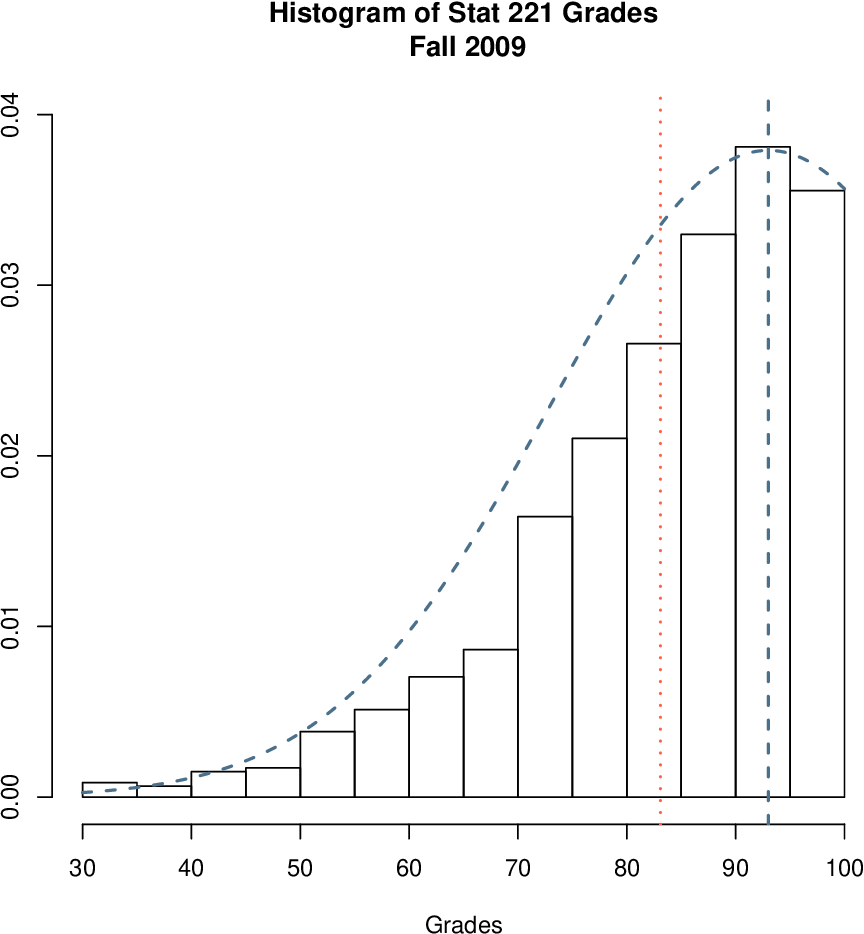
With a truncated normal, the situation is not symmetric, it's possible to get a a grade further bellow the mean than above the mean. (And, again, I'm talking about the Platonic mean of a C, not the mean of a specific group of students.) Without value judgement, truncation explains why a score bellow 50% is so painful. E.g. If a student gets a grade of 25% and they want to get back to a 75% average, the quickest way to do it would be to score 100% on the next three tests, (1*(25%) + 3*(100%))/4 = 75%. Likely a very difficult task for someone who just scored a 25%. The 50% rule is an example of a censored normal distribution. This is one way to remedy the situation, and reduce the impact of any one test. It would then be possible to get back into passing range after one assessment, (50% + 100%)/2 = 75%. Another possible remedy would be offering extra credit (eliminate the truncation by providing grading opportunities above 100%). This isn't allowed in MCPS. |
Anonymous
Again, you're distract by an unnecessary detail. Suppose instead you have a math test with 8 questions of varying value which totals to 100 points. The question is how is each question graded, and what sorts of answers lead to a given grade. E.g. if each question is all or nothing, then it's simple, the student would need to get all the points on at least 70% of the items to get a C on the test. But more typically the rubric assigns partial credit. If it does, how is the partial credit distributed? Is it distributed such that middling work gets 50% of the points or 70% of the points? It can be either way, but it certainly makes a difference in how total grades distribute.
See above. |
Anonymous
| Could anyone expain the 50% rule? If my child took a math test with 10 problems to solve and finished all but only got 5 correct answers, shoul$ he receive 50% for this rest? What if he only wrote his name but didnt try write anything ? What if he got 7 right answers? |
Anonymous
If your child only wrote him name, he would get a zero. If he answered 1/2 the question and ran out of time he would get a 50% regardless of whether they were correct. If he answered all 10 but remembered the formula wrong and did not get any correct answers he would get a 50%. 7 correct answers would be a 70% (assuming no partial credit etc) |
Anonymous
|
"Yes, but end of the day, the student is assigned a letter grade, at which point, how badly the student failed is irrelevant."
It's only irrelevant if you only care about grades and not about how much the student is actually learning. A student who earns a 58% is not the same as a student who earns an 8% when it comes to the percent of the course material they have mastered. And that's my main issue with the state of the conversation here. It seems that everyone here other than me is exclusively focused on a letter on a report card and does not care about having the grade mean something about the actual level of learning. "Qualitatively, letter grades are a normal distribution with mean at C and tails at A and E--at least that was the original concept." I can assure you that that's not why the 50% rule was implemented, nor why MCPS required reassessment. Indeed, MCPS does not want a normal distribution, they want a left-skewed distribution. They want as many students getting A's and B's as possible. Besides, the 50% rule does not force grades into a normal distribution, contrary to your later claim. Not even close, in fact. "Sure, sure, but that 50% test average doesn't *help* them pass the class" Sure it does. If a student earns under 50% on a test, their grade would be lower than it would be with a 50%. Gifting them 50% improves their chances of passing the class, especially for kids who consistently bomb tests. "If a student gets a grade of 25% and they want to get back to a 75% average, the quickest way to do it would be to score 100% on the next three tests, (1*(25%) + 3*(100%))/4 = 75%" This would be true IF a student's grade was entirely determined by tests. But that's never the case. Getting a 75% average in the *course* would likely not require three perfect scores. I'll also point out that no student is entitled to whatever grade they want. A student who earns a 25% is not entitled to be able to finish with a 75% average, any more than a student who earns a 50% is entitled to be able to finish with a 95% average. |