What is a "donut hole family"?

Anonymous
Anonymous wrote:Financial aid should take into account income from the past decade rather than current income. I'm irritated that people who bought an expensive house get financial aid when people with thr dame income bought a cheap one and saved more.


It should look at housing and life style choices as well.
Anonymous
Anonymous wrote:
Anonymous wrote:
Anonymous wrote:
Anonymous wrote:new poster here

Wow. I thought we were a "donut hole" family but I guess not.

What is a step below "donut hole" called? We make too much to qualify for aid, but paying for an expensive school would involve far more than "liquidating assets." It would be more like taking on a second full time job, skipping at least one meal a day, absolutely zero entertainment budget (not even cable tv or netflix) etc.


Well, there is this thing that you had 18 years to save for college. Which is what most people do.


You're assuming stagnant incomes. We have a HHI of about 225k and one in 7th and one in 8th. Three hears ago HHI was 150k. When the kids start college it will be about 250k if we continue on the same track. 160k a year in tuition is both not possible and not a number that we ever could have saved for on our incomes.


It's also laughable that PP thinks "most people" save for college for 18 years. I mean, GTFO.


Just because you didn't save, doesn't meant eh rest of us haven't. We have a $160K or so income, much less just a few years ago. We saved starting at birth. You live in a cheap house, no fancy groceries, very few vacations, old cars...
Anonymous
Anonymous wrote:The problem is this describes a bunch of different families. And their situations may be sympathetic or not depending on your viewpoint.

Some people windup in the donut hole because they have more kids. If you have one or two kids, it's easier to sacrifice to get those kids through school than if you have three or four. People with more kids also struggle to save as much for college and feel frustrated when schools won't make up the difference. Personal bias here: I have little sympathy for these parents because I don't understand how you keep having kids without considering how you will pay for their college. But I have a lot of sympathy for these kids because it puts them in a really crappy situation where their existence is itself the thing keeping them from going to a school they got into but can't afford. Parents who have 3+ kids and then complain about how much college costs makes me angry.

But one I have more sympathy for is when one or both parents own a business and financial aid expects them to be willing to borrow against or liquidate business assets in order to pay for school. That seems like such a terrible choice. I know people who have done it and respect how much they are willing to put on the line for their kids education, but I'm not sure if I'd be able to make the same choice. That's a really tough one.

Another one is people who had kids late and are nearing retirement, and get caught two ways. First, they don't save as much for college because they are also saving for retirement (sometimes they are also caring for elderly parents and it's a squeeze). Second, they may have more liquid assets specifically because they are looking to retire soon, and financial aid will lay claim to those. I feel bad for these folks because often being late to parenting is not a choice. However, as someone who had kids late, I also just assumed that meant I'd have to work a little longer to get my kid through school. So again, this is something you can anticipate and should be able to if having kids late because you are old enough to understand how this works.

I also think people who come from modest backgrounds and who went to schools on scholarships sometimes don't understand how to save for college and then are surprised when their income pushes them into the "no aid" position. I have sympathy for this one because it's a knowledge gap -- their parents didn't save for college either and they just didn't know better. Though I do think if you are going to have kids you have to educate yourself. This was my DH and I had to work on him because he was convinced our kid would just qualify for aid. Now he gets that even though we aren't wealthy, we have more resource than our parents and we have to dedicate some of them to college savings if we want to ensure our kid can go to school. If I hadn't worked on him, though, we'd have zero saved.

There are probably others I'm unaware of. But these are the ones I hear the most. I think it's hardest for people who are outliers in their school or social community in terms of money. If everyone else you know can afford to pay out of pocket, and you can't because of the number of kids or your age, you might feel like it's unfair. And likewise, if everyone you know qualifies for aid because you are in a lower-income community, and you don't because you run a business with assets and therefore are actually in a higher bracket, it could feel unfair.

But usually it's not unfair. The actual unfair thing is that money is such a barrier to higher education in general in this country and having kids pretty much requires you to save for college, while also saving for retirement, while also paying your health insurance premiums. And yet we still have fairly high taxes! It's hard, but if it's "unfair" it's unfair to everyone except the very rich who inherited their wealth. And that's by design.

Oh how I love this post!
Anonymous
Anonymous wrote:
Anonymous wrote:
Anonymous wrote:I do wonder what the atmosphere is like at these expensive private schools. With really no middle class kids there at all. Doesn’t sound like a nice environment.


+1. Something to think about


What are you guys talking about? Middle class people are there and going for free.


No, if they are there, it is because the parents took out Plus loans. You have to be pretty poor to get aid that isn’t a loan.
Anonymous
I think one of the biggest flaws is that the calculator assumes that your current income is the income that you have had since your kid was born, and bases the amount that you could have saved on that. For many families, especially if they had their kids in their 20s, that just isn't the case.
Anonymous
Anonymous wrote:
Anonymous wrote:
Anonymous wrote:
Anonymous wrote:
Anonymous wrote:new poster here

Wow. I thought we were a "donut hole" family but I guess not.

What is a step below "donut hole" called? We make too much to qualify for aid, but paying for an expensive school would involve far more than "liquidating assets." It would be more like taking on a second full time job, skipping at least one meal a day, absolutely zero entertainment budget (not even cable tv or netflix) etc.


Well, there is this thing that you had 18 years to save for college. Which is what most people do.


You're assuming stagnant incomes. We have a HHI of about 225k and one in 7th and one in 8th. Three hears ago HHI was 150k. When the kids start college it will be about 250k if we continue on the same track. 160k a year in tuition is both not possible and not a number that we ever could have saved for on our incomes.


It's also laughable that PP thinks "most people" save for college for 18 years. I mean, GTFO.


Just because you didn't save, doesn't meant eh rest of us haven't. We have a $160K or so income, much less just a few years ago. We saved starting at birth. You live in a cheap house, no fancy groceries, very few vacations, old cars...


Cool story bro.

Still most haven’t.
Anonymous
Anonymous wrote:
Anonymous wrote:
Anonymous wrote:


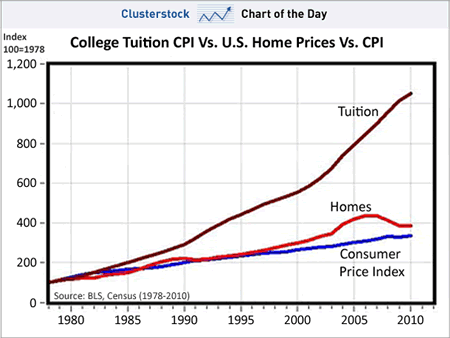
This is an awesome graphic! Thank you PP for putting this up. Everyone needs to keep this image in mind when thinking about the unfairness of it all.


I don't think anyone disagrees that the increase in college tuition is hugely unfair.

The "donut hole" idea is based on the idea that it's more unfair to a family who makes $300K than it is to a family who makes $80K or $40K. That is what people object to.


Citation please. I have never heard the donut hole defined this way.

Yea donut hole is $130K-$200K
Anonymous
Anonymous wrote:
Anonymous wrote:The problem is this describes a bunch of different families. And their situations may be sympathetic or not depending on your viewpoint.

Some people windup in the donut hole because they have more kids. If you have one or two kids, it's easier to sacrifice to get those kids through school than if you have three or four. People with more kids also struggle to save as much for college and feel frustrated when schools won't make up the difference. Personal bias here: I have little sympathy for these parents because I don't understand how you keep having kids without considering how you will pay for their college. But I have a lot of sympathy for these kids because it puts them in a really crappy situation where their existence is itself the thing keeping them from going to a school they got into but can't afford. Parents who have 3+ kids and then complain about how much college costs makes me angry.

But one I have more sympathy for is when one or both parents own a business and financial aid expects them to be willing to borrow against or liquidate business assets in order to pay for school. That seems like such a terrible choice. I know people who have done it and respect how much they are willing to put on the line for their kids education, but I'm not sure if I'd be able to make the same choice. That's a really tough one.

Another one is people who had kids late and are nearing retirement, and get caught two ways. First, they don't save as much for college because they are also saving for retirement (sometimes they are also caring for elderly parents and it's a squeeze). Second, they may have more liquid assets specifically because they are looking to retire soon, and financial aid will lay claim to those. I feel bad for these folks because often being late to parenting is not a choice. However, as someone who had kids late, I also just assumed that meant I'd have to work a little longer to get my kid through school. So again, this is something you can anticipate and should be able to if having kids late because you are old enough to understand how this works.

I also think people who come from modest backgrounds and who went to schools on scholarships sometimes don't understand how to save for college and then are surprised when their income pushes them into the "no aid" position. I have sympathy for this one because it's a knowledge gap -- their parents didn't save for college either and they just didn't know better. Though I do think if you are going to have kids you have to educate yourself. This was my DH and I had to work on him because he was convinced our kid would just qualify for aid. Now he gets that even though we aren't wealthy, we have more resource than our parents and we have to dedicate some of them to college savings if we want to ensure our kid can go to school. If I hadn't worked on him, though, we'd have zero saved.

There are probably others I'm unaware of. But these are the ones I hear the most. I think it's hardest for people who are outliers in their school or social community in terms of money. If everyone else you know can afford to pay out of pocket, and you can't because of the number of kids or your age, you might feel like it's unfair. And likewise, if everyone you know qualifies for aid because you are in a lower-income community, and you don't because you run a business with assets and therefore are actually in a higher bracket, it could feel unfair.

But usually it's not unfair. The actual unfair thing is that money is such a barrier to higher education in general in this country and having kids pretty much requires you to save for college, while also saving for retirement, while also paying your health insurance premiums. And yet we still have fairly high taxes! It's hard, but if it's "unfair" it's unfair to everyone except the very rich who inherited their wealth. And that's by design.

Oh how I love this post!


+1000

Love the way you made your point.
Anonymous
[guardian]
Anonymous wrote:
Anonymous wrote:
Anonymous wrote:
Anonymous wrote:
Anonymous wrote:new poster here

Wow. I thought we were a "donut hole" family but I guess not.

What is a step below "donut hole" called? We make too much to qualify for aid, but paying for an expensive school would involve far more than "liquidating assets." It would be more like taking on a second full time job, skipping at least one meal a day, absolutely zero entertainment budget (not even cable tv or netflix) etc.


Well, there is this thing that you had 18 years to save for college. Which is what most people do.


You're assuming stagnant incomes. We have a HHI of about 225k and one in 7th and one in 8th. Three hears ago HHI was 150k. When the kids start college it will be about 250k if we continue on the same track. 160k a year in tuition is both not possible and not a number that we ever could have saved for on our incomes.


It's also laughable that PP thinks "most people" save for college for 18 years. I mean, GTFO.


Just because you didn't save, doesn't meant eh rest of us haven't. We have a $160K or so income, much less just a few years ago. We saved starting at birth. You live in a cheap house, no fancy groceries, very few vacations, old cars...


Most people that plan to send their kids to college start saving at birth. If you haven’t been saving for 18 years, you shouldn’t be complaining that you aren’t getting financial aid. People on this board outraged that they don’t get financial aid is what is laughable. You made the choice about your priorities for the last 18 years. Sorry your kid has to go to UVA rather than Tufts. They will survive.
Anonymous
Anonymous wrote:We’re in that donut hole, mostly because we have three kids. But one went to UMD, one went to OOS flagship on merit scholarship (and will graduate early with APs), and one is still in high school.

All three want careers where they have to go to grad school so it didn’t make sense for us to go overboard with loans etc. for undergrad. Plus I’m still paying off my own student loan (but it will be paid off this summer)!

But the UMD kid just got into a bunch of top notch grad programs, including an Ivy. So I don’t think we really needed to pay all that extra money for a Carnegie Mellon undergrad (for example). Maybe it’s worth it if your kid isn’t going to grad school? It wasn’t for us.


Thanks for saying this. I attended public schools all my life and hoped I would be able to send my kids to a school like Williams. I saved lots of money every year and when my eldest graduated HS last year we theoretically had the $ to do it, but 1) the kid wasn't that interested (Although unable to tour because of COVID and 2) the price differential between public and Williams was so large that we just couldn't stomach it. Kid is at a large OOS public school (we are DC residents so TAG helps) and loving it. He is thinking he may want grad school and I love stories like yours that suggest that he can still get into prestigious grad school programs even if he didn't go to Williams. By not going to Williams, we can afford to help pay for grad school. I do suspect that you do get a better education at Williams, but not sure it is in the end worth all that $$. It's like a LAmborgini when a Honda is fine.

In sum, sure, it would be a dream come true for one of my kids to attend a school like that, but I don't feel entitled to it. These schools are tiny and can easily fill up a class by charging as much as they like and end up with mostly very wealthy kids-- and then for diversity add in low income. That is working for them, I guess. IF it really bugged me, I guess I'd try to start up a school that offered an alternative.

I understand St. John's in Annapolis is making an effort to be more affordable to middle class -- and it offers a great education.

Anonymous
Anonymous wrote:I think one of the biggest flaws is that the calculator assumes that your current income is the income that you have had since your kid was born, and bases the amount that you could have saved on that. For many families, especially if they had their kids in their 20s, that just isn't the case.


That's not my understanding of the way any calculator works. They don't look at your income and make some sort of backwards projection. They look at your income. and assets, and determine the EFC based on that.
Anonymous
Anonymous wrote:
Anonymous wrote:I think one of the biggest flaws is that the calculator assumes that your current income is the income that you have had since your kid was born, and bases the amount that you could have saved on that. For many families, especially if they had their kids in their 20s, that just isn't the case.


That's not my understanding of the way any calculator works. They don't look at your income and make some sort of backwards projection. They look at your income. and assets, and determine the EFC based on that.


If you run the EFC with savings vs no savings with the same income it comes back exactly the same.

You are correct they don't look backwards, but they should.

For 7 years i was paying about $35K out of pocket for a medical condition for my H and he did not work those years. When he went back to work our HHI went back up to $200K from $100K, we had to refinance the home to not lose it.

But it doesn't matter to the EFC, we make $200K, they don't care that we have no savings and our house (at 50) has 25 more years on the mortgage.
Anonymous
Anonymous wrote:
Anonymous wrote:Financial aid should take into account income from the past decade rather than current income. I'm irritated that people who bought an expensive house get financial aid when people with thr dame income bought a cheap one and saved more.


It should look at housing and life style choices as well.


How in the world would you do that? What would that spreadsheet look like?
Anonymous
Anonymous wrote:
Anonymous wrote:
Anonymous wrote:People who do not qualify for financial aid, but whose real economic situation means they can't afford expensive colleges even if their kids are admitted. They are the families whose kids turn down Carnegie Mellon and take the merit award at Pitt.


But can’t they/don’t they take out loans to pay the tuition?


A family earning around 250k is not going to take out loans to cover the 50k a year difference in cost between publics and privates for multiple kids unless they are utterly terrible with money


If they made $199k do they get aid?
Anonymous
Anonymous wrote:
Anonymous wrote:
Anonymous wrote:
Anonymous wrote:People who do not qualify for financial aid, but whose real economic situation means they can't afford expensive colleges even if their kids are admitted. They are the families whose kids turn down Carnegie Mellon and take the merit award at Pitt.


But can’t they/don’t they take out loans to pay the tuition?


A family earning around 250k is not going to take out loans to cover the 50k a year difference in cost between publics and privates for multiple kids unless they are utterly terrible with money


If they made $199k do they get aid?


I think the magic number is 120K for a lot of aid, $150 gets some
post reply Forum Index » College and University Discussion
Message Quick Reply
Go to: