
Prices dropping in COVID Boomtowns
![[Post New]](/jforum/templates/default/images/icon_minipost_new.gif)
Anonymous
|
I have been interested in whether price increases in more remote areas that boomed during covid would stick. Looks like they’re headed back down as people have to be in the office, even if just part-time.
https://finurah.com/2021/10/22/housing-market-shows-cracks-with-price-cuts-in-pandemic-boomtowns/ The slowdown is particularly pronounced in areas away from major urban hubs where buyers were seeking affordability and picturesque havens during the pandemic. That demand has ebbed as people have more reasons to stay put this fall, with the return of in-person school and more companies ordering workers back to the office, or at least requiring them to be somewhere in the vicinity. The result: Prices are running up against the reality of local economic fundamentals. “The markets where we’re seeing the most price cuts were flying a little too close to the sun earlier this year,” said Daryl Fairweather, chief economist for the brokerage Redfin. “Sellers got eager in their asking prices. It was not sustainable and benefited from pandemic trends that still persist, but not as extremely.” Across the U.S., home-price appreciation slowed for a second straight month in September as part of a modest cooldown, Zillow Group Inc. reported this week. The number of homes with price cuts is growing, with counties near Denver, Salt Lake City and Indianapolis seeing more than half of listings get reductions, according to Redfin. Even some of the hottest areas where workers from large urban cities sprawled out to, such as the counties including Portland, Maine, and Tacoma, Washington, have had cuts on more than 40% of listings, Redfin data show. In Idaho’s Canyon County, about eight out of 10 listings have had price cuts, the biggest share in the U.S. It’s a popular area for people who can’t afford nearby Boise, a city of about 230,000 that has boomed as Californians and other escapees of high-cost regions spread out. |
Anonymous
|
Ahh the bubble happened - just not where DCUM expected. Your small towns and beach resorts are getting hit by the whiplash of office recalls and people realizing...living in the middle of nowhere is not what its cracked up to be.
I'd be curious if it was the community, the amenities in the area, their jobs being in-person at least 2-3 times a week, or the schools that had most people returning to urban areas. |
Anonymous
| Ok but what are prices compared to a year ago? Reporting on the number of sellers that drop their asking price is meaningless without that context. |
Anonymous
|
Ouch. A big bubble in the Midwest or small-town Maine is not going to be easy to recouperate from.
The number of homes with price cuts is growing, with counties near Denver, Salt Lake City and Indianapolis seeing more than half of listings get reductions, according to Redfin. Even some of the hottest areas where workers from large urban cities sprawled out to, such as the counties including Portland, Maine, and Tacoma, Washington, have had cuts on more than 40% of listings, Redfin data show. |
Anonymous
| Redfin is part of the problem here because they are trying to unload housing they bought up. |
Anonymous
Well if you look at Nampa, Idaho as the article mentioned: CBH Homes, the most prolific builder in Idaho, has 99 Canyon County homes with active listings on Realtor.com — and 52 have price reductions. The prices seem to be settling back to where they were before Covid. No better. 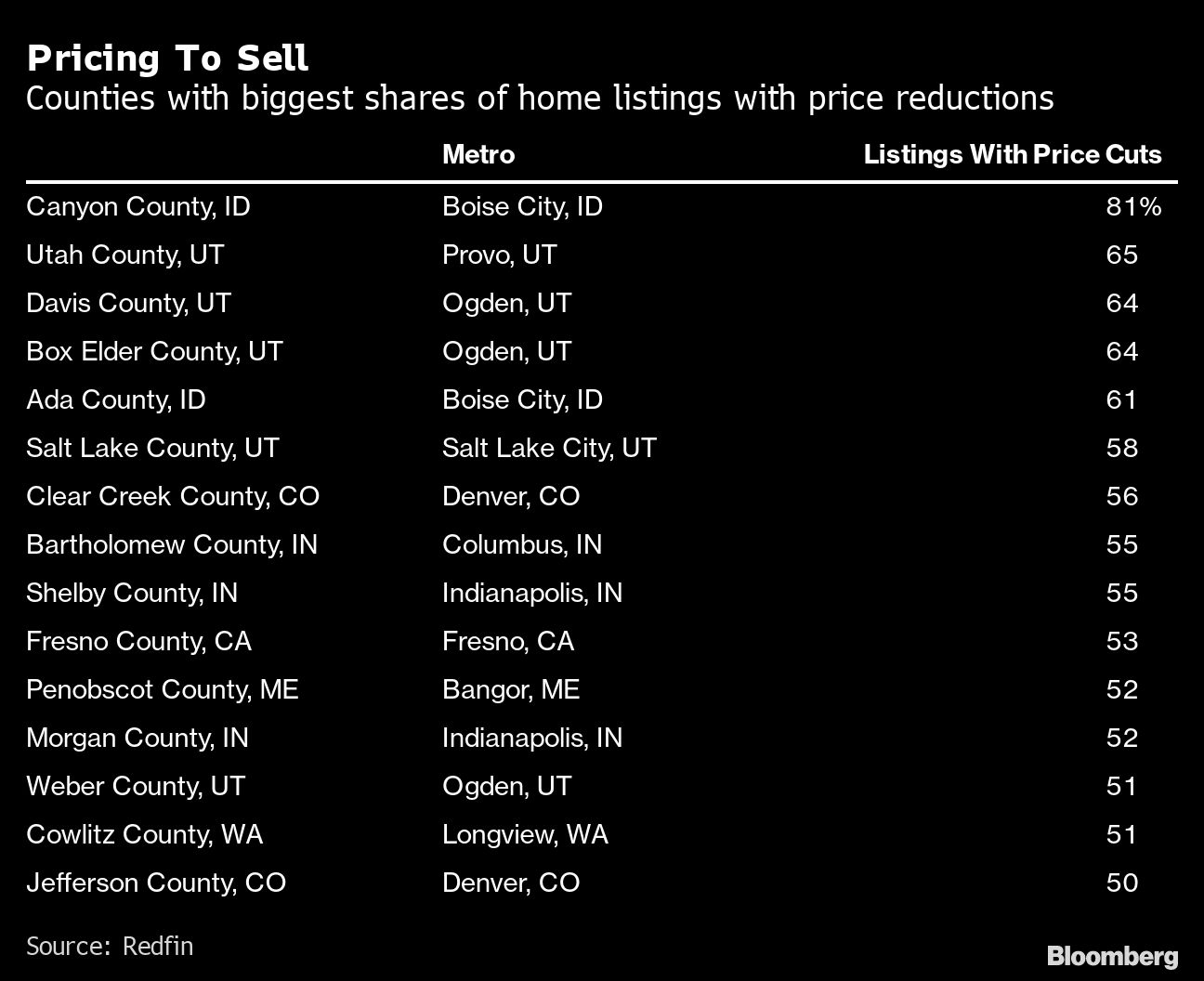
|
Anonymous
| Noticing this in the more rural parts of va and md |
Anonymous
| Prices are still up in our area near a metro stop that no one o DCUM likes. |
Anonymous
I’m OP, and I always figured that school would be the driver, even if remote work caught on. Kids were going to be eager to get back to their schools, and having a second home in a really remote location isn’t that useful when you’re constrained by the school schedule (I know through experience). I also think it’s turned out that most people need to be in the office at least 1-2 days a week, and having workers in other states has raised some legal and tax issues smaller companies don’t want to deal with. |
Anonymous
If you're got a metro stop no one is talking about you. Its the fools that moved out to FauquierCounty 'because you're never going back into the office' that are in trouble. 
|
Anonymous
RE Schools, the way DCUM told it, they were leaving their NOVA school systems entirely and enrolling their kids in new systems far away. I guess not. |
Anonymous
Enrollment is down at FCPS and APS, but it seems to be in the 5% range, so pretty marginal, so far. I think the exurbs may continue to do well — anything in commuting distance, even if longer than you’d want to do on a daily basis. The OP article is about the people who moved across the country. |
Anonymous
| Love it. I want a vacation home but unwilling to pay these prices |
Anonymous
| RE across the country is a joke. Prices need to fall 30-40%. |
Anonymous
| No downward movement in my Annapolis-area zip code. |