
What is your definition of Middle class, upper middle class and lower middle class
![[Post New]](/jforum/templates/default/images/icon_minipost_new.gif)
Anonymous
Please tell me this is a joke. |
Anonymous
| We make $110 HHI, an we feel like we're lower middle. Sucks. I have a PhD and went to Ivy League undergrad. |
Anonymous
The evidence is contrary to your claim that money and education are poor/hollow proxies by themselves. The the strength of the US comes from our system of laws and government that effectively nurture the right kind of money and education. Whereas people in a corrupt country may get rich mostly through criminal acts, embezzlement or abuse of the rights of others, people in the US mostly get rich through hard work, taking on well calculated risk, and conducting their business in a legal and ethical manner. Similarly, the US system of education is of very high practical quality and our network of public and private colleges/universities are sought after for the prestige they bestow on their alumni. The value of these degrees are directly the result of the rigorous and high quality curriculum delivered by these institutions. In short, in the US, with minor exceptions, there is a strong correlation between rich and well educated, and being a person with integrity, character, and a sense of contributing to a greater common good. The important distinction here is that these are natural and organic manifestations, rather than artificial ideological mantras that we've seen fail miserably in history.
Okay, thanks for clarifying. I read your initial post differently. I would offer that the reason money and diploma are offered as proxies because they are good quality proxies for how well a person is doing in life as I argued above, and also because these are metrics that have specific and well understood measurements. There are many different ways that someone can exhibit integrity, character, and caring for others, but it's rather difficult to measure these traits directly, much less put them into a table for analysis. The pursuit of money and education in the US occurs within a frame work that rewards integrity, character, and caring for others. The American model is that you work hard, treat others fairly, care for your family and community, and you will be successful. In other words, these characteristics make up the framework within which the pursuit of wealth and education take place. |
Anonymous
Wrong major? |
Anonymous
|
All of you are poor according to this: http://www.huffingtonpost.com/2014/07/31/richest-person-in-each-state_n_5617993.html |
Anonymous
I think we end up agreeing in many respects except probably in the two points that you made and that I bolded above. 1. You say evidence exists that there is a strong correlation between money/education and integrity/character/caring, etc. Seems inconsistent to state that these things correlate and at the same time argue that the latter are difficult to measure. The evidence would need to show that this correlation is higher here than in other countries. Please provide citation for this evidence. 2. I think that the practices that led to the near collapse of the financial system in 2007-2008 argue strongly against your thesis. Mortgage fraud, securities fraud, rates/labor fraud have resulted in hundreds of billions in legal settlements. That is still a small fraction of the harm imposed onto people from the subset of acts that were successfully prosecuted. Highly educated people argue that tobacco, asbestos, chemical spills don't cause harm to the public explicitly for money. The market is replete with failures that require regulatory intervention to cure the effects of incentives people have to screw others for money. The US system is one where you are free to innovate ways to screw people until you meet opposition that is sufficiently well funded, politically strong and with a sufficiently compelling moral basis to stop it from continuing. Otherwise it just keeps plugging along. This happens everywhere in the world. It's a little pollyannaish to think that it doesn't happen here. It just happens that it occurs here under a veil of respectability and in much greater scale. |
Anonymous
|
PP above. I'll offer my evidence first:
How Wealth Reduces Compassion http://www.scientificamerican.com/article/how-wealth-reduces-compassion/ |
Anonymous
Adding link to article and abstract. http://www.pnas.org/content/109/11/4086.short Higher social class predicts increased unethical behavior Paul K. Piffa,1, Daniel M. Stancatoa, Stéphane Côtéb, Rodolfo Mendoza-Dentona, and Dacher Keltnera Author Affiliations aDepartment of Psychology, University of California, Berkeley, CA 94720; and bRotman School of Management, University of Toronto, Toronto, ON, Canada M5S 3E6 Edited* by Richard E. Nisbett, University of Michigan, Ann Arbor, MI, and approved January 26, 2012 (received for review November 8, 2011) Abstract Seven studies using experimental and naturalistic methods reveal that upper-class individuals behave more unethically than lower-class individuals. In studies 1 and 2, upper-class individuals were more likely to break the law while driving, relative to lower-class individuals. In follow-up laboratory studies, upper-class individuals were more likely to exhibit unethical decision-making tendencies (study 3), take valued goods from others (study 4), lie in a negotiation (study 5), cheat to increase their chances of winning a prize (study 6), and endorse unethical behavior at work (study 7) than were lower-class individuals. Mediator and moderator data demonstrated that upper-class individuals’ unethical tendencies are accounted for, in part, by their more favorable attitudes toward greed. |
Anonymous
On the hollow nature of consumerism and materialism:

|
Anonymous
On the often absurd logic of capitalism:

|
Anonymous
On the damage that we inflict on ourselves:

|
Anonymous
On the priorities of plutocrats:

|
Anonymous
|
More people are willing to sell out their ethical beliefs as larger sums of money are involved. Opportunities to make larger sums fall disproportionately on wealthier people.
A $100 traffic ticket is more punitive to someone who makes minimum wage than for someone who makes six figures. Penalties are therefore less onerous for wealthier people Weathier people therefore have greater opportunity and a lower cost for malfeasance. Seems consistent with studies, logic and intuition. |
Anonymous
|
I am 30 years old, middle class with a graduate degree, live within my means, and am happy to have my health, a great marriage, and lots of hobbies and interests to keep me busy. Studies show that once your basic needs are met, there really isn't a huge difference in happiness levels amongst the different SES levels.
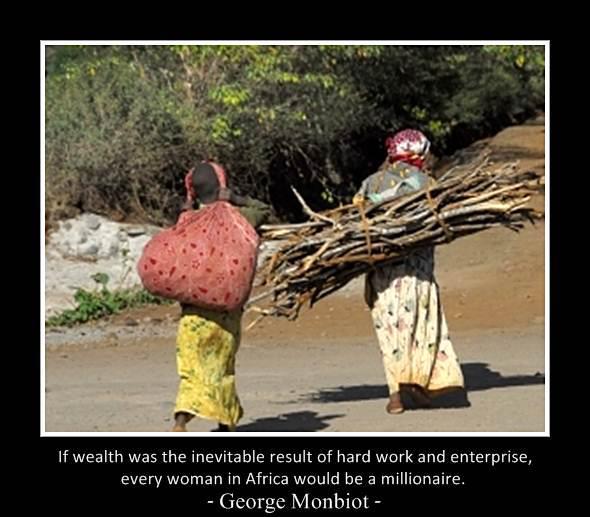
A lot of the wealthy people on this forum seem completely out of touch with the rest of society and I think it must be somewhat sad and lonely to have so much money, but still think you need more or that you're somehow superior because of what you make. Also -- lots of Wall Street bankers contribute much less to society than those who take low paying public interest jobs, so these arguments that contributing to society corresponds to a paycheck are full of it. Also, I think people born into wealth totally downplay the impact it has had on their lives and totally attribute all their success to hard work. While many do work hard, life circumstances are a huge factor. Having family connections to get the right internship, a down payment on a house, pay for school, etc. are a huge advantage that most people don't benefit from. |
Anonymous
Word.
|