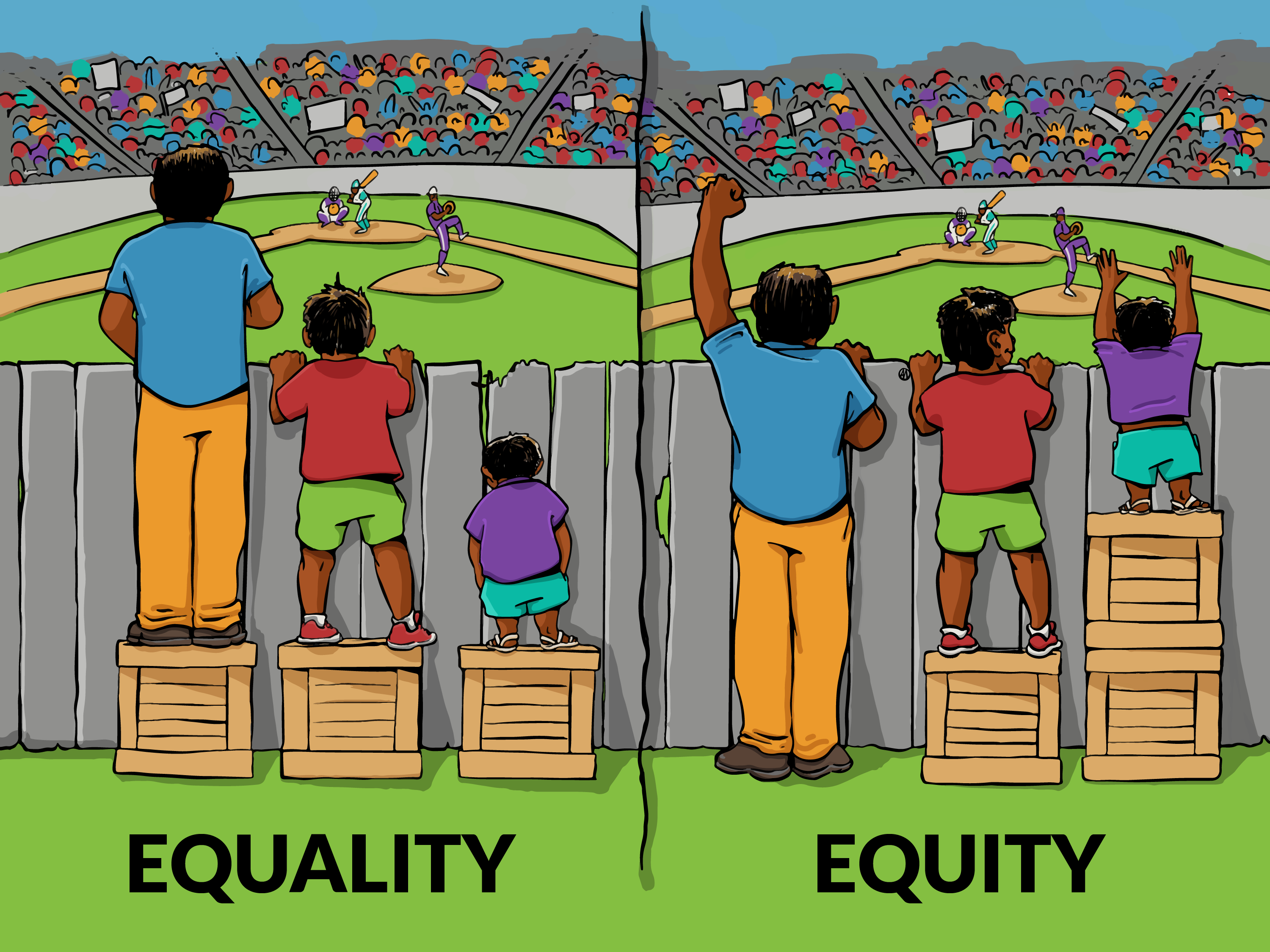
The true meaning of "equity"

Anonymous
Who decides who gets what size “box”? On what basis is this decided? This comic is so stupid because it assumes we know how much support each individual needs.
Anonymous
FCPS doesn’t care about high achievers. Their dreams and accomplishments are their parents responsibility. FCPS only feels responsible for lower achievers. At least that’s what they want to show it out to the public and in books/ data.
Anonymous
Anonymous wrote:Agit-prop, but people see through it and are leaving FCPS in droves rather than put up with the neglect of their kids’ education simply because they are deemed privileged.


Racist says wut?
Anonymous
Anonymous wrote:
Anonymous wrote:A lot of postings over the last few weeks on the 2nd grade AAP pool made me realize that many on this board don't actually know what "equity" means. It is NOT equal treatment for all. It is "right sizing" the treatment based on the needs of the population. (alt+p)

Equity means providing the Title I kids more benefits than the kids from the higher SES schools because the Title I kids theoretically need greater support to have an equal footing as the kids from the SES schools.


So the high achiever receives nothing in order to give more to the lowest achiever? Seems like the direction FCPS is heading in.


It’s a shame that the high achiever is pulled down to support and make a way for the lower achiever. I wish Equity was there during my time growing up. I would have been a lower achiever and enjoying my young age, rather than spending time on academics and working hard to achieve my best to my full potential. Why work hard when food is served on your platter?
Anonymous
We haven’t really seen a huge difference in class sizes in the schools that are, let’s just say it- rich. We just don’t. Those schools are happy. AAP center schools are happy. I don’t hear any complaints from my local level IV school because the AART is good at her job.

The people I see leaving FCPS are the ones that didn’t get their kids in to AAP. Or are super religious. Or needs their kids in private- because their kids were so disruptive- so they could go to work. They are really happy.

And to be honest- I’m ok with that. The funding per kid is the same. There are less issues in the classes - literally my oldest is like- omg, so and so are gone and the class is so much better. My youngest is thriving- though it took a bit!. Their SOL scores and Iready scores are off the charts. They have learned things.

There is this falsely perceived concept that we don’t people to leave FCPS schools. The truth is, most parents don’t care if you leave. It makes room for another kids in the AAP class. But losing one or two kids…. It’s such a small percentage! If it prevents over crowding, we are going to say yes please.

But the reality is that the two families I knew that pulled their kids out to private- both of their kids have ADHD and couldn’t sit still for virtual school and were failing.

So to me- this whole- we’re losing enrollment- is bs.
Anonymous
Anonymous wrote:FCPS doesn’t care about high achievers. Their dreams and accomplishments are their parents responsibility. FCPS only feels responsible for lower achievers. At least that’s what they want to show it out to the public and in books/ data.


The actuality is the FCPS does care about high achievers.

It just can’t talk about it.
Anonymous
Why can’t they talk about caring for high achievers?
Anonymous
Anonymous wrote:We haven’t really seen a huge difference in class sizes in the schools that are, let’s just say it- rich. We just don’t. Those schools are happy. AAP center schools are happy. I don’t hear any complaints from my local level IV school because the AART is good at her job.

The people I see leaving FCPS are the ones that didn’t get their kids in to AAP. Or are super religious. Or needs their kids in private- because their kids were so disruptive- so they could go to work. They are really happy.

And to be honest- I’m ok with that. The funding per kid is the same. There are less issues in the classes - literally my oldest is like- omg, so and so are gone and the class is so much better. My youngest is thriving- though it took a bit!. Their SOL scores and Iready scores are off the charts. They have learned things.

There is this falsely perceived concept that we don’t people to leave FCPS schools. The truth is, most parents don’t care if you leave. It makes room for another kids in the AAP class. But losing one or two kids…. It’s such a small percentage! If it prevents over crowding, we are going to say yes please.

But the reality is that the two families I knew that pulled their kids out to private- both of their kids have ADHD and couldn’t sit still for virtual school and were failing.

So to me- this whole- we’re losing enrollment- is bs.


You really don’t see what’s wrong with that? My kid has ADHD and we can’t afford private school, so we just had to suffer with virtual.
Anonymous
Anonymous wrote:
Anonymous wrote:We haven’t really seen a huge difference in class sizes in the schools that are, let’s just say it- rich. We just don’t. Those schools are happy. AAP center schools are happy. I don’t hear any complaints from my local level IV school because the AART is good at her job.

The people I see leaving FCPS are the ones that didn’t get their kids in to AAP. Or are super religious. Or needs their kids in private- because their kids were so disruptive- so they could go to work. They are really happy.

And to be honest- I’m ok with that. The funding per kid is the same. There are less issues in the classes - literally my oldest is like- omg, so and so are gone and the class is so much better. My youngest is thriving- though it took a bit!. Their SOL scores and Iready scores are off the charts. They have learned things.

There is this falsely perceived concept that we don’t people to leave FCPS schools. The truth is, most parents don’t care if you leave. It makes room for another kids in the AAP class. But losing one or two kids…. It’s such a small percentage! If it prevents over crowding, we are going to say yes please.

But the reality is that the two families I knew that pulled their kids out to private- both of their kids have ADHD and couldn’t sit still for virtual school and were failing.

So to me- this whole- we’re losing enrollment- is bs.


You really don’t see what’s wrong with that? My kid has ADHD and we can’t afford private school, so we just had to suffer with virtual.


That’s strange that PP has no complaints with FCPS. Everyone can’t afford private. PP, if you can afford private, please go, we need less people like you in public schools. People support equity if there are benefitted by it.
Anonymous
Anonymous wrote:
Anonymous wrote:A lot of postings over the last few weeks on the 2nd grade AAP pool made me realize that many on this board don't actually know what "equity" means. It is NOT equal treatment for all. It is "right sizing" the treatment based on the needs of the population. (alt+p)

Equity means providing the Title I kids more benefits than the kids from the higher SES schools because the Title I kids theoretically need greater support to have an equal footing as the kids from the SES schools.


So the high achiever receives nothing in order to give more to the lowest achiever? Seems like the direction FCPS is heading in.


The high achiever gets no boost in this example because they don't need it. They can already see the game without help. In other words, the high-SES child with a score of 132 is already surrounded by many other high-scoring kids (see FCPS example from prior years of schools with 40+ kids in-pool) and is likely receiving a higher level of educational services already as a result--for example, the elementary schools that are already using an AAP curriculum for gen ed.
Anonymous
Anonymous wrote:
Anonymous wrote:
Anonymous wrote:A lot of postings over the last few weeks on the 2nd grade AAP pool made me realize that many on this board don't actually know what "equity" means. It is NOT equal treatment for all. It is "right sizing" the treatment based on the needs of the population. (alt+p)

Equity means providing the Title I kids more benefits than the kids from the higher SES schools because the Title I kids theoretically need greater support to have an equal footing as the kids from the SES schools.


So the high achiever receives nothing in order to give more to the lowest achiever? Seems like the direction FCPS is heading in.


The high achiever gets no boost in this example because they don't need it. They can already see the game without help. In other words, the high-SES child with a score of 132 is already surrounded by many other high-scoring kids (see FCPS example from prior years of schools with 40+ kids in-pool) and is likely receiving a higher level of educational services already as a result--for example, the elementary schools that are already using an AAP curriculum for gen ed.


Looks like you are enjoying the benefits of Equity. That’s why you support it.
Anonymous
The issue is this won’t just extend to schools. Too pretty, nope photo shoot for the less good looking. It’s just not fair. A talented swimmer, ugh, not fair, time to let someone else on the team, too much talent from a certain group.
Anonymous
Anonymous wrote:
Anonymous wrote:
Anonymous wrote:
Anonymous wrote:A lot of postings over the last few weeks on the 2nd grade AAP pool made me realize that many on this board don't actually know what "equity" means. It is NOT equal treatment for all. It is "right sizing" the treatment based on the needs of the population. (alt+p)

Equity means providing the Title I kids more benefits than the kids from the higher SES schools because the Title I kids theoretically need greater support to have an equal footing as the kids from the SES schools.


So the high achiever receives nothing in order to give more to the lowest achiever? Seems like the direction FCPS is heading in.


The high achiever gets no boost in this example because they don't need it. They can already see the game without help. In other words, the high-SES child with a score of 132 is already surrounded by many other high-scoring kids (see FCPS example from prior years of schools with 40+ kids in-pool) and is likely receiving a higher level of educational services already as a result--for example, the elementary schools that are already using an AAP curriculum for gen ed.


Looks like you are enjoying the benefits of Equity. That’s why you support it.


No, my kid scored 140+ and is in-pool regardless.
Anonymous
Anonymous wrote:
Anonymous wrote:
Anonymous wrote:
Anonymous wrote:
Anonymous wrote:A lot of postings over the last few weeks on the 2nd grade AAP pool made me realize that many on this board don't actually know what "equity" means. It is NOT equal treatment for all. It is "right sizing" the treatment based on the needs of the population. (alt+p)

Equity means providing the Title I kids more benefits than the kids from the higher SES schools because the Title I kids theoretically need greater support to have an equal footing as the kids from the SES schools.


So the high achiever receives nothing in order to give more to the lowest achiever? Seems like the direction FCPS is heading in.


The high achiever gets no boost in this example because they don't need it. They can already see the game without help. In other words, the high-SES child with a score of 132 is already surrounded by many other high-scoring kids (see FCPS example from prior years of schools with 40+ kids in-pool) and is likely receiving a higher level of educational services already as a result--for example, the elementary schools that are already using an AAP curriculum for gen ed.


Looks like you are enjoying the benefits of Equity. That’s why you support it.


No, my kid scored 140+ and is in-pool regardless.


My kid also scored 140+ and is in pool but I DO NOT support equity.
Anonymous
Pp please go private if you like, but lobby for a voucher system so the money follows the student. Then the people that stay in the public school can play their equity games from morning till night.

Equity is always more fair when it’s not done on your dime. It feels even good to be magnanimous with the less fortunate as long as it doesn’t hurt your pocket.

For the equity crowd, what have you personally done with your own resources to advance equity? Chances are the answer is nothing.
post reply Forum Index » Advanced Academic Programs (AAP)
Message Quick Reply
Go to: