Anonymous
 04/23/2020 10:49
Subject: Re:COVID, blood clots, and aspirin
04/23/2020 10:49
Subject: Re:COVID, blood clots, and aspirin
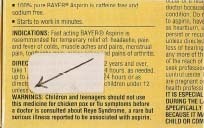
Typically, Reye's syndrome begins after a viral infection, such as a cold, influenza, or chickenpox. Most such infections do not lead to Reye's syndrome, and some cases are so mild that no one notices. Other cases are more serious.
Although adults and babies can develop Reye's syndrome, it usually occurs in children between the ages of 2 and 16.
Symptoms include vomiting, nausea, and drowsiness. There is also a change in behavior, and patients may act irrationally and seem to have lost touch with reality. If untreated, Reye's syndrome can cause loss of consciousness, coma, and death.
Reye's syndrome causes the brain and liver to swell and the liver to develop fatty deposits. The chemistry of the blood and other body fluids becomes abnormal.
No one is sure how some viral infections develop into Reye's syndrome. Some doctors suspect that an unidentified virus causes Reye's syndrome. Others theorize that people with certain genes * are more likely to get it. Some studies in the 1980s linked aspirin to the development of Reye's syndrome (see sidebar).
Reye's Syndrome warning on aspirin box.
© Leonard Lessin, Peter Arnold, Inc.
HISTORY OF REYE SYNDROME
The children always arrived at the Australian hospital on the verge of death. They often would be unconscious or in a coma. Sometimes their bodies suffered uncontrollable spasms, and the children seemed to be slipping into insanity.
It was a tragic—and puzzling—situation. Only a week or so earlier, the children had been experiencing the typical childhood infections such as earaches, chest colds, or sore throats. Then things took a turn for the worse.
Dr. Douglas Reye was the director of pathology at that Australian hospital when these children died in the 1950s and early 1960s. He discovered odd things, such as swollen brains, discolored livers, and damaged kidneys in the children. He realized that they were dealing with an as yet unnamed disease.
In 1963, a doctor in North Carolina named George Johnson saw a link between the disease Reye had discovered and one he was seeing in children after an outbreak of influenza. The disease was initially called Reye-Johnson syndrome and is now simply Reye's syndrome.
Read more: http://www.humanillnesses.com/original/Pre-Sei/Reye-s-Syndrome.html#ixzz6KRnVBZk4

Anonymous
04/23/2020 10:48
Subject: Re:COVID, blood clots, and aspirin
Hmm, WebMD says aspirin is safe to take with coronavirus:
https://www.webmd.com/lung/qa/is-it-safe-to-take-aspirin-to-treat-coronavirus-symptoms
https://www.webmd.com/lung/qa/is-it-safe-to-take-aspirin-to-treat-coronavirus-symptoms
QUESTION
Is it safe to take aspirin to treat coronavirus symptoms?
ANSWER
For adults, it’s safe to take aspirin for pain or fever from COVID-19. Due to initial concern that anti-inflammatory drugs like ibuprofen and aspirin may worsen coronavirus symptoms, the World Health Organization initially recommended against the use of these anti-inflammatory drugs. However, they reversed that recommendation several days later and no longer recommend against ibuprofen or other anti-inflammatory drugs, including aspirin. Children and teenagers should not take aspirin due to the risk of it causing a life-threatening condition called Reye’s syndrome.
Anonymous
04/23/2020 10:46
Subject: COVID, blood clots, and aspirin
Anonymous wrote:Anonymous wrote:Anonymous wrote:Is this actually safe?
So many people take 81 per day.
No they don't. Their bottom would corrode and fall out and they would be dragging their guts behind leaving a smudge so we would know who they are.
I think PP meant 81 mg, which is a baby aspirin. Not 81 pills!
Anonymous
04/23/2020 10:43
Subject: COVID, blood clots, and aspirin
Anonymous wrote:Anonymous wrote:Is this actually safe?
So many people take 81 per day.
No they don't. Their bottom would corrode and fall out and they would be dragging their guts behind leaving a smudge so we would know who they are.
Anonymous
04/23/2020 10:40
Subject: Re:COVID, blood clots, and aspirin
My ND recommends serrapeptase and nattokinase for coagulation issues. See here:
https://www.ncbi.nlm.nih.gov/pubmed/24799449
These are the two I took:
https://www.amazon.com/Cardiovascular-Research-Serraflazyme-Tablets-Count/dp/B00014DU16/ref=cm_cr_arp_d_product_top?ie=UTF8
https://www.amazon.com/Pure-Encapsulations-Nattokinase-Circulation-Function/dp/B0029X3KBM/ref=pd_ybh_a_1?_encoding=UTF8&psc=1&refRID=99TMY972CNC7K3GZM6CS
https://www.ncbi.nlm.nih.gov/pubmed/24799449
These are the two I took:
https://www.amazon.com/Cardiovascular-Research-Serraflazyme-Tablets-Count/dp/B00014DU16/ref=cm_cr_arp_d_product_top?ie=UTF8
https://www.amazon.com/Pure-Encapsulations-Nattokinase-Circulation-Function/dp/B0029X3KBM/ref=pd_ybh_a_1?_encoding=UTF8&psc=1&refRID=99TMY972CNC7K3GZM6CS
Anonymous
04/23/2020 10:39
Subject: Re:COVID, blood clots, and aspirin
What is Reye's Syndrome?
Reye's Syndrome: A Real and Present Danger
Reye's Syndrome, a deadly disease, strikes swiftly and can attack any child, teen, or adult without warning. All body organs are affected with the liver and brain suffering most seriously. While the cause and cure remain unknown, research has established a link between Reye's Syndrome and the use of aspirin and other salicylate containing medications, over the counter products, and topical use products.
http://www.reyessyndrome.org/facts.html
Reye's Syndrome: A Real and Present Danger
Reye's Syndrome, a deadly disease, strikes swiftly and can attack any child, teen, or adult without warning. All body organs are affected with the liver and brain suffering most seriously. While the cause and cure remain unknown, research has established a link between Reye's Syndrome and the use of aspirin and other salicylate containing medications, over the counter products, and topical use products.
http://www.reyessyndrome.org/facts.html
Anonymous
04/23/2020 10:31
Subject: Re:COVID, blood clots, and aspirin
Anonymous
04/23/2020 10:27
Subject: Re:COVID, blood clots, and aspirin
People. This has been covered 1000 times. Aspirin is NOT safe I the viral diseases of ANY KIND at any age.
Why there is no warning on the Aspirin box?
Why there is no warning on the Aspirin box?
Anonymous
04/23/2020 10:26
Subject: COVID, blood clots, and aspirin
Anonymous wrote:Is this actually safe?
So many people take 81 per day.
Anonymous
04/23/2020 10:25
Subject: COVID, blood clots, and aspirin
Is this actually safe?
Anonymous
04/23/2020 09:36
Subject: COVID, blood clots, and aspirin
I have started taking 81 of aspirin each day.
Dr in family said to watch for blood in stool.
Dr in family said to watch for blood in stool.
Anonymous
04/23/2020 09:35
Subject: COVID, blood clots, and aspirin
I also take a daily aspirin. My OBGYN suggested it when I was trying to get pregnant. Then once I got pregnant, she had me keep taking it through the pregnancy. I decided I may as well keep taking it so I have ever since. I only have stopped before a surgery I had bc it can cause excess bleeding.
Anonymous
04/23/2020 09:34
Subject: COVID, blood clots, and aspirin
I take daily aspirin anyway.
Anonymous
04/23/2020 08:45
Subject: COVID, blood clots, and aspirin
I take daily baby aspirin because I have a genetic heart condition and my cardiologist said I should do so. He also said that so many doctors take daily baby aspirin not only for heart reasons, but because it cuts down on so many cancer risks.
Anonymous
04/23/2020 08:40
Subject: COVID, blood clots, and aspirin
There are new media reports of blood clots being a major issue in patients who are seriously ill/die (including those who deteriorate quickly). Does it make sense to take aspirin prophylactically? Or once you think you have COVID?
Obviously daily aspirin is not without risk and I don't know enough to weigh it all. Does anyone have any actual knowledge about this?
Obviously daily aspirin is not without risk and I don't know enough to weigh it all. Does anyone have any actual knowledge about this?