
For those with high HHI ($500K), tax saving strategies

Anonymous
Anonymous wrote:Relatively high earning W-2 employees have very few tax advantage strategies. The tax code is designed to encourage business development not workers. It sucks.


People like Mark Zuckerberg do not take regular salaries which saves them millions in savings and don’t pay federal taxes or much lower than a W2 worker. Zuckerberg pays himself $1 dollar yearly salary. The rest of his salary comes from Meta stock and other ways that aren’t clear.

There’s no reason this loophole should exist.
Anonymous
Another multi billionaire trick is to pledge your stockmagainst a line of credit. Then you can spend hundreds of millions a year in borrowed, tax free money.
Anonymous
Anonymous wrote:
Anonymous wrote:
Anonymous wrote:
Anonymous wrote:
Anonymous wrote:
Anonymous wrote:Talk about first world problems lol my 30% tax rate is twice the median household income in the US whatever can I do about it?


Well most of us got to that place by choices we made. I grew up poor, neither parent went to college, I've had free lunch several years in school, and we were on/off from food stamps whenever parents were laid off. Yet I managed to go to college, pay off my college debt and do well in life. Nothing was handed to me, I had to work hard for it all. Yes, I recognize there are others who have it "worse" but my life wasn't a picnic. I just knew working hard and an education was key to a better life. Then I chose to live within my means and save save save and take career risks to advance.
The fact that those making $178K+ pay approximately 80% of the taxes in the US means that why yes we are in fact providing for the vast majority of society. It's our taxes that make roads, infrastructure, schools, and everything else happen. We more than pay our "fair share"


You acknowledge that for years you benefited from government programs. And now you don't want to pay into them?


Can you read? We have contributed far more than most. My family used those benefits for a total of about 2 years in my lifetime. We've paid $500K+ into medicare in our lifetime (probably much more), and that's just medicare. Happy to pay, but at some point, no I don't need to pay more. So we will do what we can to avoid estate tax issues (at both federal and StaTE level---our state starts much lower and would affect many people more than just us). That money was taxed once and we don't need to send 40% of everything above $3M to our state when we die.

We also contribute smartly to organizations that provide much more than the govt does with our tax dollars. I'd prefer to have it go locally to organizations that actually maximize it

You haven’t contributed enough. Freedom is priceless. Your contributions are still needed to support our defense spending. We all benefit from it.

Haaa! Yup, that's one of the main issues!

But yes, even after paying ALL of that into medicare, when we turn 65, we get to pay ~$1K+ just for part B and a gap plan. Add in more for prescription coverage. So we still will pay $2400/month for the 2 of us to have basic medical coverage. It's ridiculous


It is insanely true. There's no way to escape the medicare/part B etc without the increased premium. All income including 1099/k-1 etc counts towards the income. RIDICULOUS that the premiums are so unfair.
Anonymous
Anonymous wrote:
Anonymous wrote:
Anonymous wrote:OP, you need a side business: rental income, landscaping, tutoring, house cleaning, remodeling, etc.


Let’s say they have a side gig doing tutoring and earn a few extra bucks that way. How can that benefit someone earning 500k+ ?

Or you mean it needs to be an actual business where they hire others?


I think they mean a side business that loses money for the tax write off


No that's not what is meant. It would be silly to own a business just to lose money considering the time exerted and liability.
However, what does happen is this from first hand experience. I could make tons more money than i do now. I simply don't have the desire to pay $40,000 in more taxes for every $100,000 earned. It's taken away my desire to spend more time earning that money when such a huge chunk goes to pay others that don't pay tax. Our capitalist economy is already suffering and many of you fools want to tax us more out of nothing but sheer greediness. GOYA's It's not fair that someone sacrifices their time to make twice the income, but after paying tax is closer to the goof that only works 40 hr weeks.
Anonymous
Anonymous wrote:
Anonymous wrote:
Anonymous wrote:
Anonymous wrote:OP, you need a side business: rental income, landscaping, tutoring, house cleaning, remodeling, etc.


Let’s say they have a side gig doing tutoring and earn a few extra bucks that way. How can that benefit someone earning 500k+ ?

Or you mean it needs to be an actual business where they hire others?


I think they mean a side business that loses money for the tax write off


No that's not what is meant. It would be silly to own a business just to lose money considering the time exerted and liability.
However, what does happen is this from first hand experience. I could make tons more money than i do now. I simply don't have the desire to pay $40,000 in more taxes for every $100,000 earned. It's taken away my desire to spend more time earning that money when such a huge chunk goes to pay others that don't pay tax. Our capitalist economy is already suffering and many of you fools want to tax us more out of nothing but sheer greediness. GOYA's It's not fair that someone sacrifices their time to make twice the income, but after paying tax is closer to the goof that only works 40 hr weeks.


If you are starting a business just to lose money to write off against your W2 income, then it’s not much time exerted (and not sure about the liability).

Start a business as an Amazon reseller and write off your home internet and cell phone and a portion of your utilities…heck, have it resell everyday items and you buy all your normal home products as inventory.

Find some “trade shows” in vacation destinations (where you can usually walk the floor for free) and attend for one day, yet you write off a bunch of your travel expenses. Have your CPA prepare taxes for your family and the business, and write off the entire cost.

The list goes on.

Only problem is you can only lose money for 3 of 5 years, or IRS considers it a hobby and you can no longer take losses. Though you could probably eke out a small profit every 3rd year.
Anonymous
Anonymous wrote:
Anonymous wrote:
Anonymous wrote:
Anonymous wrote:
Anonymous wrote:For all the storm and drang about 'loopholes' in the tax code there really aren't that many unless you're willing to do things like become a real estate professional (which is a lot of time and effort!). Even for small businesses/the rich the main ones are:

1. Buy, borrow die -- where you have enough assets to borrow from them and then when you die your heirs get the step up in basis so they don't have to pay taxes on gains. That said, you need to earn more than the interest rate plus cap gains to make this work and you need to be ultra rich.

2. Cash Balance Plans -- a 401k/pension hybrid for business owners where an individual can contribute up 150-300k depending on age. But, these cost a lot and you have to invest conservatively because they are also a pension which brings in a bunch of rules.

3. Solo 401k for small business owners where you can get an additional ~55k into a 401k beyond the employee amount.

4. QBI - if you're not a SSTB you get a decent write-off here. If you are a SSTB then it phases out fairly early.

Some people talk about running personal expenses through a business but that generally isn't tax avoidance, that's tax evasion. Some small things -- maybe internet and your cell phone you can get at a discount but there has to be a bona fide business reason to be spending the money.

You could buy rentals and turn it into a short term rental to take upfront depreciation, but you need to become a bona fide landlord and 500k isn't really enough money to take advantage of it. Honestly, at 500k you're not even in the top tax bracket if you're MFJ so you're not really paying that much in taxes. It feels like a lot but you're probably at around 20% effective tax rate at the federal level. If you want to really make significant changes to your life to save on taxes you probably need to be well into the top tax bracket which starts at $768k for MFJ this year.

At the end of the day, the big 'loophole' if you can call it that is the preferential treatment that cap gains get. Of course, that money has generally already been taxed once so...

Just take the low-hanging fruit that's available to you and don't add a bunch of complexity and difficulty to your life to save a few bucks.


Agreed. $500K HHI simply isn’t that wealthy today. You’re not even cracking the 2nd highest tax bracket if you’re at $500K flat and married. At $500K I’d invest like crazy so you boost your NW as fast as possible. Once you hit $5-10M NW you can get more creative with tax strategies, deferred comp, etc.


Yes we all know our income isn’t “that” high (thanks for the reminder!) however that’s the point: we are taxed at a higher rate than our income warrants. The government treats us like we are rich, yet we’re pinching pennies and going without in order to pay bills, save for college and put $ away for retirement.


But they don’t. If you make 500k you’re not even in the top two tax brackets MFJ. Your effective federal income tax rate is probably around 20 percent. How low do you want your taxes to be?


OP claims that they pay $150k in federal taxes alone though, which is 30%... I also feel like something is wrong here.


They're wrong. Say you're MFJ, max out two 401ks and have two kids and take standard deduction. You get close to that if you include state/local and FICA taxes. You're probably around 90k in federal, 25k in state and another ~10k in FICA. That's around 125 or so. Obviously specific circumstances will change that but those seem like fairly reasonable assumptions. With SALT back they're probably itemizing as well which would put downward pressure. Of course, they may not be maxing out their 401ks but if they're not that's the first place to look to reduce their tax burden!
Anonymous
Anonymous wrote:
Anonymous wrote:
Anonymous wrote:
Anonymous wrote:
Anonymous wrote:
Anonymous wrote:For all the storm and drang about 'loopholes' in the tax code there really aren't that many unless you're willing to do things like become a real estate professional (which is a lot of time and effort!). Even for small businesses/the rich the main ones are:

1. Buy, borrow die -- where you have enough assets to borrow from them and then when you die your heirs get the step up in basis so they don't have to pay taxes on gains. That said, you need to earn more than the interest rate plus cap gains to make this work and you need to be ultra rich.

2. Cash Balance Plans -- a 401k/pension hybrid for business owners where an individual can contribute up 150-300k depending on age. But, these cost a lot and you have to invest conservatively because they are also a pension which brings in a bunch of rules.

3. Solo 401k for small business owners where you can get an additional ~55k into a 401k beyond the employee amount.

4. QBI - if you're not a SSTB you get a decent write-off here. If you are a SSTB then it phases out fairly early.

Some people talk about running personal expenses through a business but that generally isn't tax avoidance, that's tax evasion. Some small things -- maybe internet and your cell phone you can get at a discount but there has to be a bona fide business reason to be spending the money.

You could buy rentals and turn it into a short term rental to take upfront depreciation, but you need to become a bona fide landlord and 500k isn't really enough money to take advantage of it. Honestly, at 500k you're not even in the top tax bracket if you're MFJ so you're not really paying that much in taxes. It feels like a lot but you're probably at around 20% effective tax rate at the federal level. If you want to really make significant changes to your life to save on taxes you probably need to be well into the top tax bracket which starts at $768k for MFJ this year.

At the end of the day, the big 'loophole' if you can call it that is the preferential treatment that cap gains get. Of course, that money has generally already been taxed once so...

Just take the low-hanging fruit that's available to you and don't add a bunch of complexity and difficulty to your life to save a few bucks.


Agreed. $500K HHI simply isn’t that wealthy today. You’re not even cracking the 2nd highest tax bracket if you’re at $500K flat and married. At $500K I’d invest like crazy so you boost your NW as fast as possible. Once you hit $5-10M NW you can get more creative with tax strategies, deferred comp, etc.


Yes we all know our income isn’t “that” high (thanks for the reminder!) however that’s the point: we are taxed at a higher rate than our income warrants. The government treats us like we are rich, yet we’re pinching pennies and going without in order to pay bills, save for college and put $ away for retirement.


But they don’t. If you make 500k you’re not even in the top two tax brackets MFJ. Your effective federal income tax rate is probably around 20 percent. How low do you want your taxes to be?


OP claims that they pay $150k in federal taxes alone though, which is 30%... I also feel like something is wrong here.


They're wrong. Say you're MFJ, max out two 401ks and have two kids and take standard deduction. You get close to that if you include state/local and FICA taxes. You're probably around 90k in federal, 25k in state and another ~10k in FICA. That's around 125 or so. Obviously specific circumstances will change that but those seem like fairly reasonable assumptions. With SALT back they're probably itemizing as well which would put downward pressure. Of course, they may not be maxing out their 401ks but if they're not that's the first place to look to reduce their tax burden!


I suppose it's also possible that when they say $500k they're really at $580 or something like that. Once you get into the high marginal rates it really does start to hit you hard.
Anonymous
Anonymous wrote:
Anonymous wrote:
Anonymous wrote:So let me get this straight. You asked a CPA. You didn't like the correct answer s/he gave you. And so you thought you'd crowd source this?

Maybe count your blessings to be doing so well that you can contribute that level of taxation and be glad you don't live in other places of the world where taxes are higher (because the USA is basically the world's tax haven).

The short answers is the same your CPA gave you. You're salaried employees. Short of increasing exclusions like 401K contributions, there really are no magic tricks here. And thank God for that. Pay your fair share, damnit.


Ditch the attitude!!

It's frustrating to pay so much of your income in taxes. Those making over $178K pay 75-80% of all income taxes at the federal level. So while many of us are happy to do our part, it's frustrating to see so much of our hard earned income go to taxes ALL the time. We see no real breaks, and are not billionaires


That’s a load of horseshit.


72% in 2022! Pretty close to 75-80%

https://taxfoundation.org/data/all/federal/latest-federal-income-tax-data-2025/
Anonymous
Anonymous wrote:
Anonymous wrote:
Anonymous wrote:
Anonymous wrote:
Anonymous wrote:
Anonymous wrote:
Anonymous wrote:For all the storm and drang about 'loopholes' in the tax code there really aren't that many unless you're willing to do things like become a real estate professional (which is a lot of time and effort!). Even for small businesses/the rich the main ones are:

1. Buy, borrow die -- where you have enough assets to borrow from them and then when you die your heirs get the step up in basis so they don't have to pay taxes on gains. That said, you need to earn more than the interest rate plus cap gains to make this work and you need to be ultra rich.

2. Cash Balance Plans -- a 401k/pension hybrid for business owners where an individual can contribute up 150-300k depending on age. But, these cost a lot and you have to invest conservatively because they are also a pension which brings in a bunch of rules.

3. Solo 401k for small business owners where you can get an additional ~55k into a 401k beyond the employee amount.

4. QBI - if you're not a SSTB you get a decent write-off here. If you are a SSTB then it phases out fairly early.

Some people talk about running personal expenses through a business but that generally isn't tax avoidance, that's tax evasion. Some small things -- maybe internet and your cell phone you can get at a discount but there has to be a bona fide business reason to be spending the money.

You could buy rentals and turn it into a short term rental to take upfront depreciation, but you need to become a bona fide landlord and 500k isn't really enough money to take advantage of it. Honestly, at 500k you're not even in the top tax bracket if you're MFJ so you're not really paying that much in taxes. It feels like a lot but you're probably at around 20% effective tax rate at the federal level. If you want to really make significant changes to your life to save on taxes you probably need to be well into the top tax bracket which starts at $768k for MFJ this year.

At the end of the day, the big 'loophole' if you can call it that is the preferential treatment that cap gains get. Of course, that money has generally already been taxed once so...

Just take the low-hanging fruit that's available to you and don't add a bunch of complexity and difficulty to your life to save a few bucks.


Agreed. $500K HHI simply isn’t that wealthy today. You’re not even cracking the 2nd highest tax bracket if you’re at $500K flat and married. At $500K I’d invest like crazy so you boost your NW as fast as possible. Once you hit $5-10M NW you can get more creative with tax strategies, deferred comp, etc.


Yes we all know our income isn’t “that” high (thanks for the reminder!) however that’s the point: we are taxed at a higher rate than our income warrants. The government treats us like we are rich, yet we’re pinching pennies and going without in order to pay bills, save for college and put $ away for retirement.


But they don’t. If you make 500k you’re not even in the top two tax brackets MFJ. Your effective federal income tax rate is probably around 20 percent. How low do you want your taxes to be?


OP claims that they pay $150k in federal taxes alone though, which is 30%... I also feel like something is wrong here.


They're wrong. Say you're MFJ, max out two 401ks and have two kids and take standard deduction. You get close to that if you include state/local and FICA taxes. You're probably around 90k in federal, 25k in state and another ~10k in FICA. That's around 125 or so. Obviously specific circumstances will change that but those seem like fairly reasonable assumptions. With SALT back they're probably itemizing as well which would put downward pressure. Of course, they may not be maxing out their 401ks but if they're not that's the first place to look to reduce their tax burden!


I suppose it's also possible that when they say $500k they're really at $580 or something like that. Once you get into the high marginal rates it really does start to hit you hard.


Only on the next dollar of income.

You would be shocked how many people think marginal rates are a cliff and once you reach a new tax bracket it applies to all of your income.
Anonymous
Anonymous wrote:
Anonymous wrote:
Anonymous wrote:
Anonymous wrote:So let me get this straight. You asked a CPA. You didn't like the correct answer s/he gave you. And so you thought you'd crowd source this?

Maybe count your blessings to be doing so well that you can contribute that level of taxation and be glad you don't live in other places of the world where taxes are higher (because the USA is basically the world's tax haven).

The short answers is the same your CPA gave you. You're salaried employees. Short of increasing exclusions like 401K contributions, there really are no magic tricks here. And thank God for that. Pay your fair share, damnit.


Ditch the attitude!!

It's frustrating to pay so much of your income in taxes. Those making over $178K pay 75-80% of all income taxes at the federal level. So while many of us are happy to do our part, it's frustrating to see so much of our hard earned income go to taxes ALL the time. We see no real breaks, and are not billionaires


That’s a load of horseshit.


72% in 2022! Pretty close to 75-80%

https://taxfoundation.org/data/all/federal/latest-federal-income-tax-data-2025/
m

First of all that calculation is skewed by just looking at income taxes and not all taxes.

Second it’s a huge jump (fallacy) from “these people pay most of the federal income taxes” to “most of these people’s income is paid in taxes”.

The latter is just nonsense, but if you are upset about federal spending then call your member of Congress and complain about this war because they spent $5 billion in two days.
Anonymous
Anonymous wrote:
Anonymous wrote:
Anonymous wrote:
Anonymous wrote:
Anonymous wrote:So let me get this straight. You asked a CPA. You didn't like the correct answer s/he gave you. And so you thought you'd crowd source this?

Maybe count your blessings to be doing so well that you can contribute that level of taxation and be glad you don't live in other places of the world where taxes are higher (because the USA is basically the world's tax haven).

The short answers is the same your CPA gave you. You're salaried employees. Short of increasing exclusions like 401K contributions, there really are no magic tricks here. And thank God for that. Pay your fair share, damnit.


Ditch the attitude!!

It's frustrating to pay so much of your income in taxes. Those making over $178K pay 75-80% of all income taxes at the federal level. So while many of us are happy to do our part, it's frustrating to see so much of our hard earned income go to taxes ALL the time. We see no real breaks, and are not billionaires


That’s a load of horseshit.


72% in 2022! Pretty close to 75-80%

https://taxfoundation.org/data/all/federal/latest-federal-income-tax-data-2025/
m

First of all that calculation is skewed by just looking at income taxes and not all taxes.

Second it’s a huge jump (fallacy) from “these people pay most of the federal income taxes” to “most of these people’s income is paid in taxes”.

The latter is just nonsense, but if you are upset about federal spending then call your member of Congress and complain about this war because they spent $5 billion in two days.


Well, the comment was about federal income taxes. And no one said that 'most of these people's income is paid in taxes.'

Anonymous
Anonymous wrote:
Anonymous wrote:
Anonymous wrote:
Anonymous wrote:
Anonymous wrote:
Anonymous wrote:
Anonymous wrote:
Anonymous wrote:For all the storm and drang about 'loopholes' in the tax code there really aren't that many unless you're willing to do things like become a real estate professional (which is a lot of time and effort!). Even for small businesses/the rich the main ones are:

1. Buy, borrow die -- where you have enough assets to borrow from them and then when you die your heirs get the step up in basis so they don't have to pay taxes on gains. That said, you need to earn more than the interest rate plus cap gains to make this work and you need to be ultra rich.

2. Cash Balance Plans -- a 401k/pension hybrid for business owners where an individual can contribute up 150-300k depending on age. But, these cost a lot and you have to invest conservatively because they are also a pension which brings in a bunch of rules.

3. Solo 401k for small business owners where you can get an additional ~55k into a 401k beyond the employee amount.

4. QBI - if you're not a SSTB you get a decent write-off here. If you are a SSTB then it phases out fairly early.

Some people talk about running personal expenses through a business but that generally isn't tax avoidance, that's tax evasion. Some small things -- maybe internet and your cell phone you can get at a discount but there has to be a bona fide business reason to be spending the money.

You could buy rentals and turn it into a short term rental to take upfront depreciation, but you need to become a bona fide landlord and 500k isn't really enough money to take advantage of it. Honestly, at 500k you're not even in the top tax bracket if you're MFJ so you're not really paying that much in taxes. It feels like a lot but you're probably at around 20% effective tax rate at the federal level. If you want to really make significant changes to your life to save on taxes you probably need to be well into the top tax bracket which starts at $768k for MFJ this year.

At the end of the day, the big 'loophole' if you can call it that is the preferential treatment that cap gains get. Of course, that money has generally already been taxed once so...

Just take the low-hanging fruit that's available to you and don't add a bunch of complexity and difficulty to your life to save a few bucks.


Agreed. $500K HHI simply isn’t that wealthy today. You’re not even cracking the 2nd highest tax bracket if you’re at $500K flat and married. At $500K I’d invest like crazy so you boost your NW as fast as possible. Once you hit $5-10M NW you can get more creative with tax strategies, deferred comp, etc.


Yes we all know our income isn’t “that” high (thanks for the reminder!) however that’s the point: we are taxed at a higher rate than our income warrants. The government treats us like we are rich, yet we’re pinching pennies and going without in order to pay bills, save for college and put $ away for retirement.


But they don’t. If you make 500k you’re not even in the top two tax brackets MFJ. Your effective federal income tax rate is probably around 20 percent. How low do you want your taxes to be?


OP claims that they pay $150k in federal taxes alone though, which is 30%... I also feel like something is wrong here.


They're wrong. Say you're MFJ, max out two 401ks and have two kids and take standard deduction. You get close to that if you include state/local and FICA taxes. You're probably around 90k in federal, 25k in state and another ~10k in FICA. That's around 125 or so. Obviously specific circumstances will change that but those seem like fairly reasonable assumptions. With SALT back they're probably itemizing as well which would put downward pressure. Of course, they may not be maxing out their 401ks but if they're not that's the first place to look to reduce their tax burden!


I suppose it's also possible that when they say $500k they're really at $580 or something like that. Once you get into the high marginal rates it really does start to hit you hard.


Only on the next dollar of income.

You would be shocked how many people think marginal rates are a cliff and once you reach a new tax bracket it applies to all of your income.


Yeah, but an 32% (plus 5.75% for state) of another 80k would get you up to north of 150k in total taxes paid. Our federal income tax code is highly progressive.
Anonymous
Anonymous wrote:Our federal income tax code is highly progressive.


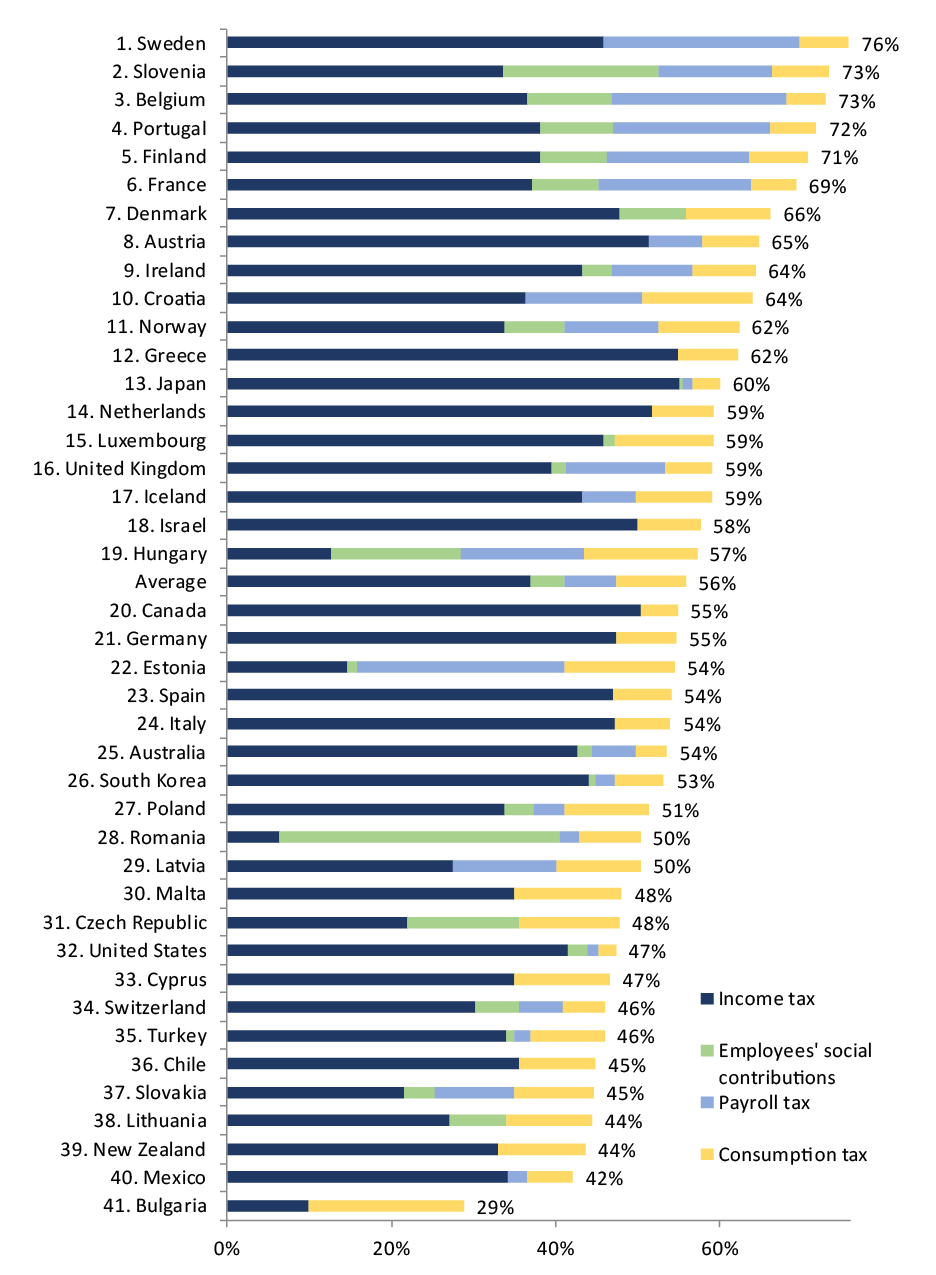

Eh...I don't know that our tax code is what you'd call "highly progressive". We're more like middle-bottom for progressive tax rates but live with high, and increasing, wealth inequality. So it's easy to say "my word, the top 10% are paying all the taxes! we're so progressive!" when in reality the 10% have almost 80% of the money so yeah.

Figure 1 Top Effective Marginal Tax Rates in 2019 and Their Composition
https://taxfoundation.org/research/all/eu/taxing-high-income-2019/
Anonymous
Anonymous wrote:
Anonymous wrote:
Anonymous wrote:So let me get this straight. You asked a CPA. You didn't like the correct answer s/he gave you. And so you thought you'd crowd source this?

Maybe count your blessings to be doing so well that you can contribute that level of taxation and be glad you don't live in other places of the world where taxes are higher (because the USA is basically the world's tax haven).

The short answers is the same your CPA gave you. You're salaried employees. Short of increasing exclusions like 401K contributions, there really are no magic tricks here. And thank God for that. Pay your fair share, damnit.


Ditch the attitude!!

It's frustrating to pay so much of your income in taxes. Those making over $178K pay 75-80% of all income taxes at the federal level. So while many of us are happy to do our part, it's frustrating to see so much of our hard earned income go to taxes ALL the time. We see no real breaks, and are not billionaires


That’s a load of horseshit.


Not really. The numbers may vary slightly (depending upon where you are pulling the data), but fact remains those making over ~$170K do contribute to 75%+ of the USA federal taxes paid (that includes Medicare as well, which has no cap). They are not paying 75% of THEIR income, but I never stated that
Anonymous
Anonymous wrote:
Anonymous wrote:Our federal income tax code is highly progressive.


Eh...I don't know that our tax code is what you'd call "highly progressive". We're more like middle-bottom for progressive tax rates but live with high, and increasing, wealth inequality. So it's easy to say "my word, the top 10% are paying all the taxes! we're so progressive!" when in reality the 10% have almost 80% of the money so yeah.

Figure 1 Top Effective Marginal Tax Rates in 2019 and Their Composition

https://taxfoundation.org/research/all/eu/taxing-high-income-2019/


Note that the above quote says our federal income tax is highly progressive. The chart shows a number of taxes stacked on each other. If you look at just the dark blue we’re much higher. And progressivity measures the difference between high and low income earners. European top tax rates start at significantly lower incomes. Europe just has significantly higher tax burdens overall.
post reply Forum Index » Money and Finances
Message Quick Reply
Go to: