
Proposed legislation would ban legacy preference at colleges, universities across New York
![[Post New]](/jforum/templates/default/images/icon_minipost_new.gif)
Anonymous
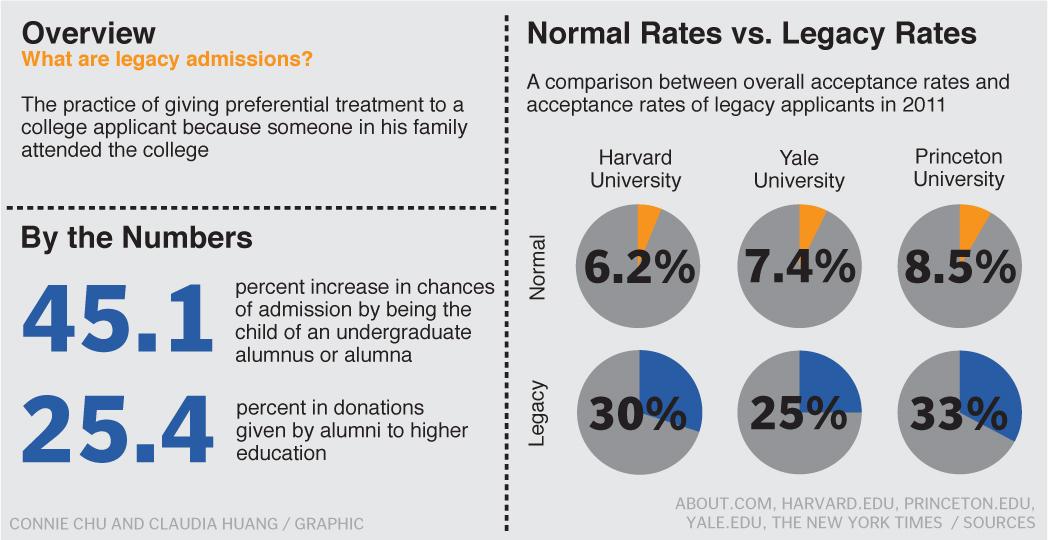
Hey genius. The chart included on this thread shows that about 30% of legacies get in. My experience corroborates that they usually don't get in. FFS. I am not in the room with the admissions committee, but I have seen that legacy admits usually do not get in, and when they do they appear to be qualified. I was mentioning my experience to highlight that point. There is no way for me or anyone else to know. I'd love to know what "supporting evidence" could support this either way. Unless you are an admissions officer at hyps violating your employment agreement. |
Anonymous
|
Anonymous
Exactly...and that's how you're not discriminated against. I am saying that those with disabilities are discriminated against based on the criteria for admissions. People on here seem to think that universities can't use their own criteria, because it's discriminatory. So I'm going to jump on that bandwagon and say that grades shouldn't count, because that discriminates against students with learning disabilities---a protected class. |
Anonymous
This, 100%. People on this board think we live and die by "the stats." Are there any studies out there about what good the typical A+ high school students do in this world compared to the B+ students? I'm going to guess, it isn't meaningful. What a person brings to a college community, or any community, is not defined soley by a very narrow set of "stats." Such small-minded thinking. Which, by the way, is why none of you are running Harvard. |
Anonymous
Since you talk about “university’s mission”, Harvard college’s Vision, Mission, and History as given by Harvard is copied below. Now, show us where in Harvard talks about “legacy” and “legacy preference”? The Transformative Power of a Liberal Arts and Sciences Education Our mission to educate future leaders is woven throughout the Harvard College experience, inspiring every member of our community to strive toward a more just, fair, and promising world. Mission The mission of Harvard College is to educate the citizens and citizen-leaders for our society. We do this through our commitment to the transformative power of a liberal arts and sciences education. Beginning in the classroom with exposure to new ideas, new ways of understanding, and new ways of knowing, students embark on a journey of intellectual transformation. Through a diverse living environment, where students live with people who are studying different topics, who come from different walks of life and have evolving identities, intellectual transformation is deepened and conditions for social transformation are created. From this we hope that students will begin to fashion their lives by gaining a sense of what they want to do with their gifts and talents, assessing their values and interests, and learning how they can best serve the world. Vision Harvard College sets the standard for residential liberal arts and sciences education. We have committed to creating and sustaining the conditions that enable all Harvard College students to experience an unparalleled educational journey that is intellectually, socially, and personally transformative. History History When you attend Harvard College, you become a part of the rich history of the nation’s oldest institution of higher learning. Founded in 1636, Harvard has changed dramatically over the centuries, but has always served as a haven for the world’s most ambitious scholars and leaders. |
Anonymous
Not true. There are hundreds of Questbridge admits (financial aid kids) who are admitted ED to Ivies and Ivy+ schools every year. |
Anonymous
And you need to know the students' race or legacy status for that? You should see each 'person' as an individual person, not as a son of somebody or as a part of a racial group. |
Anonymous
This is absolutely true. Schools will take 50-60% of the class ED which will continue to benefit yield and selectivity. The number of applicants from Questbridge and similar programs are too small to make a meaningful impact. |
Anonymous
“Mission” in the sense I’m using it is not limited to a formal mission statement written on a piece of paper. It refers to the institutional priorities and preferences as defined by the institution. |
Anonymous
If Harvard formally defined the way you are thinking, show me where you found it. |
Anonymous
The law suit against Harvard had plenty of objective data to show Asians are being discriminated against legacies and non-legacy whites. |
Anonymous
+100000000000000 |
Anonymous
A formal definition is not the point. None of these colleges deny that they give a preference to legacy applicants. They’re not hiding it, it is one of their many priorities. |
Anonymous
In other words, Harvard's Vision and Mission are lofty but EMPTY words that have no practical meaning in practice. |
Anonymous
You’re free to think that if you want. I think many would disagree with you. Many would point to Harvard’s very substantial financial aid policy and grants, including the 20% of families with incomes less than $65k who need to pay $0 in tuition and don’t need to take out loans. But the point is, these are Harvard’s decisions to make. They don’t need to make admissions decisions solely based on grades and test scores, even if you and others scream that that is the only “fair” or “meritocratic” thing to do. They don’t need to agree with the criteria by which are you judging them. And clearly, they don’t. |