
What is a "donut hole family"?

Anonymous
Anonymous wrote:
Anonymous wrote:Nobody in their right mind thinks college cost increases over the past 25 years are not exorbitant.

and congress wants to put a cap on nurses pay, come on let's put some regulations around college costs.


I don’t disagree with you, at all. But I still don’t believe there’s any such thing as a donut hole family.


The dcum experts are the best experts. Who needs trained economists and experts in higher education when we have dcum???
Anonymous
Anonymous wrote:
Anonymous wrote:
Anonymous wrote:
Anonymous wrote:
Anonymous wrote:
Anonymous wrote:
Anonymous wrote:Could someone please explain, because it sounds like people with nice resources feeling entitled to more than they can afford.


No. It is a family that won’t qualify for FA but that doesn’t have the resources to reasonably handle tuition at the priciest/most elite colleges. I don’t know about families feeling entitled, but from the colleges’ standpoint it is a real problem that they are concerned about. They don’t want their student populations to come from two stratified socioeconomic groups.


This most closely describes the issue in an unbiased way. While I don’t expect massive FA, we also can’t comfortably pay for expensive private college. The colleges take into account all assets, which is great. No one should get to hide their wealth in a boat purchase. At the same time, we can’t liquidate our retirement savings. We would have to pay penalties. The government has penalties to discourage using your retirement money for non-retirement. So, we find ourselves in a spot where savings that we can’t use without expensive penalties is used to indicate we have “too much” money.

Meanwhile, our cash flow is not high, so it’s hard to swing the full cost.

Before people call me a whiner or tell me how lucky I am, I know I am lucky. I’m not complaining. We could empty our retirement accounts, but it would then lead us into poverty and that doesn’t help society or ourselves.


I don't know anyone who thinks paying for "expensive private college" is comfortable. This is the problem with donut hole discussions - of course it's expensive! It's expensive for everyone! If you think you're hard done by because you can't just instruct your household manager to write a check and forget about it moments later, you have skewed expectations in life. "Not outrageously wealthy" is not a protected class.


I'm 60 years old and graduated from a NESCAC school in 1983. The year I started, it cost about $8K for tuition, room, and board. I paid about $2000-$2500 of that from summer and part-time job (during the school year) earnings and my parents paid the rest. They did the same for my three siblings. It was not "comfortable" meaning "cushy," but it was completely doable. Some of my friends at similar schools and at Ivy League schools needed loans, and they took them out (usually around $6K-$8K total) and paid them off fairly quickly. My friends at public universities were able to work their way through college earning minimum wage.

Fast-forward, that private school now costs $80K all-in. Very few families with four children could pay for it "comfortably" no matter how hard the kids worked during summers.

That is what people are angry about.


Once upon a time, private college was not expensive. Everyone knows that. I'm not arguing that college costs are reasonable now, I'm saying that the posters complaining about being in a "donut hole" because they cannot comfortably pay for the most expensive option are not adding anything to the discussion. The nature of an option being the most expensive is that . . . it's expensive and everyone can't afford it! And unless you're very rich, it's going to sting to write that check. If you can still afford it, just "uncomfortably"; if you can still handle tuition, just not "reasonably" - that's not sympathetic, and it's not a donut hole. And there are literally thousands of other options at lower price points. But they've convinced themselves they're uniquely challenged because the best of the best isn't a given for their kid.

If you want to talk about spiraling tuition costs, let's talk about the tax breaks that were funded by gutting state budgets for higher ed. It's not a donut hole discussion it's a political discussion. But the same people moaning that they're stuck in a donut hole are voting for the "drown it in a bathtub" people, and can't tell they did it to themselves.


Right, but again: Most everyone COULD afford the EXACT SAME THING a generation or two ago, with a little effort.

It hurts to tell a super high-performer that he can't even apply to elite schools because you can't pay for them. Is it a tragedy? No. But when you have a MEMORY of those schools being in fact, affordable when you were his age, it hurts.

That's it.

P.S. I agree re: gutting state budgets for higher ed.


UMC could afford it a generation ago. No one I knew would even have dreamed of applying to an Ivy. Not even incredibly accomplished kids.
Anonymous
Anonymous wrote:
Anonymous wrote:
Anonymous wrote:
Anonymous wrote:Nobody in their right mind thinks college cost increases over the past 25 years are not exorbitant.

and congress wants to put a cap on nurses pay, come on let's put some regulations around college costs.


I don’t disagree with you, at all. But I still don’t believe there’s any such thing as a donut hole family.


ok. How does a couple married at 26 with student loans and earning 200k by the time their oldest is in college, but whose earnings were closer to 100k combined for most of the kid's life (i.e. reasonable salaries outside of high COL cities) afford an expensive college? The family never would have earned sufficiently to save enough, but they don't qualify for aid. There is nothing right or wrong/moral or amoral about it, it's just a financial status


If they had stayed in the home they could afford at 26 they would have the ability to save. I mean that’s literally me (admittedly we married at 27 not 26 but otherwise). No upgraded house. 10 yr old cars. Modest house with no guest bedroom.


You mean rent, no. That is terrible advice since most rent and mortgage is the same.
Anonymous
Anonymous wrote:
Anonymous wrote:The problem is this describes a bunch of different families. And their situations may be sympathetic or not depending on your viewpoint.

Some people windup in the donut hole because they have more kids. If you have one or two kids, it's easier to sacrifice to get those kids through school than if you have three or four. People with more kids also struggle to save as much for college and feel frustrated when schools won't make up the difference. Personal bias here: I have little sympathy for these parents because I don't understand how you keep having kids without considering how you will pay for their college. But I have a lot of sympathy for these kids because it puts them in a really crappy situation where their existence is itself the thing keeping them from going to a school they got into but can't afford. Parents who have 3+ kids and then complain about how much college costs makes me angry.

But one I have more sympathy for is when one or both parents own a business and financial aid expects them to be willing to borrow against or liquidate business assets in order to pay for school. That seems like such a terrible choice. I know people who have done it and respect how much they are willing to put on the line for their kids education, but I'm not sure if I'd be able to make the same choice. That's a really tough one.

Another one is people who had kids late and are nearing retirement, and get caught two ways. First, they don't save as much for college because they are also saving for retirement (sometimes they are also caring for elderly parents and it's a squeeze). Second, they may have more liquid assets specifically because they are looking to retire soon, and financial aid will lay claim to those. I feel bad for these folks because often being late to parenting is not a choice. However, as someone who had kids late, I also just assumed that meant I'd have to work a little longer to get my kid through school. So again, this is something you can anticipate and should be able to if having kids late because you are old enough to understand how this works.

I also think people who come from modest backgrounds and who went to schools on scholarships sometimes don't understand how to save for college and then are surprised when their income pushes them into the "no aid" position. I have sympathy for this one because it's a knowledge gap -- their parents didn't save for college either and they just didn't know better. Though I do think if you are going to have kids you have to educate yourself. This was my DH and I had to work on him because he was convinced our kid would just qualify for aid. Now he gets that even though we aren't wealthy, we have more resource than our parents and we have to dedicate some of them to college savings if we want to ensure our kid can go to school. If I hadn't worked on him, though, we'd have zero saved.

There are probably others I'm unaware of. But these are the ones I hear the most. I think it's hardest for people who are outliers in their school or social community in terms of money. If everyone else you know can afford to pay out of pocket, and you can't because of the number of kids or your age, you might feel like it's unfair. And likewise, if everyone you know qualifies for aid because you are in a lower-income community, and you don't because you run a business with assets and therefore are actually in a higher bracket, it could feel unfair.

But usually it's not unfair. The actual unfair thing is that money is such a barrier to higher education in general in this country and having kids pretty much requires you to save for college, while also saving for retirement, while also paying your health insurance premiums. And yet we still have fairly high taxes! It's hard, but if it's "unfair" it's unfair to everyone except the very rich who inherited their wealth. And that's by design.

This really is the crux of the matter.


I'll add another scenario: parents who graduated from college with loans themselves who don't work in jobs with super high pay. When I finished graduate school I owed $67K in loans. My starting salary was $34K a year. My husband owed $24k and his starting salary was $40k. 2o years later we have paid off our student loans, have a decent amount in 401ks by always contributing at a minimum the match amount for our companies and we have a 529 for each kid with enough to cover a state school. We each now make around $100k each. Our only debt is our mortgage. Our oldest child is now in college. She ended up choosing an OOS flagship that gave her merit aid (enough that it is well below our state school price) and has a strong program in her major. She turned down 2 other schools because they did not offer any merit aid. We make a good salary and we are all happy. DD loves the college she is at. We make enough that we do not qualify for financial aid but not enough to pay for those other schools. We are a donut hole family. We are not bitter about it. Our goal is to help our children start their adult life on a better footing than we did.
Anonymous
Anonymous wrote:
Anonymous wrote:Nobody in their right mind thinks college cost increases over the past 25 years are not exorbitant.

and congress wants to put a cap on nurses pay, come on let's put some regulations around college costs.


I don’t disagree with you, at all. But I still don’t believe there’s any such thing as a donut hole family.


Anybody making $150K HHI will not qualify for aid, so explain to me how a family of 4 saves $400K to pay for college?

Assuming they make $70K HHI at 30 and by the time they are 45 they make $150K
Anonymous
Anonymous wrote:
Anonymous wrote:
Anonymous wrote:
Anonymous wrote:
Anonymous wrote:Nobody in their right mind thinks college cost increases over the past 25 years are not exorbitant.

and congress wants to put a cap on nurses pay, come on let's put some regulations around college costs.


I don’t disagree with you, at all. But I still don’t believe there’s any such thing as a donut hole family.


ok. How does a couple married at 26 with student loans and earning 200k by the time their oldest is in college, but whose earnings were closer to 100k combined for most of the kid's life (i.e. reasonable salaries outside of high COL cities) afford an expensive college? The family never would have earned sufficiently to save enough, but they don't qualify for aid. There is nothing right or wrong/moral or amoral about it, it's just a financial status


If they had stayed in the home they could afford at 26 they would have the ability to save. I mean that’s literally me (admittedly we married at 27 not 26 but otherwise). No upgraded house. 10 yr old cars. Modest house with no guest bedroom.


You mean rent, no. That is terrible advice since most rent and mortgage is the same.


??? No I don’t mean rent. We got married at 27, saved for a couple years to get into a house with PMI, and are still in that house (obviously no more PMI).
Anonymous
Anonymous wrote:
Anonymous wrote:
Anonymous wrote:Nobody in their right mind thinks college cost increases over the past 25 years are not exorbitant.

and congress wants to put a cap on nurses pay, come on let's put some regulations around college costs.


I don’t disagree with you, at all. But I still don’t believe there’s any such thing as a donut hole family.


The dcum experts are the best experts. Who needs trained economists and experts in higher education when we have dcum???


Right?

And facts? Who needs them? There's no such thing as climate change, either.
Anonymous
Anonymous wrote:
Anonymous wrote:
Anonymous wrote:Nobody in their right mind thinks college cost increases over the past 25 years are not exorbitant.

and congress wants to put a cap on nurses pay, come on let's put some regulations around college costs.


I don’t disagree with you, at all. But I still don’t believe there’s any such thing as a donut hole family.


Anybody making $150K HHI will not qualify for aid, so explain to me how a family of 4 saves $400K to pay for college?

Assuming they make $70K HHI at 30 and by the time they are 45 they make $150K


By making it their top priority and living modestly in every other possible way. If they don’t want to do that, they can use publics.
Anonymous
Anonymous wrote:
Anonymous wrote:
Anonymous wrote:People who do not qualify for financial aid, but whose real economic situation means they can't afford expensive colleges even if their kids are admitted. They are the families whose kids turn down Carnegie Mellon and take the merit award at Pitt.


But can’t they/don’t they take out loans to pay the tuition?


A family earning around 250k is not going to take out loans to cover the 50k a year difference in cost between publics and privates for multiple kids unless they are utterly terrible with money


What about student loans? Kids can payoff later? Why won’t donut hole families go for that option? Each kid takes out 50-60k loan per year to cover the cost of college?
Anonymous
Anonymous wrote:
Anonymous wrote:
Anonymous wrote:
Anonymous wrote:
Anonymous wrote:
Anonymous wrote:
Anonymous wrote:
Anonymous wrote:Could someone please explain, because it sounds like people with nice resources feeling entitled to more than they can afford.


No. It is a family that won’t qualify for FA but that doesn’t have the resources to reasonably handle tuition at the priciest/most elite colleges. I don’t know about families feeling entitled, but from the colleges’ standpoint it is a real problem that they are concerned about. They don’t want their student populations to come from two stratified socioeconomic groups.


This most closely describes the issue in an unbiased way. While I don’t expect massive FA, we also can’t comfortably pay for expensive private college. The colleges take into account all assets, which is great. No one should get to hide their wealth in a boat purchase. At the same time, we can’t liquidate our retirement savings. We would have to pay penalties. The government has penalties to discourage using your retirement money for non-retirement. So, we find ourselves in a spot where savings that we can’t use without expensive penalties is used to indicate we have “too much” money.

Meanwhile, our cash flow is not high, so it’s hard to swing the full cost.

Before people call me a whiner or tell me how lucky I am, I know I am lucky. I’m not complaining. We could empty our retirement accounts, but it would then lead us into poverty and that doesn’t help society or ourselves.


I don't know anyone who thinks paying for "expensive private college" is comfortable. This is the problem with donut hole discussions - of course it's expensive! It's expensive for everyone! If you think you're hard done by because you can't just instruct your household manager to write a check and forget about it moments later, you have skewed expectations in life. "Not outrageously wealthy" is not a protected class.


I'm 60 years old and graduated from a NESCAC school in 1983. The year I started, it cost about $8K for tuition, room, and board. I paid about $2000-$2500 of that from summer and part-time job (during the school year) earnings and my parents paid the rest. They did the same for my three siblings. It was not "comfortable" meaning "cushy," but it was completely doable. Some of my friends at similar schools and at Ivy League schools needed loans, and they took them out (usually around $6K-$8K total) and paid them off fairly quickly. My friends at public universities were able to work their way through college earning minimum wage.

Fast-forward, that private school now costs $80K all-in. Very few families with four children could pay for it "comfortably" no matter how hard the kids worked during summers.

That is what people are angry about.


Once upon a time, private college was not expensive. Everyone knows that. I'm not arguing that college costs are reasonable now, I'm saying that the posters complaining about being in a "donut hole" because they cannot comfortably pay for the most expensive option are not adding anything to the discussion. The nature of an option being the most expensive is that . . . it's expensive and everyone can't afford it! And unless you're very rich, it's going to sting to write that check. If you can still afford it, just "uncomfortably"; if you can still handle tuition, just not "reasonably" - that's not sympathetic, and it's not a donut hole. And there are literally thousands of other options at lower price points. But they've convinced themselves they're uniquely challenged because the best of the best isn't a given for their kid.

If you want to talk about spiraling tuition costs, let's talk about the tax breaks that were funded by gutting state budgets for higher ed. It's not a donut hole discussion it's a political discussion. But the same people moaning that they're stuck in a donut hole are voting for the "drown it in a bathtub" people, and can't tell they did it to themselves.


Right, but again: Most everyone COULD afford the EXACT SAME THING a generation or two ago, with a little effort.

It hurts to tell a super high-performer that he can't even apply to elite schools because you can't pay for them. Is it a tragedy? No. But when you have a MEMORY of those schools being in fact, affordable when you were his age, it hurts.

That's it.

P.S. I agree re: gutting state budgets for higher ed.


UMC could afford it a generation ago. No one I knew would even have dreamed of applying to an Ivy. Not even incredibly accomplished kids.


PP here and my parents were definitely not UMC, nor were most of the families in our orbit. They/we DID apply to Ivies etc. We WERE able to afford it because the cost bore a reasonable relationship to salaries (as did e.g. housing costs), including working-class salaries, and loans bore a reasonable relationship to college tuitions.

It was a cultural thing back then in the town I grew up in, maybe because of its proximity to where an Ivy League school was located?


Anonymous
Anonymous wrote:
Anonymous wrote:
Anonymous wrote:
Anonymous wrote:People who do not qualify for financial aid, but whose real economic situation means they can't afford expensive colleges even if their kids are admitted. They are the families whose kids turn down Carnegie Mellon and take the merit award at Pitt.


But can’t they/don’t they take out loans to pay the tuition?


A family earning around 250k is not going to take out loans to cover the 50k a year difference in cost between publics and privates for multiple kids unless they are utterly terrible with money


What about student loans? Kids can payoff later? Why won’t donut hole families go for that option? Each kid takes out 50-60k loan per year to cover the cost of college?


Because Carnegie Mellon isn’t worth it. Lol.
Anonymous
Anonymous wrote:
Anonymous wrote:
Anonymous wrote:
Anonymous wrote:People who do not qualify for financial aid, but whose real economic situation means they can't afford expensive colleges even if their kids are admitted. They are the families whose kids turn down Carnegie Mellon and take the merit award at Pitt.


But can’t they/don’t they take out loans to pay the tuition?


A family earning around 250k is not going to take out loans to cover the 50k a year difference in cost between publics and privates for multiple kids unless they are utterly terrible with money


What about student loans? Kids can payoff later? Why won’t donut hole families go for that option? Each kid takes out 50-60k loan per year to cover the cost of college?


Students cannot take out that much money in loans. The maximum amount per year is First-year undergraduate students – $5,500, with no more than $3,500 as subsidized loans; Second-year undergraduate students – $6,500, with no more than $4,500 as subsidized loans; Third- and fourth-year undergraduate students – $7,500, with no more than $5,500 as subsidized loans.

https://lendedu.com/blog/federal-student-loan-limits/
Anonymous
Anonymous wrote:
Anonymous wrote:
Anonymous wrote:
Anonymous wrote:Nobody in their right mind thinks college cost increases over the past 25 years are not exorbitant.

and congress wants to put a cap on nurses pay, come on let's put some regulations around college costs.


I don’t disagree with you, at all. But I still don’t believe there’s any such thing as a donut hole family.


Anybody making $150K HHI will not qualify for aid, so explain to me how a family of 4 saves $400K to pay for college?

Assuming they make $70K HHI at 30 and by the time they are 45 they make $150K


By making it their top priority and living modestly in every other possible way. If they don’t want to do that, they can use publics.


That just means you would make different decisions than them. It doesn't mean that donut hole families don't exist. The term donut hole family does not connote a value judgment about whether or not a family is virtuous (in your view) or deserving of something. It describes a set of factual circumstances.
Anonymous
Anonymous wrote:
Anonymous wrote:
Anonymous wrote:
Anonymous wrote:
Anonymous wrote:
Anonymous wrote:
Anonymous wrote:
Anonymous wrote:
Anonymous wrote:Could someone please explain, because it sounds like people with nice resources feeling entitled to more than they can afford.


No. It is a family that won’t qualify for FA but that doesn’t have the resources to reasonably handle tuition at the priciest/most elite colleges. I don’t know about families feeling entitled, but from the colleges’ standpoint it is a real problem that they are concerned about. They don’t want their student populations to come from two stratified socioeconomic groups.


This most closely describes the issue in an unbiased way. While I don’t expect massive FA, we also can’t comfortably pay for expensive private college. The colleges take into account all assets, which is great. No one should get to hide their wealth in a boat purchase. At the same time, we can’t liquidate our retirement savings. We would have to pay penalties. The government has penalties to discourage using your retirement money for non-retirement. So, we find ourselves in a spot where savings that we can’t use without expensive penalties is used to indicate we have “too much” money.

Meanwhile, our cash flow is not high, so it’s hard to swing the full cost.

Before people call me a whiner or tell me how lucky I am, I know I am lucky. I’m not complaining. We could empty our retirement accounts, but it would then lead us into poverty and that doesn’t help society or ourselves.


I don't know anyone who thinks paying for "expensive private college" is comfortable. This is the problem with donut hole discussions - of course it's expensive! It's expensive for everyone! If you think you're hard done by because you can't just instruct your household manager to write a check and forget about it moments later, you have skewed expectations in life. "Not outrageously wealthy" is not a protected class.


I'm 60 years old and graduated from a NESCAC school in 1983. The year I started, it cost about $8K for tuition, room, and board. I paid about $2000-$2500 of that from summer and part-time job (during the school year) earnings and my parents paid the rest. They did the same for my three siblings. It was not "comfortable" meaning "cushy," but it was completely doable. Some of my friends at similar schools and at Ivy League schools needed loans, and they took them out (usually around $6K-$8K total) and paid them off fairly quickly. My friends at public universities were able to work their way through college earning minimum wage.

Fast-forward, that private school now costs $80K all-in. Very few families with four children could pay for it "comfortably" no matter how hard the kids worked during summers.

That is what people are angry about.


Once upon a time, private college was not expensive. Everyone knows that. I'm not arguing that college costs are reasonable now, I'm saying that the posters complaining about being in a "donut hole" because they cannot comfortably pay for the most expensive option are not adding anything to the discussion. The nature of an option being the most expensive is that . . . it's expensive and everyone can't afford it! And unless you're very rich, it's going to sting to write that check. If you can still afford it, just "uncomfortably"; if you can still handle tuition, just not "reasonably" - that's not sympathetic, and it's not a donut hole. And there are literally thousands of other options at lower price points. But they've convinced themselves they're uniquely challenged because the best of the best isn't a given for their kid.

If you want to talk about spiraling tuition costs, let's talk about the tax breaks that were funded by gutting state budgets for higher ed. It's not a donut hole discussion it's a political discussion. But the same people moaning that they're stuck in a donut hole are voting for the "drown it in a bathtub" people, and can't tell they did it to themselves.


Right, but again: Most everyone COULD afford the EXACT SAME THING a generation or two ago, with a little effort.

It hurts to tell a super high-performer that he can't even apply to elite schools because you can't pay for them. Is it a tragedy? No. But when you have a MEMORY of those schools being in fact, affordable when you were his age, it hurts.

That's it.

P.S. I agree re: gutting state budgets for higher ed.


UMC could afford it a generation ago. No one I knew would even have dreamed of applying to an Ivy. Not even incredibly accomplished kids.


PP here and my parents were definitely not UMC, nor were most of the families in our orbit. They/we DID apply to Ivies etc. We WERE able to afford it because the cost bore a reasonable relationship to salaries (as did e.g. housing costs), including working-class salaries, and loans bore a reasonable relationship to college tuitions.

It was a cultural thing back then in the town I grew up in, maybe because of its proximity to where an Ivy League school was located?


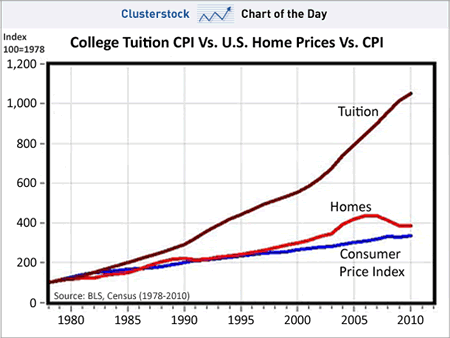
One generation ago, or 2000, is already well into the upward slope of your chart…
Anonymous
Anonymous wrote:
Anonymous wrote:
Anonymous wrote:
Anonymous wrote:People who do not qualify for financial aid, but whose real economic situation means they can't afford expensive colleges even if their kids are admitted. They are the families whose kids turn down Carnegie Mellon and take the merit award at Pitt.


But can’t they/don’t they take out loans to pay the tuition?


A family earning around 250k is not going to take out loans to cover the 50k a year difference in cost between publics and privates for multiple kids unless they are utterly terrible with money


What about student loans? Kids can payoff later? Why won’t donut hole families go for that option? Each kid takes out 50-60k loan per year to cover the cost of college?


And the kid ends up with $200k in loans just for undergrad? Have you heard of the student loan crisis?
post reply Forum Index » College and University Discussion
Message Quick Reply
Go to: