Why are DCUM parents less inclined to have their child major in business?

Anonymous
Anonymous wrote:
Anonymous wrote:
Anonymous wrote:
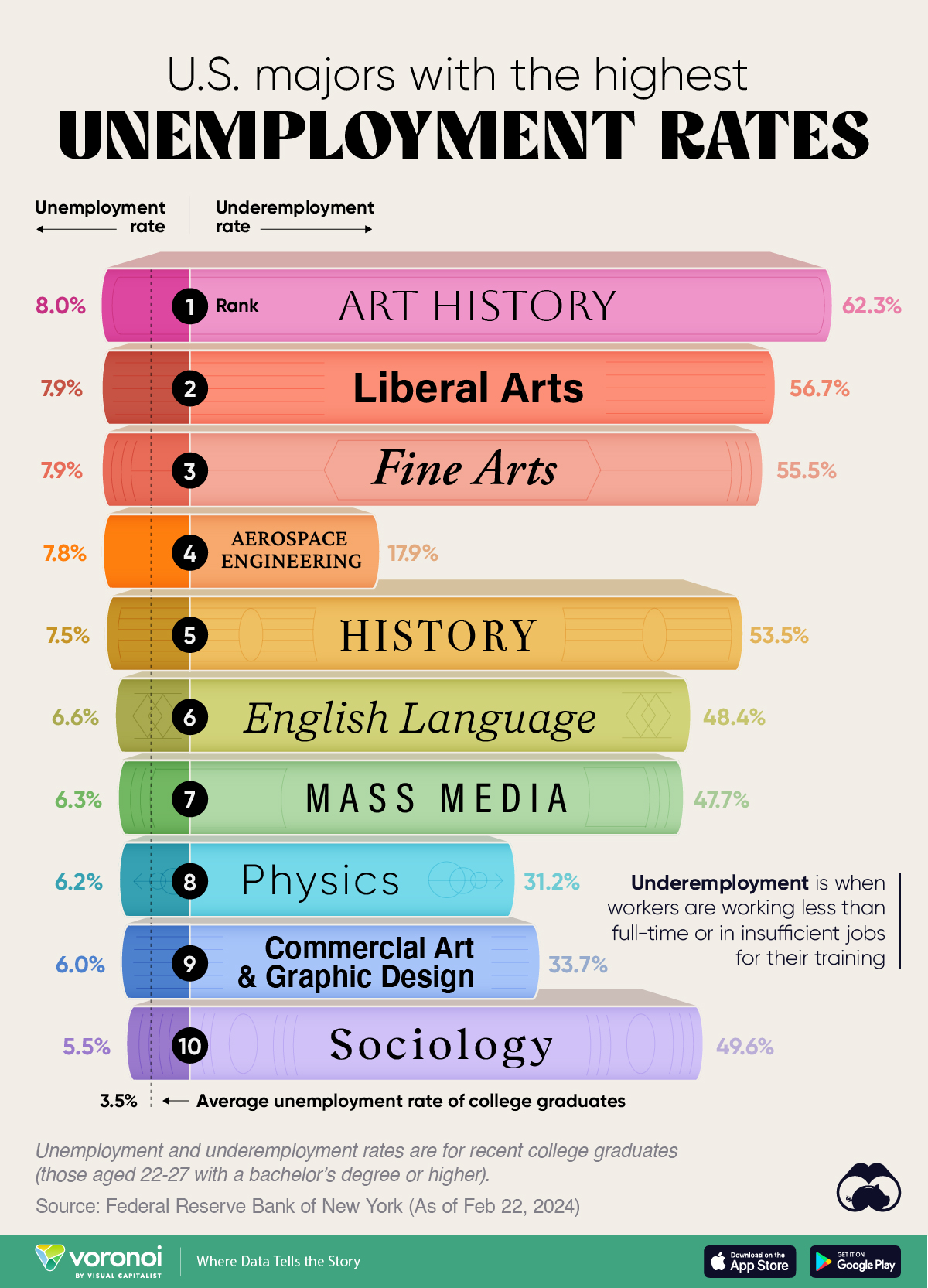
Anonymous wrote:Where are these liberal arts majors finding jobs?

My husband and I were liberal arts majors and we are suffering in the job market in our thirties. We will advise our children to study business!

They get internships.
Math and Physics Majors nab internships in finance and tech.
Anthropology/Sociology people place well into "People" teams aka HR, and they do very well when it comes to program development/non profit structure teams.
English/History majors are all over the map and can write which is always a plus.
A lot of Ethnic/Women studies in HR too along with Policy.
Econ/Government/IR end up in many similar spots.


Cool infographic? Some of us go to decent schools where this is less of a concern. Obviously don't get a sociology degree from Kent State lmao.

? but most students don't got elite colleges. They go to state colleges.
Anonymous
Anonymous wrote:
Anonymous wrote:
Anonymous wrote:
Anonymous wrote:As always, people still living in the 80s are clueless.

https://www.cbsnews.com/news/college-major-highest-lowest-incomes/

https://www.cbsnews.com/news/college-major-highest-lowest-incomes/

https://www.cbsnews.com/news/college-major-highest-lowest-incomes/

Business analytics, Finance, MIS, Accounting are all under Business program.

That's why in general, business program is harder to get in and more competitive.


You know, there does exist a general "business major" that will accept anybody. When I say I don't want my child to major in business, I mean I don't want them to major in business. That does not mean I don't want them to pick a major under the business program, like accounting or finance.


I think people are assuming you mean BA from a college or university, not the old business degrees that were for people studying stenography, etc. Some schools only allow majors/concentrations within a business college and a degree is a BBA without a subhead. So, I think people are not answering according to your definition.


If a college offers a BBA degree with a concentration in finance, is that degree as marketable as a finance degree without the BBA ?

I say this as a former BBA grad, eons ago:

If they want to go into finance, get a finance BS degree, especially fintech.
Anonymous
Anonymous wrote:
Anonymous wrote:
Anonymous wrote:
Anonymous wrote:Where are these liberal arts majors finding jobs?

My husband and I were liberal arts majors and we are suffering in the job market in our thirties. We will advise our children to study business!

They get internships.
Math and Physics Majors nab internships in finance and tech.
Anthropology/Sociology people place well into "People" teams aka HR, and they do very well when it comes to program development/non profit structure teams.
English/History majors are all over the map and can write which is always a plus.
A lot of Ethnic/Women studies in HR too along with Policy.
Econ/Government/IR end up in many similar spots.


Cool infographic? Some of us go to decent schools where this is less of a concern. Obviously don't get a sociology degree from Kent State lmao.

The unemployment rates are fraudulent levels of incorrect.
Source: https://nces.ed.gov/programs/coe/pdf/coe_sbc.pdf
Anonymous
Anonymous wrote:
Anonymous wrote:
Anonymous wrote:
Anonymous wrote:
Anonymous wrote:Where are these liberal arts majors finding jobs?

My husband and I were liberal arts majors and we are suffering in the job market in our thirties. We will advise our children to study business!

They get internships.
Math and Physics Majors nab internships in finance and tech.
Anthropology/Sociology people place well into "People" teams aka HR, and they do very well when it comes to program development/non profit structure teams.
English/History majors are all over the map and can write which is always a plus.
A lot of Ethnic/Women studies in HR too along with Policy.
Econ/Government/IR end up in many similar spots.


Cool infographic? Some of us go to decent schools where this is less of a concern. Obviously don't get a sociology degree from Kent State lmao.

? but most students don't got elite colleges. They go to state colleges.

If you can go to a decent school-UVA type place, even W&M. You can definitely earn more and be more employed than what's on that graph. I also can't find the original Fed data they did, because the unemployment rates are ridiculously high.
Anonymous
Anonymous wrote:
Anonymous wrote:
Anonymous wrote:
Anonymous wrote:
Anonymous wrote:Snobbery?

STEM is hot. Law is prestigious. DCUM seems to not like many majors outside those fields.


I think degrees in nursing, early childhood education, soil science, construction management, etc. are all better than a business degree, and I imagine that most DCUMers would agree with me. It's not about snobbery at all.


Early childhood education is important but you run the risk of making as low as minimum wage for your entire career. It would be a terrible financial decision to major in it.


Disagree. Elementary school pay is not minimum wage. I just looked it up and in my district (Arlington) pay starts at 35 dollars an hour, plus benefits, for a 10-month job. Annual raises aren't great but if you do some online coursework to get a masters and you teach year-round, you can definitely be making 100K by the end of your career. I think elementary education is just as good as a general business degree in terms of ROI, all things considered. And we know that elementary education isn't a lucrative degree, which underscores how bad a business degree can be.

(To be clear, a business major is fine if you really hustle or already have connections, and obviously business-related majors like finance and accounting are way more lucrative than elementary education.)


Have you ever lived outside the DMV? And if you teach in MoCo, can you afford to live where your comfortable students live?

Elementary is very low paid in my state. Early childhood specialization is often what daycare staff get.

Business, engineering, cs interns get paid decent money. Student teaching might even cost the candidate $$$.


Like I said, I'm not saying it is a lucrative major. I'm just saying you aren't doomed financially if you pick it. As with any major, you need to be thoughtful and realistic about the future. People hear "business" and get stars in their eyes and then are shocked when they can't get a job out of college. and back to the main point, I would approve much more of early Ed than I would a generic business major.
Anonymous
Anonymous wrote:
Anonymous wrote:
Anonymous wrote:
Anonymous wrote:As always, people still living in the 80s are clueless.

https://www.cbsnews.com/news/college-major-highest-lowest-incomes/

https://www.cbsnews.com/news/college-major-highest-lowest-incomes/

https://www.cbsnews.com/news/college-major-highest-lowest-incomes/

Business analytics, Finance, MIS, Accounting are all under Business program.

That's why in general, business program is harder to get in and more competitive.


You know, there does exist a general "business major" that will accept anybody. When I say I don't want my child to major in business, I mean I don't want them to major in business. That does not mean I don't want them to pick a major under the business program, like accounting or finance.

dp.. the way it general works is you are a business major, then pick a track, like accounting or finance. Most colleges don't have a "finance" major. It's within the business major.


This is how it is at my son’s university.


Same. To study finance your diploma will be BS in Business, Finance concentration - thus you are a business major. I think this is what was not understood by many PPs, including the OP.
Anonymous
Anonymous wrote:Business is a safe major and pretty much guarantees a well paid job after college and lucrative career options afterwards

The young adults now who majored in business or attended an undergraduate business program are thriving post college. Some are in PE others are in investment banking or in finance teams at Fortune 500 companies.


Not really.

https://www.coursera.org/articles/business-degree-salary

According to the US Bureau of Labor Statistics (BLS), the median annual wage for people with a business degree is $65,000. That’s a bit higher than the median wage for bachelor’s degree holders across all fields, $60,000.

Money aside, what I wanted for my kids was an education that would enable them to understand and appreciate the world in its entirety, while developing excellent analytical and communications skills. In that sense, a business major is useless. It's not so much about education as it is about well, business. Making money.
Anonymous
dcum always recommends CS and Engineering as degrees with best employment but I recruit finance undergrad and it is a decent major.
Anonymous
When I was a business major, the "generic business major" was to have a "management" concentration. It seemed to be where students ended up when they didn't really like any other track (and probably should have picked another major). Popular concentrations were finance, mgt information systems, accounting, marketing. I was a Business/Marketing major with a focus on research so I added a bunch of quant classes (MIS, Stats) as electives.

It worked out fine for me. Psychology + Statistics could have gotten me to the same place but I don't know that I'd have necessarily been exposed to the specific field if I went that way. I got interested via a required consumer behavior class plus a "business statistics" class.

I got a lot of practical experience in my college's program and got my first job at a consulting firm as a direct result of a required capstone project where I conducted a research project for a local business.
Anonymous
Because many are highly educated and well-bred and don’t view college as a trade school.
Anonymous
Anonymous wrote:dcum always recommends CS and Engineering as degrees with best employment but I recruit finance undergrad and it is a decent major.

I don't really see the difference between DCUM promoting econ majors and finance degrees. They overwhelmingly go to the same careers.
Anonymous
Anonymous wrote:
Anonymous wrote:dcum always recommends CS and Engineering as degrees with best employment but I recruit finance undergrad and it is a decent major.

I don't really see the difference between DCUM promoting econ majors and finance degrees. They overwhelmingly go to the same careers.


That’s not really true. Econ and Finance majors from top schools may end up in IB and consulting, but you will find more Finance majors working for F500 companies either in trainee programs or going into financial planning & analysis or treasury functions. Econ majors aren’t usually hired for these roles.

Statistically, you have far more Econ majors pursuing graduate work vs finance majors as well (and interestingly, you have Math and Econ majors pursuing finance PhDs in higher numbers than finance undergrads).
Anonymous
Anonymous wrote:
Anonymous wrote:
Anonymous wrote:dcum always recommends CS and Engineering as degrees with best employment but I recruit finance undergrad and it is a decent major.

I don't really see the difference between DCUM promoting econ majors and finance degrees. They overwhelmingly go to the same careers.


That’s not really true. Econ and Finance majors from top schools may end up in IB and consulting, but you will find more Finance majors working for F500 companies either in trainee programs or going into financial planning & analysis or treasury functions. Econ majors aren’t usually hired for these roles.

Statistically, you have far more Econ majors pursuing graduate work vs finance majors as well (and interestingly, you have Math and Econ majors pursuing finance PhDs in higher numbers than finance undergrads).

I don't necessarily see the difference, other than you just saying econ majors aren't hired. From DC's recent cohort, quite a few are going to Apple after going into their Financial Developer program, and a ton participate in those trainee programs for financial planning and many of those jobs list "Finance, Financial Economics, Econ,..." as acceptable degrees. Sure, many went into IB or Consulting, but most end up in typical financial positions that you would get from a decent finance program. Of course, more people are going into Econ grad school-there's more economics to do out in the academic world, and if your goal is to work for the Fed or some prime-time international NPO, grad programs place well into them. The math majors going into finance want to be quants, not really surprising to me.
Anonymous
Anonymous wrote:
Anonymous wrote:
Anonymous wrote:
Anonymous wrote:dcum always recommends CS and Engineering as degrees with best employment but I recruit finance undergrad and it is a decent major.

I don't really see the difference between DCUM promoting econ majors and finance degrees. They overwhelmingly go to the same careers.


That’s not really true. Econ and Finance majors from top schools may end up in IB and consulting, but you will find more Finance majors working for F500 companies either in trainee programs or going into financial planning & analysis or treasury functions. Econ majors aren’t usually hired for these roles.

Statistically, you have far more Econ majors pursuing graduate work vs finance majors as well (and interestingly, you have Math and Econ majors pursuing finance PhDs in higher numbers than finance undergrads).

I don't necessarily see the difference, other than you just saying econ majors aren't hired. From DC's recent cohort, quite a few are going to Apple after going into their Financial Developer program, and a ton participate in those trainee programs for financial planning and many of those jobs list "Finance, Financial Economics, Econ,..." as acceptable degrees. Sure, many went into IB or Consulting, but most end up in typical financial positions that you would get from a decent finance program. Of course, more people are going into Econ grad school-there's more economics to do out in the academic world, and if your goal is to work for the Fed or some prime-time international NPO, grad programs place well into them. The math majors going into finance want to be quants, not really surprising to me.


From what school? You have to go beyond the Top 50 to understand the difference for an Econ major vs a Finance major and career paths.

Actually…there is plenty of grad school work for Finance PhDs but schools have a hard time getting people to pursue those PhDs…that is why a finance PhD comes with a generous stipend and it is one of the few academic areas with lots of tenure-track jobs.
Anonymous
Anonymous wrote:
Anonymous wrote:
Anonymous wrote:
Anonymous wrote:
Anonymous wrote:dcum always recommends CS and Engineering as degrees with best employment but I recruit finance undergrad and it is a decent major.

I don't really see the difference between DCUM promoting econ majors and finance degrees. They overwhelmingly go to the same careers.


That’s not really true. Econ and Finance majors from top schools may end up in IB and consulting, but you will find more Finance majors working for F500 companies either in trainee programs or going into financial planning & analysis or treasury functions. Econ majors aren’t usually hired for these roles.

Statistically, you have far more Econ majors pursuing graduate work vs finance majors as well (and interestingly, you have Math and Econ majors pursuing finance PhDs in higher numbers than finance undergrads).

I don't necessarily see the difference, other than you just saying econ majors aren't hired. From DC's recent cohort, quite a few are going to Apple after going into their Financial Developer program, and a ton participate in those trainee programs for financial planning and many of those jobs list "Finance, Financial Economics, Econ,..." as acceptable degrees. Sure, many went into IB or Consulting, but most end up in typical financial positions that you would get from a decent finance program. Of course, more people are going into Econ grad school-there's more economics to do out in the academic world, and if your goal is to work for the Fed or some prime-time international NPO, grad programs place well into them. The math majors going into finance want to be quants, not really surprising to me.


From what school? You have to go beyond the Top 50 to understand the difference for an Econ major vs a Finance major and career paths.

Actually…there is plenty of grad school work for Finance PhDs but schools have a hard time getting people to pursue those PhDs…that is why a finance PhD comes with a generous stipend and it is one of the few academic areas with lots of tenure-track jobs.

I don't see why. The type of students to get into a Finance PhD program are top students. The type of students to get into a good finance development program are from top schools overwhelmingly (in the case of Apple, they take a few "local" students at Santa Clara University for DEI). If you have the chops to get into a good finance career, you typically come from the top 50 or 100 colleges.
DC attended CMC.
post reply Forum Index » College and University Discussion
Message Quick Reply
Go to: