
University of Chicago on Trigger Warnings

Anonymous
U of C. Maroons, not morons.
Anonymous
Anonymous wrote:
Anonymous wrote:Hundreds of zombie-like Democrats will now converge on UoC moaning "triggered, feelbad" and will demand retraction, apologies, safe spaces.


I'm a liberal Democrat and I agree with this policy 100% So shut your piehole


Np. Well, then you're not actually a liberal as that term is understood these days. But whatever makes you feel good.
Anonymous
Anonymous wrote:The UofC sent a letter to its incoming first-years clarifying the College's stance against trigger warnings and intellectual safe spaces. Read the letter here:

https://www.washingtonpost.com/news/grade-point/wp/2016/08/25/dont-ask-us-for-trigger-warnings-or-safe-spaces-the-university-of-chicago-tells-freshmen/

FWIW, I'm a professor in the humanities, politically very liberal, and I am glad that the UofC is taking this stance. (Yes, I would not only support Donald Trump coming to speak to my university, but I would encourage all my students to listen to him speak with an open, yet critical, mind. I would also encourage them to ask challenging questions if such an opportunity arose.) I firmly believe that all students ought to be exposed to different ideas and perspectives and learn to engage in civil discourse with people who hold those views and have had different life experiences.
+1. I will assume you (and UChicago) mean any and all conflicting views. I would expect the New Black Panther Party, the Nation of Islam, etc, to be afforded the right to express their opinion in the same venue that would afford the right to David Duke or Alex Jones. That's only fair no matter how much you disagree.
Anonymous
Anonymous wrote:Kudos. Mega kudos to U. Chicago. A serious school. Too bad it is so tough to get into.
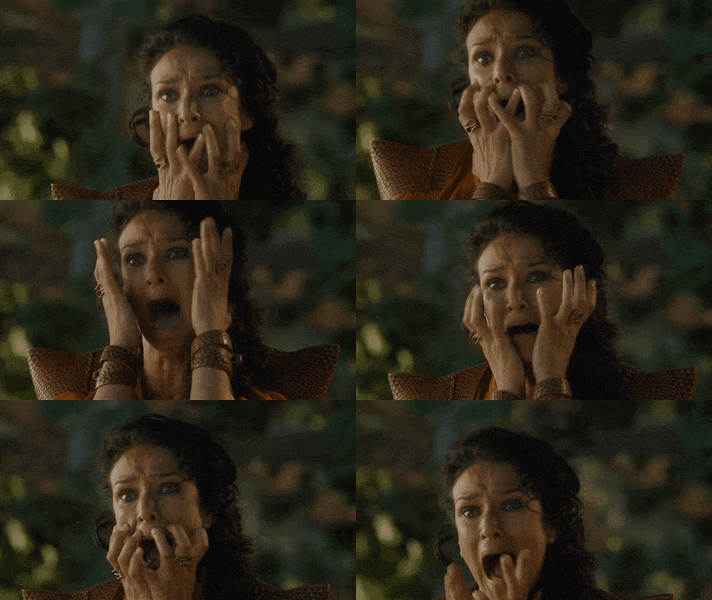
Scratched Claremont-McKenna from our list and Yale after the screamer lady bullshit that the admin. actually caved in to rather than stood up to.
I don't think Claremont or Yale is heartbroken because your snowflake won't be attending.
Anonymous
Anonymous wrote:
Anonymous wrote:
Anonymous wrote:How does this work fairly for actual victims of rape or military vets or gays who have PTSD from actual trauma? Is it not fair to afford them a trigger warning for material that may indeed trigger a PTSD episode?


Don't people with PTSD need psychiatric treatment, not trigger warnings? I don't understand how you can be in college and study literature or history or (insert probably many different disciplines here) and not be exposed to some pretty dreadful stuff. I don't have PTSD but I majored in Russian and couldn't eat or sleep for three days after I read book I of the Gulag Archipelago. If I HAD PTSD...what would a trigger warning have done? It's not like there's an alternate reading you can do if you're studying 20th century Soviet history, that lets you avoid hearing about the sick shit they did to political prisoners. I just don't get what trigger warnings are supposed to do in the classroom. If you're so emotionally fragile that you can't read a book or participate in a seminar or listen to a lecture, you need treatment. You can't handle college, which is already a pretty "safe space" compared to the real world.


+1


Don't you think they need treatment and deserve trigger warnings to avoid episodes? It's odd you presume they are not in treatment.
Anonymous
Anonymous wrote:
Anonymous wrote:
Anonymous wrote:
Anonymous wrote:How does this work fairly for actual victims of rape or military vets or gays who have PTSD from actual trauma? Is it not fair to afford them a trigger warning for material that may indeed trigger a PTSD episode?


Don't people with PTSD need psychiatric treatment, not trigger warnings? I don't understand how you can be in college and study literature or history or (insert probably many different disciplines here) and not be exposed to some pretty dreadful stuff. I don't have PTSD but I majored in Russian and couldn't eat or sleep for three days after I read book I of the Gulag Archipelago. If I HAD PTSD...what would a trigger warning have done? It's not like there's an alternate reading you can do if you're studying 20th century Soviet history, that lets you avoid hearing about the sick shit they did to political prisoners. I just don't get what trigger warnings are supposed to do in the classroom. If you're so emotionally fragile that you can't read a book or participate in a seminar or listen to a lecture, you need treatment. You can't handle college, which is already a pretty "safe space" compared to the real world.


+1


Don't you think they need treatment and deserve trigger warnings to avoid episodes? It's odd you presume they are not in treatment.


For one thing, it's hard to operationalize. My best friend, a science major, was raped in college while doing a summer internship at a famous lab and what "triggered" her was not a mention of rape but a mention of the lab (where her rapist continued to work). I have no idea how should could have disclosed to a science professor what happened to her or how the professor could have gotten the class to avoid mentioning that lab or the associated research, or to avoid it coming up in class discussions, or to avoid it being used in citations. She had to suffer through it. It sucked. What helped her was counseling to deal with the fact the world was going to keep throwing this at her and she had to learn to live with it (or learn to live without it by changing fields).
Anonymous
Anonymous wrote:
Anonymous wrote:
Anonymous wrote:
Anonymous wrote:
Anonymous wrote:How does this work fairly for actual victims of rape or military vets or gays who have PTSD from actual trauma? Is it not fair to afford them a trigger warning for material that may indeed trigger a PTSD episode?


Don't people with PTSD need psychiatric treatment, not trigger warnings? I don't understand how you can be in college and study literature or history or (insert probably many different disciplines here) and not be exposed to some pretty dreadful stuff. I don't have PTSD but I majored in Russian and couldn't eat or sleep for three days after I read book I of the Gulag Archipelago. If I HAD PTSD...what would a trigger warning have done? It's not like there's an alternate reading you can do if you're studying 20th century Soviet history, that lets you avoid hearing about the sick shit they did to political prisoners. I just don't get what trigger warnings are supposed to do in the classroom. If you're so emotionally fragile that you can't read a book or participate in a seminar or listen to a lecture, you need treatment. You can't handle college, which is already a pretty "safe space" compared to the real world.


+1


Don't you think they need treatment and deserve trigger warnings to avoid episodes? It's odd you presume they are not in treatment.


For one thing, it's hard to operationalize. My best friend, a science major, was raped in college while doing a summer internship at a famous lab and what "triggered" her was not a mention of rape but a mention of the lab (where her rapist continued to work). I have no idea how should could have disclosed to a science professor what happened to her or how the professor could have gotten the class to avoid mentioning that lab or the associated research, or to avoid it coming up in class discussions, or to avoid it being used in citations. She had to suffer through it. It sucked. What helped her was counseling to deal with the fact the world was going to keep throwing this at her and she had to learn to live with it (or learn to live without it by changing fields).


This is a very good example of the problem with the concept of a trigger warning. How do we know for what trauma we should be warning people about? How do we figure out what trauma each and every participant in a class or seminar has faced? What warnings do we put out there? Part of learning to heal from trauma is to DEAL with it, not be protected from it.

I'm an alum and very proud of my alma mater's clear and unequivocal stance on this.
Anonymous
Anonymous wrote:
Anonymous wrote:Great for you prof

Serious question what do you do when BLM or some other organization comes in and demands actions

Serious answer. You let them speak just like you would if David Duke or Alex Jones came to U of Chicago and were granted the right to speak.

It's not complicated unless you don't like what BLM has to say. Though I'm sure there are many who wouldn't like what Duke or Jones has to say.


OP here. If there were some compelling reason for David Duke or Alex Jones to speak, I think they should be permitted. I brought up Trump as an example because he is a Presidential candidate, and therefore a person to take seriously by virtue of his position in the current election cycle.
Anonymous
Anonymous wrote:
Anonymous wrote:Kudos. Mega kudos to U. Chicago. A serious school. Too bad it is so tough to get into.
Scratched Claremont-McKenna from our list and Yale after the screamer lady bullshit that the admin. actually caved in to rather than stood up to.
I don't think Claremont or Yale is heartbroken because your snowflake won't be attending.


My super-smart, fully bilingual and athletic Hispanic children won't be applying to Yale either -- their choice. Whether Yale is heartbroken or not, who cares. The future is MIT, Berkeley, Stanford.
Anonymous
Anonymous wrote:Great for you prof

Serious question what do you do when BLM or some other organization comes in and demands actions


NP. Please note that there is a vast difference between a speaker/ organization going to a campus to speak at a function, vs "demanding actions."
Anonymous
Anonymous wrote:
Anonymous wrote:
Anonymous wrote:Kudos. Mega kudos to U. Chicago. A serious school. Too bad it is so tough to get into.
Scratched Claremont-McKenna from our list and Yale after the screamer lady bullshit that the admin. actually caved in to rather than stood up to.
I don't think Claremont or Yale is heartbroken because your snowflake won't be attending.


My super-smart, fully bilingual and athletic Hispanic children won't be applying to Yale either -- their choice. Whether Yale is heartbroken or not, who cares. The future is MIT, Berkeley, Stanford.


Sorry, meant to ask, Claremont-McKenna, what is that?
Anonymous
Anonymous wrote:Great for you prof

Serious question what do you do when BLM or some other organization comes in and demands actions.


Got damn y'all seriously terrified of BLM aren't you?
Anonymous
Anonymous wrote:
Anonymous wrote:Great for you prof

Serious question what do you do when BLM or some other organization comes in and demands actions.


Got damn y'all seriously terrified of BLM aren't you?

Sigh, terrified of NAACP, Urban League, Universal Negro Improvement Association, even the Missouri Compromise! Nothing new under the sun, today or yesterday.

But let's do this in the Political forum. Okay? Cool!!
Anonymous
Anonymous wrote:I also am politically liberal and black, and I believe no one should be provided a "safe space" with crayons and coloring book if you're over 7. Since we probably agree on many social issues, how would you address the issue of a student in a required sociology class denigrating and castigating African-Americans as being lazy, uneducated, and unproductive justifying it by altering historical fact and stating a First amendment right? When I was told about this spring last semester, I thought that the student was probably echoing what he has heard politically and probably at home.

I would have given this student the mental finger as I quietly and respectfully listened because I've heard it before, been there and heard that. Though I am significantly older and have a much different race related life experience, posters would probably state that I would want an safe space and should stay and debate. Why would any student be forced to continue that kind of debate when years of history have proven otherwise? Why is it those students' job is to debate and most likely unsuccessfully change the thinking of a student who probably has racist familial conditioning?

Professor, I tell you this story as told to me by the parent of one of the two African-American students in the course who left the class because the other student was allowed to give his ideas without rebuttal and the class was instructed to listen, a learning experience. The two AA students returned to the next class and respectfully declined debate because they were unsure how a debate would affect their grade.

Where would you draw the line, OP? I would love to hear your thoughts on this type of freedom of speech (or as the U of Chicago said "inquiry and expression") and the rights of the student speaker versus the rights of the classroom student listeners to not debate and "retreat" to a different environment of intellectual quiet or as some here would label as "safe space."

Your thoughts, OP, are definitely welcomed.


OP here. You raise important points and a common concern among parents of color. My thoughts:

(1) The responsibility of the professor is to ensure that students have an accurate understanding of the topic studied--and if a student makes arguments in class that are factually incorrect, unsubstantiated, and motivated by bias (even if unintended), then the professor needs to correct the statements and teach how analysis from the discipline (sociology) is performed. So, if the class is about the sociology of race, the job of the professor is to try to get students to think about and analyze race the way sociologists would do so--and spouting off wrong historical data to make a point is NOT what a competent sociologist would do. Class is not the Jerry Springer show, despite students' desire to be "entertained." I am surprised that the professor allowed such historical inaccuracies to go on uncorrected--if other students in class are not correcting the inaccuracies, then the professor needs to step up. There are a lot of ways in which professors can make such tirades educational--have the student state the peer-reviewed sources, statistical surveys, sociological studies, etc., for such views.

(2) Classroom discussions need to be civil and students need to show mutual respect for each other. Making racist, sexist, homophobic, etc., comments ruin the atmosphere of collegial, intellectual, and rigorous discussion. It effectively shuts down alternative views (i.e., AfAm students now feel uncomfortable speaking up in class) and stops the inquiry.

3) Is is not the job of students of color to serve as "tokens" in the classroom. However, students, regardless of color, race, sex, etc., need to contribute to the discussion. In other words, I don't expect black students to speak on behalf black Americans, however, neither are they given a pass to remain silent if they have information that would change the flow of the conversation. It is everyone's job to speak up.

(4) Freedom of speech does not equal a passing grade. It is not an excuse to spout unfounded, inaccurate information.

(5) I wouldn't give up on students who come from racist backgrounds. Confession--my family growing up was, in fact, pretty racist and VERY sexist. College was a hugely liberating and eye-opening experience for me, personally. My professors, classes, and college friends taught me see the world in very different ways that I had been exposed to at home, and they gave me the vocabulary and critical thinking skills necessary to see my upbringing with a clearer lens.

(6) Some unsolicited advice--I don't know the background of the AfAm students in the course, but students need to go to office hours and talk to the professor (i.e., engage in dialogue!). The vast majority of us are, in fact, pretty reasonable and are in this because we want to teach (we are certainly not in it for the money). Unfortunately, by not participating in subsequent classes, those two students have shot themselves in the foot. They need to understand they they may very well be viewed as disengaged and/or unprepared for class discussion. They can't let their disgust get in the way of their getting a good grade. The professor is not a mind-reader, s/he doesn't know why the students aren't talking in in class. For all s/he knows, they agreed with the other student!
Anonymous
Anonymous wrote:
Anonymous wrote:I also am politically liberal and black, and I believe no one should be provided a "safe space" with crayons and coloring book if you're over 7. Since we probably agree on many social issues, how would you address the issue of a student in a required sociology class denigrating and castigating African-Americans as being lazy, uneducated, and unproductive justifying it by altering historical fact and stating a First amendment right? When I was told about this spring last semester, I thought that the student was probably echoing what he has heard politically and probably at home.

I would have given this student the mental finger as I quietly and respectfully listened because I've heard it before, been there and heard that. Though I am significantly older and have a much different race related life experience, posters would probably state that I would want an safe space and should stay and debate. Why would any student be forced to continue that kind of debate when years of history have proven otherwise? Why is it those students' job is to debate and most likely unsuccessfully change the thinking of a student who probably has racist familial conditioning?

Professor, I tell you this story as told to me by the parent of one of the two African-American students in the course who left the class because the other student was allowed to give his ideas without rebuttal and the class was instructed to listen, a learning experience. The two AA students returned to the next class and respectfully declined debate because they were unsure how a debate would affect their grade.

Where would you draw the line, OP? I would love to hear your thoughts on this type of freedom of speech (or as the U of Chicago said "inquiry and expression") and the rights of the student speaker versus the rights of the classroom student listeners to not debate and "retreat" to a different environment of intellectual quiet or as some here would label as "safe space."

Your thoughts, OP, are definitely welcomed.


OP here. You raise important points and a common concern among parents of color. My thoughts:

(1) The responsibility of the professor is to ensure that students have an accurate understanding of the topic studied--and if a student makes arguments in class that are factually incorrect, unsubstantiated, and motivated by bias (even if unintended), then the professor needs to correct the statements and teach how analysis from the discipline (sociology) is performed. So, if the class is about the sociology of race, the job of the professor is to try to get students to think about and analyze race the way sociologists would do so--and spouting off wrong historical data to make a point is NOT what a competent sociologist would do. Class is not the Jerry Springer show, despite students' desire to be "entertained." I am surprised that the professor allowed such historical inaccuracies to go on uncorrected--if other students in class are not correcting the inaccuracies, then the professor needs to step up. There are a lot of ways in which professors can make such tirades educational--have the student state the peer-reviewed sources, statistical surveys, sociological studies, etc., for such views.

(2) Classroom discussions need to be civil and students need to show mutual respect for each other. Making racist, sexist, homophobic, etc., comments ruin the atmosphere of collegial, intellectual, and rigorous discussion. It effectively shuts down alternative views (i.e., AfAm students now feel uncomfortable speaking up in class) and stops the inquiry.

3) Is is not the job of students of color to serve as "tokens" in the classroom. However, students, regardless of color, race, sex, etc., need to contribute to the discussion. In other words, I don't expect black students to speak on behalf black Americans, however, neither are they given a pass to remain silent if they have information that would change the flow of the conversation. It is everyone's job to speak up.

(4) Freedom of speech does not equal a passing grade. It is not an excuse to spout unfounded, inaccurate information.

(5) I wouldn't give up on students who come from racist backgrounds. Confession--my family growing up was, in fact, pretty racist and VERY sexist. College was a hugely liberating and eye-opening experience for me, personally. My professors, classes, and college friends taught me see the world in very different ways that I had been exposed to at home, and they gave me the vocabulary and critical thinking skills necessary to see my upbringing with a clearer lens.

(6) Some unsolicited advice--I don't know the background of the AfAm students in the course, but students need to go to office hours and talk to the professor (i.e., engage in dialogue!). The vast majority of us are, in fact, pretty reasonable and are in this because we want to teach (we are certainly not in it for the money). Unfortunately, by not participating in subsequent classes, those two students have shot themselves in the foot. They need to understand they they may very well be viewed as disengaged and/or unprepared for class discussion. They can't let their disgust get in the way of their getting a good grade. The professor is not a mind-reader, s/he doesn't know why the students aren't talking in in class. For all s/he knows, they agreed with the other student!


Wow, this made my day.

Most intelligent DCUM comment in 10 years.
post reply Forum Index » College and University Discussion
Message Quick Reply
Go to: