
Great colleges for kids with great grades, social skills, and athletics, but parents make minimal salaries
![[Post New]](/jforum/templates/default/images/icon_minipost_new.gif)
Anonymous
"donut hole" families qualify for NO aid but have a hard time being full pay, usually make 220-320k. That group is overrepresented among in-state students UVA and come off as quite rich because their parents are so happy not to be shelling out more for a private, frankly. They have no need to have a campus job and have plenty of $ for frats and vacations. This is not what OP is describing. OP said minimal salaries implying below average. OP's family will qualify for great aid and will go for free at the elite schools and have lots of company with similar families. Anyone over 320k should be able to be full pay without much trouble. |
Anonymous
They tend to be too expensive, privates have more merit and aid |
Anonymous
If OP is really making "minimal salary", they would get decent financial aid, even at state schools. Did op state what their salaries actually are? |
Anonymous
Reread the subject line as well. Minimal salaries does not suggest skipping meals. Such a weird inference. Regardless, my suggestion of Ivies stands (I also include QB and full need students as part of friend group). Many other schools meet full need and will have some degree of a cohort. (Lafayette is far more generous than most of its peers. Student with 0 EFC only pays the student contribution, about $2500/year). BigFuture has a filter for meets full need, but then compare that to npc. (Lafayette endeavor beating W&L, Emory and several others). Any school good at meeting need should also have good support and decent cohort. Try for fly-in programs. |
Anonymous
Both. So the word poverty WAS used. PP (you?) said "No" that it wasn't. So that pp was WRONG |
Anonymous
Poverty DOES suggest food insecurity. So weird to read the word POVERTY and infer that the person does not actually mean it. |
Anonymous
It really doesn’t. I think you just have stereotypes about poor people. Many parts of the US are fine to live in with a sub $50k income. |
Anonymous
|
Life can be awkward. Your child’s best bet is a meet fill needs college - if they are lucky enough to get in. Some of these colleges don’t even package loans. Your child should also apply to their state schools. Some have initiatives to help defray the cost for Pell Grant recipients.
https://umdrightnow.umd.edu/university-of-maryland-announces-20m-investment-in-need-based-financial-aid And if none of those are affordable, your child can attend the community college and transfer to an instate four year school. I would recommend taking out the guaranteed loans freshman and sophomore year, even if not yet needed, to be used for any gap the last two years. Your child can get a head start by doing dual enrollment (where I think the school district might pick up the costs of the community college) or taking AP/ IB courses. Another option is to work and attend college. Places like Starbucks have tuition help for online college. If your child starts with a bunch of dual enrollment or testing credit, they may not take long to get through. Another option is a military college or work college. There are a few work colleges like Berea that are specifically created for lower income families. |
Anonymous
| I'm enjoying the exegesis of OP's lazily drafted two-sentence post. |
Anonymous
| State universities. |
Anonymous
People aren't reading what OP wrote:
Sure, Princeton provides merit aid to many, but most of the students there come from families making more than "minimal salaries". 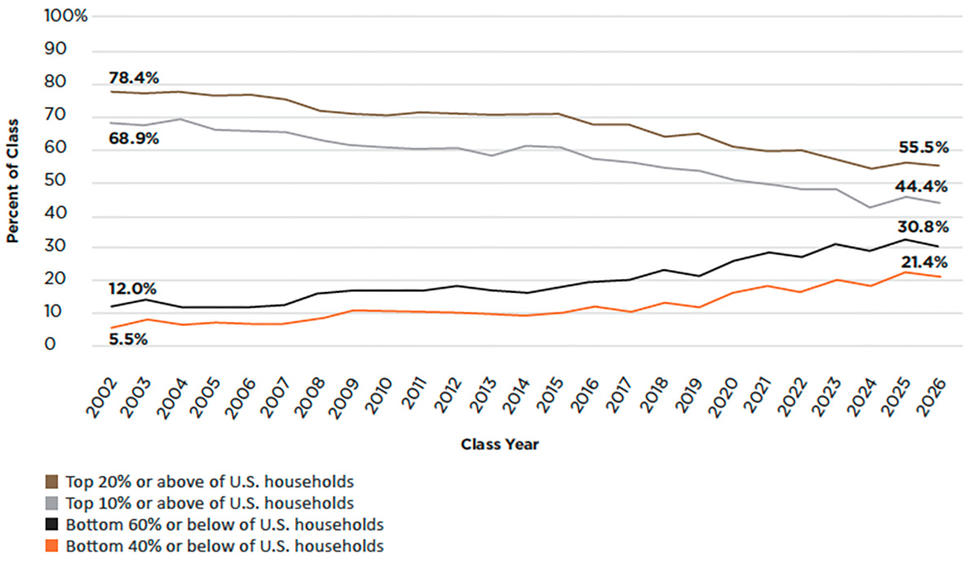
https://paw.princeton.edu/article/bending-socioeconomic-curve-selective-college-admissions |
Anonymous
|
Berea is an excellent suggestion.
I actually think public flagships are the worst possible choice. Usually don't offer fin aid as good as the best endowed privates and they also tend to self-segregate along socioeconomic lines. Many have heavy Greek presences and the cost of belonging to a frat and especially a sorority is beyond the means of many families. At some state schools--notably U Texas-Austin--the "top" houses are made up mostly of young women whose mothers were in the same sororities and who went to public high schools, but the ones in the most affluent neighborhoods. Check out the parking lots; they bring their cars to college and they aren't beat up old bangers. They are the ones who spend thousands of dollars to decorate their dorm rooms --sometimes hiring an interior decorator. They sometimes hire consultants to help them get into a "good" sorority. Yes, there are trust fund babies at the Ivies. Yes, some of them socialize with each other. But there's a lot more mixing because most people live on campus for at least 3 years, all the dorm rooms cost the same, at most---though not all--Greeks exist but don't dominate the social scene, very few people have their cars at college. |
Anonymous
So if they are "fine to live" are they really living in POVERTY? OP didn't give an income amount. She said poverty. I would not desribe poverty as "fine to live in." |
Anonymous
+1. Middle class is increasingly limited in top schools. This creates a weird, patronizing noblesse oblige/embrace your victimhood dynamic. |
Anonymous
|
I guess I'm middle class (HHI of $88k) and my kid goes to a Jesuit university. They give lots of aid and it brought the cost down to what it would cost to Towson in-state.
His school has a lot of wealthy kids but that's not surprising. He doesn't stand out and he knows kids just like him who got tons of aid. We weren't living in poverty but maybe we are because he got a Pell grant this year. |