
Dc to allow prisoners to vote
![[Post New]](/jforum/templates/default/images/icon_minipost_new.gif)
Anonymous
There’s a logical nexus with that prohibition. Taking away the right to vote was implemented during Jim Crow era. It was part and parcel with mass incarceration of black people at the turn of the century. |
Anonymous
Didn't Virginia recently change the law giving felons the right to vote? |

Anonymous
| ^^That is, after prison? |
Anonymous
| What is the problem with prisoners voting? I don't understand the issue. |
Anonymous
OMG GOOD POINT. I work in a prison. If only I had told my inmates they couldn't vote if they committed their crimes, hot diggity they all would have stopped murdering and thieving. Silly me !! |
Anonymous
|
The DC Council associates Jim Crow laws and the Rights of Blacks to vote with felons?
Okay. ? |
Anonymous
NP. As seen in the graphic, VA restores voting rights to those convicted of a felony after completion of probation/etc. |
Anonymous
What was the mass incarceration of black people at the turn of the century? I am not doubting you--just had not heard of a mass incarceration between 1895 and 1905? That turn of the century? |
Anonymous
Slavery had made the South’s agriculture-based economy the most powerful force in the global cotton market, but the Civil War devastated this economy. How to build a new one? Well, after the Civil War, slavery persisted in the form of convict leasing, a system in which Southern states leased prisoners to private railways, mines, and large plantations. Here’s how it worked. Black men – and sometimes women and children – were arrested and convicted for crimes enumerated in the Black Codes, state laws criminalizing petty offenses and aimed at keeping freed people tied to their former owners’ plantations and farms. The most sinister crime was vagrancy – the “crime” of being unemployed – which brought a large fine that few blacks could afford to pay. Black convicts were leased to private companies, typically industries profiteering from the region’s untapped natural resources. As many as 200,000 black Americans were forced into back-breaking labor in coal mines, turpentine factories and lumber camps. They lived in squalid conditions, chained, starved, beaten, flogged and sexually violated. They died by the thousands from injury, disease and torture. Black orphaned children and juvenile offenders could be bought to serve as laborers for white planters in many Southern states from 1865 until the 1940s. Mass incarceration. 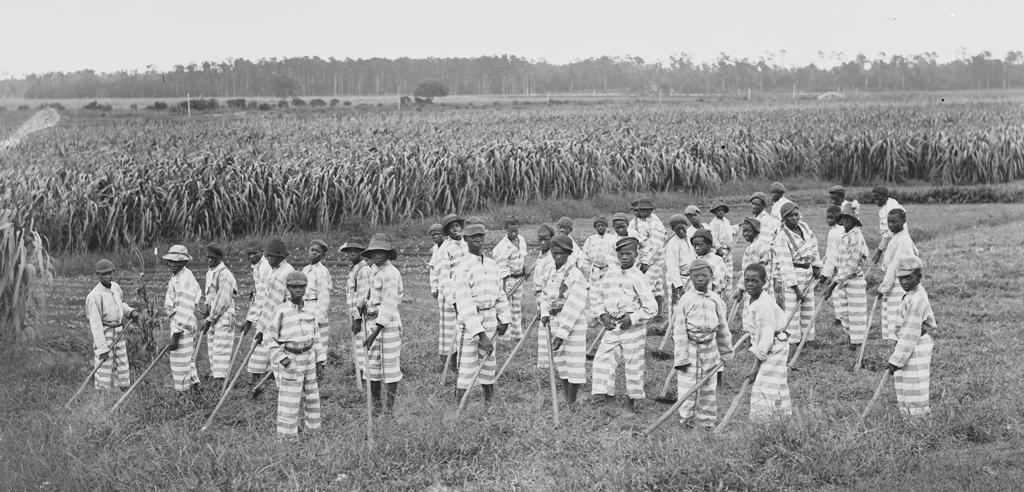
|
Anonymous
The first mass expansion of prisons happened after the Civil War. They didn’t give up on forced, free labor after Emancipation. First there was convict leasing. Hiring prisoners out to businesses to do work. Then chain gangs. Here are two sources to read. But the best book I’ve read on it is Slavery by Another Name. http://theconversation.com/prison-records-from-1800s-georgia-show-mass-incarcerations-racially-charged-beginnings-96612 https://www.ancestry.com/contextux/historicalinsights/prison-life-united-states-after-civil-war |
Anonymous
They are bad citizens; they have broken the social contract and norms of society so egregiously that they are being punished. You might as well ask... - why have they lost freedoms of movement? - why have they lost privacy - why have they lost freedom of choice re what to eat and when? - why can’t they have weapons to protect themselves in dangerous prisons? Why on earth should they have a say in policy when they ignore the laws we have? |
Anonymous
People who go “murdering and thieving”, and are caught, convicted, and jailed, have no business voting. They are bad citizens. |
Anonymous
| “Citizenship is not a right that expires upon misbehavior,” Chief Justice Earl Warren wrote for the majority in Trop v. Dulles, a 1958 case dealing with the rights of a military deserter. And, he continued, “citizenship is not lost every time a duty of citizenship is shirked.” Yes, prisoners have committed crimes, and yes, some of those are egregious. But depriving any citizen of the right to vote should be the grave exception, not a routine part of national life. Universal suffrage means universal suffrage. |
Anonymous
A sense of virtue and decency. |
Anonymous
+ a million |