
Someone has started sleeping on the sidewalk next to our house

Anonymous
You want OP to take a risk and find out? You first, you first.
Anonymous
Where would you like this person to go? I’m so sorry your kids don’t want to play outside now that a person who doesn’t have a home is trying to sleep on property that you don’t own.
Anonymous
Anonymous wrote:
Anonymous wrote:
Anonymous wrote:
Anonymous wrote:I would watch and move their things when they are gone. And call the police/behavior health/shelter emergency line constantly. I’m all for supporting people but not allowing a homeless encampment to be established by my fence. Because it will never go away. They can camp beneath an underpass or on a median - not on a residential corner.

Don't touch their stuff. That's not legal.


it’s not illegal to move trash/stuff people leave on sidewalks. also, I don’t care. point is you must demonstrate that this corner is not a friendly place to take over. they will find someplace else. if you’re naive and do nothing you’ll end up with an entire encampment in front of your house.


OP, ignore posters saying to move things. Call 311.


The advice to move stuff is ridiculous. Homeless people take their stuff with them when they move around, or, if too much, find a hidden place to stash it. People who have been homeless a long time, when they first get a place to live, often have the habit of continuing to do so. There are some spots in and around my property where I sometimes find things stashed--there are a couple of areas that a frequently used by people moving around who for whatever reason don't want the visibility of the sidewalks--there are 2 alleys on my block going perpendicular from each other as well as a couple of small parking lots so there are many options for people moving through the neighborhood to avoid the sidewalks.
Anonymous
Anonymous wrote:Where would you like this person to go? I’m so sorry your kids don’t want to play outside now that a person who doesn’t have a home is trying to sleep on property that you don’t own.


to a median or a highway shoulder or somewhere out of the way, not on a public thoroughfare.
Anonymous
Anonymous wrote:
Anonymous wrote:
Anonymous wrote:
Anonymous wrote:
Anonymous wrote:I would watch and move their things when they are gone. And call the police/behavior health/shelter emergency line constantly. I’m all for supporting people but not allowing a homeless encampment to be established by my fence. Because it will never go away. They can camp beneath an underpass or on a median - not on a residential corner.

Don't touch their stuff. That's not legal.


it’s not illegal to move trash/stuff people leave on sidewalks. also, I don’t care. point is you must demonstrate that this corner is not a friendly place to take over. they will find someplace else. if you’re naive and do nothing you’ll end up with an entire encampment in front of your house.


OP, ignore posters saying to move things. Call 311.


The advice to move stuff is ridiculous. Homeless people take their stuff with them when they move around, or, if too much, find a hidden place to stash it. People who have been homeless a long time, when they first get a place to live, often have the habit of continuing to do so. There are some spots in and around my property where I sometimes find things stashed--there are a couple of areas that a frequently used by people moving around who for whatever reason don't want the visibility of the sidewalks--there are 2 alleys on my block going perpendicular from each other as well as a couple of small parking lots so there are many options for people moving through the neighborhood to avoid the sidewalks.


that sounds sketchy as f.
Anonymous
Anonymous wrote:
Anonymous wrote:Keep in mind, many of these people are still homeless by choice. We need to face the fact that shelters and social programs won't have the same affect on them as they do with the temporary homeless or families.


Why are there no public campgrounds for people who don't want to live in a house?


You think that would make a difference? Oh you sweet naive soul
Anonymous
Anonymous wrote:Keep in mind, many of these people are still homeless by choice. We need to face the fact that shelters and social programs won't have the same affect on them as they do with the temporary homeless or families.


"Choice" is a loaded word. For many people, homelessness is the result of many circumstances, and choices, that led them to a situation to which they have adapted, and without significant support have a very hard time adapting or re-adapting to maintaining stability in a permanent place to live.

I know someone who has been homeless by choice since he lost the house but had to pay the mortgage in a divorce 20 years ago. He figured out ways to make money while travelling (some of it remote IT work, some of it driving cars and pets cross country for people) and this has been his life for 20 years. That's a totally different scenario than what you are probably thinking of as homelessness "by choice".
Anonymous
Anonymous wrote:
Anonymous wrote:Keep in mind, many of these people are still homeless by choice. We need to face the fact that shelters and social programs won't have the same affect on them as they do with the temporary homeless or families.


"Choice" is a loaded word. For many people, homelessness is the result of many circumstances, and choices, that led them to a situation to which they have adapted, and without significant support have a very hard time adapting or re-adapting to maintaining stability in a permanent place to live.

I know someone who has been homeless by choice since he lost the house but had to pay the mortgage in a divorce 20 years ago. He figured out ways to make money while travelling (some of it remote IT work, some of it driving cars and pets cross country for people) and this has been his life for 20 years. That's a totally different scenario than what you are probably thinking of as homelessness "by choice".


Coming from the the military, I am unfortunately very familiar with that "by choice" scenario as well.
Anonymous
Anonymous wrote:
Anonymous wrote:
Anonymous wrote:Keep in mind, many of these people are still homeless by choice. We need to face the fact that shelters and social programs won't have the same affect on them as they do with the temporary homeless or families.


Why are there no public campgrounds for people who don't want to live in a house?


You think that would make a difference? Oh you sweet naive soul


You'd be surprised how many homeless people DO spend time living in campgrounds--not national or state parks or private campgrounds but places like municipal campgrounds in smaller cities and towns. We were camping for a week one year in a smallish city and on one side of us were a couple of guys who worked construction and were from several states away, along with one kid and a hooker who came along to watch the kid (she shared it all in the showers one day). One the other side it started with a couple of guys who had gotten a charity voucher to camp for a week, and very quickly everyone they knew showed up. They got kicked out pretty quickly and were replaced by a couple of older guys with a voucher who were quiet. A ways down the road was a family from out of state, their car had broken down but also was not registered or insured and they had been told by the cops as soon as they drove out the car would be impounded. The woman would walk to a nearby liquor store to fetch beer for the guy, who sat around swearing at the kids and did s**t. There was another woman, single, who was living for the summer in an old RV who had a job as a blackjack dealer. There were also other more traditional RV campers and a cub scout group.

It was an eye opener.
Anonymous
Anonymous wrote:
Anonymous wrote:
Anonymous wrote:Keep in mind, many of these people are still homeless by choice. We need to face the fact that shelters and social programs won't have the same affect on them as they do with the temporary homeless or families.


Why are there no public campgrounds for people who don't want to live in a house?


You think that would make a difference? Oh you sweet naive soul


LA is trying that. They are having issues......
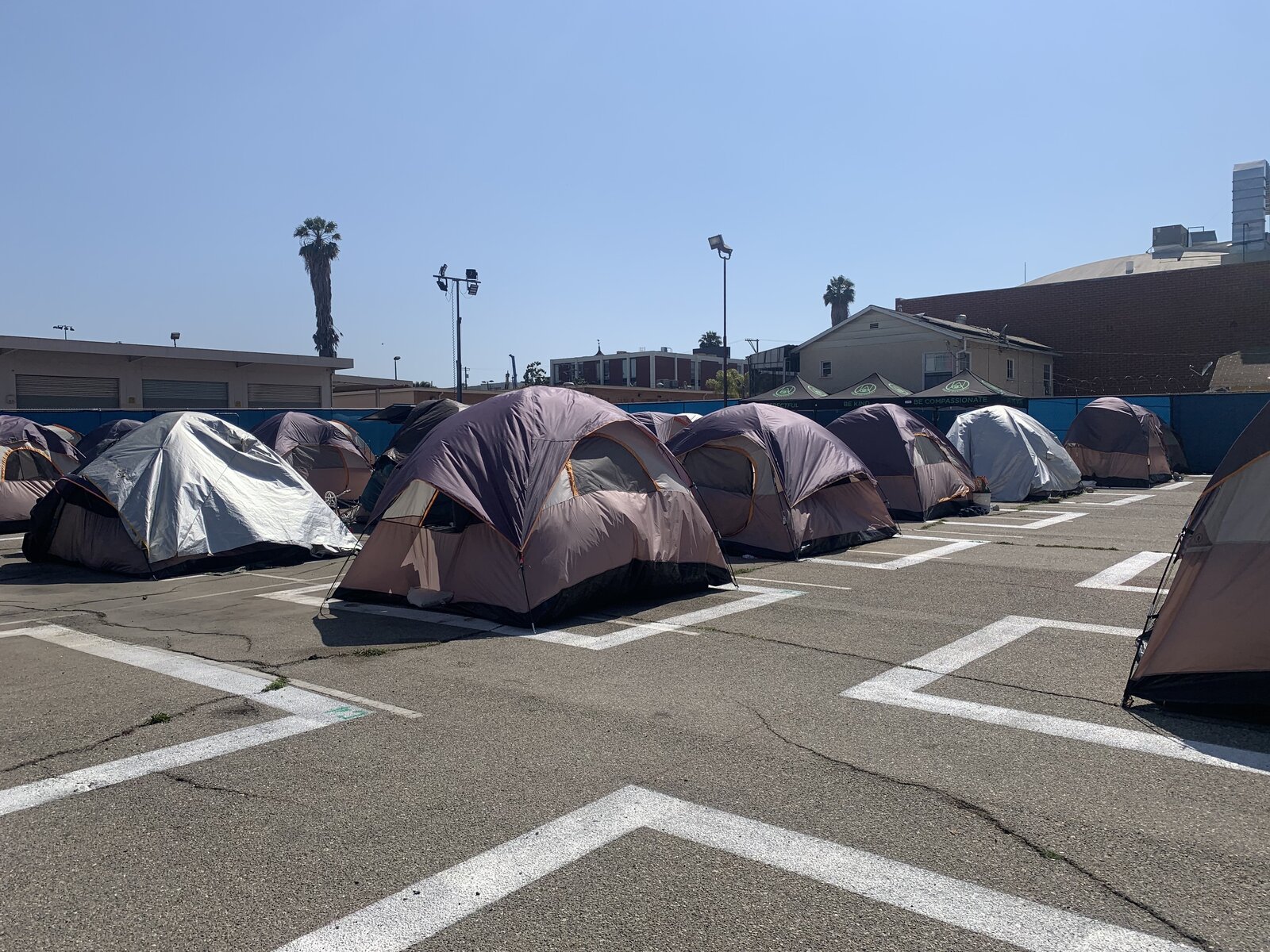


In Los Angeles, city officials grappling with an ongoing homelessness crisis have turned to an idea that for decades was politically unpopular and considered radical: a government-funded tent encampment.

Other cities, including San Francisco, Seattle and Tampa, Fla., have opened similar programs in recent years. But the high public cost of LA's first sanctioned campground — more than $2,600 per tent, per month — has advocates worried it will come at the expense of more permanent housing.

The campsite opened in late April on a fenced-in parking lot beside the 101 freeway in East Hollywood. The lot-turned-campground can accommodate up to about 70 tents in 12-by-12-foot spots marked by white squares painted on the asphalt.

On a recent afternoon, the site was nearly full. A row of port-a-potties stood along one side of the camp. The program also provides showers, three meals a day and 24-hour security. Campers get entered into the county's database for matching unhoused people with social services and housing resources.

According to a report by the city administrative officer, the new East Hollywood campground costs approximately $2,663 per participant per month. That's higher than what a typical one-bedroom apartment rents for in the city, according to the website RentCafe. While the per-tent cost covers services, meals, sanitation and staffing, some are concerned that the city is investing too much in short-term Band-Aids over long-term solutions.

"If you can paint lines on a sidewalk for the same cost that you can give someone the rent for an apartment," says Shayla Myers, an attorney with the Legal Aid Foundation of Los Angeles, "I'm concerned that our city is making the choice to paint the lines rather than actually get people into housing."


https://www.npr.org/2021/05/25/999969718/high-cost-of-los-angeles-homeless-camp-raises-eyebrows-and-questions
Anonymous
Anonymous wrote:
Anonymous wrote:Keep in mind, many of these people are still homeless by choice. We need to face the fact that shelters and social programs won't have the same affect on them as they do with the temporary homeless or families.


"Choice" is a loaded word. For many people, homelessness is the result of many circumstances, and choices, that led them to a situation to which they have adapted, and without significant support have a very hard time adapting or re-adapting to maintaining stability in a permanent place to live.

I know someone who has been homeless by choice since he lost the house but had to pay the mortgage in a divorce 20 years ago. He figured out ways to make money while travelling (some of it remote IT work, some of it driving cars and pets cross country for people) and this has been his life for 20 years. That's a totally different scenario than what you are probably thinking of as homelessness "by choice".


that literally sounds like a choice. assuming no mental illnesses or drug addiction, he could have let the house go into forclosure and rented a place and got a decent paying IT job. something else was going on.
Anonymous
Anonymous wrote:
Anonymous wrote:
Anonymous wrote:
Anonymous wrote:Keep in mind, many of these people are still homeless by choice. We need to face the fact that shelters and social programs won't have the same affect on them as they do with the temporary homeless or families.


Why are there no public campgrounds for people who don't want to live in a house?


You think that would make a difference? Oh you sweet naive soul


LA is trying that. They are having issues......


In Los Angeles, city officials grappling with an ongoing homelessness crisis have turned to an idea that for decades was politically unpopular and considered radical: a government-funded tent encampment.

Other cities, including San Francisco, Seattle and Tampa, Fla., have opened similar programs in recent years. But the high public cost of LA's first sanctioned campground — more than $2,600 per tent, per month — has advocates worried it will come at the expense of more permanent housing.

The campsite opened in late April on a fenced-in parking lot beside the 101 freeway in East Hollywood. The lot-turned-campground can accommodate up to about 70 tents in 12-by-12-foot spots marked by white squares painted on the asphalt.

On a recent afternoon, the site was nearly full. A row of port-a-potties stood along one side of the camp. The program also provides showers, three meals a day and 24-hour security. Campers get entered into the county's database for matching unhoused people with social services and housing resources.

According to a report by the city administrative officer, the new East Hollywood campground costs approximately $2,663 per participant per month. That's higher than what a typical one-bedroom apartment rents for in the city, according to the website RentCafe. While the per-tent cost covers services, meals, sanitation and staffing, some are concerned that the city is investing too much in short-term Band-Aids over long-term solutions.

"If you can paint lines on a sidewalk for the same cost that you can give someone the rent for an apartment," says Shayla Myers, an attorney with the Legal Aid Foundation of Los Angeles, "I'm concerned that our city is making the choice to paint the lines rather than actually get people into housing."


https://www.npr.org/2021/05/25/999969718/high-cost-of-los-angeles-homeless-camp-raises-eyebrows-and-questions


why is that tent city on asphalt better than an SRO?
Anonymous
Alvin and the Chipmunks on repeat
Anonymous
Does something about your house make it inviting? Tree in front as some protection? Bench? consider this
Anonymous
Anonymous wrote:why is that tent city on asphalt better than an SRO?

You could do some research. SROs were financially unsustainable and unsafe.

Problems Plague City-Backed Hotel : Housing: Drugs, crime are rampant at Downtown hotel renovated under ambitious program, police say.
NOV. 25, 1995 12 AM PT
TIMES STAFF WRITER
After living on the grimy streets of Downtown Los Angeles, Herman Lewis thought that moving into the Hayward Manor hotel at 6th and Spring streets would bring more safety and comfort.

Within days, he realized he was wrong. “You might as well be on the street,” said Lewis, who lived at the Hayward from August, 1994, through May, 1995. “Drugs are everywhere. You don’t even have to go outside of the place. You can get anything you want inside.”

Drug dealing and drug use are only some of the problems facing the Hayward Manor, according to police and the current manager, a court-appointed receivership representative. There’s also prostitution, murder, sexual assault, robbery and other crimes.

These kinds of problems are not unusual for some of the low-cost hotels on the fringe of Skid Row. But unlike the others, the Hayward is part of a $110-million citywide project hailed as the most ambitious affordable housing effort in Los Angeles history by outgoing Mayor Tom Bradley in 1993. At a cost of $25 million, the Hayward was the most expensive of the 15 affordable housing projects unveiled that day.

Now, two years later, the 525-unit single resident occupancy hotel is in danger of defaulting on a $13.4-million city-authorized revenue bond, according to the credit rating agency Standard & Poor’s. And taxpayers may never be repaid for a $10-million city loan made in 1992 for acquisition and rehabilitation of the beleaguered hotel, city officials acknowledge.
https://www.latimes.com/archives/la-xpm-1995-11-25-me-6994-story.html

post reply Forum Index » Metropolitan DC Local Politics
Message Quick Reply
Go to: