Anonymous
 08/12/2021 16:24
Subject: Re:Why would non-one percent families let their kids major in the humanities?
08/12/2021 16:24
Subject: Re:Why would non-one percent families let their kids major in the humanities?
Humanities major here. Wound up going to law school. I am comfortable financially and my kid's college will be paid for. My parents were not rich at all and I financed law school with loans. You can definitely find a well-paying job and a rewarding career in the humanities.
Outside of engineering and the hard sciences, or people who want to go to med school, it doesn't really matter what you major in to a large degree. I would personally encourage my child to avoid a major that is too narrow unless they had a really clear plan for post-grad (like don't major in Arabic or Dance or Film Studies unless you pretty much know what you are going to do after school and how you will apply that degree). But any broad humanities major is pretty versatile (History, English, Psychology, Sociology, Government or Political Science, Philosophy, etc.). Add a minor in something a bit more specialized or technical (a language minor is great) and you will be pretty marketable after school. You won't make a ton of money no matter where you go at first, and that's normal and should be expected. The goal should be paying off any money you borrowed and beginning to establish yourself professionally. It's okay to start at the bottom. Also zero shame in living with mom and dad or in a group house or a crummy apartment in your 20s -- that is what your 20s are for. Figure out how to earn a paycheck, then build from there.
These people who obsessively demand their kids need to major in STEM and are fixated on certain jobs and earnings targets before their kid goes to college are often deluded. If the kid isn't self-motivated in those fields, they will struggle to get decent grades and many will struggle to finish school. My undergrad was full of engineering majors with demanding parents who were barely able to function. I sat on the student ethics committee for a semester and all the cheating cases we got were from the engineering school. I felt really bad for those kids. They clearly didn't have the interest or aptitude, they were taking these highly technical classes with strict requirements, and they couldn't keep their head above water. I have no idea why you would push your kid into that. Not everyone can be an engineer or a doctor. We actually do need other kinds of people.
Outside of engineering and the hard sciences, or people who want to go to med school, it doesn't really matter what you major in to a large degree. I would personally encourage my child to avoid a major that is too narrow unless they had a really clear plan for post-grad (like don't major in Arabic or Dance or Film Studies unless you pretty much know what you are going to do after school and how you will apply that degree). But any broad humanities major is pretty versatile (History, English, Psychology, Sociology, Government or Political Science, Philosophy, etc.). Add a minor in something a bit more specialized or technical (a language minor is great) and you will be pretty marketable after school. You won't make a ton of money no matter where you go at first, and that's normal and should be expected. The goal should be paying off any money you borrowed and beginning to establish yourself professionally. It's okay to start at the bottom. Also zero shame in living with mom and dad or in a group house or a crummy apartment in your 20s -- that is what your 20s are for. Figure out how to earn a paycheck, then build from there.
These people who obsessively demand their kids need to major in STEM and are fixated on certain jobs and earnings targets before their kid goes to college are often deluded. If the kid isn't self-motivated in those fields, they will struggle to get decent grades and many will struggle to finish school. My undergrad was full of engineering majors with demanding parents who were barely able to function. I sat on the student ethics committee for a semester and all the cheating cases we got were from the engineering school. I felt really bad for those kids. They clearly didn't have the interest or aptitude, they were taking these highly technical classes with strict requirements, and they couldn't keep their head above water. I have no idea why you would push your kid into that. Not everyone can be an engineer or a doctor. We actually do need other kinds of people.

Anonymous
08/12/2021 16:22
Subject: Why would non-one percent families let their kids major in the humanities?
All of the big law partners at my firm come from Humanities backgrounds and humble means.
Anonymous
08/12/2021 16:21
Subject: Re:Why would non-one percent families let their kids major in the humanities?
Anonymous wrote:Anonymous wrote:Anonymous wrote:Anonymous wrote:Anonymous wrote:Anonymous wrote:Anonymous wrote:Anonymous wrote:Easy reason: Because parents don't pick majors, their adult children do.
Reason in my family: The humanities are critical, and enhance your ability to succeed. DH and I both have jobs that are basically translating STEM concepts into policy and persuasive documents. STEM in the absence of humanities (includes history, communication, ethics, cultural studies, etc) is often useless or harmful.
+1
~Philosophy major making a good living
I'm very happy that some people have made a good living with humanities degrees. However, nationwide representative data clearly show that humanities majors on average earn far less money than peers who majored in things like STEM or business.
Business is a terrible undergrad major. Terrible. Research shows that students who major in general business and marketing are more likely to be unemployed or underemployed, meaning they hold jobs that don’t require a college degree. They also earn less than those in more math-focused business majors, such as finance and accounting. In fact, in the latest college degree salary survey from Payscale (see https://www.payscale.com/college-salary-report/common-jobs-for-majors), business is NOT one of the best-paying college degrees. When PayScale looked at starting and mid-career salaries of college graduates in dozens of college majors, business came in as the 56th best-paying college degree. It fared worse than such "impractical" college degrees as philosophy, history and American studies.
Philosophy, on the other hand:
...when it comes to earnings for people who only have undergraduate degrees, philosophy majors have the fourth-highest median earnings, $81,200 per year, out-ranking business and chemistry majors, according to the ETS. Bar none, philosophy majors have the highest salary growth trajectory from entry to mid-career.
https://fivethirtyeight.com/features/philosophers-dont-get-much-respect-but-their-earnings-dont-suck/
Here is a Georgetown research report indicating that business majors earn far more than humanities majors, using BLS data. BLS is the most accurate labor data:
https://cew.georgetown.edu/cew-reports/valueofcollegemajors
Here is a quote from the report: "STEM (science, technology, engineering, and mathematics), health, and business majors are the highest paying, leading to average annual wages of $37,000 or more at the entry level and an average of $65,000 or more annually over the course of a recipient’s career."
You can play around with the data yourself and figure out exactly how much the earnings differential is throughout the entire distribution and over the lifetime, not just the median earnings at graduation.
But both agree that philosophy majors earn more than business majors.
Your mistake is searching for "business." Very few people actually major in an undergraduate major called "business." They pick accounting, finance, information systems, marketing, etc. You need to compare those actual majors to philosophy. Even within humanities, there is a wide range of salaries between majors. Philosophy is 39k-76k and finance is 49k-109k. Accounting is 47k-103k. So, those are substantially higher than philosophy
PP again, actually, according to that data even general business earns more than philosophy. SO I have no idea what you are talking about
More proof humanities majors are clueless around data. Mea culpa
Anonymous
08/12/2021 16:20
Subject: Re:Why would non-one percent families let their kids major in the humanities?
Anonymous wrote:Anonymous wrote:Anonymous wrote:Anonymous wrote:Anonymous wrote:Anonymous wrote:Easy reason: Because parents don't pick majors, their adult children do.
Reason in my family: The humanities are critical, and enhance your ability to succeed. DH and I both have jobs that are basically translating STEM concepts into policy and persuasive documents. STEM in the absence of humanities (includes history, communication, ethics, cultural studies, etc) is often useless or harmful.
+1
~Philosophy major making a good living
I'm very happy that some people have made a good living with humanities degrees. However, nationwide representative data clearly show that humanities majors on average earn far less money than peers who majored in things like STEM or business.
That's primarily the kid, not the degree. Self-motivated kids with humanities and liberal arts degrees do fine. Kids who are not self-motivated will not do fine, regardless of degree type. They are not as likely to finish a STEM degree, so you'll see more of them with completed degrees elsewhere, but it's not like signing up for STEM would have changed their outlook or likelihood of success.
NP here. I very much think it's this, though I've yet to see a study that tries to assess whether it's the person or the major. I think it's partially because it's hard to separate these things in the data, and I also think it's because everyone who studies labor markets seems to be so enamored of STEM that they refuse to look critically at the observed correlations.
I grew up UMC/UC and have a STEM PhD (and double majored with a humanities degree). I have a comfortable, UMC/UC lifestyle, though that's at least partially because growing up UMC/UC I know how to navigate the types of workplaces and networks to get the opportunities I have. I also know a lot of people with STEM degrees (esp. in the life sciences) who are underemployed and underpaid. Anecdotally, the people I know who have moved up in financial status the most all have humanities degrees and went into finance, law, or consulting.
There's a lot of things hidden in the data that suggests that people with STEM degrees have better career outcomes. For one thing, those data usually include healthcare, which overall tends to have high-demand whether you are an MA, RN, PA, or MD. Especially at the lower levels of education, you are more likely to always be employed if you want to be...so your lifetime earnings will be higher. Beyond that, anyone with computing skills is currently in high demand, because there's been steep growth in need for those skills. The same is not true for other STEM-related skills, meaning not all STEM degrees are created the same. Nevertheless, I suspect in 5-10 years programming skills will be as ubiquitous as, say, Excel skills, and the premium for having them will be significantly diminished if not gone altogether.
+1 This is happening with programming and other general CS skills. A friend that is a director of IT for a T20 school mentioned this recently. Higher ed educators are seeing a trend in students minoring in CS or taking some classes are getting jobs similar to CS majors. Also, there is growing competition in larger markets like NY and CA from coding bootcamps such as General Assembly (no college degree in CS needed).
I think this points to another misperception people have about college and long-term financial success. College is not vocational school, and it's very risky to treat it like it is.
I work in an extremely lucrative field of computing right now (AI), but it's not what I went to school to study. It just so happens that skills I gained while studying my STEM field became highly sought after a few years after I graduated, and I had a combination of skills and theoretical underpinning to transform that into a well-paying job. But it's kind of a fluke. When I was in grad school, everything I was doing seemed very niche and not particularly useful...but I really liked it and was good at it. Now I see people clamoring to get degrees in something I learned incidentally, and I also see that the field is changing such that my once niche skills are now becoming commoditized.
Anonymous
08/12/2021 16:19
Subject: Why would non-one percent families let their kids major in the humanities?
Anonymous wrote:Anonymous wrote:Anonymous wrote:Anonymous wrote:Anonymous wrote:Anonymous wrote:Anonymous wrote:Anonymous wrote:Anonymous wrote:Anonymous wrote:Anonymous wrote:Some people just don’t care about prestige and doesn't function well when focused on social mobility. I was a humanity major knowing I could be driving a taxi at the end. Not everyone’s cut out to be a doctor, a lawyer, or an engineer. This world also needs social misfits, taxi drivers, line cooks, and janitors.
Noble jobs, but I wouldn’t want my kid being part of the 50% of Americans who have trouble finding enough money for a $600 emergency.
PP humanities major here. I sent my kid to an ivy. I don’t have to worry about her being part of the 50%.
No one who goes to 99% of colleges will have to worry about that either.
2 million students graduate from U.S. colleges every year. I assure you - that's a worry from a great many of them. Too many idiots getting too many degrees period.
You either have a useless degree or you have a useful degree but you're in the bottom percentage of your class. Either way - - you're screwed.
Haha that’s literally 0.6% of the US population. College grads kill it over non-college grads on average without even controlling for school prestige.
2 million is roughly 40% of the yearly age-group of 18-year-olds in the U.S. So that means every year 50% of the age-eligible population is matriculating to a college/university degree.
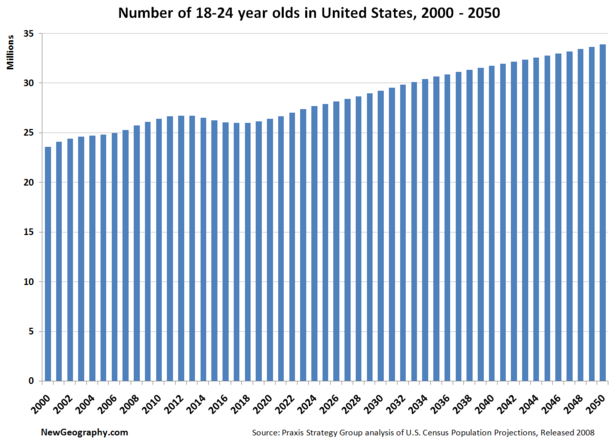
Note: 30 million 18-24-year-olds in the U.S. That's 6 separate age-groups and a total of 5 million per group.
So what’s your point? The rich should go to college (and end up making even more money) and the poor should just not bother and go to trade school?
I bet you tell people “fewer kids should go to college” while of course sending your own kids to college.
Not at all. Just that a college-degree alone isn't a solution to most economic problems and the sooner people learn that, the sooner they can teach their kids, and stop whining on the money forum about Biden not forgiving their six-figures in student loans.
So you can opt out of college first. The reality is that people with a college degree make way more than people without one. The sooner people learn that, the sooner they can teach their kid that. Should poor people just know their place in life?
I just realized you think I'm the person who sent their kid to an Ivy or the one with the dismissive post on line cooks. I started in this thread in response to the 99% post. Only to refute the fact that you think a college degree is 'rare'. When it is in fact not anymore. It is a baseline and the overcrowded degree marketplace has far-reaching repercussions as far as salary parity is concerned.
I never said it’s rare. But I still think it’s the best option unless the kid is a horrific, god awful student. You proved my point: it’s a baseline to even get a decent job. What do you think, that not having one makes you a shiny standout!?
Anonymous
08/12/2021 16:15
Subject: Re:Why would non-one percent families let their kids major in the humanities?
Anonymous wrote:Anonymous wrote:Anonymous wrote:Anonymous wrote:Anonymous wrote:Anonymous wrote:Anonymous wrote:Easy reason: Because parents don't pick majors, their adult children do.
Reason in my family: The humanities are critical, and enhance your ability to succeed. DH and I both have jobs that are basically translating STEM concepts into policy and persuasive documents. STEM in the absence of humanities (includes history, communication, ethics, cultural studies, etc) is often useless or harmful.
+1
~Philosophy major making a good living
I'm very happy that some people have made a good living with humanities degrees. However, nationwide representative data clearly show that humanities majors on average earn far less money than peers who majored in things like STEM or business.
Business is a terrible undergrad major. Terrible. Research shows that students who major in general business and marketing are more likely to be unemployed or underemployed, meaning they hold jobs that don’t require a college degree. They also earn less than those in more math-focused business majors, such as finance and accounting. In fact, in the latest college degree salary survey from Payscale (see https://www.payscale.com/college-salary-report/common-jobs-for-majors), business is NOT one of the best-paying college degrees. When PayScale looked at starting and mid-career salaries of college graduates in dozens of college majors, business came in as the 56th best-paying college degree. It fared worse than such "impractical" college degrees as philosophy, history and American studies.
Philosophy, on the other hand:
...when it comes to earnings for people who only have undergraduate degrees, philosophy majors have the fourth-highest median earnings, $81,200 per year, out-ranking business and chemistry majors, according to the ETS. Bar none, philosophy majors have the highest salary growth trajectory from entry to mid-career.
https://fivethirtyeight.com/features/philosophers-dont-get-much-respect-but-their-earnings-dont-suck/
Here is a Georgetown research report indicating that business majors earn far more than humanities majors, using BLS data. BLS is the most accurate labor data:
https://cew.georgetown.edu/cew-reports/valueofcollegemajors
Here is a quote from the report: "STEM (science, technology, engineering, and mathematics), health, and business majors are the highest paying, leading to average annual wages of $37,000 or more at the entry level and an average of $65,000 or more annually over the course of a recipient’s career."
You can play around with the data yourself and figure out exactly how much the earnings differential is throughout the entire distribution and over the lifetime, not just the median earnings at graduation.
But both agree that philosophy majors earn more than business majors.
Your mistake is searching for "business." Very few people actually major in an undergraduate major called "business." They pick accounting, finance, information systems, marketing, etc. You need to compare those actual majors to philosophy. Even within humanities, there is a wide range of salaries between majors. Philosophy is 39k-76k and finance is 49k-109k. Accounting is 47k-103k. So, those are substantially higher than philosophy
PP again, actually, according to that data even general business earns more than philosophy. SO I have no idea what you are talking about
Anonymous
08/12/2021 16:14
Subject: Why would non-one percent families let their kids major in the humanities?
Anonymous wrote:Anonymous wrote:Anonymous wrote:There are a lot of posts here recently about major and concern distress. Why would non-wealthy or trust fund families ever let their kid major in something like philosophy or history?
https://www.reddit.com/r/ApplyingToCollege/comments/p2rdwp/firstgenlowincome_students_do_not_major_in_the/?utm_source=share&utm_medium=ios_app&utm_name=iossmf
The point of college is social mobility. Why would you intentionally hamper that with a humanities degree? No judgement, just wondering.
Not everyone holds this view. There are other great reasons to go to college.
Again the only people who disagree with me are the independently wealthy.
I completely disagree with you. I am not rich and I live in the same provincial town I did before I went to college.
Anonymous
08/12/2021 16:13
Subject: Re:Why would non-one percent families let their kids major in the humanities?
Anonymous wrote:Anonymous wrote:Anonymous wrote:Anonymous wrote:Anonymous wrote:Anonymous wrote:Easy reason: Because parents don't pick majors, their adult children do.
Reason in my family: The humanities are critical, and enhance your ability to succeed. DH and I both have jobs that are basically translating STEM concepts into policy and persuasive documents. STEM in the absence of humanities (includes history, communication, ethics, cultural studies, etc) is often useless or harmful.
+1
~Philosophy major making a good living
I'm very happy that some people have made a good living with humanities degrees. However, nationwide representative data clearly show that humanities majors on average earn far less money than peers who majored in things like STEM or business.
Business is a terrible undergrad major. Terrible. Research shows that students who major in general business and marketing are more likely to be unemployed or underemployed, meaning they hold jobs that don’t require a college degree. They also earn less than those in more math-focused business majors, such as finance and accounting. In fact, in the latest college degree salary survey from Payscale (see https://www.payscale.com/college-salary-report/common-jobs-for-majors), business is NOT one of the best-paying college degrees. When PayScale looked at starting and mid-career salaries of college graduates in dozens of college majors, business came in as the 56th best-paying college degree. It fared worse than such "impractical" college degrees as philosophy, history and American studies.
Philosophy, on the other hand:
...when it comes to earnings for people who only have undergraduate degrees, philosophy majors have the fourth-highest median earnings, $81,200 per year, out-ranking business and chemistry majors, according to the ETS. Bar none, philosophy majors have the highest salary growth trajectory from entry to mid-career.
https://fivethirtyeight.com/features/philosophers-dont-get-much-respect-but-their-earnings-dont-suck/
Here is a Georgetown research report indicating that business majors earn far more than humanities majors, using BLS data. BLS is the most accurate labor data:
https://cew.georgetown.edu/cew-reports/valueofcollegemajors
Here is a quote from the report: "STEM (science, technology, engineering, and mathematics), health, and business majors are the highest paying, leading to average annual wages of $37,000 or more at the entry level and an average of $65,000 or more annually over the course of a recipient’s career."
You can play around with the data yourself and figure out exactly how much the earnings differential is throughout the entire distribution and over the lifetime, not just the median earnings at graduation.
But both agree that philosophy majors earn more than business majors.
Your mistake is searching for "business." Very few people actually major in an undergraduate major called "business." They pick accounting, finance, information systems, marketing, etc. You need to compare those actual majors to philosophy. Even within humanities, there is a wide range of salaries between majors. Philosophy is 39k-76k and finance is 49k-109k. Accounting is 47k-103k. So, those are substantially higher than philosophy
Anonymous
08/12/2021 16:12
Subject: Why would non-one percent families let their kids major in the humanities?
Anonymous wrote:Anonymous wrote:Anonymous wrote:Anonymous wrote:Anonymous wrote:Anonymous wrote:Anonymous wrote:Anonymous wrote:Anonymous wrote:Anonymous wrote:Some people just don’t care about prestige and doesn't function well when focused on social mobility. I was a humanity major knowing I could be driving a taxi at the end. Not everyone’s cut out to be a doctor, a lawyer, or an engineer. This world also needs social misfits, taxi drivers, line cooks, and janitors.
Noble jobs, but I wouldn’t want my kid being part of the 50% of Americans who have trouble finding enough money for a $600 emergency.
PP humanities major here. I sent my kid to an ivy. I don’t have to worry about her being part of the 50%.
No one who goes to 99% of colleges will have to worry about that either.
2 million students graduate from U.S. colleges every year. I assure you - that's a worry from a great many of them. Too many idiots getting too many degrees period.
You either have a useless degree or you have a useful degree but you're in the bottom percentage of your class. Either way - - you're screwed.
Haha that’s literally 0.6% of the US population. College grads kill it over non-college grads on average without even controlling for school prestige.
2 million is roughly 40% of the yearly age-group of 18-year-olds in the U.S. So that means every year 50% of the age-eligible population is matriculating to a college/university degree.
Note: 30 million 18-24-year-olds in the U.S. That's 6 separate age-groups and a total of 5 million per group.
So what’s your point? The rich should go to college (and end up making even more money) and the poor should just not bother and go to trade school?
I bet you tell people “fewer kids should go to college” while of course sending your own kids to college.
Not at all. Just that a college-degree alone isn't a solution to most economic problems and the sooner people learn that, the sooner they can teach their kids, and stop whining on the money forum about Biden not forgiving their six-figures in student loans.
So you can opt out of college first. The reality is that people with a college degree make way more than people without one. The sooner people learn that, the sooner they can teach their kid that. Should poor people just know their place in life?
I just realized you think I'm the person who sent their kid to an Ivy or the one with the dismissive post on line cooks. I started in this thread in response to the 99% post. Only to refute the fact that you think a college degree is 'rare'. When it is in fact not anymore. It is a baseline and the overcrowded degree marketplace has far-reaching repercussions as far as salary parity is concerned.
Anonymous
08/12/2021 16:12
Subject: Why would non-one percent families let their kids major in the humanities?
Anonymous wrote:Anonymous wrote:Anonymous wrote:Anonymous wrote:Anonymous wrote:Anonymous wrote:Some people just don’t care about prestige and doesn't function well when focused on social mobility. I was a humanity major knowing I could be driving a taxi at the end. Not everyone’s cut out to be a doctor, a lawyer, or an engineer. This world also needs social misfits, taxi drivers, line cooks, and janitors.
Noble jobs, but I wouldn’t want my kid being part of the 50% of Americans who have trouble finding enough money for a $600 emergency.
PP humanities major here. I sent my kid to an ivy. I don’t have to worry about her being part of the 50%.
No one who goes to 99% of colleges will have to worry about that either.
+1
My kids are smart, capable, and motivated, and their parents are highly educated and from the ~3-4%. The likelihood of them being part of the 50% is extremely low. Indeed, the older one graduated with a humanities degree several years ago and is making six figures.
We are all good here.
Key point being your kids are from a wealthy background. If they were just middle class they’d be screwed. Count your blessings.
DP. Explain how pp’s kids would be “screwed.”
I’ve noticed that liberals are obsessed with the prestige of the college vs getting a degree and it’s nauseating.
Anonymous
08/12/2021 16:10
Subject: Re:Why would non-one percent families let their kids major in the humanities?
ok troll.
Anonymous
08/12/2021 16:09
Subject: Why would non-one percent families let their kids major in the humanities?
Anonymous wrote:Anonymous wrote:Anonymous wrote:Anonymous wrote:Anonymous wrote:Some people just don’t care about prestige and doesn't function well when focused on social mobility. I was a humanity major knowing I could be driving a taxi at the end. Not everyone’s cut out to be a doctor, a lawyer, or an engineer. This world also needs social misfits, taxi drivers, line cooks, and janitors.
Noble jobs, but I wouldn’t want my kid being part of the 50% of Americans who have trouble finding enough money for a $600 emergency.
PP humanities major here. I sent my kid to an ivy. I don’t have to worry about her being part of the 50%.
No one who goes to 99% of colleges will have to worry about that either.
+1
My kids are smart, capable, and motivated, and their parents are highly educated and from the ~3-4%. The likelihood of them being part of the 50% is extremely low. Indeed, the older one graduated with a humanities degree several years ago and is making six figures.
We are all good here.
Key point being your kids are from a wealthy background. If they were just middle class they’d be screwed. Count your blessings.
Anonymous
08/12/2021 16:08
Subject: Why would non-one percent families let their kids major in the humanities?
Anonymous wrote:Anonymous wrote:Anonymous wrote:Anonymous wrote:Anonymous wrote:Anonymous wrote:Anonymous wrote:Anonymous wrote:Anonymous wrote:Some people just don’t care about prestige and doesn't function well when focused on social mobility. I was a humanity major knowing I could be driving a taxi at the end. Not everyone’s cut out to be a doctor, a lawyer, or an engineer. This world also needs social misfits, taxi drivers, line cooks, and janitors.
Noble jobs, but I wouldn’t want my kid being part of the 50% of Americans who have trouble finding enough money for a $600 emergency.
PP humanities major here. I sent my kid to an ivy. I don’t have to worry about her being part of the 50%.
No one who goes to 99% of colleges will have to worry about that either.
2 million students graduate from U.S. colleges every year. I assure you - that's a worry from a great many of them. Too many idiots getting too many degrees period.
You either have a useless degree or you have a useful degree but you're in the bottom percentage of your class. Either way - - you're screwed.
Haha that’s literally 0.6% of the US population. College grads kill it over non-college grads on average without even controlling for school prestige.
2 million is roughly 40% of the yearly age-group of 18-year-olds in the U.S. So that means every year 50% of the age-eligible population is matriculating to a college/university degree.
Note: 30 million 18-24-year-olds in the U.S. That's 6 separate age-groups and a total of 5 million per group.
So what’s your point? The rich should go to college (and end up making even more money) and the poor should just not bother and go to trade school?
I bet you tell people “fewer kids should go to college” while of course sending your own kids to college.
Not at all. Just that a college-degree alone isn't a solution to most economic problems and the sooner people learn that, the sooner they can teach their kids, and stop whining on the money forum about Biden not forgiving their six-figures in student loans.
So you can opt out of college first. The reality is that people with a college degree make way more than people without one. The sooner people learn that, the sooner they can teach their kid that. Should poor people just know their place in life?
Anonymous
08/12/2021 16:00
Subject: Why would non-one percent families let their kids major in the humanities?
Anonymous wrote:Anonymous wrote:Anonymous wrote:Anonymous wrote:Anonymous wrote:Anonymous wrote:Anonymous wrote:Anonymous wrote:Some people just don’t care about prestige and doesn't function well when focused on social mobility. I was a humanity major knowing I could be driving a taxi at the end. Not everyone’s cut out to be a doctor, a lawyer, or an engineer. This world also needs social misfits, taxi drivers, line cooks, and janitors.
Noble jobs, but I wouldn’t want my kid being part of the 50% of Americans who have trouble finding enough money for a $600 emergency.
PP humanities major here. I sent my kid to an ivy. I don’t have to worry about her being part of the 50%.
No one who goes to 99% of colleges will have to worry about that either.
2 million students graduate from U.S. colleges every year. I assure you - that's a worry from a great many of them. Too many idiots getting too many degrees period.
You either have a useless degree or you have a useful degree but you're in the bottom percentage of your class. Either way - - you're screwed.
Haha that’s literally 0.6% of the US population. College grads kill it over non-college grads on average without even controlling for school prestige.
2 million is roughly 40% of the yearly age-group of 18-year-olds in the U.S. So that means every year 50% of the age-eligible population is matriculating to a college/university degree.
Note: 30 million 18-24-year-olds in the U.S. That's 6 separate age-groups and a total of 5 million per group.
So what’s your point? The rich should go to college (and end up making even more money) and the poor should just not bother and go to trade school?
I bet you tell people “fewer kids should go to college” while of course sending your own kids to college.
Not at all. Just that a college-degree alone isn't a solution to most economic problems and the sooner people learn that, the sooner they can teach their kids, and stop whining on the money forum about Biden not forgiving their six-figures in student loans.
Anonymous
08/12/2021 16:00
Subject: Re:Why would non-one percent families let their kids major in the humanities?
Anonymous wrote:Anonymous wrote:Anonymous wrote:Anonymous wrote:Anonymous wrote:Easy reason: Because parents don't pick majors, their adult children do.
Reason in my family: The humanities are critical, and enhance your ability to succeed. DH and I both have jobs that are basically translating STEM concepts into policy and persuasive documents. STEM in the absence of humanities (includes history, communication, ethics, cultural studies, etc) is often useless or harmful.
+1
~Philosophy major making a good living
I'm very happy that some people have made a good living with humanities degrees. However, nationwide representative data clearly show that humanities majors on average earn far less money than peers who majored in things like STEM or business.
That's primarily the kid, not the degree. Self-motivated kids with humanities and liberal arts degrees do fine. Kids who are not self-motivated will not do fine, regardless of degree type. They are not as likely to finish a STEM degree, so you'll see more of them with completed degrees elsewhere, but it's not like signing up for STEM would have changed their outlook or likelihood of success.
NP here. I very much think it's this, though I've yet to see a study that tries to assess whether it's the person or the major. I think it's partially because it's hard to separate these things in the data, and I also think it's because everyone who studies labor markets seems to be so enamored of STEM that they refuse to look critically at the observed correlations.
I grew up UMC/UC and have a STEM PhD (and double majored with a humanities degree). I have a comfortable, UMC/UC lifestyle, though that's at least partially because growing up UMC/UC I know how to navigate the types of workplaces and networks to get the opportunities I have. I also know a lot of people with STEM degrees (esp. in the life sciences) who are underemployed and underpaid. Anecdotally, the people I know who have moved up in financial status the most all have humanities degrees and went into finance, law, or consulting.
There's a lot of things hidden in the data that suggests that people with STEM degrees have better career outcomes. For one thing, those data usually include healthcare, which overall tends to have high-demand whether you are an MA, RN, PA, or MD. Especially at the lower levels of education, you are more likely to always be employed if you want to be...so your lifetime earnings will be higher. Beyond that, anyone with computing skills is currently in high demand, because there's been steep growth in need for those skills. The same is not true for other STEM-related skills, meaning not all STEM degrees are created the same. Nevertheless, I suspect in 5-10 years programming skills will be as ubiquitous as, say, Excel skills, and the premium for having them will be significantly diminished if not gone altogether.
+1 This is happening with programming and other general CS skills. A friend that is a director of IT for a T20 school mentioned this recently. Higher ed educators are seeing a trend in students minoring in CS or taking some classes are getting jobs similar to CS majors. Also, there is growing competition in larger markets like NY and CA from coding bootcamps such as General Assembly (no college degree in CS needed).