Anonymous
 07/31/2019 10:06
Subject: Mcps has a dropout problem
07/31/2019 10:06
Subject: Mcps has a dropout problem
Anonymous wrote:Anonymous wrote:Anonymous wrote:Anonymous wrote:Anonymous wrote:Well over half are either in ESOL or are Hispanic https://wtop.com/montgomery-county/2019/07/montgomery-co-public-schools-have-a-dropout-problem-heres-why/
Well I guest the response to this topic says it: who cares?
I am not being sarcastic. I truly believe that if these students and/or their families do not care, others should not (yes, SHOULD not - or at least PUBLIC RESOURCES should not be used to deal with this).
They care, but often they are facing very immediate economic needs that can’t wait two to three years to address. A third income earner can make the difference between rent or eviction, vegetables and fruit or malnutrition. This was not an unusual pattern in white immigrant families two generations ago. My XH’s grandmother left school at 15 to work FT in a store. Her sacrifice made it possible for the family to survive and her younger siblings to graduate HS. T
Many schools provide three meals to kids on FARMs.
There is no such thing as a school provided dinner for FARMS students. I work in a high FARMS elementary school. Many kids on FARMS don't even eat the free breakfast. They don't get to school early enough to have it. You can imagine how that goes when some students have lunch at 1pm. Totally unavailable to learn. But we can't force parents to get their kids to school early enough to eat breakfast. We try, and even go as far as providing alarm clocks to families who are chronically late, but we don't live in their houses with them and can't physically get them there. Sometimes I will send kids up to the nurse when I know they haven't had breakfast and lunchtime is far away. I write a code word on the note and the nurse knows that means to provide some pretzels she keeps in the health room for students with low blood sugar. But they miss instructional time and then you have to be careful about it becoming an expectation and habit. My principal doesn't allow snack time in classrooms due to inequity (some kids would bring snack but the ones who need it most won't), and also due to insect/rodent issues. But kids need food so I have come up with this plan. Some other teachers in my building keep a secret stash of snacks in their rooms and find a way to sneak it to kids.
FWIW the students I see this the most with are not necessarily the immigrant families. Many are AA kids living in a single parent household.
As a parent volunteer, I am seeing many students like this who are AA and White mostly. They are not recent immigrants. I think one other issue is that many adults are lacking the basic cooking skills that some immigrants have so that they can cook with low cost ingredients (rice, beans) from scratch and feed their child for very little money.
It is unfortunate but in this instance a compassionate and creative administrator can perhaps come up with some alternative with the help of teachers and parents.
School can provide snack and hot dinner for free if there are after school clubs and students are participating in it. MCPS funds this at some schools.

Anonymous
07/31/2019 10:01
Subject: Re:Mcps has a dropout problem
Anonymous wrote:Serious question. As an Asian-American I have seen poor performing students in my parent's country of origin and it is usually due to 1) poverty or 2) kids who are not interested in studying or have developmental disability.
Who are these Asian-Americans who are doing poorly? Is it a disability issue? resource issue? language barrier? immigration status issue? I am sure there are at least a few community resources that can help them to do better?
Is there any reason to assume that Asian-Americans kids who drop out, drop out for different reasons than kids from other demographic groups who drop out?
Anonymous
07/31/2019 10:00
Subject: Mcps has a dropout problem
Anonymous wrote:Anonymous wrote:Anonymous wrote:Anonymous wrote:Anonymous wrote:Well over half are either in ESOL or are Hispanic https://wtop.com/montgomery-county/2019/07/montgomery-co-public-schools-have-a-dropout-problem-heres-why/
Well I guest the response to this topic says it: who cares?
I am not being sarcastic. I truly believe that if these students and/or their families do not care, others should not (yes, SHOULD not - or at least PUBLIC RESOURCES should not be used to deal with this).
They care, but often they are facing very immediate economic needs that can’t wait two to three years to address. A third income earner can make the difference between rent or eviction, vegetables and fruit or malnutrition. This was not an unusual pattern in white immigrant families two generations ago. My XH’s grandmother left school at 15 to work FT in a store. Her sacrifice made it possible for the family to survive and her younger siblings to graduate HS. T
Many schools provide three meals to kids on FARMs.
There is no such thing as a school provided dinner for FARMS students. I work in a high FARMS elementary school. Many kids on FARMS don't even eat the free breakfast. They don't get to school early enough to have it. You can imagine how that goes when some students have lunch at 1pm. Totally unavailable to learn. But we can't force parents to get their kids to school early enough to eat breakfast. We try, and even go as far as providing alarm clocks to families who are chronically late, but we don't live in their houses with them and can't physically get them there. Sometimes I will send kids up to the nurse when I know they haven't had breakfast and lunchtime is far away. I write a code word on the note and the nurse knows that means to provide some pretzels she keeps in the health room for students with low blood sugar. But they miss instructional time and then you have to be careful about it becoming an expectation and habit. My principal doesn't allow snack time in classrooms due to inequity (some kids would bring snack but the ones who need it most won't), and also due to insect/rodent issues. But kids need food so I have come up with this plan. Some other teachers in my building keep a secret stash of snacks in their rooms and find a way to sneak it to kids.
FWIW the students I see this the most with are not necessarily the immigrant families. Many are AA kids living in a single parent household.
Yes some MCPS schools provide dinner. Blair is one of them. I do not know how many others but assume they are not the only one.
Anonymous
07/31/2019 09:55
Subject: Re:Mcps has a dropout problem
Serious question. As an Asian-American I have seen poor performing students in my parent's country of origin and it is usually due to 1) poverty or 2) kids who are not interested in studying or have developmental disability.
Who are these Asian-Americans who are doing poorly? Is it a disability issue? resource issue? language barrier? immigration status issue? I am sure there are at least a few community resources that can help them to do better?
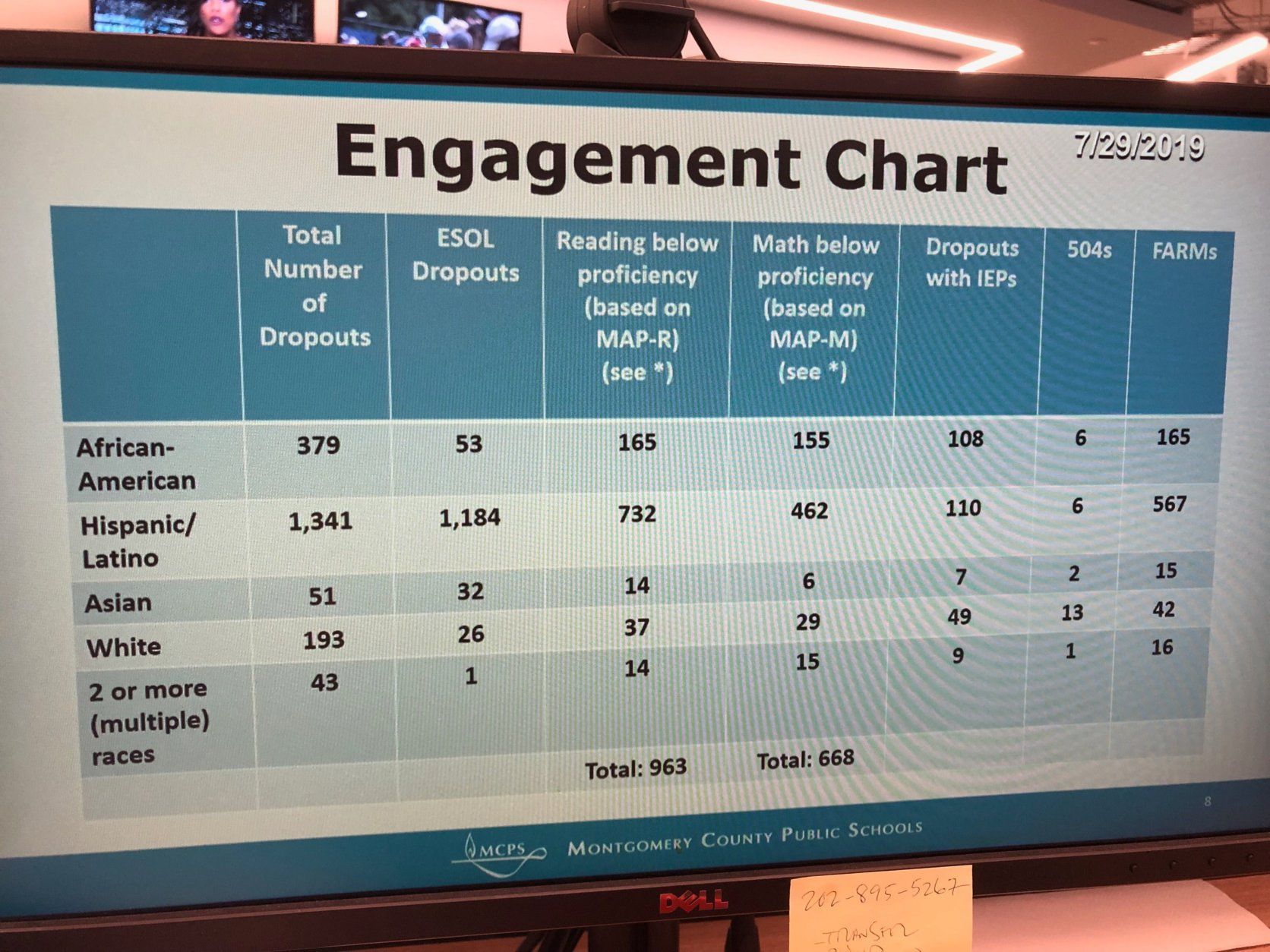
Who are these Asian-Americans who are doing poorly? Is it a disability issue? resource issue? language barrier? immigration status issue? I am sure there are at least a few community resources that can help them to do better?
Anonymous
07/31/2019 09:50
Subject: Mcps has a dropout problem
Anonymous wrote:
Needing to make money at age 15, is not a problem for the MCPS. It is mainly a problem from the parents. If you really want to put this as a problem for the society, it can be discussed but it is NOT a problem for the school system to solve.
I'm baffled by the person/people who keep insisting that kids not being in school is not a school problem.
Anonymous
07/31/2019 09:50
Subject: Re:Mcps has a dropout problem
Anonymous
07/31/2019 09:47
Subject: Mcps has a dropout problem
Anonymous wrote:Anonymous wrote:Anonymous wrote:Anonymous wrote:there were far fewer social services then than now . I’m high school I had all sorts of extracurricular activities and worked 15 hours a week. My father grew up dirt poor in Roxbury . Zero social welfare benefits and he worked nearly fulll time in high school and got a full ride scholarship to northeastern . It can be done if people don’t excuse failureAnonymous wrote:Anonymous wrote:when I was in mcps I went to school with very poor immigrants from South Asia . They managed to not only bot drop out they also got into Ivy League collegesAnonymous wrote:Anonymous wrote:Anonymous wrote:Well over half are either in ESOL or are Hispanic https://wtop.com/montgomery-county/2019/07/montgomery-co-public-schools-have-a-dropout-problem-heres-why/
Well I guest the response to this topic says it: who cares?
I am not being sarcastic. I truly believe that if these students and/or their families do not care, others should not (yes, SHOULD not - or at least PUBLIC RESOURCES should not be used to deal with this).
They care, but often they are facing very immediate economic needs that can’t wait two to three years to address. A third income earner can make the difference between rent or eviction, vegetables and fruit or malnutrition. This was not an unusual pattern in white immigrant families two generations ago. My XH’s grandmother left school at 15 to work FT in a store. Her sacrifice made it possible for the family to survive and her younger siblings to graduate HS. T
Good for them! But what does that have to do with other people with different experiences?
My grandfather had to drop out of high school to go to work, too. That would have been 1917 or 1918. He got his GED later, through night school.
Social services aren’t always available to these students, especially those who are undocumented.
And why the F should we be offering social services to illegal aliens.
Because they are children and human beings who shouldn’t be hungry, cold, or sick.
For me, it comes from my Catholic faith, my own childhood in poverty, and my duty/privilege as a teacher to care for these kids. I can not think of a single circumstance in which it is moral defensible to deny any person basic human needs like food, shelter, clothing, and medical care.
I don't have a "Catholic faith". I don't have a duty as a teacher either.
I have no problem with other people's faith. It is just not fair to use public resources to help you keep your faith. So if you help these kids using your personal time/money, there is nothing wrong. If there are enough people like you who are willing to do that (using their personal time and money to help), then these people could actually live a happy life.
Are there?
I do see many people interested in using public resources to help their "faith".
Anonymous
07/31/2019 09:43
Subject: Mcps has a dropout problem
Anonymous wrote:Anonymous wrote:high school, especially on level or remedial is simple. Compare high school to taking the bar exam . Which is much harder ?Anonymous wrote:Anonymous wrote:Anonymous wrote:Objectively high school is incredibly easy. The people who don’t well refuse to study do homework etc. I knew very smart people who did poorly because they didn’t bother trying but as they got older their work study ethic improved .
This is the sort of topic that brings out the ignorance and unkindness in people. Prime example here. High school is not incredibly easy. Many kids struggle even if they study and do homework. Add to that language barriers in both student and family and also the stress of financial concerns. While there is a set of kids who have an incredibly easy time in high school, it is definitely not the norm.
Students struggle because they want to do well. If they just want to pass, it is not hard - "incredibly easy" may be a bit exaggerating, but certainly not hard.
If you moved to Sweden at age 15 and had three years to master Swedish, make enough money to help pay rent, and take care of your younger siblings, do you think that would be “not hard”? The cultural and linguistic transition and the economic needs are a huge deal.
Needing to make money at age 15, is not a problem for the MCPS. It is mainly a problem from the parents. If you really want to put this as a problem for the society, it can be discussed but it is NOT a problem for the school system to solve.
Anonymous
07/31/2019 09:38
Subject: Mcps has a dropout problem
but I’ve done both. High school was much easier than the bar exam though law school was easier than college. There are kids in advanced high school courses that take higher Math courses than I ever took in college . However on level math is insanely easy . When I was in 9th grade there were seniors in my algebra classAnonymous wrote:Anonymous wrote:high school, especially on level or remedial is simple. Compare high school to taking the bar exam . Which is much harder ?Anonymous wrote:Anonymous wrote:Anonymous wrote:Objectively high school is incredibly easy. The people who don’t well refuse to study do homework etc. I knew very smart people who did poorly because they didn’t bother trying but as they got older their work study ethic improved .
This is the sort of topic that brings out the ignorance and unkindness in people. Prime example here. High school is not incredibly easy. Many kids struggle even if they study and do homework. Add to that language barriers in both student and family and also the stress of financial concerns. While there is a set of kids who have an incredibly easy time in high school, it is definitely not the norm.
Students struggle because they want to do well. If they just want to pass, it is not hard - "incredibly easy" may be a bit exaggerating, but certainly not hard.
You are a moron.
You can't compare HS to the bar exam which is a POST law school test!
And you don't get into law school w/o a HS degree.
Anonymous
07/31/2019 08:09
Subject: Mcps has a dropout problem
Jesus was a child refugee.
Anonymous
07/31/2019 07:43
Subject: Mcps has a dropout problem
Anonymous wrote:
And why the F should we be offering social services to illegal aliens.
Because they're human beings, and so are we.
I hope that you don't consider yourself a Christian.
Anonymous
07/31/2019 07:39
Subject: Mcps has a dropout problem
Anonymous wrote:Anonymous wrote:Anonymous wrote:there were far fewer social services then than now . I’m high school I had all sorts of extracurricular activities and worked 15 hours a week. My father grew up dirt poor in Roxbury . Zero social welfare benefits and he worked nearly fulll time in high school and got a full ride scholarship to northeastern . It can be done if people don’t excuse failureAnonymous wrote:Anonymous wrote:when I was in mcps I went to school with very poor immigrants from South Asia . They managed to not only bot drop out they also got into Ivy League collegesAnonymous wrote:Anonymous wrote:Anonymous wrote:Well over half are either in ESOL or are Hispanic https://wtop.com/montgomery-county/2019/07/montgomery-co-public-schools-have-a-dropout-problem-heres-why/
Well I guest the response to this topic says it: who cares?
I am not being sarcastic. I truly believe that if these students and/or their families do not care, others should not (yes, SHOULD not - or at least PUBLIC RESOURCES should not be used to deal with this).
They care, but often they are facing very immediate economic needs that can’t wait two to three years to address. A third income earner can make the difference between rent or eviction, vegetables and fruit or malnutrition. This was not an unusual pattern in white immigrant families two generations ago. My XH’s grandmother left school at 15 to work FT in a store. Her sacrifice made it possible for the family to survive and her younger siblings to graduate HS. T
Good for them! But what does that have to do with other people with different experiences?
My grandfather had to drop out of high school to go to work, too. That would have been 1917 or 1918. He got his GED later, through night school.
Social services aren’t always available to these students, especially those who are undocumented.
And why the F should we be offering social services to illegal aliens.
Because they are children and human beings who shouldn’t be hungry, cold, or sick.
For me, it comes from my Catholic faith, my own childhood in poverty, and my duty/privilege as a teacher to care for these kids. I can not think of a single circumstance in which it is moral defensible to deny any person basic human needs like food, shelter, clothing, and medical care.
Anonymous
07/31/2019 03:09
Subject: Mcps has a dropout problem
Anonymous wrote:Anonymous wrote:there were far fewer social services then than now . I’m high school I had all sorts of extracurricular activities and worked 15 hours a week. My father grew up dirt poor in Roxbury . Zero social welfare benefits and he worked nearly fulll time in high school and got a full ride scholarship to northeastern . It can be done if people don’t excuse failureAnonymous wrote:Anonymous wrote:when I was in mcps I went to school with very poor immigrants from South Asia . They managed to not only bot drop out they also got into Ivy League collegesAnonymous wrote:Anonymous wrote:Anonymous wrote:Well over half are either in ESOL or are Hispanic https://wtop.com/montgomery-county/2019/07/montgomery-co-public-schools-have-a-dropout-problem-heres-why/
Well I guest the response to this topic says it: who cares?
I am not being sarcastic. I truly believe that if these students and/or their families do not care, others should not (yes, SHOULD not - or at least PUBLIC RESOURCES should not be used to deal with this).
They care, but often they are facing very immediate economic needs that can’t wait two to three years to address. A third income earner can make the difference between rent or eviction, vegetables and fruit or malnutrition. This was not an unusual pattern in white immigrant families two generations ago. My XH’s grandmother left school at 15 to work FT in a store. Her sacrifice made it possible for the family to survive and her younger siblings to graduate HS. T
Good for them! But what does that have to do with other people with different experiences?
My grandfather had to drop out of high school to go to work, too. That would have been 1917 or 1918. He got his GED later, through night school.
Social services aren’t always available to these students, especially those who are undocumented.
And why the F should we be offering social services to illegal aliens.
Anonymous
07/30/2019 23:05
Subject: Mcps has a dropout problem
Anonymous wrote:Anonymous wrote:Anonymous wrote:Anonymous wrote:Well over half are either in ESOL or are Hispanic https://wtop.com/montgomery-county/2019/07/montgomery-co-public-schools-have-a-dropout-problem-heres-why/
Well I guest the response to this topic says it: who cares?
I am not being sarcastic. I truly believe that if these students and/or their families do not care, others should not (yes, SHOULD not - or at least PUBLIC RESOURCES should not be used to deal with this).
They care, but often they are facing very immediate economic needs that can’t wait two to three years to address. A third income earner can make the difference between rent or eviction, vegetables and fruit or malnutrition. This was not an unusual pattern in white immigrant families two generations ago. My XH’s grandmother left school at 15 to work FT in a store. Her sacrifice made it possible for the family to survive and her younger siblings to graduate HS. T
Many schools provide three meals to kids on FARMs.
There is no such thing as a school provided dinner for FARMS students. I work in a high FARMS elementary school. Many kids on FARMS don't even eat the free breakfast. They don't get to school early enough to have it. You can imagine how that goes when some students have lunch at 1pm. Totally unavailable to learn. But we can't force parents to get their kids to school early enough to eat breakfast. We try, and even go as far as providing alarm clocks to families who are chronically late, but we don't live in their houses with them and can't physically get them there. Sometimes I will send kids up to the nurse when I know they haven't had breakfast and lunchtime is far away. I write a code word on the note and the nurse knows that means to provide some pretzels she keeps in the health room for students with low blood sugar. But they miss instructional time and then you have to be careful about it becoming an expectation and habit. My principal doesn't allow snack time in classrooms due to inequity (some kids would bring snack but the ones who need it most won't), and also due to insect/rodent issues. But kids need food so I have come up with this plan. Some other teachers in my building keep a secret stash of snacks in their rooms and find a way to sneak it to kids.
FWIW the students I see this the most with are not necessarily the immigrant families. Many are AA kids living in a single parent household.
Anonymous
07/30/2019 22:58
Subject: Mcps has a dropout problem
Anonymous wrote:Anonymous wrote:Anonymous wrote:Anonymous wrote:Anonymous wrote:Well over half are either in ESOL or are Hispanic https://wtop.com/montgomery-county/2019/07/montgomery-co-public-schools-have-a-dropout-problem-heres-why/
Well I guest the response to this topic says it: who cares?
I am not being sarcastic. I truly believe that if these students and/or their families do not care, others should not (yes, SHOULD not - or at least PUBLIC RESOURCES should not be used to deal with this).
They care, but often they are facing very immediate economic needs that can’t wait two to three years to address. A third income earner can make the difference between rent or eviction, vegetables and fruit or malnutrition. This was not an unusual pattern in white immigrant families two generations ago. My XH’s grandmother left school at 15 to work FT in a store. Her sacrifice made it possible for the family to survive and her younger siblings to graduate HS. T
Many schools provide three meals to kids on FARMs.
But households also include kids too young for school (and therefore FARMs) and adults too old. There are students who bring home part of their school lunch to feed younger siblings.
I've never seen that and I've been in high-FARMs high schools for the bulk of my career. Maybe younger kids do that.
makes sense, however