Anonymous
 10/27/2018 13:53
Subject: Re:Started my PHD and parents think I’m making a mistake
10/27/2018 13:53
Subject: Re:Started my PHD and parents think I’m making a mistake
Anonymous wrote:Wow. Are you ignorant.
Have you heard of the MeToo movement?
Honor killings?
Child Marriage?
Female Genital Mutilation?
Countries that STILL resolve rapes by having the perpetrators marry their victims?
Saudi Arabia (where women need a male relatives' permission--could even be that of their male child--to leave the country?)
https://www.hrw.org/report/2016/07/16/boxed/women-and-saudi-arabias-male-guardianship-system
Pfffft. In this country, men don't have any rights that women don't have. And women have more rights than men. I don't care what happens in Muslim countries -- all those horror stories are a good reason not to let any of them live here, and it remains a mystery to me why feminists don't oppose such immigration.

Anonymous
10/27/2018 13:32
Subject: Re:Started my PHD and parents think I’m making a mistake
Wow. Are you ignorant.
Have you heard of the MeToo movement?
Honor killings?
Child Marriage?
Female Genital Mutilation?
Countries that STILL resolve rapes by having the perpetrators marry their victims?
Saudi Arabia (where women need a male relatives' permission--could even be that of their male child--to leave the country?)
https://www.hrw.org/report/2016/07/16/boxed/women-and-saudi-arabias-male-guardianship-system
Have you heard of the MeToo movement?
Honor killings?
Child Marriage?
Female Genital Mutilation?
Countries that STILL resolve rapes by having the perpetrators marry their victims?
Saudi Arabia (where women need a male relatives' permission--could even be that of their male child--to leave the country?)
https://www.hrw.org/report/2016/07/16/boxed/women-and-saudi-arabias-male-guardianship-system
Anonymous
10/27/2018 13:23
Subject: Started my PHD and parents think I’m making a mistake
Women's rights is stupid, they already have rights
Anonymous
10/27/2018 13:21
Subject: Started my PHD and parents think I’m making a mistake
Op, you sound like a baby. If you're *completely* supporting yourself financially --- not taking any of Mommy & Daddy's money --- then you are adult-enough for their criticism to not bother you. AND it means criticism, said more than once, is rude of them and you do not have to put up with that.
Anonymous
10/27/2018 12:32
Subject: Started my PHD and parents think I’m making a mistake
Anonymous wrote:Anonymous wrote:My parents were not happy about my earning a PhD in a humanities field. Signed, prof who now makes 6 figures
How did you fund it?
That really is the question.
With a combination of scholarships (first four years) and working (adjunct teaching at multiple institutions in the last two years). I took a 7K loan so that I could have one entire semester free to complete dissertation writing, and that was it. Paid it off while teaching in a FT visiting professorship the following year. Entered a tenure track position the year after that, eventually tenured. I was absolutely one of the lucky ones, but I was also strategic in choosing a topic I knew would have perceived value by hiring committees. I was a finalist for all three "good" TT positions that year, and was offered two of them.
I certainly agree a self-funded PhD is a bad idea, for two reasons. First, it's true the ROI is simply not there. Second, it is an indication that institutions don't view you as among top talent. That perception rarely changes and doesn't bode well for an academic career. I always always advise against, but ethically would only encourage the very most talented students to consider a PhD at all. And I'm careful to advise them it will still be risky. But so long as they're not self pay, and are flexible about outcomes, it can be worthwhile to try.
Anonymous
10/27/2018 12:30
Subject: Re:Started my PHD and parents think I’m making a mistake
Anonymous wrote:To the person complaining about making a $100,000 salary...your bubble is showing.
In 2017, that would have meant you made more than 88% of US households. AND in all likelihood, that figure does not include a spouse's contribution to your household income.
You choose to live here, where it is expensive. But you should not let that distort your view of what constitutes a decent salary.
Consider living in the college town of Ann Arbor, where the median house price is $364,000 vs Bethesda, where it is $868,000.
1. I don't make a $100k salary. I support my family on $68k and do not own a home, my bubble is fairly average income-wise. My point is that other graduate degrees do not have $100k earning ceilings. If you do want to have more options in more expensive places like this, which ARE above average in cost of living, that's worth thinking about in a more detailed and systematic way then "that sounds like a lot of money." $50k sounded like a lot when i was a grad student making $20k, but i wasn't worried about saving for retirement, long term rent increases, I had free health insurance, etc.
2. If my government agency wants to move to Ann Arbor I'd be thrilled. But when you have a PhD in a narrow field, you can't find a job in any city you want like a nurse or accountant, even if you leave academia. I DO have to live here, because that's where i got the best job offer. This is the reality of being specialized.
Anonymous
10/27/2018 12:00
Subject: Re:Started my PHD and parents think I’m making a mistake
To the person complaining about making a $100,000 salary...your bubble is showing.
In 2017, that would have meant you made more than 88% of US households. AND in all likelihood, that figure does not include a spouse's contribution to your household income.
You choose to live here, where it is expensive. But you should not let that distort your view of what constitutes a decent salary.
Consider living in the college town of Ann Arbor, where the median house price is $364,000 vs Bethesda, where it is $868,000.
In 2017, that would have meant you made more than 88% of US households. AND in all likelihood, that figure does not include a spouse's contribution to your household income.
You choose to live here, where it is expensive. But you should not let that distort your view of what constitutes a decent salary.
Consider living in the college town of Ann Arbor, where the median house price is $364,000 vs Bethesda, where it is $868,000.
Anonymous
10/27/2018 11:52
Subject: Started my PHD and parents think I’m making a mistake
Anonymous wrote:But since we will never be able to design a study where people are randomized to complete a PhD degree, these data should still encourage those who choose to go that route.
The OP was not trying to isolate whatever the secret ingredient is inside the special PhD sauce. She was trying to figure out if future looked bleak. Despite the posters here (some of whom did NOT complete their degrees), it does not.
Okay, this is a fair point.
Anonymous
10/27/2018 11:51
Subject: Started my PHD and parents think I’m making a mistake
But since we will never be able to design a study where people are randomized to complete a PhD degree, these data should still encourage those who choose to go that route.
The OP was not trying to isolate whatever the secret ingredient is inside the special PhD sauce. She was trying to figure out if future looked bleak. Despite the posters here (some of whom did NOT complete their degrees), it does not.
The OP was not trying to isolate whatever the secret ingredient is inside the special PhD sauce. She was trying to figure out if future looked bleak. Despite the posters here (some of whom did NOT complete their degrees), it does not.
Anonymous
10/27/2018 11:48
Subject: Re:Started my PHD and parents think I’m making a mistake
I have a PhD in a social science that's probably on par with women's and gender studies in terms of employability. I have a GS-11/12 government job in my field, and unless I get pretty lucky and advance further than average or find a rare private sector opportunity, I'll probably top out at 13 (which is around $100k). Fine but not a lot around here. OP, if you go this route, you'll probably always be in a "passion" job in one way or another - think about that seriously.
Anonymous
10/27/2018 11:44
Subject: Re:Started my PHD and parents think I’m making a mistake
Anonymous wrote:What is interesting is to look at BLS statistics (https://www.bls.gov/emp/chart-unemployment-earnings-education.htm)
People with the highest degrees have the lowest unemployment rate and highest salaries (ok, prof. degrees are higher than doctoral degrees in salary).
But, PhD's have a 1.5% unemployment rate, and $1743*52=90636 median salary.
You might not be able to directly work in your field but the analytical approaches you learn will have broad applications.
I've never found this data to be a compelling argument for getting a PhD, because while there is a correlation there is really no great reason to expect causation. When economists point this stuff out, my answer is always, "So, really. People who are willing and able to work for barely subsistence wages through the better part of the 20s, usually with minimal direction, in order to contribute new knowledge to a field don't have a lot of trouble finding paid employment? And I'm somehow supposed to believe it's the piece of paper they got at the end of that slog and not the characteristics they had going into it that is the reason for their low unemployment rate?" I'm actually being somewhat facetious, because I do think there is value in going through that slog...but you have to be careful when interpreting these stats.
Anonymous
10/27/2018 11:34
Subject: Re:Started my PHD and parents think I’m making a mistake
<>
+1
I was in my second year of doctoral training at supposedly the best grad school in my field, before I understood that academics (at least those who teach in grad school) are expected to bring in a LARGE chunk of their own salary to keep their jobs. For example, at Johns Hopkins School of Public Health, even tenured, full professors are expected to cover 85% of their own salaries with grants.
What a SCAM.
The government should not agree to the outrageous indirect cost rates charged by prestigious research institutions AND universities should be forced to pay their faculty's own salaries.
Believe me, they seem to find $$ to pay administrators/deans!
+1
I was in my second year of doctoral training at supposedly the best grad school in my field, before I understood that academics (at least those who teach in grad school) are expected to bring in a LARGE chunk of their own salary to keep their jobs. For example, at Johns Hopkins School of Public Health, even tenured, full professors are expected to cover 85% of their own salaries with grants.
What a SCAM.
The government should not agree to the outrageous indirect cost rates charged by prestigious research institutions AND universities should be forced to pay their faculty's own salaries.
Believe me, they seem to find $$ to pay administrators/deans!
Anonymous
10/27/2018 11:31
Subject: Started my PHD and parents think I’m making a mistake
Anonymous wrote:Anonymous wrote:
I know you intended to give a balanced overview, I really do. You have to understand that when OP reads what you wrote, her only takeaway is going to be “if I follow my passion, everything will work out!” But OP is never going to get a job in her field that doesn’t require food stamps. It’s not like physics where people will just hire you straight into a data science position regardless of your industry knowledge.
Different physics PhD poster, and data science is not a job in the field of physics either. We are all saying that she has to plan ahead for the reality that she will almost certainly not be a professor in her field. I can say that some people with particularly quantitative social science PhDs can find data science positions...and there are also many other routes to employment with a PhD in the social sciences. OP should navigate her PhD with eyes wide open to the reality of what lays on the other side. If she wants to pursue her PhD anyway, that's her decision. I think academia is completely f'ed up, and American universities basically lie to every PhD student who matriculates. But it would also be a sad world if no one who was interested in contributing new knowledge to the field pursued those interests...I just think we need to be strong advocates for ourselves...because no one is looking out for us.
Original PhD Physics PP. +1e7
Anonymous
10/27/2018 11:27
Subject: Started my PHD and parents think I’m making a mistake
Anonymous wrote:
I know you intended to give a balanced overview, I really do. You have to understand that when OP reads what you wrote, her only takeaway is going to be “if I follow my passion, everything will work out!” But OP is never going to get a job in her field that doesn’t require food stamps. It’s not like physics where people will just hire you straight into a data science position regardless of your industry knowledge.
Different physics PhD poster, and data science is not a job in the field of physics either. We are all saying that she has to plan ahead for the reality that she will almost certainly not be a professor in her field. I can say that some people with particularly quantitative social science PhDs can find data science positions...and there are also many other routes to employment with a PhD in the social sciences. OP should navigate her PhD with eyes wide open to the reality of what lays on the other side. If she wants to pursue her PhD anyway, that's her decision. I think academia is completely f'ed up, and American universities basically lie to every PhD student who matriculates. But it would also be a sad world if no one who was interested in contributing new knowledge to the field pursued those interests...I just think we need to be strong advocates for ourselves...because no one is looking out for us.
Anonymous
10/27/2018 11:25
Subject: Re:Started my PHD and parents think I’m making a mistake
What is interesting is to look at BLS statistics (https://www.bls.gov/emp/chart-unemployment-earnings-education.htm)
People with the highest degrees have the lowest unemployment rate and highest salaries (ok, prof. degrees are higher than doctoral degrees in salary).
But, PhD's have a 1.5% unemployment rate, and $1743*52=90636 median salary.
You might not be able to directly work in your field but the analytical approaches you learn will have broad applications.
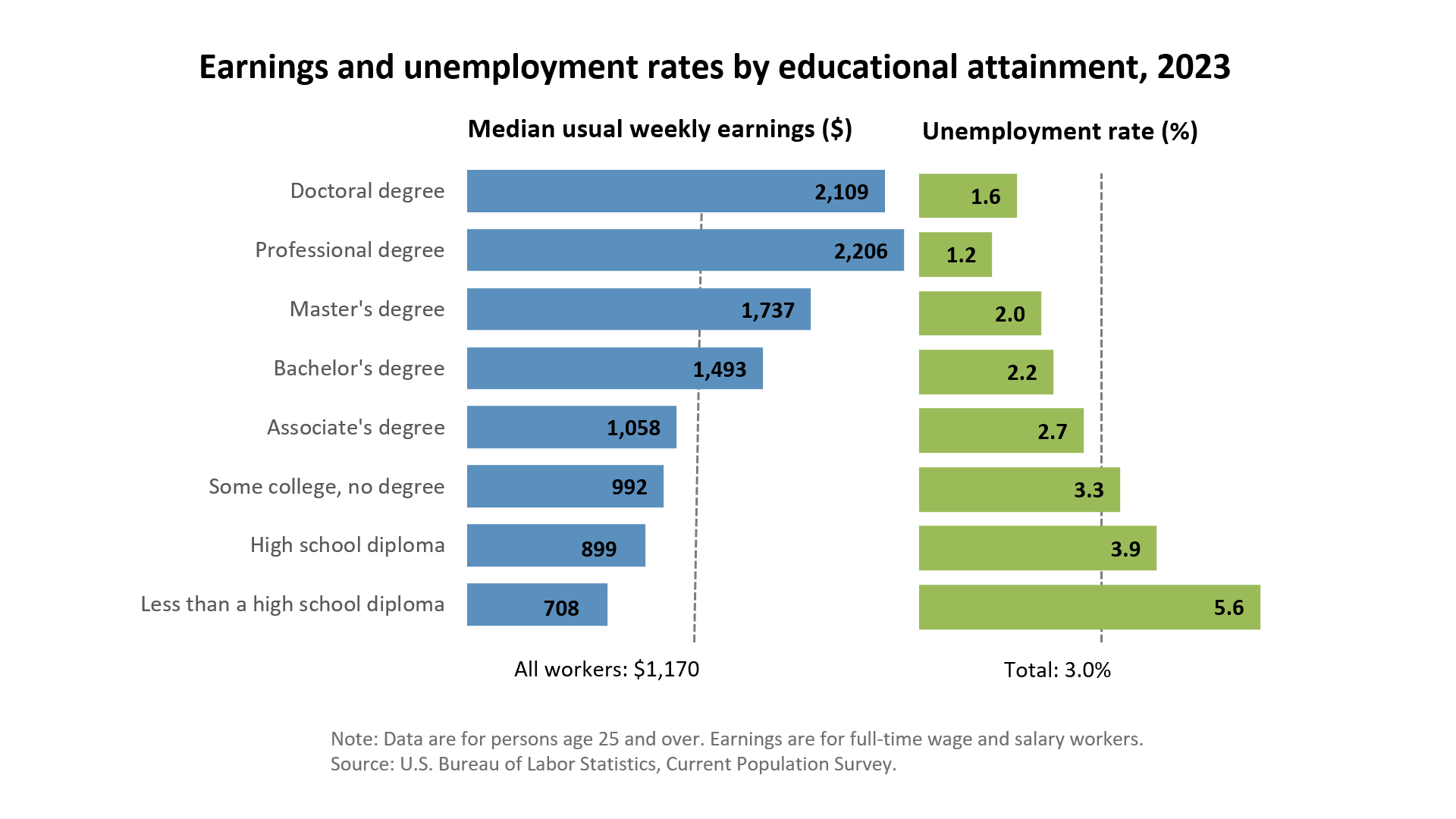
People with the highest degrees have the lowest unemployment rate and highest salaries (ok, prof. degrees are higher than doctoral degrees in salary).
But, PhD's have a 1.5% unemployment rate, and $1743*52=90636 median salary.
You might not be able to directly work in your field but the analytical approaches you learn will have broad applications.