Anonymous
 10/06/2016 16:10
Subject: Why is NPR allowed to be so far left?
10/06/2016 16:10
Subject: Why is NPR allowed to be so far left?
Anonymous wrote:Anonymous wrote:Anonymous wrote:Anonymous wrote:Anonymous wrote:NPR seems pretty mainstream to me.
Our radios are set to NPR in our cars, bedroom, office, and kitchen. We listen to it all the time, but their interviews frequently "lean left." We're fairly conservative, and I find it rather amusing that their interviewers will frame questions in a way that sets up the conservative candidate or policy as "concerning to many Americans." So obvious. Of course, they're using perfect English and speaking with a well-modulated, concerned tone of voice to express their thoughts.
NPR has "conservative" voices on all the time - David Brooks, Ross Douthout, etc. Lots of in-depth stories about religion. They are also frequent critics of Obamacare, national security policies, lack of accountability of police and local governments, and (lack of) whistleblower protections. WAMU in DC is extremely critical of the DC government.
I feel that they've always been fair and stuck to the facts.
+1. I think people who complain how "liberal" it is don't listen to it all that much. And can't handle when a news organization doesn't puppet their own views like Fox.
Not really; they definitely have a leftward bias, and I say this as someone who is generally left leaning. I find the bias in stories about illegal immigration to be especially obvious. I'm not sure I've heard one story about the negative repercussions of illegal immigration; it's always stories about the wonderful hard working people fleeing bad situations, stories about 4.0 honor students that are now facing deportation etc, etc. I don't think they skew facts, but their selection of which stories to cover is obviously biased.
I think it was NPR who followed a group of Central American teens as they tried to sneak across the US border. Obviously illiterate. They wanted to go to the US "To escape violence ... be able to skateboard in the USA." And it was the most sympathetic slant. W-t-f.

Anonymous
10/06/2016 15:41
Subject: Why is NPR allowed to be so far left?
Anonymous wrote:Anonymous wrote:Anonymous wrote:Anonymous wrote:Anonymous wrote:NPR seems pretty mainstream to me.
Our radios are set to NPR in our cars, bedroom, office, and kitchen. We listen to it all the time, but their interviews frequently "lean left." We're fairly conservative, and I find it rather amusing that their interviewers will frame questions in a way that sets up the conservative candidate or policy as "concerning to many Americans." So obvious. Of course, they're using perfect English and speaking with a well-modulated, concerned tone of voice to express their thoughts.
NPR has "conservative" voices on all the time - David Brooks, Ross Douthout, etc. Lots of in-depth stories about religion. They are also frequent critics of Obamacare, national security policies, lack of accountability of police and local governments, and (lack of) whistleblower protections. WAMU in DC is extremely critical of the DC government.
I feel that they've always been fair and stuck to the facts.
+1. I think people who complain how "liberal" it is don't listen to it all that much. And can't handle when a news organization doesn't puppet their own views like Fox.
Not really; they definitely have a leftward bias, and I say this as someone who is generally left leaning. I find the bias in stories about illegal immigration to be especially obvious. I'm not sure I've heard one story about the negative repercussions of illegal immigration; it's always stories about the wonderful hard working people fleeing bad situations, stories about 4.0 honor students that are now facing deportation etc, etc. I don't think they skew facts, but their selection of which stories to cover is obviously biased.
So that is an important distinction! It's not so much that you are finding the reporting itself to be flawed; it's that you don't like the mix of stories, or that there are "too many" stories that highlight viewpoints that you disagree with. This is what I LOVE about NPR; that it puts the human face on a political reality that often is reduced to 5-second soundbites on commercial radio or TV.
Anonymous
10/06/2016 15:30
Subject: Why is NPR allowed to be so far left?
Regarding the chart, everyone calls themselves middle of the road and two, many college-educated adults just put on NPR to get their news all day. It's a default...because we pay for it.
Anonymous
10/06/2016 15:26
Subject: Why is NPR allowed to be so far left?
Anonymous wrote:Anonymous wrote:Anonymous wrote:Anonymous wrote:NPR seems pretty mainstream to me.
Our radios are set to NPR in our cars, bedroom, office, and kitchen. We listen to it all the time, but their interviews frequently "lean left." We're fairly conservative, and I find it rather amusing that their interviewers will frame questions in a way that sets up the conservative candidate or policy as "concerning to many Americans." So obvious. Of course, they're using perfect English and speaking with a well-modulated, concerned tone of voice to express their thoughts.
NPR has "conservative" voices on all the time - David Brooks, Ross Douthout, etc. Lots of in-depth stories about religion. They are also frequent critics of Obamacare, national security policies, lack of accountability of police and local governments, and (lack of) whistleblower protections. WAMU in DC is extremely critical of the DC government.
I feel that they've always been fair and stuck to the facts.
+1. I think people who complain how "liberal" it is don't listen to it all that much. And can't handle when a news organization doesn't puppet their own views like Fox.
Not really; they definitely have a leftward bias, and I say this as someone who is generally left leaning. I find the bias in stories about illegal immigration to be especially obvious. I'm not sure I've heard one story about the negative repercussions of illegal immigration; it's always stories about the wonderful hard working people fleeing bad situations, stories about 4.0 honor students that are now facing deportation etc, etc. I don't think they skew facts, but their selection of which stories to cover is obviously biased.
Anonymous
10/06/2016 15:16
Subject: Why is NPR allowed to be so far left?
Anonymous wrote:I mean how does covering international events constitute a liberal bias?!
It's the same logic that says covering LGBTQ issues constitutes a liberal bias. These are real issues affecting real lives, but just talking about it somehow makes NPR liberal.
Aka "What we've got here is failure to communicate"
Anonymous
10/06/2016 15:12
Subject: Why is NPR allowed to be so far left?
I mean how does covering international events constitute a liberal bias?!
Anonymous
10/06/2016 15:11
Subject: Why is NPR allowed to be so far left?
Anonymous wrote:Anonymous wrote:Anonymous wrote:Regarding choosing NOT to listen..
NPR is commercial free which is why I like to listen to it. Also, I like that it has a variety of types of show and I like the format of the morning and afternoon news-based shows.
However, I wish it was not so liberally biased. This is a legitimate complaint.
NPR is supposed to be our national non profit radio station. We don't have to just change the channel.
NPR should strive to be more balanced and unbiased.
The bias this election season is gag worthy. I mean - it is over the top slanted towards the Democrats. It is more anti-Trump than the Huffington Post. It is completely irritating.
What is your example of a balanced and unbiased news outlet?
Ha, trick question! NPR is the best we got by most measures. Doesn't mean people need to be happy with that, but pretty much every news source in the US is more biased (either to Dems or GOP) than NPR.
Interviews/comments provided by Think Tank pundits
Every news outlet relies on expert commentators from think tanks to provide comments or to be interviewed. Those think tanks include organizations such as American Enterprise, The Brookings Institute, and the Heritage Foundation. A study in 2005 counted the number of commentators from conservative-leaning think tanks and the number of commentators from liberal-leaning think tanks. The tally came to 249 conservatives and 141 liberals. That means that 63.8% of the commentators from think tanks were conservatives. So, NPR clearly is not trying to prevent conservative viewpoints from reaching its audience.
Stories about the Obama Administration
Pew did a study and found that 52% of stories on the administration were neutral, compared to a 40% average for the media in general. 28% of stories about the administration were positive, compared to 37% for the media in general. So, NPR clearly is not trying to be the voice of the current Democrat administration.
Democrat and Republican Voices on the Fiscal Cliff Story
Another study looked at the audio clips played between Nov. 7 and Dec. 6 2012, concerning the Fiscal Cliff news story. The count came to 94 Republican voices and 77 Democrat voices. That means 54.9% of the audio clips of politicians providing their insight on the fiscal cliff came from Republicans. So, NPR clearly is not trying to prevent conservative viewpoints from reaching its audience.
The Audience Makeup
The Wall Street Journal reported on surveys by Gfk MRI that measured political leanings of NPR's weekly audience:

NPR audience is the most balanced among audiences for any other major American news source.
The one place that analysts have detected a liberal bias is in the range of stories covered - specifically, NPR covers stories that tend to be of more interest to people that describe themselves as center-left to left than center-right to right. For example, 31% of NPR's stories are about international news - whereas for US commercial radio, 3% of the news stories are about international news.
How NPR covers these stories does not demonstrate a bias, but the fact that they are covering them is deemed a bias, by some.
Wow! That's kind of crazy to me. I guess it's no wonder that so many Americans are uninformed about international issues.
Anonymous
10/06/2016 15:03
Subject: Why is NPR allowed to be so far left?
Anonymous wrote:Anonymous wrote:Anonymous wrote:Anonymous wrote:Anonymous wrote:NPR seems pretty mainstream to me.
Our radios are set to NPR in our cars, bedroom, office, and kitchen. We listen to it all the time, but their interviews frequently "lean left." We're fairly conservative, and I find it rather amusing that their interviewers will frame questions in a way that sets up the conservative candidate or policy as "concerning to many Americans." So obvious. Of course, they're using perfect English and speaking with a well-modulated, concerned tone of voice to express their thoughts.
NPR has "conservative" voices on all the time - David Brooks, Ross Douthout, etc. Lots of in-depth stories about religion. They are also frequent critics of Obamacare, national security policies, lack of accountability of police and local governments, and (lack of) whistleblower protections. WAMU in DC is extremely critical of the DC government.
I feel that they've always been fair and stuck to the facts.
+1. I think people who complain how "liberal" it is don't listen to it all that much. And can't handle when a news organization doesn't puppet their own views like Fox.
Not sure why Fox is brought up. OP said he did not support NPR because it is slanted left and funded with tax payer money. Fox is not funded with tax payer money. Big difference.
Point being that some conservatives can't seem to handle news that doesn't have an explicit conservative slant like Fox. They express such disdain for *any* mainstream media outlet. Just because they view NPR as some leftist news organization doesnt mean it actually is.
Anonymous
10/06/2016 15:02
Subject: Why is NPR allowed to be so far left?
Anonymous wrote:Anonymous wrote:Regarding choosing NOT to listen..
NPR is commercial free which is why I like to listen to it. Also, I like that it has a variety of types of show and I like the format of the morning and afternoon news-based shows.
However, I wish it was not so liberally biased. This is a legitimate complaint.
NPR is supposed to be our national non profit radio station. We don't have to just change the channel.
NPR should strive to be more balanced and unbiased.
The bias this election season is gag worthy. I mean - it is over the top slanted towards the Democrats. It is more anti-Trump than the Huffington Post. It is completely irritating.
What is your example of a balanced and unbiased news outlet?
Ha, trick question! NPR is the best we got by most measures. Doesn't mean people need to be happy with that, but pretty much every news source in the US is more biased (either to Dems or GOP) than NPR.
Interviews/comments provided by Think Tank pundits
Every news outlet relies on expert commentators from think tanks to provide comments or to be interviewed. Those think tanks include organizations such as American Enterprise, The Brookings Institute, and the Heritage Foundation. A study in 2005 counted the number of commentators from conservative-leaning think tanks and the number of commentators from liberal-leaning think tanks. The tally came to 249 conservatives and 141 liberals. That means that 63.8% of the commentators from think tanks were conservatives. So, NPR clearly is not trying to prevent conservative viewpoints from reaching its audience.
Stories about the Obama Administration
Pew did a study and found that 52% of stories on the administration were neutral, compared to a 40% average for the media in general. 28% of stories about the administration were positive, compared to 37% for the media in general. So, NPR clearly is not trying to be the voice of the current Democrat administration.
Democrat and Republican Voices on the Fiscal Cliff Story
Another study looked at the audio clips played between Nov. 7 and Dec. 6 2012, concerning the Fiscal Cliff news story. The count came to 94 Republican voices and 77 Democrat voices. That means 54.9% of the audio clips of politicians providing their insight on the fiscal cliff came from Republicans. So, NPR clearly is not trying to prevent conservative viewpoints from reaching its audience.
The Audience Makeup
The Wall Street Journal reported on surveys by Gfk MRI that measured political leanings of NPR's weekly audience:
NPR audience is the most balanced among audiences for any other major American news source.
The one place that analysts have detected a liberal bias is in the range of stories covered - specifically, NPR covers stories that tend to be of more interest to people that describe themselves as center-left to left than center-right to right. For example, 31% of NPR's stories are about international news - whereas for US commercial radio, 3% of the news stories are about international news.
How NPR covers these stories does not demonstrate a bias, but the fact that they are covering them is deemed a bias, by some.
Anonymous
10/06/2016 14:53
Subject: Why is NPR allowed to be so far left?
Anonymous wrote:Regarding choosing NOT to listen..
NPR is commercial free which is why I like to listen to it. Also, I like that it has a variety of types of show and I like the format of the morning and afternoon news-based shows.
However, I wish it was not so liberally biased. This is a legitimate complaint.
NPR is supposed to be our national non profit radio station. We don't have to just change the channel.
NPR should strive to be more balanced and unbiased.
The bias this election season is gag worthy. I mean - it is over the top slanted towards the Democrats. It is more anti-Trump than the Huffington Post. It is completely irritating.
What is your example of a balanced and unbiased news outlet?
Anonymous
10/06/2016 14:42
Subject: Why is NPR allowed to be so far left?
Dear NPR listeners,
The Ombudsman serves as an independent mediator on questions raised by the audience regarding the standards and ethics of NPR’s journalism.
If you have complaints or comments about NPR and its shows please click the link below and feel free to bitch to your hearts content.
http://help.npr.org/customer/portal/emails/new
The Ombudsman serves as an independent mediator on questions raised by the audience regarding the standards and ethics of NPR’s journalism.
If you have complaints or comments about NPR and its shows please click the link below and feel free to bitch to your hearts content.
http://help.npr.org/customer/portal/emails/new
Anonymous
10/06/2016 14:34
Subject: Why is NPR allowed to be so far left?
OH, no! poor poor trump supporters - it hurts your feelings that any thinking human being does not support that man?
Anonymous
10/06/2016 14:31
Subject: Why is NPR allowed to be so far left?
Anonymous wrote:Regarding choosing NOT to listen..
NPR is commercial free which is why I like to listen to it. Also, I like that it has a variety of types of show and I like the format of the morning and afternoon news-based shows.
However, I wish it was not so liberally biased. This is a legitimate complaint.
NPR is supposed to be our national non profit radio station. We don't have to just change the channel.
NPR should strive to be more balanced and unbiased.
The bias this election season is gag worthy. I mean - it is over the top slanted towards the Democrats. It is more anti-Trump than the Huffington Post. It is completely irritating.
Trump is a unique figure in politics. No candidate, at least in my lifetime of 50+ years, has upended conventional politics the way he has. He has actively sought media coverage with his over the top antics; and his strategy has brought a lot of criticism from both conservatives, too.
Anonymous
10/06/2016 14:24
Subject: Why is NPR allowed to be so far left?
Anonymous wrote:Anonymous wrote:Anonymous wrote:Anonymous wrote:Anonymous wrote:I vote democrat and even I think that NPR is liberal BS. This morning they spent my commute time interviewing a male police officer who decided to become a woman in his 40s or 50s. Can't they just report the news?
So don't listen?
What else is there to listen to? I listen because I expect a centrist bi partisan pov. It's never that.
Are we listening to the same NPR? They have centrist conservative commentators on ALL THE TIME. Unfortunately, they themselves are exasperated by their own party most of the time because of the batshit crazy things GOP leaders are saying and doing.
If you were a fan of Reagan and Bush Sr, you should be a fan of what conservative commentators on NPR are saying. They levy fair criticisms of both Obama's and the extreme right's policies (not that Obama is an "extreme leftist"). Hillary Clinton is a center-right candidate in pretty much any other democracy in the world.
I will agree I hear more criticism of Obama on npr than any other left-biased media. Making them only slightly left? Left but not afraid to allow room for criticism (my theory is they are just negative all the time* so it fits). However HRC is NOT center right. *I* am the epitome of center right (very center, very slightly right), and I disagree with her on almost every issue. Only area we'd agree is foreign policy. So I guess she's center right on FP (and that makes sense as I guess the libs are always naming her a warhawk.)
*negatuvd all the time = yep, they feed off of a negative news story. Ones that are as hopeless and contentious as possible. All of the music/beats they play in between segments give me momentary depression. Stuff I would have listened to when I was 21. In my emo phase.
It doesn't matter what you "think" - by any normal measure by political scientists who study ideology across the world, Hillary Clinton is a center-right politician. This is a FACT, no matter how much you personal despise her. Do you even know what a truly candidate calls for? They are even more "radical" than even Bernie Sanders.
Here is a "political compass" plot based on policy positions and statement made by the candidate. HRC is centre right.
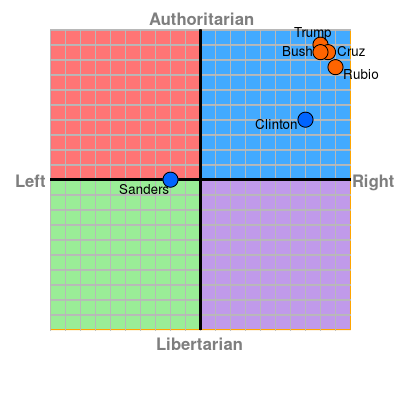
https://www.politicalcompass.org/uselection2016
Anonymous
10/06/2016 14:23
Subject: Why is NPR allowed to be so far left?
Regarding choosing NOT to listen..
NPR is commercial free which is why I like to listen to it. Also, I like that it has a variety of types of show and I like the format of the morning and afternoon news-based shows.
However, I wish it was not so liberally biased. This is a legitimate complaint.
NPR is supposed to be our national non profit radio station. We don't have to just change the channel.
NPR should strive to be more balanced and unbiased.
The bias this election season is gag worthy. I mean - it is over the top slanted towards the Democrats. It is more anti-Trump than the Huffington Post. It is completely irritating.
NPR is commercial free which is why I like to listen to it. Also, I like that it has a variety of types of show and I like the format of the morning and afternoon news-based shows.
However, I wish it was not so liberally biased. This is a legitimate complaint.
NPR is supposed to be our national non profit radio station. We don't have to just change the channel.
NPR should strive to be more balanced and unbiased.
The bias this election season is gag worthy. I mean - it is over the top slanted towards the Democrats. It is more anti-Trump than the Huffington Post. It is completely irritating.