Anonymous
 09/05/2023 09:31
Subject: Why so many human development indices favor Scandinavian countries?
09/05/2023 09:31
Subject: Why so many human development indices favor Scandinavian countries?
Anonymous wrote:France also has a strong social safety net like the Scandinavian countries. Why has France not had the same level of success?
What makes the Scandinavian countries different?
They're whiter.

Anonymous
09/05/2023 09:21
Subject: Why so many human development indices favor Scandinavian countries?
Anonymous wrote:Anonymous wrote:Anonymous wrote:Anonymous wrote:Anonymous wrote:Anonymous wrote:Diversity is the most important factor in any country’s economic success. Look at postwar Japan and Germany and present day Korea and China and Taiwan. So, so diverse. Just oozing multiculturalism.
? The US propped up Korea and Japan after the wars.
Also, Korea is allowing immigrants because their people aren't having enough kids. Japan refuses to because they are more xenophobic, and so their population will die out.
-signed a Korea American
There are barely any immigrants in Korea right now and the ones that are there aren’t Islamic, Latino, or African.
Korea will integrate back into one nation before they let Seoul become 20% white, 10% black, 15% Latino, and 55% Korean
"Barely" is relative. It has less than the US, for sure, but more than Japan. And admitting more and more. They have to. They don't have enough workers.
Even so, unlike the US, Korea is not a nation of immigrants. You just don't like the color of the recent immigrants coming to the US.
The vast majority of Korean immigrants are Chinese or Vietnamese!
Give me a 100 million non-Muslim ASEAN immigrants tomorrow and I will gladly give all greencards and an accelerated pathway to citizenship.
I would gladly open the doors to 50 million Vietnamese people tomorrow to come to the us.
It isn’t impressive to use ASEAN immigration as an example of a country being open to immigration — from our perspective, that’s easy.
That's just flat out bigotry.
+1 I'm the Korean American PP.. I responded to that bigoted pp: " You just don't like the color of the recent immigrants coming to the US. "
I'm sure there are many white people in the US who felt the same way about my Asian family immigrating to the US. Many of them have expressed such sentiments, yelling, "Go back to your own country.".
This country is made up of immigrants of all races and creeds.
Anonymous
09/05/2023 07:17
Subject: Re:Why so many human development indices favor Scandinavian countries?
Anonymous wrote:Anonymous wrote:Anonymous wrote:I really don't think this is a difficult analysis. A strong social safety net including universal healthcare and a guaranteed pension, plus strong worker's rights including guaranteed sick leave, vacation leave, parental leave, etc. And generally high government standards against corruption couple with a belief that government is in existence to work for the people.
Homogeneity definitely helps, but the issue with immigrants isn't just that they look different. It's that many of them don't want to assimilate and embrace the culture of their adopted country.
Study after study shows that the rate of assimilation is the same for the European immigrants of the late 1800s-early 1900s as it is for modern immigrants. Here's a good one that looks at what immigrants name their own babies. Shocker, the trends today are very similar to the trends back then. https://www.ncbi.nlm.nih.gov/pmc/articles/PMC7508458/
In the US, not abroad.
But I wonder if newcomers are assimilating at the same rates as they did in the past. Here’s why: we now have rather large swaths of areas/regions where a Spanish speaker doesn’t need to learn English to get by.
Stop wondering. Spanish speakers have already been studied in this country. They follow the same pattern as the other immigrants.
Anonymous
09/05/2023 07:15
Subject: Why so many human development indices favor Scandinavian countries?
Anonymous wrote:Anonymous wrote:Anonymous wrote:Anonymous wrote:Anonymous wrote:Diversity is the most important factor in any country’s economic success. Look at postwar Japan and Germany and present day Korea and China and Taiwan. So, so diverse. Just oozing multiculturalism.
? The US propped up Korea and Japan after the wars.
Also, Korea is allowing immigrants because their people aren't having enough kids. Japan refuses to because they are more xenophobic, and so their population will die out.
-signed a Korea American
There are barely any immigrants in Korea right now and the ones that are there aren’t Islamic, Latino, or African.
Korea will integrate back into one nation before they let Seoul become 20% white, 10% black, 15% Latino, and 55% Korean
"Barely" is relative. It has less than the US, for sure, but more than Japan. And admitting more and more. They have to. They don't have enough workers.
Even so, unlike the US, Korea is not a nation of immigrants. You just don't like the color of the recent immigrants coming to the US.
The vast majority of Korean immigrants are Chinese or Vietnamese!
Give me a 100 million non-Muslim ASEAN immigrants tomorrow and I will gladly give all greencards and an accelerated pathway to citizenship.
I would gladly open the doors to 50 million Vietnamese people tomorrow to come to the us.
It isn’t impressive to use ASEAN immigration as an example of a country being open to immigration — from our perspective, that’s easy.
That's just flat out bigotry.
Anonymous
09/05/2023 06:55
Subject: Why so many human development indices favor Scandinavian countries?
Anonymous wrote:Anonymous wrote:Anonymous wrote:Anonymous wrote:Anonymous wrote:Anonymous wrote:Scandinavians have amazing social services. They don't worry about healthcare, retirement or college costs.
I wish we had similar social services here. We can certainly afford it.
Not when most (70%) of the population is overweight or obese and demand/require weight loss/insulin/BP drugs.
"Ya kin pry mah 64 ounce Big Gulp o' high fructose corn seerup from mah cold, dead hands!!!!"

She looks pretty damn good to me
Better than what we have now, that’s for sure
I'm sure that's what we need in a leader.

Better than what we have now, that’s for sure
Anonymous
09/05/2023 05:11
Subject: Why so many human development indices favor Scandinavian countries?
Anonymous wrote:I think it's because they don't have a systematically disadvantaged underclass.
They don’t have a systemically disadvantaged underclass because they are very supportive of the state redistributing resources.
Anonymous
09/04/2023 21:53
Subject: Why so many human development indices favor Scandinavian countries?
Anonymous wrote:Anonymous wrote:Anonymous wrote:Anonymous wrote:Diversity is the most important factor in any country’s economic success. Look at postwar Japan and Germany and present day Korea and China and Taiwan. So, so diverse. Just oozing multiculturalism.
? The US propped up Korea and Japan after the wars.
Also, Korea is allowing immigrants because their people aren't having enough kids. Japan refuses to because they are more xenophobic, and so their population will die out.
-signed a Korea American
There are barely any immigrants in Korea right now and the ones that are there aren’t Islamic, Latino, or African.
Korea will integrate back into one nation before they let Seoul become 20% white, 10% black, 15% Latino, and 55% Korean
"Barely" is relative. It has less than the US, for sure, but more than Japan. And admitting more and more. They have to. They don't have enough workers.
Even so, unlike the US, Korea is not a nation of immigrants. You just don't like the color of the recent immigrants coming to the US.
The vast majority of Korean immigrants are Chinese or Vietnamese!
Give me a 100 million non-Muslim ASEAN immigrants tomorrow and I will gladly give all greencards and an accelerated pathway to citizenship.
I would gladly open the doors to 50 million Vietnamese people tomorrow to come to the us.
It isn’t impressive to use ASEAN immigration as an example of a country being open to immigration — from our perspective, that’s easy.
Anonymous
09/04/2023 20:54
Subject: Re:Why so many human development indices favor Scandinavian countries?
Poland cuts tax for first-time homebuyers and raises it for those buying multiple properties
https://notesfrompoland.com/2023/09/01/poland-cuts-tax-for-first-time-homebuyers-and-raises-it-for-those-buying-multiple-properties/
https://notesfrompoland.com/2023/09/01/poland-cuts-tax-for-first-time-homebuyers-and-raises-it-for-those-buying-multiple-properties/
Anonymous
09/04/2023 20:22
Subject: Why so many human development indices favor Scandinavian countries?
Anonymous wrote:Anonymous wrote:Anonymous wrote:Diversity is the most important factor in any country’s economic success. Look at postwar Japan and Germany and present day Korea and China and Taiwan. So, so diverse. Just oozing multiculturalism.
? The US propped up Korea and Japan after the wars.
Also, Korea is allowing immigrants because their people aren't having enough kids. Japan refuses to because they are more xenophobic, and so their population will die out.
-signed a Korea American
There are barely any immigrants in Korea right now and the ones that are there aren’t Islamic, Latino, or African.
Korea will integrate back into one nation before they let Seoul become 20% white, 10% black, 15% Latino, and 55% Korean
"Barely" is relative. It has less than the US, for sure, but more than Japan. And admitting more and more. They have to. They don't have enough workers.
Even so, unlike the US, Korea is not a nation of immigrants. You just don't like the color of the recent immigrants coming to the US.
Anonymous
09/04/2023 19:11
Subject: Why so many human development indices favor Scandinavian countries?
Anonymous wrote:Anonymous wrote:Diversity is the most important factor in any country’s economic success. Look at postwar Japan and Germany and present day Korea and China and Taiwan. So, so diverse. Just oozing multiculturalism.
? The US propped up Korea and Japan after the wars.
Also, Korea is allowing immigrants because their people aren't having enough kids. Japan refuses to because they are more xenophobic, and so their population will die out.
-signed a Korea American
There are barely any immigrants in Korea right now and the ones that are there aren’t Islamic, Latino, or African.
Korea will integrate back into one nation before they let Seoul become 20% white, 10% black, 15% Latino, and 55% Korean
Anonymous
09/04/2023 18:25
Subject: Re:Why so many human development indices favor Scandinavian countries?
Anonymous wrote:Anonymous wrote:Anonymous wrote:I really don't think this is a difficult analysis. A strong social safety net including universal healthcare and a guaranteed pension, plus strong worker's rights including guaranteed sick leave, vacation leave, parental leave, etc. And generally high government standards against corruption couple with a belief that government is in existence to work for the people.
Homogeneity definitely helps, but the issue with immigrants isn't just that they look different. It's that many of them don't want to assimilate and embrace the culture of their adopted country.
Study after study shows that the rate of assimilation is the same for the European immigrants of the late 1800s-early 1900s as it is for modern immigrants. Here's a good one that looks at what immigrants name their own babies. Shocker, the trends today are very similar to the trends back then. https://www.ncbi.nlm.nih.gov/pmc/articles/PMC7508458/
In the US, not abroad.
But I wonder if newcomers are assimilating at the same rates as they did in the past. Here’s why: we now have rather large swaths of areas/regions where a Spanish speaker doesn’t need to learn English to get by.
yea, that's a function of immigrant population size. You can bet that Polish immigrants back then also kept largely to their polish enclaves, and some never learned English.
Anonymous
09/04/2023 18:24
Subject: Why so many human development indices favor Scandinavian countries?
Anonymous wrote:Anonymous wrote:France also has a strong social safety net like the Scandinavian countries. Why has France not had the same level of success?
What makes the Scandinavian countries different?
Islam
France really struggles with Islamists
Any democratic country over 10% Islamic is gonna have problems
If Islamists get to be over 10% of the population in Sweden I am confident they would handle it even worse than France because Swedes don’t have an outward mindset or even try to do the “libertie/fraternitie/egalitie” thing which the median Frenchman does still believe in.
That said, France is way nicer to live in as an expat than Scandinavia. Lyon, nice, strasbourg, Mulhouse, annecy, Toulouse, etc are all way better QoL
dp.. It's not just Islam. It's any type of fundamentalist religion. Look at the countries that are still heavily into Catholicism. Having a large populace that adheres to fundamentalist regressive religions keep their people suppressed and uneducated = 3rd world country.
Anonymous
09/04/2023 18:21
Subject: Why so many human development indices favor Scandinavian countries?
Anonymous wrote:Diversity is the most important factor in any country’s economic success. Look at postwar Japan and Germany and present day Korea and China and Taiwan. So, so diverse. Just oozing multiculturalism.
? The US propped up Korea and Japan after the wars.
Also, Korea is allowing immigrants because their people aren't having enough kids. Japan refuses to because they are more xenophobic, and so their population will die out.
-signed a Korea American
Anonymous
09/04/2023 18:19
Subject: Re:Why so many human development indices favor Scandinavian countries?
Anonymous wrote:Anonymous wrote:Anonymous wrote:Anonymous wrote:Anonymous wrote:I really don't think this is a difficult analysis. A strong social safety net including universal healthcare and a guaranteed pension, plus strong worker's rights including guaranteed sick leave, vacation leave, parental leave, etc. And generally high government standards against corruption couple with a belief that government is in existence to work for the people.
Homogeneity definitely helps, but the issue with immigrants isn't just that they look different. It's that many of them don't want to assimilate and embrace the culture of their adopted country.
It's funny how Americans are so quick to jump to "they don't want to assimilate and embrace the culture of their adopted country" while forgetting that they probably have an immigrant Italian nonna who came to America at 20 years old yet went to the grave at 80 still barely speaking a lick of English. They forget that in the 1920s most of the major cities in America had newspapers that were published in German, or Italian, or Polish, or a number of other languages, reflecting the language and culture of the immigrants. Assimilation doesn't happen overnight. It didn't for your own ancestors, either.
Not really. Very few immigrants in the early 20th century failed to learn at least spoken English. Relatively few passed their native tongue to the next generation.
According to this, those German and Polish immigrants have passed down their language:
Did you even look at that map? Italian and German and Polish immigrants were concentrated in the NE cities. Those areas on the map are not showing that European immigrants kept their language.
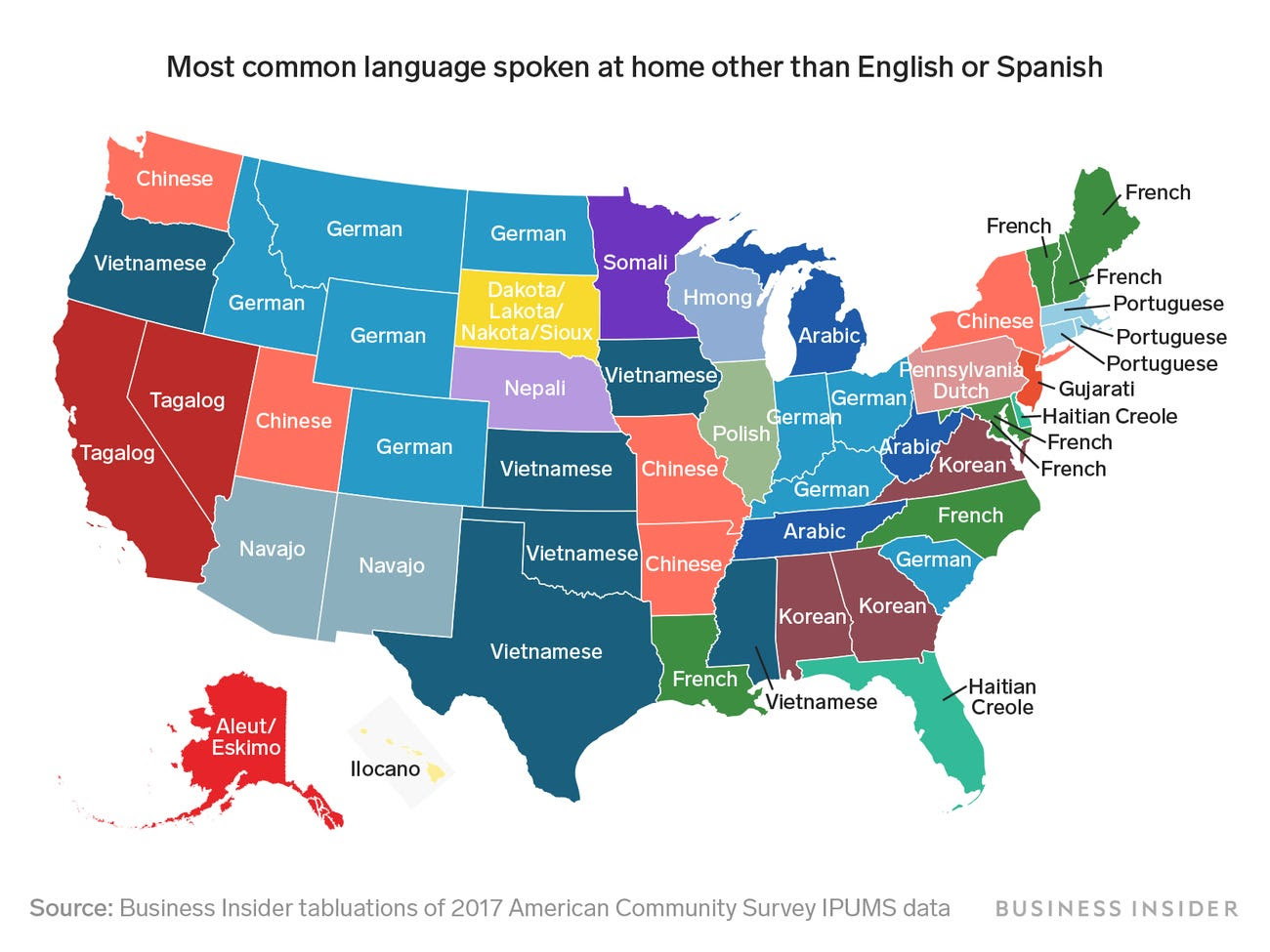
Do you even know US history? Immigrants migrated west with the great expansion.
Explain how German is the most spoken language (outside of English and Spanish) in the upper west?
Anonymous
09/04/2023 18:12
Subject: Re:Why so many human development indices favor Scandinavian countries?
Anonymous wrote:Anonymous wrote:I really don't think this is a difficult analysis. A strong social safety net including universal healthcare and a guaranteed pension, plus strong worker's rights including guaranteed sick leave, vacation leave, parental leave, etc. And generally high government standards against corruption couple with a belief that government is in existence to work for the people.
Homogeneity definitely helps, but the issue with immigrants isn't just that they look different. It's that many of them don't want to assimilate and embrace the culture of their adopted country.
Study after study shows that the rate of assimilation is the same for the European immigrants of the late 1800s-early 1900s as it is for modern immigrants. Here's a good one that looks at what immigrants name their own babies. Shocker, the trends today are very similar to the trends back then. https://www.ncbi.nlm.nih.gov/pmc/articles/PMC7508458/
In the US, not abroad.
But I wonder if newcomers are assimilating at the same rates as they did in the past. Here’s why: we now have rather large swaths of areas/regions where a Spanish speaker doesn’t need to learn English to get by.