Anonymous
 02/06/2023 16:52
Subject: Equality vs Equity
02/06/2023 16:52
Subject: Equality vs Equity
Anonymous wrote:Anonymous wrote:Equality means everyone has the same opportunity but outcomes are different.
Equity means outcomes are the same. It will never be, and it sets everyone up for failure .
You are wrong. It is not about the outcome, it is about the opportunity. Equity means you give people the same opportunity even if it means giving people different things. It is up to them to turn that into an outcome.
It's absolutely about the outcome, with the false premise that it's even possible for everyone to achieve the same thing.

Anonymous
02/06/2023 16:50
Subject: Re:Equality vs Equity
Equity is a falsehood fantasy because it is impossible to achieve. Equality is a worthwhile goal, one that we as a nation have been working towards for 250 years and, hopefully, will one day see.
Anonymous
02/06/2023 16:49
Subject: Re:Equality vs Equity
Anonymous wrote:Equity should mean giving everyone the support they need. The problem that cartoon shows is that it actually gives some absolutely nothing. They aren’t allowed equal opportunity to advance beyond where they are.
I actually agree with this, and I wouldn't have said that a few years ago. I understand the argument for equity in terms of giving support/assistance to those most in need in order to "level the playing field."
The problem is that the way this works in practice is that people get divided into two groups: privileged and underprivileged. The privileged group is not supposed to get any extra help and may even be asked to give up certain things to help the other group. And the underprivileged group gets support and help in order to make up for their lack of privilege.
But where does the line get drawn? It gets really messy and can result in more inequity, not less. Sometimes privileged people game the system to get themselves on the "underprivileged" side of the line. And sometimes people with one privilege are deemed privileged even if they are underprivileged in other ways. I think this often happens with poor white people, because people instinctively think that race privilege can trump economic privilege and... it's not true.
You can also see this debate over the line in action at times, as right now with white women. For a long time, all women were on the "underprivileged" side of the line. But people are starting to recognize that some women aren't really underprivileged at all. Like if you are white, and especially if you are rich, and for sure if you are very well connected, it's really hard to argue that you are underprivileged.
Oh, and before people come at me -- I'm an UMC white woman. So this isn't about me being resentful of women or black people or whatever. I've just increasingly noticed that whether you get labeled privileged or not doesn't always line up with who I know to be most in need of accommodations and support. Often it's just a political determination that is divorced from need. I've become pretty cynical about it.
Anonymous
02/06/2023 16:45
Subject: Equality vs Equity
Anonymous wrote:Anonymous wrote:Equality means everyone has the same opportunity but outcomes are different.
Equity means outcomes are the same. It will never be, and it sets everyone up for failure .
You are wrong. It is not about the outcome, it is about the opportunity. Equity means you give people the same opportunity even if it means giving people different things. It is up to them to turn that into an outcome.
Can’t you be bothered to research your opinion before parading it as fact? You are flat out weong and that is why people are frustrated. It’s not because they are white supremacist it’s because the concept is flawed.
“Equality means each individual or group of people is given the same resources or opportunities. Equity recognizes that each person has different circumstances and allocates the exact resources and opportunities needed to reach an equal outcome.”
https://onlinepublichealth.gwu.edu/resources/equity-vs-equality/
That is clear and written in plain english. Equity means identical outcomes not a level playing field.
Anonymous
02/06/2023 16:20
Subject: Equality vs Equity
Anonymous wrote:Equality means everyone has the same opportunity but outcomes are different.
Equity means outcomes are the same. It will never be, and it sets everyone up for failure .
You are wrong. It is not about the outcome, it is about the opportunity. Equity means you give people the same opportunity even if it means giving people different things. It is up to them to turn that into an outcome.
Anonymous
02/06/2023 14:52
Subject: Re:Equality vs Equity
Anonymous wrote:
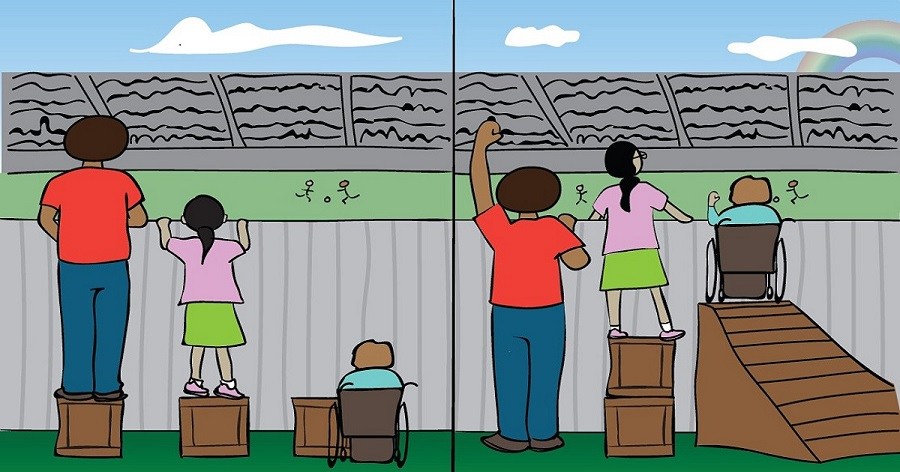
Perfect image.
Yes, this is neither equality nor equity. This is ENTITLEMENT. The three people can pay for the game like everyone else and watch the game sitting in a proper seat in the stadium. Instead they are indulging in dishonest practices and watching from outside the fence without paying. They could watch it for free on a TV, but they feel entitled to breaking rules/laws.
( In 1...2...3, someone will talk about how having married law-abiding parents is a massive privilege. Oh, so sorry. How do we prevent men from sticking their dicks in random women? )
Anonymous
02/06/2023 14:52
Subject: Equality vs Equity
Anonymous wrote:This thread proves exactly how Youngkin was able to win. Scare a bunch of gullible women with fake scenarios and you'll have em beleiveing anything.
Exactly.
Anonymous
02/06/2023 14:38
Subject: Re:Equality vs Equity
Anonymous wrote:Anonymous wrote:Anonymous wrote:Anonymous wrote:Equity should mean giving everyone the support they need. The problem that cartoon shows is that it actually gives some absolutely nothing. They aren’t allowed equal opportunity to advance beyond where they are.
Because the support given is relative to the goal. It's okay if not everybody "gets something" if they don't need it to try to achieve the goal. If the goal is to see over the fence to watch the baseball game, of course the tall kid on the left doesn't get anything to assist him, because he doesn't need it. He already has everything he needs with his two long legs. When you go to the movies, some people sit in a chair and listen with their ears, some people sit in a chair and listen to audio description because they are visually impaired, and some people sit in their wheelchair in a designated space to watch the movie.
Let's use an educational example. When students attend college, some students need assistance to be successful their first year. Universities offer tutoring, counseling, and career counseling to help students when they need academic and social support. When I taught years ago, there was also a specific program designated to support migrant students who had not had consistent schooling. It provided academic and social support from people who were familiar with the needs of that specific population. That has since been merged with a multicultural assistance program. There are also programs that provide supports to veterans and students with disabilities. There are supports for everyone, and supports for some that need them. It takes nothing from one group to offer assistance to the other.
Except that this cartoon always, always is used in the wrong circumstances.
Should children behind in reading (or math or handwriting, etc.) have extra help? Yes, absolutely. But should children already performing ahead of expectations be left to their own devices? No. They also need help to continue on their path, to the best of their abilities.
And that’s why I dislike this cartoon.
Even worse, by removing the box for the tall person, the cartoon is actually about taking away opportunities for kids performing ahead of expectations. Basically schools must cancel all AP classes and only focus on remedial assistance.
NP. Yes this is exactly what happens. These are kids! They shouldn't be punished for being on grade level or above grade level. They basically just get stuck on their laptops while the teacher works with below level kids.
Yep. Our middle school no longer has honors level courses. My DD has literally a 100% in every class, is bored to tears and hates going to school. She asks every day not to go because it’s so boring. It’s heartbreaking.
Anonymous
02/06/2023 14:07
Subject: Equality vs Equity
This thread proves exactly how Youngkin was able to win. Scare a bunch of gullible women with fake scenarios and you'll have em beleiveing anything.
Anonymous
02/06/2023 11:09
Subject: Re:Equality vs Equity
Anonymous wrote:Anonymous wrote:Anonymous wrote:Equity should mean giving everyone the support they need. The problem that cartoon shows is that it actually gives some absolutely nothing. They aren’t allowed equal opportunity to advance beyond where they are.
Because the support given is relative to the goal. It's okay if not everybody "gets something" if they don't need it to try to achieve the goal. If the goal is to see over the fence to watch the baseball game, of course the tall kid on the left doesn't get anything to assist him, because he doesn't need it. He already has everything he needs with his two long legs. When you go to the movies, some people sit in a chair and listen with their ears, some people sit in a chair and listen to audio description because they are visually impaired, and some people sit in their wheelchair in a designated space to watch the movie.
Let's use an educational example. When students attend college, some students need assistance to be successful their first year. Universities offer tutoring, counseling, and career counseling to help students when they need academic and social support. When I taught years ago, there was also a specific program designated to support migrant students who had not had consistent schooling. It provided academic and social support from people who were familiar with the needs of that specific population. That has since been merged with a multicultural assistance program. There are also programs that provide supports to veterans and students with disabilities. There are supports for everyone, and supports for some that need them. It takes nothing from one group to offer assistance to the other.
Except that this cartoon always, always is used in the wrong circumstances.
Should children behind in reading (or math or handwriting, etc.) have extra help? Yes, absolutely. But should children already performing ahead of expectations be left to their own devices? No. They also need help to continue on their path, to the best of their abilities.
And that’s why I dislike this cartoon.
Even worse, by removing the box for the tall person, the cartoon is actually about taking away opportunities for kids performing ahead of expectations. Basically schools must cancel all AP classes and only focus on remedial assistance.
NP. Yes this is exactly what happens. These are kids! They shouldn't be punished for being on grade level or above grade level. They basically just get stuck on their laptops while the teacher works with below level kids.
Anonymous
02/06/2023 11:02
Subject: Re:Equality vs Equity
Anonymous wrote:Anonymous wrote:Anonymous wrote:Equity should mean giving everyone the support they need. The problem that cartoon shows is that it actually gives some absolutely nothing. They aren’t allowed equal opportunity to advance beyond where they are.
Because the support given is relative to the goal. It's okay if not everybody "gets something" if they don't need it to try to achieve the goal. If the goal is to see over the fence to watch the baseball game, of course the tall kid on the left doesn't get anything to assist him, because he doesn't need it. He already has everything he needs with his two long legs. When you go to the movies, some people sit in a chair and listen with their ears, some people sit in a chair and listen to audio description because they are visually impaired, and some people sit in their wheelchair in a designated space to watch the movie.
Let's use an educational example. When students attend college, some students need assistance to be successful their first year. Universities offer tutoring, counseling, and career counseling to help students when they need academic and social support. When I taught years ago, there was also a specific program designated to support migrant students who had not had consistent schooling. It provided academic and social support from people who were familiar with the needs of that specific population. That has since been merged with a multicultural assistance program. There are also programs that provide supports to veterans and students with disabilities. There are supports for everyone, and supports for some that need them. It takes nothing from one group to offer assistance to the other.
Except that this cartoon always, always is used in the wrong circumstances.
Should children behind in reading (or math or handwriting, etc.) have extra help? Yes, absolutely. But should children already performing ahead of expectations be left to their own devices? No. They also need help to continue on their path, to the best of their abilities.
And that’s why I dislike this cartoon.
Our society is likely screwed. Victimhood is prevailing.
Even worse, by removing the box for the tall person, the cartoon is actually about taking away opportunities for kids performing ahead of expectations. Basically schools must cancel all AP classes and only focus on remedial assistance.
Anonymous
02/06/2023 10:36
Subject: Re:Equality vs Equity
Anonymous wrote:Anonymous wrote:Equity should mean giving everyone the support they need. The problem that cartoon shows is that it actually gives some absolutely nothing. They aren’t allowed equal opportunity to advance beyond where they are.
Because the support given is relative to the goal. It's okay if not everybody "gets something" if they don't need it to try to achieve the goal. If the goal is to see over the fence to watch the baseball game, of course the tall kid on the left doesn't get anything to assist him, because he doesn't need it. He already has everything he needs with his two long legs. When you go to the movies, some people sit in a chair and listen with their ears, some people sit in a chair and listen to audio description because they are visually impaired, and some people sit in their wheelchair in a designated space to watch the movie.
Let's use an educational example. When students attend college, some students need assistance to be successful their first year. Universities offer tutoring, counseling, and career counseling to help students when they need academic and social support. When I taught years ago, there was also a specific program designated to support migrant students who had not had consistent schooling. It provided academic and social support from people who were familiar with the needs of that specific population. That has since been merged with a multicultural assistance program. There are also programs that provide supports to veterans and students with disabilities. There are supports for everyone, and supports for some that need them. It takes nothing from one group to offer assistance to the other.
Except that this cartoon always, always is used in the wrong circumstances.
Should children behind in reading (or math or handwriting, etc.) have extra help? Yes, absolutely. But should children already performing ahead of expectations be left to their own devices? No. They also need help to continue on their path, to the best of their abilities.
And that’s why I dislike this cartoon.
Even worse, by removing the box for the tall person, the cartoon is actually about taking away opportunities for kids performing ahead of expectations. Basically schools must cancel all AP classes and only focus on remedial assistance.
Anonymous
02/06/2023 10:12
Subject: Equality vs Equity
My issue with equity and equality is that we should be supporting each kid to the best of their ability. So both of those cartoons are incorrect.
If one kid will never get beyond a 3rd grade reading level, that's fine. They should be supported to get there so that they can be a self supporting member of society. There should be vocational training available. If another kid is the next Stephen Hawking, there should be special classes, magnet schools or even permission to take community colleges courses. That's where society is getting this wrong. High performing kids should be supported as well as low performing kids.
If one kid will never get beyond a 3rd grade reading level, that's fine. They should be supported to get there so that they can be a self supporting member of society. There should be vocational training available. If another kid is the next Stephen Hawking, there should be special classes, magnet schools or even permission to take community colleges courses. That's where society is getting this wrong. High performing kids should be supported as well as low performing kids.
Anonymous
02/06/2023 09:41
Subject: Equality vs Equity
Anonymous wrote:Anonymous wrote:Anonymous wrote:Anonymous wrote:Anonymous wrote:Equality means everyone has the same opportunity but outcomes are different.
Equity means outcomes are the same. It will never be, and it sets everyone up for failure .
No. It doesn’t mean that every individual has equal outcomes. It means achieving more aggregate equal outcomes, I.e. women get paid the same as men, blacks have equal levels of home ownership, there is less income inequality across races, etc.
People who say it means equal outcomes for everyone have a narrow understanding of the concept. But they are tend to be the type of people who are frequently wrong but rarely in doubt.
Except the outcomes that you are citing are based almost entirely on people's choices. The differential in wages between men and women is almost entirely based on choice of profession, time taken out from the workforce to raise children, willingness to risk physical injury or death on the job, etc. Individual women working the same job as a man, with these factors the same make nearly the same. So your outcome means that as a society, we have to artificially boost the wages of certain professions, mandate state-funded childcare, etc. I don't think these policies (which have other negative consequences) are worth the "equity" that you desire.
Our society will address many inequalities with better K-12 education and more aggressive child welfare policies, not by artificially boosting people's income after they are miseducated.
How do you explain women and men in the same job making different wages?
Not that poster, but men's and women's salaries are relatively equal until women reach the age of carrying the family caregiving burden. Usually they take more time off, or have fewer personal hours to devote to work, because of kids. But many are also taking care of sick parents, etc. Until the cultural caregiving practices change, women will make less than men in aggregate.
I hope they don't change! This is the kind of policy that I was citing above that would have negative repercussions for our society. Supports? Yes. An expectation that kids and old people are better off in institutions, or that men do half the care-giving, no.
Anonymous
02/06/2023 09:36
Subject: Equality vs Equity
Anonymous wrote:Virtually no one argues for equal outcomes— just a bogeyman.
That's literally what the cartoon in this thread is promoting.