Anonymous
 05/24/2022 22:55
Subject: NIH Long Covid study
05/24/2022 22:55
Subject: NIH Long Covid study
Anonymous wrote:How do you explain my cardiac issues that are very clearly seen via MRI and echocardiogram? And no, they weren’t there previously. I am in my 30s, incredibly fit, was running 35-40 miles per week before I got sick (this was pre-vaccine; first wave). Literally couldn’t breathe even though my lung capacity is usually off the charts. I needed inhalers for the first time in my life and even those didn’t work super well. Ekg and blood work showed many abnormalities. I was declared disabled for 1.5 years because I had medical evidence of my persistent illness. These are all very objective measures. Nothing psychosomatic about it.
Pneumonia can do that to you. You may have had covid and had bacterial pneumonia as well. Had pneumonia and had effects for about 2 yrs afterward. It’s sucked, but it did pass.

Anonymous
05/24/2022 22:51
Subject: NIH Long Covid study
Anonymous wrote:CDC also released report on long covid today
https://www.cdc.gov/mmwr/volumes/71/wr/mm7121e1.htm
That's another high-quality study. Though, it has a rather significant limitation, briefly discussed near the end of the paper:
"Finally, the study only assessed conditions thought to be attributable to COVID-19 or post-COVID illness, which might have biased RRs away from the null. For example, clinicians might have been more likely to document possible post-COVID conditions among case-patients. In addition, because several conditions examined are also risk factors for moderate to severe COVID-19, it is possible that case-patients were more likely to have had an existing condition that was not documented in their EHR during the year preceding their COVID-19 diagnosis, resulting in overestimated risk for this group."
That is, the study targeted conditions that doctors would be more likely to look for in post-COVID patients. And while the paper didn't quite come out and say it, the same thing could be said for the patients themselves. Given the media coverage of long COVID, post-COVID patients may be more inclined to notice and seek care for both conditions. Both of these would lead to an overestimated risk associated with COVID infections.
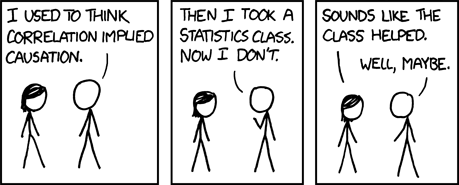
The second half of the above quote is equally important. It's acknowledging that many of the conditions they were looking for as possible "long COVID" complications also happen to be substantial risk factors for severe illness from COVID infections. So, were those previously-unknown preexisting conditions that may have contributed to a more severe COVID illness? Or did a COVID infection actually lead to those conditions? They can't really tell from the data they had.
Or, letting XKCD illustrate the concept:
Anonymous
05/24/2022 22:43
Subject: Re:NIH Long Covid study
I would be really curious to know the baseline level of self reported anxiety both before and during infection in the people with long Covid. The definition of traumatic stress is being in a situation where are you truly believe your life is in danger. If someone who is terrified of Covid catches it and truly believes that they might end up on a ventilator or die, that is a form of traumatic stress. It may be that some people who have long Covid symptoms like brain fog, fatigue, anxiety, and/or heart palpitations are actually suffering from a form of post traumatic stress disorder. This doesn’t mean long Covid isn’t real it just means that that effective treatments may be those used for psychiatric conditions not physical ones.
Anonymous
05/24/2022 22:32
Subject: Re:NIH Long Covid study
Anonymous wrote:Anonymous wrote:Anonymous wrote:Anonymous wrote:Anonymous wrote:Isn't the takeaway this, which most people here don't seem to be understanding: the physical ailments that would generally be responsible for causing the reported symptoms of "long Covid" are not present in higher rates in the Covid test group than in the control group. Meaning, there is, according to this study, no evidence of Covid causing long-term health problems. There is some evidence that those symptoms may be caused by underlying anxiety. So many posters seem to be interpreting this as "long term Covid exists and we still don't know why."
No, that is not the correct interpretation (scientist here). The correct interpretation is not that there are no health problems. In fact, there are numerous studies that connect COVID with increased risk for vascular problems, diabetes, even impotence. That said, long covid is not about increased risk but about symptoms.
The correct interpretation is that “none of the tests performed in this study were significantly different between the two groups.”
There are numerous illnesses we accept as real and that there are no physiological tests for, just reports of symptoms or fuzzy cognitive tests that are impossible to standardize. Examples include schizophrenia, Alzheimer’s, ADHD, and chronic back or knee pain. We assume many many people are sick with colds even without finding their specific virus or physiological signals. So the conclusion of this study doesn’t say much. It definitely does not say long covid is just a bunch of lazy fakers, and it definitely doesn’t say it isn’t, either. Science is slow, and is abused if you jump to conclusions.
Like jumping to the conclusion that covid will cause rampant long term damage to the health of the majority of people who get it? Is that the type of conclusion you’re worried about people jumping to?
That would not be a warranted conclusion of this study, but your histrionics are unwarranted. This is one study. It was a high quality study. It ran some good tests. We can draw the conclusions I stated above from it. We cannot address your agenda particular at this stage.
It takes us hundreds of studies to figure out that smoking is bad for you and hundreds of studies to see that oat bran is not a heart panacea. We are learning. We will keep learning, if we continue to be methodical, rigorous and open minded. If you want to be sure of something one way or the other in terms of the far future of this pandemic, sadly science has little to offer you at this stage. This study did not identify physiological signatures of long covid. That is all.
There were long term effects of the 1918 influenza pandemic (for example, increased risk of Parkinson’s by sufferers). There has also a lot of speculation of some sort of post viral syndrome for that pandemic too for which there is reasonably strong circumstantial evidence for this (there is a good discussion of this along with some more speculative ideas in “The Great Influenza,” if you are looking for a popular treatment), but few scientists would say we are able to have conclusive evidence of this being true or not.
This is all reasonable, but the problem is that this reasonable approach is not reflected in the way long Covid is covered in the media, nor in the way many individuals draw conclusions about what we as a society should be doing regarding Covid mitigation. If everyone talked about long Covid like this, I don't think you'd get a lot of pushback. Unfortunately, most people who are discussing long Covid these days talk about it as though it is killing as many or more people than Covid itself. They cherry pick anecdotes of people who are suffering with genuinely debilitating issues (often omitting important aspects of that person's medical history) in order to argue in favor of whatever Covid policy they want that day. It's disingenuous and genuinely damaging.
+100. I am a psychiatrist and I can't tell you how many of my anxious patients' lives have been seriously adversely affected by fear of long covid due to sensationalism in the media. It's really irresponsible and manipulative.
Anonymous
05/24/2022 21:19
Subject: NIH Long Covid study
Anonymous
05/24/2022 16:57
Subject: Re:NIH Long Covid study
Anonymous wrote:Anonymous wrote:Anonymous wrote:Anonymous wrote:Anonymous wrote:Anonymous wrote:Isn't the takeaway this, which most people here don't seem to be understanding: the physical ailments that would generally be responsible for causing the reported symptoms of "long Covid" are not present in higher rates in the Covid test group than in the control group. Meaning, there is, according to this study, no evidence of Covid causing long-term health problems. There is some evidence that those symptoms may be caused by underlying anxiety. So many posters seem to be interpreting this as "long term Covid exists and we still don't know why."
No, that is not the correct interpretation (scientist here). The correct interpretation is not that there are no health problems. In fact, there are numerous studies that connect COVID with increased risk for vascular problems, diabetes, even impotence. That said, long covid is not about increased risk but about symptoms.
The correct interpretation is that “none of the tests performed in this study were significantly different between the two groups.”
There are numerous illnesses we accept as real and that there are no physiological tests for, just reports of symptoms or fuzzy cognitive tests that are impossible to standardize. Examples include schizophrenia, Alzheimer’s, ADHD, and chronic back or knee pain. We assume many many people are sick with colds even without finding their specific virus or physiological signals. So the conclusion of this study doesn’t say much. It definitely does not say long covid is just a bunch of lazy fakers, and it definitely doesn’t say it isn’t, either. Science is slow, and is abused if you jump to conclusions.
Like jumping to the conclusion that covid will cause rampant long term damage to the health of the majority of people who get it? Is that the type of conclusion you’re worried about people jumping to?
That would not be a warranted conclusion of this study, but your histrionics are unwarranted. This is one study. It was a high quality study. It ran some good tests. We can draw the conclusions I stated above from it. We cannot address your agenda particular at this stage.
It takes us hundreds of studies to figure out that smoking is bad for you and hundreds of studies to see that oat bran is not a heart panacea. We are learning. We will keep learning, if we continue to be methodical, rigorous and open minded. If you want to be sure of something one way or the other in terms of the far future of this pandemic, sadly science has little to offer you at this stage. This study did not identify physiological signatures of long covid. That is all.
There were long term effects of the 1918 influenza pandemic (for example, increased risk of Parkinson’s by sufferers). There has also a lot of speculation of some sort of post viral syndrome for that pandemic too for which there is reasonably strong circumstantial evidence for this (there is a good discussion of this along with some more speculative ideas in “The Great Influenza,” if you are looking for a popular treatment), but few scientists would say we are able to have conclusive evidence of this being true or not.
This is all reasonable, but the problem is that this reasonable approach is not reflected in the way long Covid is covered in the media, nor in the way many individuals draw conclusions about what we as a society should be doing regarding Covid mitigation. If everyone talked about long Covid like this, I don't think you'd get a lot of pushback. Unfortunately, most people who are discussing long Covid these days talk about it as though it is killing as many or more people than Covid itself. They cherry pick anecdotes of people who are suffering with genuinely debilitating issues (often omitting important aspects of pthat person's medical history) in order to argue in favor of whatever Covid policy they want that day. It's disingenuous and genuinely damaging.
I’m sure there are examples of extremes being portrayed as more common than they are really in the media. (This is very common; plane crashes scaring people more than they should is a classic example.). That said, is the correct response to this sensationalism to overhype studies to the contrary, perpetuating the same cycle.
Studying the phenomenon of long covid and trying to identify what we can is really important. It is also completely good to state that this study did not identify clear physiological signatures. It is a good study and decreases the evidence that there is an obvious physical signature available to us that we have missed. But again, this study can’t shed light on whether the symptoms are real or not. There were more symptoms in the covid group than in the control group. It is possible these some of these are psychosomatic, but one simply cannot draw that conclusion from a lack of measurable physiological stat. If that logic followed, as I said, above, we’d dismiss and stop studying Alzheimer’s and schizophrenia too. I hope you don’t have those opinions.
I think it would be great for a good study to try to elucidate more broadly the spectrum of symptoms and try to identify the severity of truly severe symptoms, and then perhaps try to specifically first address people with those concerns over the much broader population of people who report milder symptoms. One might also try to measure the frequency of “Severe” symptoms in the population to help us as a society understand this. But that will take time and be hard work. And this point is just my personal and relatively uninformed opinion on what study sounds worthy to conduct, it doesn’t tell you anything about what one would find (or not) in such a study.
Certainly not. But how much we pay attention to a particular study should be driven by the quality of the study. If you've read some of the studies referenced in media reports, a lot of them are strikingly bad. Worse, you see some of those studies referenced in other scientific papers. While they're often accompanied by standard language acknowledging the weaknesses of the study, the quotes from the authors that do media interviews strongly suggest those people are not making a strong effort to clearly explain those weaknesses to journalists. There's a small, but very local, group of researchers that seem to have a very strong personal interest in playing to the fears that people have with covid.
Anonymous
05/24/2022 16:52
Subject: Re:NIH Long Covid study
Anonymous wrote:Anonymous wrote:Anonymous wrote:Isn't the takeaway this, which most people here don't seem to be understanding: the physical ailments that would generally be responsible for causing the reported symptoms of "long Covid" are not present in higher rates in the Covid test group than in the control group. Meaning, there is, according to this study, no evidence of Covid causing long-term health problems. There is some evidence that those symptoms may be caused by underlying anxiety. So many posters seem to be interpreting this as "long term Covid exists and we still don't know why."
Yes, that is the conclusion (the "scientist's" objection notwithstanding), and it is congruent with all other Long Covid studies that had a proper control group. The problem isn't that we don't have the proper tests to pinpoint the physiological cause. The problem is that there is no statistical difference in the prevalence of these symptoms between the test group and the control group, and therefore no evidence that the virus caused the symptoms.
Some experts disagree that the testing was adequate:
https://www.npr.org/2022/05/23/1100878802/a-new-federal-study-is-trying-to-solve-some-of-the-mysterious-about-long-covid
In any event, this study did not find that the control group not previously infected with COVID had the same symptoms as the long COVID group (although I understand that other studies have).
We all hope that long COVID is rare, especially in vaccinated people. Many people have understandable anger about what was lost due to COVID precautions. However, claiming that long COVID is a mental illness is unjustifiably cruel and blind to the fact that, whatever the cause, many people are suffering with an array of symptoms following a COVID infection. The fact that the medical community can't explain it does not mean that these problems don't exist or that they weren't caused by COVID.
Saying that Long Covid is a psychogenic, functional illness isn't the same as saying that someone is crazy, and shouldn't be stigmatized (and neither should true mental illness). It's also not cruel, if that is where the treatment that will ultimately help the sufferers should be targeted.
I just dug up this article on Havana syndrome that this whole discussion reminded me of:
https://www.nytimes.com/interactive/2019/05/15/magazine/diplomat-disorder.html
Maybe something similar is going on with Long Covid, and maybe considering that will help the sufferers more than an endless barrage of diagnostic tests in search of a definitive physiological cause.
Anonymous
05/24/2022 16:43
Subject: Re:NIH Long Covid study
Anonymous wrote:Anonymous wrote:Anonymous wrote:Anonymous wrote:Isn't the takeaway this, which most people here don't seem to be understanding: the physical ailments that would generally be responsible for causing the reported symptoms of "long Covid" are not present in higher rates in the Covid test group than in the control group. Meaning, there is, according to this study, no evidence of Covid causing long-term health problems. There is some evidence that those symptoms may be caused by underlying anxiety. So many posters seem to be interpreting this as "long term Covid exists and we still don't know why."
No, that is not the correct interpretation (scientist here). The correct interpretation is not that there are no health problems. In fact, there are numerous studies that connect COVID with increased risk for vascular problems, diabetes, even impotence. That said, long covid is not about increased risk but about symptoms.
The correct interpretation is that “none of the tests performed in this study were significantly different between the two groups.”
There are numerous illnesses we accept as real and that there are no physiological tests for, just reports of symptoms or fuzzy cognitive tests that are impossible to standardize. Examples include schizophrenia, Alzheimer’s, ADHD, and chronic back or knee pain. We assume many many people are sick with colds even without finding their specific virus or physiological signals. So the conclusion of this study doesn’t say much. It definitely does not say long covid is just a bunch of lazy fakers, and it definitely doesn’t say it isn’t, either. Science is slow, and is abused if you jump to conclusions.
Like jumping to the conclusion that covid will cause rampant long term damage to the health of the majority of people who get it? Is that the type of conclusion you’re worried about people jumping to?
That would not be a warranted conclusion of this study, but your histrionics are unwarranted. This is one study. It was a high quality study. It ran some good tests. We can draw the conclusions I stated above from it. We cannot address your agenda particular at this stage.
It takes us hundreds of studies to figure out that smoking is bad for you and hundreds of studies to see that oat bran is not a heart panacea. We are learning. We will keep learning, if we continue to be methodical, rigorous and open minded. If you want to be sure of something one way or the other in terms of the far future of this pandemic, sadly science has little to offer you at this stage. This study did not identify physiological signatures of long covid. That is all.
There were long term effects of the 1918 influenza pandemic (for example, increased risk of Parkinson’s by sufferers). There has also a lot of speculation of some sort of post viral syndrome for that pandemic too for which there is reasonably strong circumstantial evidence for this (there is a good discussion of this along with some more speculative ideas in “The Great Influenza,” if you are looking for a popular treatment), but few scientists would say we are able to have conclusive evidence of this being true or not.
DP. I get what you’re saying, but I think the main source of histrionics comes from much of the reporting around “long Covid,” as well as many of the low quality studies that were effectively clickbait.
There's a pretty common pattern in long Covid studies. The studies that survey people that self-identify as having Covid end up finding a lot of reports of subjectively-assessed, common symptoms (e.g., fatigue, headaches, malaise). The studies that include control groups find a much narrower differences between people that did and did not have Covid than the naive studies would have you believe.
This is obviously something that is worthy of further study, but the media and scientific community should be paying much greater attention to high equality studies like the one referenced in this thread rather than the low quality studies that have gotten so much attention up to this point.
Anonymous
05/24/2022 16:42
Subject: NIH Long Covid study
Anonymous wrote:Anonymous wrote:Anonymous wrote:Anonymous wrote:Anonymous wrote:Anonymous wrote:yup its the new fibromialga
FM is a real diagnosis.
It’s a diagnosis of exclusion.
But a diagnosis.
Fibromyalgia ICD 10 Code
The ICD 10 code for fibromyalgia is M79.7. It is a billable diagnostic code used to code a medical diagnosis of fibromyalgia.
Code M79.7 is valid for the 2022 fiscal year from 01 October 2021 to 30 September 2022 to deliver HIPAA transactions coverage.
This code can be found in chapter XIII of the ICD 10 book Diseases of the musculoskeletal system and connective tissue (M00-M99) under the block M60-M79, which codes for Soft tissue disorders and the category M70-M79, which codes for Other soft tissue disorders.
It may have a code, but it is a diagnosis they use when they can’t find any other reason for your pain. It may have a code, it may be billable, but it’s not a medically verifiable disease.
Do some research. You are wrong.
I don’t need to do any research. I already know there is no test for fibromyalgia. There are only tests to rule out other conditions.
Anonymous
05/24/2022 16:41
Subject: Re:NIH Long Covid study
Anonymous wrote:Anonymous wrote:Anonymous wrote:Isn't the takeaway this, which most people here don't seem to be understanding: the physical ailments that would generally be responsible for causing the reported symptoms of "long Covid" are not present in higher rates in the Covid test group than in the control group. Meaning, there is, according to this study, no evidence of Covid causing long-term health problems. There is some evidence that those symptoms may be caused by underlying anxiety. So many posters seem to be interpreting this as "long term Covid exists and we still don't know why."
Yes, that is the conclusion (the "scientist's" objection notwithstanding), and it is congruent with all other Long Covid studies that had a proper control group. The problem isn't that we don't have the proper tests to pinpoint the physiological cause. The problem is that there is no statistical difference in the prevalence of these symptoms between the test group and the control group, and therefore no evidence that the virus caused the symptoms.
Some experts disagree that the testing was adequate:
https://www.npr.org/2022/05/23/1100878802/a-new-federal-study-is-trying-to-solve-some-of-the-mysterious-about-long-covid
In any event, this study did not find that the control group not previously infected with COVID had the same symptoms as the long COVID group (although I understand that other studies have).
We all hope that long COVID is rare, especially in vaccinated people. Many people have understandable anger about what was lost due to COVID precautions. However, claiming that long COVID is a mental illness is unjustifiably cruel and blind to the fact that, whatever the cause, many people are suffering with an array of symptoms following a COVID infection. The fact that the medical community can't explain it does not mean that these problems don't exist or that they weren't caused by COVID.
Note this important acknowledgment of (a likely significant) bias on this matter by the study authors:
"The prevalence of reported PASC was likely overestimated in [the Covid] cohort because persons with PASC may have been more motivated to enroll."
Anonymous
05/24/2022 16:38
Subject: NIH Long Covid study
Anonymous wrote:Anonymous wrote:Anonymous wrote:Anonymous wrote:Anonymous wrote:yup its the new fibromialga
FM is a real diagnosis.
It’s a diagnosis of exclusion.
But a diagnosis.
Fibromyalgia ICD 10 Code
The ICD 10 code for fibromyalgia is M79.7. It is a billable diagnostic code used to code a medical diagnosis of fibromyalgia.
Code M79.7 is valid for the 2022 fiscal year from 01 October 2021 to 30 September 2022 to deliver HIPAA transactions coverage.
This code can be found in chapter XIII of the ICD 10 book Diseases of the musculoskeletal system and connective tissue (M00-M99) under the block M60-M79, which codes for Soft tissue disorders and the category M70-M79, which codes for Other soft tissue disorders.
It may have a code, but it is a diagnosis they use when they can’t find any other reason for your pain. It may have a code, it may be billable, but it’s not a medically verifiable disease.
Do some research. You are wrong.
Anonymous
05/24/2022 16:37
Subject: Re:NIH Long Covid study
Anonymous wrote:Anonymous wrote:Anonymous wrote:Anonymous wrote:Anonymous wrote:Isn't the takeaway this, which most people here don't seem to be understanding: the physical ailments that would generally be responsible for causing the reported symptoms of "long Covid" are not present in higher rates in the Covid test group than in the control group. Meaning, there is, according to this study, no evidence of Covid causing long-term health problems. There is some evidence that those symptoms may be caused by underlying anxiety. So many posters seem to be interpreting this as "long term Covid exists and we still don't know why."
No, that is not the correct interpretation (scientist here). The correct interpretation is not that there are no health problems. In fact, there are numerous studies that connect COVID with increased risk for vascular problems, diabetes, even impotence. That said, long covid is not about increased risk but about symptoms.
The correct interpretation is that “none of the tests performed in this study were significantly different between the two groups.”
There are numerous illnesses we accept as real and that there are no physiological tests for, just reports of symptoms or fuzzy cognitive tests that are impossible to standardize. Examples include schizophrenia, Alzheimer’s, ADHD, and chronic back or knee pain. We assume many many people are sick with colds even without finding their specific virus or physiological signals. So the conclusion of this study doesn’t say much. It definitely does not say long covid is just a bunch of lazy fakers, and it definitely doesn’t say it isn’t, either. Science is slow, and is abused if you jump to conclusions.
Like jumping to the conclusion that covid will cause rampant long term damage to the health of the majority of people who get it? Is that the type of conclusion you’re worried about people jumping to?
That would not be a warranted conclusion of this study, but your histrionics are unwarranted. This is one study. It was a high quality study. It ran some good tests. We can draw the conclusions I stated above from it. We cannot address your agenda particular at this stage.
It takes us hundreds of studies to figure out that smoking is bad for you and hundreds of studies to see that oat bran is not a heart panacea. We are learning. We will keep learning, if we continue to be methodical, rigorous and open minded. If you want to be sure of something one way or the other in terms of the far future of this pandemic, sadly science has little to offer you at this stage. This study did not identify physiological signatures of long covid. That is all.
There were long term effects of the 1918 influenza pandemic (for example, increased risk of Parkinson’s by sufferers). There has also a lot of speculation of some sort of post viral syndrome for that pandemic too for which there is reasonably strong circumstantial evidence for this (there is a good discussion of this along with some more speculative ideas in “The Great Influenza,” if you are looking for a popular treatment), but few scientists would say we are able to have conclusive evidence of this being true or not.
This is all reasonable, but the problem is that this reasonable approach is not reflected in the way long Covid is covered in the media, nor in the way many individuals draw conclusions about what we as a society should be doing regarding Covid mitigation. If everyone talked about long Covid like this, I don't think you'd get a lot of pushback. Unfortunately, most people who are discussing long Covid these days talk about it as though it is killing as many or more people than Covid itself. They cherry pick anecdotes of people who are suffering with genuinely debilitating issues (often omitting important aspects of pthat person's medical history) in order to argue in favor of whatever Covid policy they want that day. It's disingenuous and genuinely damaging.
I’m sure there are examples of extremes being portrayed as more common than they are really in the media. (This is very common; plane crashes scaring people more than they should is a classic example.). That said, is the correct response to this sensationalism to overhype studies to the contrary, perpetuating the same cycle.
Studying the phenomenon of long covid and trying to identify what we can is really important. It is also completely good to state that this study did not identify clear physiological signatures. It is a good study and decreases the evidence that there is an obvious physical signature available to us that we have missed. But again, this study can’t shed light on whether the symptoms are real or not. There were more symptoms in the covid group than in the control group. It is possible these some of these are psychosomatic, but one simply cannot draw that conclusion from a lack of measurable physiological stat. If that logic followed, as I said, above, we’d dismiss and stop studying Alzheimer’s and schizophrenia too. I hope you don’t have those opinions.
I think it would be great for a good study to try to elucidate more broadly the spectrum of symptoms and try to identify the severity of truly severe symptoms, and then perhaps try to specifically first address people with those concerns over the much broader population of people who report milder symptoms. One might also try to measure the frequency of “Severe” symptoms in the population to help us as a society understand this. But that will take time and be hard work. And this point is just my personal and relatively uninformed opinion on what study sounds worthy to conduct, it doesn’t tell you anything about what one would find (or not) in such a study.
Anonymous
05/24/2022 16:36
Subject: NIH Long Covid study
Anonymous wrote:Anonymous wrote:Anonymous wrote:Anonymous wrote:yup its the new fibromialga
FM is a real diagnosis.
It’s a diagnosis of exclusion.
But a diagnosis.
Fibromyalgia ICD 10 Code
The ICD 10 code for fibromyalgia is M79.7. It is a billable diagnostic code used to code a medical diagnosis of fibromyalgia.
Code M79.7 is valid for the 2022 fiscal year from 01 October 2021 to 30 September 2022 to deliver HIPAA transactions coverage.
This code can be found in chapter XIII of the ICD 10 book Diseases of the musculoskeletal system and connective tissue (M00-M99) under the block M60-M79, which codes for Soft tissue disorders and the category M70-M79, which codes for Other soft tissue disorders.
It may have a code, but it is a diagnosis they use when they can’t find any other reason for your pain. It may have a code, it may be billable, but it’s not a medically verifiable disease.
Anonymous
05/24/2022 16:33
Subject: NIH Long Covid study
Anonymous wrote:Anonymous wrote:Anonymous wrote:yup its the new fibromialga
FM is a real diagnosis.
It’s a diagnosis of exclusion.
But a diagnosis.
Fibromyalgia ICD 10 Code
The ICD 10 code for fibromyalgia is M79.7. It is a billable diagnostic code used to code a medical diagnosis of fibromyalgia.
Code M79.7 is valid for the 2022 fiscal year from 01 October 2021 to 30 September 2022 to deliver HIPAA transactions coverage.
This code can be found in chapter XIII of the ICD 10 book Diseases of the musculoskeletal system and connective tissue (M00-M99) under the block M60-M79, which codes for Soft tissue disorders and the category M70-M79, which codes for Other soft tissue disorders.
Anonymous
05/24/2022 16:33
Subject: Re:NIH Long Covid study
Anonymous wrote:Anonymous wrote:Anonymous wrote:Anonymous wrote:Isn't the takeaway this, which most people here don't seem to be understanding: the physical ailments that would generally be responsible for causing the reported symptoms of "long Covid" are not present in higher rates in the Covid test group than in the control group. Meaning, there is, according to this study, no evidence of Covid causing long-term health problems. There is some evidence that those symptoms may be caused by underlying anxiety. So many posters seem to be interpreting this as "long term Covid exists and we still don't know why."
No, that is not the correct interpretation (scientist here). The correct interpretation is not that there are no health problems. In fact, there are numerous studies that connect COVID with increased risk for vascular problems, diabetes, even impotence. That said, long covid is not about increased risk but about symptoms.
The correct interpretation is that “none of the tests performed in this study were significantly different between the two groups.”
There are numerous illnesses we accept as real and that there are no physiological tests for, just reports of symptoms or fuzzy cognitive tests that are impossible to standardize. Examples include schizophrenia, Alzheimer’s, ADHD, and chronic back or knee pain. We assume many many people are sick with colds even without finding their specific virus or physiological signals. So the conclusion of this study doesn’t say much. It definitely does not say long covid is just a bunch of lazy fakers, and it definitely doesn’t say it isn’t, either. Science is slow, and is abused if you jump to conclusions.
Like jumping to the conclusion that covid will cause rampant long term damage to the health of the majority of people who get it? Is that the type of conclusion you’re worried about people jumping to?
That would not be a warranted conclusion of this study, but your histrionics are unwarranted. This is one study. It was a high quality study. It ran some good tests. We can draw the conclusions I stated above from it. We cannot address your agenda particular at this stage.
It takes us hundreds of studies to figure out that smoking is bad for you and hundreds of studies to see that oat bran is not a heart panacea. We are learning. We will keep learning, if we continue to be methodical, rigorous and open minded. If you want to be sure of something one way or the other in terms of the far future of this pandemic, sadly science has little to offer you at this stage. This study did not identify physiological signatures of long covid. That is all.
There were long term effects of the 1918 influenza pandemic (for example, increased risk of Parkinson’s by sufferers). There has also a lot of speculation of some sort of post viral syndrome for that pandemic too for which there is reasonably strong circumstantial evidence for this (there is a good discussion of this along with some more speculative ideas in “The Great Influenza,” if you are looking for a popular treatment), but few scientists would say we are able to have conclusive evidence of this being true or not.
DP. Nobody is doubting the reality of post-viral syndrome. The question is whether it occurs at higher frequency with SARS-CoV-2 than with a variety of other viruses, and what its absolute prevalence is, especially in people with mild disease.
This new study adds to the evidence that it cannot be shown that the symptoms people often attribute to prior Covid infection are linked to the virus, because they occur with similar frequency in the control group that did not have Covid.