Anonymous
 02/17/2021 22:05
Subject: Someone help me with Math
02/17/2021 22:05
Subject: Someone help me with Math
Anonymous wrote:This is the best and most useful post in this thread:
Anonymous wrote:You are doing the math wrong because you don't seem to understand how admissions works. They don't rank kids by ACT/SAT and pick off the top. They don't, and they never did. Kids with much lower stats than your kid will get into those 90,000 spots you mistakenly expect belong to the top test takers.
The most important thing to realize is that your child should be focused on what they want to study and which of the thousands of school out there have great undergraduate departments in that area.
The second most helpful is the one telling you to become very familiar with Naviance scattergrams to gage your chances and develop a proper "reach/match/safety" balance.
Now, this is the worst post in this thread, unhelpful, bitter and total BS to boot.
What you're missing is that university admissions are not based on a meritocacy {sic} in this country.
Diversity is everything here. Which means that someone who checks a box on a form that you child doesn't check will overtake someone like your child who has way better scores.
Let's please ignore this and stay on the OPs topic otherwise this devolves into the same old tired debate. Let's be helpful to the OP who seems sincere.
Didn’t say that admissions were ALL test. But at 3.9uw, and what would seem like at least average EC and recommendations the math would work out differently. Of course there would be some movement both ways where some higher stat kids would be more concerned with finances and then some legacies and recruits but it seems numbers wise the fit into top 50 would be more slam dunk. Especially considering cost is not an issue. But enough nasty comments for what was really a question. Done..

Anonymous
02/17/2021 15:42
Subject: Re:Someone help me with Math
Anonymous wrote:Let's use Dartmouth as a case study to help provide some insights to your question.
For the Class of 2024 there were 1,058 students admitted. Of those:
- Approximately 20% of the class or 210+ students were recruited athletes that comprise the vast majority of ED admits, it should be noted that at Ivy League schools the recruited athletes are of similar academic profile to the non-recruited athletes but can contribute both academically and athletically and the meaning of a recruited athlete is very different than an SEC or Big10 recruited athletes
- 10% were international students that not only pay full tuition but typically have a track record of donating more on a per capita basis than non-international students and often come from extreme high net worth families
- 10% were Legacy, while there could be some overlap between Legacy and Athletes or International, its probably a significant minority of Legacy admits that are recruited athletes and/or international
- 15% are first generation college students that probably worked really hard in high school but lacked the capabilities to test prep ad naseum from an early age to a 1,500+ score, etc.
- 27% are urm (black 11%, hispanic 12%, native 4%) so without getting into a debate about affirmative action, etc. this group is evaluated separately and statistically have a 200 to 300point SAT handicapped compared to the non-urm students, and interestingly there is not much overlap between recruited athletes and urm status at Ivy League schools
Assuming there is no overlap above the total is 82%, realistically its probably somewhere above 70%.
So if your student is not in any of the above categories, they are competing for the remaining 18% to ~30%...
There's definitely overlap between first-generation and URM - maybe half.
Anonymous
02/17/2021 14:00
Subject: Someone help me with Math
1057 not 1058 ENROLLED at Dartmouth for c/o 2024. Not admits.
Anonymous
02/17/2021 13:49
Subject: Re:Someone help me with Math
Anonymous wrote:Let's use Dartmouth as a case study to help provide some insights to your question.
For the Class of 2024 there were 1,058 students admitted. Of those:
- Approximately 20% of the class or 210+ students were recruited athletes that comprise the vast majority of ED admits, it should be noted that at Ivy League schools the recruited athletes are of similar academic profile to the non-recruited athletes but can contribute both academically and athletically and the meaning of a recruited athlete is very different than an SEC or Big10 recruited athletes
- 10% were international students that not only pay full tuition but typically have a track record of donating more on a per capita basis than non-international students and often come from extreme high net worth families
- 10% were Legacy, while there could be some overlap between Legacy and Athletes or International, its probably a significant minority of Legacy admits that are recruited athletes and/or international
- 15% are first generation college students that probably worked really hard in high school but lacked the capabilities to test prep ad naseum from an early age to a 1,500+ score, etc.
- 27% are urm (black 11%, hispanic 12%, native 4%) so without getting into a debate about affirmative action, etc. this group is evaluated separately and statistically have a 200 to 300point SAT handicapped compared to the non-urm students, and interestingly there is not much overlap between recruited athletes and urm status at Ivy League schools
Assuming there is no overlap above the total is 82%, realistically its probably somewhere above 70%.
So if your student is not in any of the above categories, they are competing for the remaining 18% to ~30%...
Actually 9-15% because they also seek to balance for gender.
Anonymous
02/17/2021 13:43
Subject: Re:Someone help me with Math
Anonymous wrote:Anonymous wrote:Anonymous wrote:Anonymous wrote:I hear you. I also don't get how some schools now are supposedly "so much harder to get into now than they were 30 years ago." Where do all these students come from to fill all of these seats? Where were they going before?
Population growth and more international applicants while number of seats remains relatively flat.
This isn't as impactful as you think, and in fact the number has gone down over the last decade:
https://educationdata.org/college-enrollment-statistics#:~:text=Among%20first%2Dtime%2C%20first%2D,institutions%20had%20open%2Dadmissions%20policies.
Although it has gone up substantially over the 30 years referenced.
Doesn't this validate my theory - number of applicants have been trending up?
Sigh... sorry maybe should have used bold text.
To be clear:
Over the last 30 years, yes.
Over the last 15, no.
Anonymous
02/17/2021 12:42
Subject: Re:Someone help me with Math
Anonymous wrote:Anonymous wrote:Anonymous wrote:I hear you. I also don't get how some schools now are supposedly "so much harder to get into now than they were 30 years ago." Where do all these students come from to fill all of these seats? Where were they going before?
Population growth and more international applicants while number of seats remains relatively flat.
This isn't as impactful as you think, and in fact the number has gone down over the last decade:
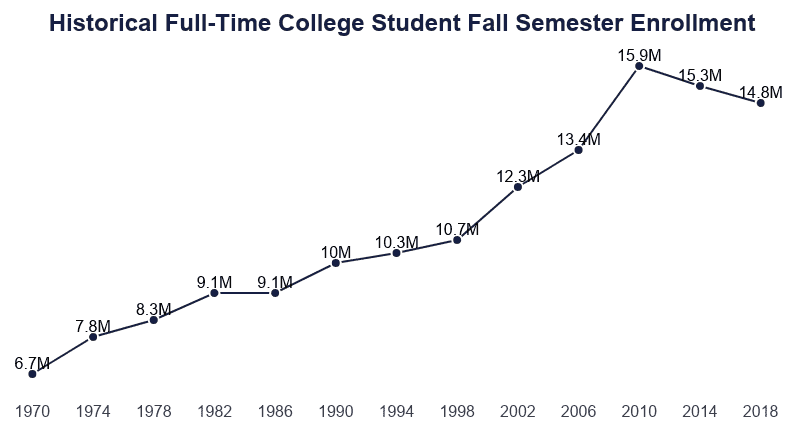
https://educationdata.org/college-enrollment-statistics#:~:text=Among%20first%2Dtime%2C%20first%2D,institutions%20had%20open%2Dadmissions%20policies.
Although it has gone up substantially over the 30 years referenced.
Doesn't this validate my theory - number of applicants have been trending up?
Anonymous
02/17/2021 12:25
Subject: Re:Someone help me with Math
Anonymous wrote:Anonymous wrote:I hear you. I also don't get how some schools now are supposedly "so much harder to get into now than they were 30 years ago." Where do all these students come from to fill all of these seats? Where were they going before?
Population growth and more international applicants while number of seats remains relatively flat.
This isn't as impactful as you think, and in fact the number has gone down over the last decade:
https://educationdata.org/college-enrollment-statistics#:~:text=Among%20first%2Dtime%2C%20first%2D,institutions%20had%20open%2Dadmissions%20policies.
Although it has gone up substantially over the 30 years referenced.
Anonymous
02/17/2021 12:22
Subject: Re:Someone help me with Math
Let's use Dartmouth as a case study to help provide some insights to your question.
For the Class of 2024 there were 1,058 students admitted. Of those:
- Approximately 20% of the class or 210+ students were recruited athletes that comprise the vast majority of ED admits, it should be noted that at Ivy League schools the recruited athletes are of similar academic profile to the non-recruited athletes but can contribute both academically and athletically and the meaning of a recruited athlete is very different than an SEC or Big10 recruited athletes
- 10% were international students that not only pay full tuition but typically have a track record of donating more on a per capita basis than non-international students and often come from extreme high net worth families
- 10% were Legacy, while there could be some overlap between Legacy and Athletes or International, its probably a significant minority of Legacy admits that are recruited athletes and/or international
- 15% are first generation college students that probably worked really hard in high school but lacked the capabilities to test prep ad naseum from an early age to a 1,500+ score, etc.
- 27% are urm (black 11%, hispanic 12%, native 4%) so without getting into a debate about affirmative action, etc. this group is evaluated separately and statistically have a 200 to 300point SAT handicapped compared to the non-urm students, and interestingly there is not much overlap between recruited athletes and urm status at Ivy League schools
Assuming there is no overlap above the total is 82%, realistically its probably somewhere above 70%.
So if your student is not in any of the above categories, they are competing for the remaining 18% to ~30%...
For the Class of 2024 there were 1,058 students admitted. Of those:
- Approximately 20% of the class or 210+ students were recruited athletes that comprise the vast majority of ED admits, it should be noted that at Ivy League schools the recruited athletes are of similar academic profile to the non-recruited athletes but can contribute both academically and athletically and the meaning of a recruited athlete is very different than an SEC or Big10 recruited athletes
- 10% were international students that not only pay full tuition but typically have a track record of donating more on a per capita basis than non-international students and often come from extreme high net worth families
- 10% were Legacy, while there could be some overlap between Legacy and Athletes or International, its probably a significant minority of Legacy admits that are recruited athletes and/or international
- 15% are first generation college students that probably worked really hard in high school but lacked the capabilities to test prep ad naseum from an early age to a 1,500+ score, etc.
- 27% are urm (black 11%, hispanic 12%, native 4%) so without getting into a debate about affirmative action, etc. this group is evaluated separately and statistically have a 200 to 300point SAT handicapped compared to the non-urm students, and interestingly there is not much overlap between recruited athletes and urm status at Ivy League schools
Assuming there is no overlap above the total is 82%, realistically its probably somewhere above 70%.
So if your student is not in any of the above categories, they are competing for the remaining 18% to ~30%...
Anonymous
02/17/2021 12:16
Subject: Someone help me with Math
This is the best and most useful post in this thread:
The second most helpful is the one telling you to become very familiar with Naviance scattergrams to gage your chances and develop a proper "reach/match/safety" balance.
Now, this is the worst post in this thread, unhelpful, bitter and total BS to boot.
Let's please ignore this and stay on the OPs topic otherwise this devolves into the same old tired debate. Let's be helpful to the OP who seems sincere.
Anonymous wrote:You are doing the math wrong because you don't seem to understand how admissions works. They don't rank kids by ACT/SAT and pick off the top. They don't, and they never did. Kids with much lower stats than your kid will get into those 90,000 spots you mistakenly expect belong to the top test takers.
The most important thing to realize is that your child should be focused on what they want to study and which of the thousands of school out there have great undergraduate departments in that area.
The second most helpful is the one telling you to become very familiar with Naviance scattergrams to gage your chances and develop a proper "reach/match/safety" balance.
Now, this is the worst post in this thread, unhelpful, bitter and total BS to boot.
What you're missing is that university admissions are not based on a meritocacy {sic} in this country.
Diversity is everything here. Which means that someone who checks a box on a form that you child doesn't check will overtake someone like your child who has way better scores.
Let's please ignore this and stay on the OPs topic otherwise this devolves into the same old tired debate. Let's be helpful to the OP who seems sincere.
Anonymous
02/17/2021 11:58
Subject: Re:Someone help me with Math
Anonymous wrote:I hear you. I also don't get how some schools now are supposedly "so much harder to get into now than they were 30 years ago." Where do all these students come from to fill all of these seats? Where were they going before?
Population growth and more international applicants while number of seats remains relatively flat.
Anonymous
02/17/2021 11:54
Subject: Re:Someone help me with Math
I hear you. I also don't get how some schools now are supposedly "so much harder to get into now than they were 30 years ago." Where do all these students come from to fill all of these seats? Where were they going before?
Anonymous
02/17/2021 11:42
Subject: Re:Someone help me with Math
Anonymous wrote:Anonymous wrote:
There are roughly 38,000 freshmen spots at the USNWR T20 institutions. About 3 million freshman enrolled in American universities the fall of 2020. So a spot on the T20 freshman class was only available to 1.3% of the pool of 3 million. If spots were awarded solely on standardized test scores, the cutoff would be above 33 on the ACT.
Of course no admissions are conducted this way. But it does underline why such highly competitive schools are a reach for every applicant.
Yes, and I get that the stats are not there for a T20. Just saying that not being shoe in for at least a few 30-75 schools like Emory, Boston, Berkeley seems mathematically.
Are you trolling? Emory is ranked 21 and Berkeley is ranked 22. They have top 20 admissions. BC on the other hand would be a better fit for your DS.
Anonymous
02/17/2021 11:42
Subject: Re:Someone help me with Math
Anonymous wrote:Anonymous wrote:
There are roughly 38,000 freshmen spots at the USNWR T20 institutions. About 3 million freshman enrolled in American universities the fall of 2020. So a spot on the T20 freshman class was only available to 1.3% of the pool of 3 million. If spots were awarded solely on standardized test scores, the cutoff would be above 33 on the ACT.
Of course no admissions are conducted this way. But it does underline why such highly competitive schools are a reach for every applicant.
Are you trolling? Emory is ranked 21 and Berkeley is ranked 22. They have top 20 admissions. BC on the other hand would be a better fit for your DS.
Yes, and I get that the stats are not there for a T20. Just saying that not being shoe in for at least a few 30-75 schools like Emory, Boston, Berkeley seems mathematically.
Anonymous
02/13/2021 10:38
Subject: Re:Someone help me with Math
Anonymous wrote:
There are roughly 38,000 freshmen spots at the USNWR T20 institutions. About 3 million freshman enrolled in American universities the fall of 2020. So a spot on the T20 freshman class was only available to 1.3% of the pool of 3 million. If spots were awarded solely on standardized test scores, the cutoff would be above 33 on the ACT.
Of course no admissions are conducted this way. But it does underline why such highly competitive schools are a reach for every applicant.
Yes, and I get that the stats are not there for a T20. Just saying that not being shoe in for at least a few 30-75 schools like Emory, Boston, Berkeley seems mathematically.
Anonymous
02/10/2021 13:51
Subject: Someone help me with Math
Anonymous wrote:What you're missing is that university admissions are not based on a meritocacy in this country.
Diversity is everything here. Which means that someone who checks a box on a form that you child doesn't check will overtake someone like your child who has way better scores.
Sure. Like the top of class in a hs Montana for instance.