Anonymous
 05/11/2019 13:47
Subject: Chernobyl on HBO
05/11/2019 13:47
Subject: Chernobyl on HBO
For those who are interested in reading the eyewitnesses’ accounts, there is Chernobyl Prayer by Svetlana Alexievich. Warning: you will weep. The book, as all her other books, is heartbreaking.

Anonymous
05/11/2019 13:40
Subject: Chernobyl on HBO
My family was stationed at Comiso, Italy (Sicily) and I remember a ban on fruits and milk; But I was high school and not totally focused on world events.
I read a book a few years ago from a survivor, cannot remember the title but it was fascinating
I read a book a few years ago from a survivor, cannot remember the title but it was fascinating
Anonymous
05/11/2019 12:38
Subject: Chernobyl on HBO
I was in Finland at the time.
Russia did not tell neighboring nation's anything. The cloud moved thru eastern Europe and went north. Sweden noticed high radiation level's and alerted everyone. It was initially believed Poland had had an accident, except that they do not have a nuclear power plant. It took international pressure for Russia to admit it.
In Poland people were discarding the milk cows produced and moved to powdered milk. A short distance east from Poland's border it was not so
The ones living close to Western media sources like Estonia and the Baltics knew. Suddenly their stores had Ukrainian and Belorussian produce, and their own locally produced food disappeared from shelves.
In some ways the proximity to Western TV and radio changed a lot for them
Russia did not tell neighboring nation's anything. The cloud moved thru eastern Europe and went north. Sweden noticed high radiation level's and alerted everyone. It was initially believed Poland had had an accident, except that they do not have a nuclear power plant. It took international pressure for Russia to admit it.
In Poland people were discarding the milk cows produced and moved to powdered milk. A short distance east from Poland's border it was not so
The ones living close to Western media sources like Estonia and the Baltics knew. Suddenly their stores had Ukrainian and Belorussian produce, and their own locally produced food disappeared from shelves.
In some ways the proximity to Western TV and radio changed a lot for them
Anonymous
05/11/2019 11:36
Subject: Chernobyl on HBO
Anonymous wrote:Thanks for the chart and link.
+1 Fascinating. Also a good illustration of why you should avoid CTs unless there is no alternative.
Anonymous
05/11/2019 09:21
Subject: Chernobyl on HBO
Thanks for the chart and link.
Anonymous
05/11/2019 09:17
Subject: Chernobyl on HBO
Source page to see the graphic better (you may need to zoom in on your browswer): https://xkcd.com/radiation/
Anonymous
05/11/2019 09:17
Subject: Re:Chernobyl on HBO
I found this really helpful to put into context the radiation amounts:
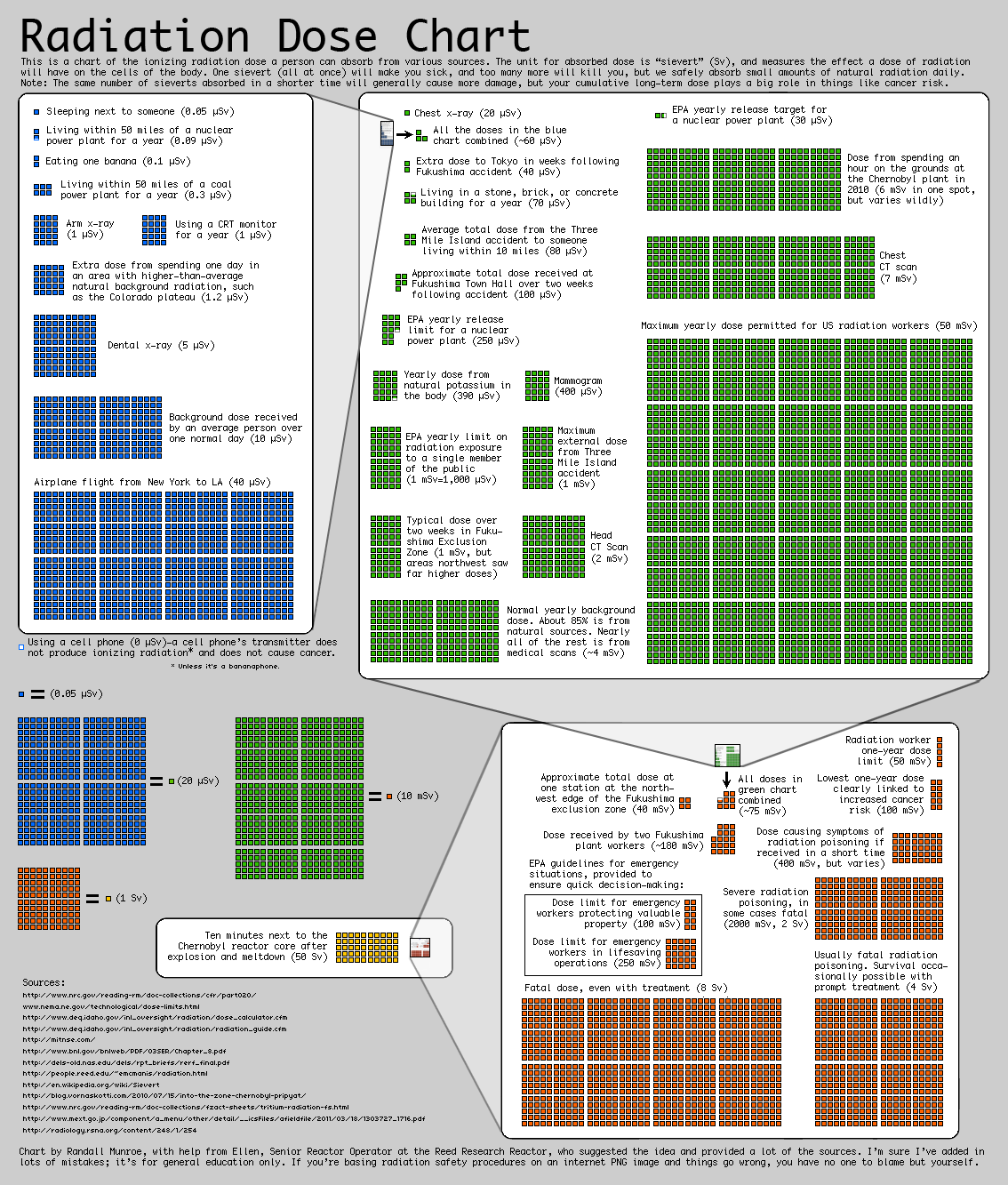
According to this website, the rescue workers at Chernobyl were exposed to approximately 6 sieverts (6000 mSv) of radiation that night. This would put them in the lower right corner of the graphic ('usually fatal radiation poisoning. survival occasionally possible with prompt treatment')
http://www.chernobylgallery.com/chernobyl-disaster/radiation-levels/
According to this website, the rescue workers at Chernobyl were exposed to approximately 6 sieverts (6000 mSv) of radiation that night. This would put them in the lower right corner of the graphic ('usually fatal radiation poisoning. survival occasionally possible with prompt treatment')
http://www.chernobylgallery.com/chernobyl-disaster/radiation-levels/
Anonymous
05/10/2019 21:49
Subject: Chernobyl on HBO
Anonymous wrote:Holy f#ck
Terrifying.
Watching ep1 right now and it is so much more upsetting than I thought it would be. I’m screaming at the characters to just leave, stopping touching things, don’t open doors, etc. DH and DD think I’ve lost my mind.
Anonymous
05/10/2019 20:38
Subject: Chernobyl on HBO
Anonymous wrote:Anonymous wrote:Anonymous wrote:I've re-read a lot about Chernobyl after watching the series; I've always been fascinated by it.
The man ordered to look into the reactor from the roof was Sitnokov, and he got a fatal dose of radiation from that action.
His name was Anatoly Sitnikov.
The firefighter with the pregnant wife...he dies but the baby later dies from heart failure and cirrhosis of the liver.
A little spoiler heads up would’ve been nice! So not cool!

Anonymous
05/10/2019 20:10
Subject: Chernobyl on HBO
Anonymous wrote:Anonymous wrote:Anonymous wrote:I was scheduled to go on a trip to the Soviet Union two weeks after the Chernobyl accident. We were supposed to go to Kiev for a few days but that got rescheduled and we spent those days in Vladimir and Suzdal. I remember our American guides talking about how they figured that most produce in the USSR came from nearby farms so that it was probably okay to eat it in Moscow and Leningrad (later St. Petersburg) but I noticed that our guide wasn't eating butter on her bread or ice cream. I figured I shouldn't eat it either but it's hard to be in the Soviet Union and not eat ice cream!
Also there was a famous picture of the destroyed reactor vessel in Pravda, the official newspaper - which was shocking at the time because the Soviet government was basically admitting that there was a problem. I think it was also considered a sign of the coming of glasnoct (but I may be remembering that wrong - 86 seems too early for that).
Anyway, I'll never forget our Soviet guide standing in the front of the bus and showing us that picture in Pravda. I think she was trying to show that maybe the government wasn't as closed off as it seemed (and as it was in reality).
I am the PP from Minsk. I don't know if this is true, but the prevailing opinion at the time was that the radiation went west, was detected outside the country, and the news were announced over Voice of America, and the USSR couldn't keep it silent. But certainly, there was no stomach at the time for the kind of scary government actions that took place in the 1930s or even 1950s. But until then, they didn't bother telling anyone and the news didn't travel that quickly. These days, with cell phones and social media, things would be completely different, though the rumors would still be a huge problem, I'm sure there'd be a lot of conflicting information going around.
Hi, I am also from Minsk. The way we found out - our neighbor worked in Borovlyany, there was some (research?) facility there. Bottom line, they had the equipment to measure radiation, and they picked it up. They first got worried that something happened at the facility, then they got worried even more when they realized that whatever happened did not happen in a close vicinity, and yet it was enough to set off their equipment, so must be something major. But of course the May 1 festivities went on - I don’t think there even was an announcement before that.
Is that how it got out to the international community as well- a facility in Sweden picked up the radiation levels? Craziness.
Anonymous
05/10/2019 19:04
Subject: Re:Chernobyl on HBO
I visited the medical school in Cuba and they talked about how they cared for many of the children that were affected after the incident
Anonymous
05/10/2019 18:05
Subject: Chernobyl on HBO
Anonymous wrote:Anonymous wrote:Anonymous wrote:Anonymous wrote:Anonymous wrote:Anonymous wrote:Anonymous wrote:As horrible as this incident is, I hope rehashing it in this miniseries is not bad PR for nuclear power. A lot went wrong in this situation, and a lot has changed since then.
Really? This is your concern? There are, perhaps, millions of individuals dealing with radiation-induced cancers and birth defects related to the Chernobyl disaster. And that's just one incident.
I really hope that nuclear power does not spread. We have other options. I'll take tar sand oil before more nuclear power.
Then you really know nothing.
Educate me.
PS - do you work at one of these "public affairs" groups that are trying to shape the narrative online about this mini-series?
My spouse is a former nuclear engineer. I certainly don't understand nuclear power to the depths that he does, but he's been blathering on endlessly about the Chernobyl miniseries, so I pick up a thing here and there.
The type of reactor built for Chernobyl has never been built outside of the USSR. A Chernobyl type incident couldn't be replicated in the US because we simply don't have reactors like that. The physics are different.
There's never been a death in 50 years of the US using nuclear power. There's been three historic incidents in all that time. The horrible one, Chernobyl. The one where there was some containment leakage and the lasting impact is unknown, Fukushima. And three mile island, where it was completely contained and no one was injured.
The space it takes to run a nuclear power plant is incredibly small compared to the power generated.
Most of the waste is recyclable. The small amount that isn't recyclable is exactly that....small.
It's cheap, low impact to the environment, safe, and doesn't use land which could best be used for other purposes. I'll never convince people of all that, of course. Some people are still afraid of air travel, and the incidents of accidents are historically low...but that's not on the news.
NP. Out of curiosity, is the one you didn’t name the one that occurred in the Soviet Union in the 1960s or 1970s that they suppressed information about? I think it was maybe near Tomsk but I could be wrong. I lived in the Soviet Union for a short time and knew someone who lived there as a child. He said all the kids in his school got really sick and the government told them all not to worry. His mother pulled a lot of strings to get his family moved out of town.
PP here. I realized I was talking a little out of my behind, so I went back and look up some more incidents. There's an international scale of nuclear events where things are ranked from 1-7 with 7 being the worst. There's been two 7s..Fukushima and Chernobyl. Three Mile Island was a 5. The one 6 was the Kyshtym disaster at Mayak Chemical Combine in the Soviet Union in 1957. I've never heard of that one; maybe that's what you're referring to?
Yes, that's it. It's been so many years, I was totally not counting right about how old my acquaintance was. He was in his 40s in the early 90's, so that's exactly the right timing. He was a little boy. Oddly, he said his mother treated him with betacarotine -- so much that his skin turned orange and kids made fun of him for it. I've always wondered if there was something to that, or if it other precautions she took that allowed him to be healthy into his 40's. Of course, he may also have dropped dead by 1995, for all i know. I hope not because he was a really nice guy.
I knew someone else that was in tomsk when there was another, smaller nuclear accident in 1993 at a nearby nuclear faciilty. That one was reported in the press. He said people were passing around an iodine bottle and a vodka bottle, advising a chug from each (or maybe a bunch of chugs from the vodka bottle) as a preventive.
Anonymous
05/10/2019 17:55
Subject: Chernobyl on HBO
Anonymous wrote:Yes, and as an American tourist, we were pretty isolated from the rest of the country. I remember sitting in the hotel bar with people on my trip and we were all talking about what Soviet people were really like based on books we had read. Because locals weren't allowed to hang out in tourist hotels so we were all talking to ourselves! I did run into a woman in a local park and talked to her in my pathetic Russian. She was very interested in whether I had my own apartment all to myself in the United States but she told me how great things were there. Vsevo svobodna! (I think i remember that right) Everything was free! I don't know if she meant "free" in the monetary sense or "free" in the civil liberties sense. It was a beautiful but mystifying country and I realized that I didn't really have a clue what was going on around me.Anonymous wrote:Anonymous wrote:I was scheduled to go on a trip to the Soviet Union two weeks after the Chernobyl accident. We were supposed to go to Kiev for a few days but that got rescheduled and we spent those days in Vladimir and Suzdal. I remember our American guides talking about how they figured that most produce in the USSR came from nearby farms so that it was probably okay to eat it in Moscow and Leningrad (later St. Petersburg) but I noticed that our guide wasn't eating butter on her bread or ice cream. I figured I shouldn't eat it either but it's hard to be in the Soviet Union and not eat ice cream!
Also there was a famous picture of the destroyed reactor vessel in Pravda, the official newspaper - which was shocking at the time because the Soviet government was basically admitting that there was a problem. I think it was also considered a sign of the coming of glasnoct (but I may be remembering that wrong - 86 seems too early for that).
Anyway, I'll never forget our Soviet guide standing in the front of the bus and showing us that picture in Pravda. I think she was trying to show that maybe the government wasn't as closed off as it seemed (and as it was in reality).
I am the PP from Minsk. I don't know if this is true, but the prevailing opinion at the time was that the radiation went west, was detected outside the country, and the news were announced over Voice of America, and the USSR couldn't keep it silent. But certainly, there was no stomach at the time for the kind of scary government actions that took place in the 1930s or even 1950s. But until then, they didn't bother telling anyone and the news didn't travel that quickly. These days, with cell phones and social media, things would be completely different, though the rumors would still be a huge problem, I'm sure there'd be a lot of conflicting information going around.
Svobodni would mean free like freedom. There's a different word for free meaning without cost. For a really easy read but infomative book about living in the USSR, read Mastering the Art of Soviet Cooking (it's a memoir, not a cookbook, and it's great).
After studying the Soviet Union for many years, I am very disinclined to purchase any products from, or travel in, countries that don't have freedom of the press. You just never really know what you're getting, safety wise. it astounds me that Americans are willing to gobble up all these Chinese goods without much concern about the safety rules there, or whether some of it is coming from North Korea, which is even worse. And because people don''t care, it's impossible to avoid it.
Anonymous
05/10/2019 17:09
Subject: Chernobyl on HBO
Anonymous wrote:Anonymous wrote:I was scheduled to go on a trip to the Soviet Union two weeks after the Chernobyl accident. We were supposed to go to Kiev for a few days but that got rescheduled and we spent those days in Vladimir and Suzdal. I remember our American guides talking about how they figured that most produce in the USSR came from nearby farms so that it was probably okay to eat it in Moscow and Leningrad (later St. Petersburg) but I noticed that our guide wasn't eating butter on her bread or ice cream. I figured I shouldn't eat it either but it's hard to be in the Soviet Union and not eat ice cream!
Also there was a famous picture of the destroyed reactor vessel in Pravda, the official newspaper - which was shocking at the time because the Soviet government was basically admitting that there was a problem. I think it was also considered a sign of the coming of glasnoct (but I may be remembering that wrong - 86 seems too early for that).
Anyway, I'll never forget our Soviet guide standing in the front of the bus and showing us that picture in Pravda. I think she was trying to show that maybe the government wasn't as closed off as it seemed (and as it was in reality).
I am the PP from Minsk. I don't know if this is true, but the prevailing opinion at the time was that the radiation went west, was detected outside the country, and the news were announced over Voice of America, and the USSR couldn't keep it silent. But certainly, there was no stomach at the time for the kind of scary government actions that took place in the 1930s or even 1950s. But until then, they didn't bother telling anyone and the news didn't travel that quickly. These days, with cell phones and social media, things would be completely different, though the rumors would still be a huge problem, I'm sure there'd be a lot of conflicting information going around.
Hi, I am also from Minsk. The way we found out - our neighbor worked in Borovlyany, there was some (research?) facility there. Bottom line, they had the equipment to measure radiation, and they picked it up. They first got worried that something happened at the facility, then they got worried even more when they realized that whatever happened did not happen in a close vicinity, and yet it was enough to set off their equipment, so must be something major. But of course the May 1 festivities went on - I don’t think there even was an announcement before that.
Anonymous
05/10/2019 16:41
Subject: Chernobyl on HBO
The nuclear industry likes to portray crunchy hippies as their enemy. We can argue the numbers of deaths from Chernobyl and the relative safety of American nuclear plants. None of that is determining the state and future of nuclear in the U.S.
Nuclear is being crushed by the accountants. Natural gas and renewables are eating its lunch on cost. South Carolina wasted about $9B on building new nuclear units this decade. Google that story if you want to know why big money investors, utilities and state utility regulators are running away from nuclear.
Nuclear is being crushed by the accountants. Natural gas and renewables are eating its lunch on cost. South Carolina wasted about $9B on building new nuclear units this decade. Google that story if you want to know why big money investors, utilities and state utility regulators are running away from nuclear.