Anonymous
 09/04/2025 12:55
Subject: Which school offered the best financial aid package to your child?
09/04/2025 12:55
Subject: Which school offered the best financial aid package to your child?
OP, other posters' results may be due to their own mix of income and assets. Please use Net Price Calculators.

Anonymous
09/04/2025 12:49
Subject: Which school offered the best financial aid package to your child?
DD's cheapest option was UMW - $17k/year after merit (and in-state)
Several LACs ranked in the 60-90 range all gave similar merit, all ending up with net price around $35k. She went to Juniata for $30k, with a music scholarship added to the initial merit award.
Several LACs ranked in the 60-90 range all gave similar merit, all ending up with net price around $35k. She went to Juniata for $30k, with a music scholarship added to the initial merit award.
Anonymous
09/04/2025 12:38
Subject: Which school offered the best financial aid package to your child?
Anonymous wrote:My kids applied to many CTCL colleges in the Midwest and the Pacific Northwest. Every single one of the CTCLs offered about 50 percent off. These were merit scholarships. By contrast, the NESCACs offered no aid at all, which was fair since both spouses worked and the family had enough money to pay full tuition. We ended up with a NESCAC student and a CTCL student. (My kids actually preferred many CTCLs to many NESCACs due to location, vibe, etc )
This tracks. Not a CTCL, but very similar to many of them, my daughter really liked Randolph College. They offered merit aid+an arts scholarship+a visit scholarship+VTAG money. COA would have been @$20K/yr, and that's for a not great student. For the right student, COA could have been @15K before even applying for loans of any sort or getting a FA offer if lower income than most in this area.
Anonymous
09/04/2025 12:36
Subject: Which school offered the best financial aid package to your child?
Rice was the best for my high performing kid.
There seem to be a handful of schools that really want the talent and will make it work for every family.
There seem to be a handful of schools that really want the talent and will make it work for every family.
Anonymous
09/04/2025 12:32
Subject: Which school offered the best financial aid package to your child?
Fordham $30K
Pace $36K
At Fordham.
Pace $36K
At Fordham.
Anonymous
09/04/2025 12:30
Subject: Which school offered the best financial aid package to your child?
Anonymous wrote:HS class of 23
Lehigh-$30.6K ($51K COA)
CWRU-$30K ($56K COA)
BU-$28.5K ($61K COA)
UMN-$25K ($31K COA)
Ohio St.-$16.5K ($45K COA)
UMD-$10K ($47K COA) ATTENDING
Stats?
Anonymous
09/04/2025 12:26
Subject: Which school offered the best financial aid package to your child?
Anonymous wrote:George Washington, 20K merit aid a year, guaranteed for 5 years or until graduation. We were not eligible for financial aid.
DS did indeed go to GW. The merit aid was one but not the only factor in choosing the Elliott School of International Affairs over W&M's International Affairs dual degree programme with St Andrews. With merit aid, it made the two equally expensive. DS found GW had more courses to choose from and a study program at Sciences Po in Paris (specializing in his major, which he really wanted). He visited W&M's Admitted Student Day and was a little turned off by the vibe, and preferred GW's urban campus, which clinched it.
My DD is interested in GW. Do you have any insights on social life, how friendly and open students are? It’s the one thing causing pause.
Anonymous
09/04/2025 12:03
Subject: Which school offered the best financial aid package to your child?
Anonymous wrote:
Alabama seems to be following that formula. Their honors program is trying to buy high stat kids for what sounds like a pretty good program.
This is unusual because state schools generally have all fallen (especially in the rust belt with places like Michigan, UIUC and Wisconsin.
Yup, Michigan, UIUC and Wisconsin have all "fallen" to rank 21, 33 and 39, whereas the great Alabama has improved so much that it is now ranked...... 171.
Anonymous
09/04/2025 11:58
Subject: Re:Which school offered the best financial aid package to your child?
This was really interesting. On average, half the kids at private schools got merit money.
https://www.insidehighered.com/news/business/revenue-strategies/2025/06/24/tuition-discounting-hits-another-high
https://www.insidehighered.com/news/business/revenue-strategies/2025/06/24/tuition-discounting-hits-another-high
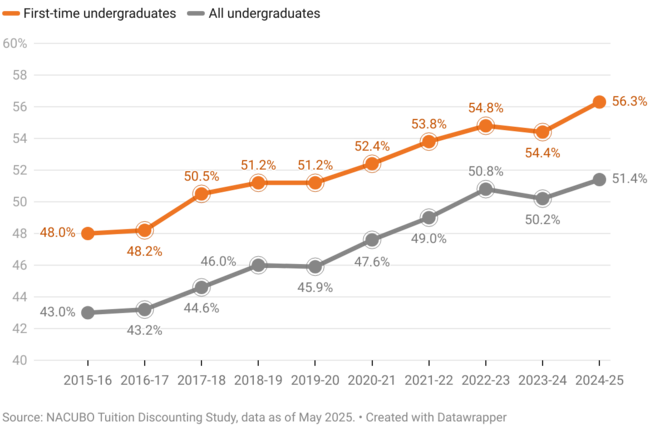
The average discount rate in the 2024–25 academic year was 56.3 percent for first-time, full-time undergraduates at private colleges and 51.4 percent for all undergraduates, according to an annual study commissioned by the National Association of College and University Business Officers. That means that for every dollar of undergraduate tuition, private nonprofit colleges kicked in 56 cents in grant aid for first-time undergraduates and 51 cents to all undergraduates who received institutional grant aid.
The rate for first-time, full-time undergraduates ticked up two percentage points compared to the 2023–24 academic year, while the rate for all undergraduates increased by about one percentage point. In all, 286 private nonprofit institutions participated in the NACUBO Tuition Discounting Study.
As the study noted, discounting strategies are often “used to attract or retain students who are unable or unwilling to pay” full tuition and fees, or what is commonly known as “sticker price.” Although lawmakers and others point to the sticker price as a reflection of the cost of college, the practice of tuition discounting muddies the waters and makes it difficult to know what students are actually paying. The study focused only on private nonprofit institutions, explaining, “Public institutions also award institutional grants. However, private nonprofit institutions and public colleges and universities are built on fundamentally different revenue models, so their discounting practices cannot be compared fairly.”
More than 83 percent of students received some institutional grant aid, according to NACUBO. Among first-time, full-time undergraduates, that number was just under 90 percent.
Anonymous
09/04/2025 11:40
Subject: Which school offered the best financial aid package to your child?
My son got pretty good merit from Iowa. I think it would have been about the same as in state at Pitt, where he is going. WVU would have been about 3,000-4,000 less.
Anonymous
09/04/2025 11:21
Subject: Which school offered the best financial aid package to your child?
Anonymous wrote:Anonymous wrote:UMD full ride BK scholarship. Is full pay at Harvard.
Curious: was that a hard decision to make?
You have no idea how hard this was. She wanted Harvard because she’d worked her butt off in high school (long story). We are immigrants with not many connections here and thought it’d be worth it for just for that. I think she might have worked less at UMD but at Harvard, she has to work hard for every.single.thing!
Anonymous
09/04/2025 11:11
Subject: Which school offered the best financial aid package to your child?
Anonymous wrote:Which school offered the best financial aid package to your student?
Did your child attend or decline the offer?
TLDR: Check out Alabama Honors program
There are always a handful of schools trying to bring high stat kids in with merit aid.
In my day it was places like USC, Notre Dame and Rice (I graduated in the 1980s).
USC and Notre Dame used that foozball money and publicity to buy their way into academic selectivity.
Alabama seems to be following that formula.
Their honors program is trying to buy high stat kids for what sounds like a pretty good program.
This is unusual because state schools generally have all fallen (especially in the rust belt with places like Michigan, UIUC and Wisconsin. Cal is a different case because they seem to have intentionally sacrificed academic selectivity to be more of an engine of social mobility).
Northeastern has clawed its way into academic relevancy with merit aid, I don't know if they still do that these days.
Wash U has sort of done something similar to Rice.
Anonymous
09/04/2025 11:03
Subject: Which school offered the best financial aid package to your child?
Need-based for my DC
1. Princeton
2. MIT
3. Caltech
4. Stanford
5. Harvard
6. Yale
1. Princeton
2. MIT
3. Caltech
4. Stanford
5. Harvard
6. Yale
Anonymous
09/04/2025 10:51
Subject: Which school offered the best financial aid package to your child?
Anonymous wrote:
Is this the amount of aid you would receive or is this the cost of attendance?
COA after need-based aid.
Anonymous
09/04/2025 10:50
Subject: Which school offered the best financial aid package to your child?
Anonymous wrote:Anonymous wrote:My kids applied to many CTCL colleges in the Midwest and the Pacific Northwest. Every single one of the CTCLs offered about 50 percent off. These were merit scholarships. By contrast, the NESCACs offered no aid at all, which was fair since both spouses worked and the family had enough money to pay full tuition. We ended up with a NESCAC student and a CTCL student. (My kids actually preferred many CTCLs to many NESCACs due to location, vibe, etc )
The CTCL schools give merit to everyone, with many giving the 50% figure you mention.
At some point maybe they will just drop the COA by 50% beciause the rack rate is scaring people off.
A couple of schools dropped the list price for tuition in the 1990s, and they found that applications DECREASED. College is a luxury good and people think high prices signal quality, apparently.