Anonymous
 01/18/2018 18:56
Subject: Colleges to Look At Suggestions - Biology major
01/18/2018 18:56
Subject: Colleges to Look At Suggestions - Biology major
I'm correcting the narrative that LACs cannot produce top notch scientists or lead to research opportunities compelling enough for graduate school. That simply isn't correct and really a reflection of ignorance than any firm grasp on educational nuances between schools. If you want to share your opinion about what approach you find the best, go for it- everyone is entitled to their opinion, but making false statements about a category of schools you admit you have no experience with (past quote- I've never met a LAC graduate in my program) and using it to inform the views of other is shameful. Notice that I've made no qualitative remarks about which institution is best overall.
I'm not calling you out but rather the one person who stated liberal art colleges have nonexistent research opportunities (false) or do not prepare their grads for PhDs (also false given the statistics reflect PhD recipients, not entering students).
I'm not calling you out but rather the one person who stated liberal art colleges have nonexistent research opportunities (false) or do not prepare their grads for PhDs (also false given the statistics reflect PhD recipients, not entering students).

Anonymous
01/18/2018 18:22
Subject: Colleges to Look At Suggestions - Biology major
If I’m at NSF, this fact matters to me because I care about the pipeline in the aggregate and want to make sure resources get directed to all the places that routinely send kids to PhD programs.
If I’m a PhD-aspiring HS student applying to college (or the parent of such a student) it’s not meaningful. Which is why I began the sentence you’ve bolded with “In the context of this discussion” — which you’ve conveniently ignored.
In choosing the (most likely) ONE college s/he will attend, such a student should look at research opportunities, faculty, and course offerings in his or her specific areas of interest and make decisions among schools on that basis — not on the basis of some broad categorical assessment.
If I’m a PhD-aspiring HS student applying to college (or the parent of such a student) it’s not meaningful. Which is why I began the sentence you’ve bolded with “In the context of this discussion” — which you’ve conveniently ignored.
In choosing the (most likely) ONE college s/he will attend, such a student should look at research opportunities, faculty, and course offerings in his or her specific areas of interest and make decisions among schools on that basis — not on the basis of some broad categorical assessment.
Anonymous
01/18/2018 18:04
Subject: Colleges to Look At Suggestions - Biology major
FWIW, you’re demonstrating my point about bizarre aggregation. In the context of this discussion, why does it matter that 9 LACs combined produced more PhDs than Berkeley? No kid is choosing between going to 9 different LACs vs going to Berkeley. And, presumably, you recognize that the fact that top LACs send (small numbers of, but comparatively high percentages of) kids to top PhD programs doesn’t mean top PhD programs are filled with kids from LACs. Also the % who have done research with a faculty member stat is so vague as to be meaningless (not limited to science, not school-specific, not limited to undergrads going on to PhDs, and probably self-reported, so god knows what it means.)
The point is that statistically, if you gathered all the STEM PhD recipients from the given time frame and asked them where they attended college, you'd be more likely to have someone who went to one of those 9 LACs vs. UC Berkeley. This is despite these 9 having half the undergraduate population. I doubt you would say UC Berkeley is an insignificant force for producing PhDs, since it's literally the #1 school by absolute number (Table 2), so how can you or whomever sweepingly suggest that LACs produce an insignificant number of STEM PhD graduates? They don't.
qz.com/498534/these-25-schools-are-responsible-for-the-greatest-advances-in-science/
I'm going to exclude the top table since it doesn't distinguish between STEM Nobel laureates and excludes anyone with 2 or fewer winners (their quote: "If we had included schools with two winners in the Nobel/Fields/Turing list, Haverford, Oberlin, Rice, and Johns Hopkins would have been in the top 25 on both") and focus more on the second table, national academy memberships. There are 8 LACs with 0 overlap in members between each other (unlike the universities with both undergrad/doctoral programs), totaling to 186 in total (#1 is Harvard with 326, #2 is MIT is 255). Again, let it be reminded that these schools have 0 doctoral programs and are extremely tiny (even cumulatively, they have ~13000 undergrads), and unlike STEM focused MIT, don't even have that high of a percent majoring in a STEM field.
Anonymous
01/18/2018 17:56
Subject: Colleges to Look At Suggestions - Biology major
Nah, our system is crazy.
That said, it’s pretty straightforward if you’re a satisficer (send DC to the best in-state public s/he can get into and that has what DC wants to study) and insanely complex if you (sing or pl) are trying to optimize. All roads lead to Rome (whatever that is) but some are easier and some are much expensive than others.
That said, it’s pretty straightforward if you’re a satisficer (send DC to the best in-state public s/he can get into and that has what DC wants to study) and insanely complex if you (sing or pl) are trying to optimize. All roads lead to Rome (whatever that is) but some are easier and some are much expensive than others.
Anonymous
01/18/2018 16:59
Subject: Re:Colleges to Look At Suggestions - Biology major
OP here - while this dialogue has been incredibly interesting, my head is just spinning! Is it bad that I now long for the scatter shot, fill in random applications by typewriter from back in the day? 
Anonymous
01/18/2018 16:29
Subject: Colleges to Look At Suggestions - Biology major
15:26 is not wrong...but a kid who is if-fy for UVA isn't getting into any of those other top 10 SLACs either.
Anonymous
01/18/2018 16:28
Subject: Colleges to Look At Suggestions - Biology major
Ugh, OP. Don't let your kid become bio major unless you know she is good enough for med school or phd route. absolutely useless major otherwise.
parent of kid with bio degree currently looking for a job at target
parent of kid with bio degree currently looking for a job at target
Anonymous
01/18/2018 16:23
Subject: Colleges to Look At Suggestions - Biology major
Anonymous wrote:Anonymous wrote:But her recommendations (and observations) are more credible than the conclusions you’re drawing from bizarrely- aggregated data.
In terms of absolute numbers, significantly more PhDs earn their BAs or BSs at major research universities than at LACs. NSF adopted the yield ratio (number of PhD recipients divided by number of BA recipients in the same (broadly defined) field) as a secondary measure because LACs weren’t showing up at all in the top 50 producers of S&E PHDs. Which didn’t seem a fair representation of their role in science education. Basically, you need both pieces of data (as well as more data about subfield representation at specific LACs) to make an intelligent choice as to where your DC should go to college if s/he hopes to pursue a science PhD.
And depth and breadth of research opportunities on campus is definitely something to focus on.
Why wouldn't it be a fair representation? Do you realize how tiny LACs are, yet how much of a weight they pack as a collective force?
https://www.nsf.gov/statistics/infbrief/nsf13323/ has absolute numbers listed. Let's compare UC Berkeley (30000 undergrads), which yielded 3406 bachelor's students who went onto receive STEM PhDs, to LACs in the top 20:
Harvey Mudd (800 undergrads, 359 recipients), Reed (1400, 374), Swarthmore (1600, 472), Carleton (2000, 555), Grinnell (1800, 366), Pomona (1650, 345), Haverford (1200, 269), Williams (2000, 451), Bryn Mawr (1700, 245). Collectively, this amounts to 3436 PhD recipients at a population of 14,150. These 9 LACs are producing more STEM PhDs on an ABSOLUTE scale than UC Berkeley, which has more than double the undergraduate population. You can compare against Stanford + Harvard as well- 15500 undergraduates total, 3153 receiving PhDs. Do you see the issue? If your point is that these LACs are not significant, then your point is also that UC Berkeley or Harvard + Stanford are not significant for leading undergraduates to PhDs.
Your argument was:
1) Research is non-existent at LACs lacking research faculty (which isn't even a thing among the top LACs- virtually all science professors do some form of research). This is incorrect, LAC graduates are the most likely of all classifications of colleges to have done research with a faculty member- by far (the national average is 23%, no other classification comes close).
2) You are far more likely to get "real research" (whatever that means) at a larger school. Given that research experience/letters of references are one of the most important aspects of getting admitted to PhD programs, if these LACs are disproportionately represented, their graduates seem to do just fine in obtaining the necessary experiences.
Is your point that LAC graduates aren't getting into the best PhD programs? What's your proof of that? At the top LACs, it seems that a significant cohort goes off to the top graduate schools each year. Williams lists Harvard, Yale, and Columbia as the top 3 destinations for students going onto a PhD program. Swarthmore lists UPenn, Harvard, Yale, Cornell, Columbia, MIT, UChicago, Oxford, Stanford, and Princeton as its top 10, and the biggest percent of their alumni group is scientists at 18%.
The post you are quoting is mine but it’s the only one I’ve made in this thread on this particular topic (LACs vs MRUs). So when you say “your argument was” you’re wrong. My point was the pro-major research university poster was right that it was important for a PhD aspiring undergrad to take a careful look at the depth and range of research opportunities available on/near campus. I also agree that the sweet spot may be medium-sized universities with high volumes of research.
FWIW, you’re demonstrating my point about bizarre aggregation. In the context of this discussion, why does it matter that 9 LACs combined produced more PhDs than Berkeley? No kid is choosing between going to 9 different LACs vs going to Berkeley. And, presumably, you recognize that the fact that top LACs send (small numbers of, but comparatively high percentages of) kids to top PhD programs doesn’t mean top PhD programs are filled with kids from LACs. Also the % who have done research with a faculty member stat is so vague as to be meaningless (not limited to science, not school-specific, not limited to undergrads going on to PhDs, and probably self-reported, so god knows what it means.)
Yes, a talented, highly-motivated kid can get into a top PhD program from a LAC. But that doesn’t mean that’s the best route for most kids. Or that any LAC
is a good start. Basically, LACs have small departments with small faculties and limited course offerings. If you get lucky and you find an ambitious and simpatico faculty member in a subfield you come to love, then all’s well. But an undecided undergrad has many more opportunities to find people to work with and fields to explore in a more research-rich environment.
Also, as someone who has taught and studied and now has a kid studying in medium sized MRUs, my experience in all roles has been that working closely with faculty is easy if you’re the kind of undergrad who will end up in a PhD program. Those kids stand out and get mentored. I’m not saying don’t look at LACs. I’m saying look closely at specific LACs and have your DC compare course offerings, faculty, and research opportunities with departments in other types of schools. And keep in mind/impress upon DC the need for Plan B or C. Don’t assume that DC will major in a specific field or knows now whether s/he will ultimately want to go to grad school and what kind. Look for schools where there are lots of different things that interest DC. But feel free to rule out schools where DC’s current most likely interests will not be well-served.
Anonymous
01/18/2018 16:01
Subject: Colleges to Look At Suggestions - Biology major
I have no idea why you're fighting this point. Are you even a science grad? I have a PhD from a PI who later received a Nobel Prize. I know how to get into top labs. I also know who succeeds once they get into those labs. I know how to get full funding for grad school so you don't have to rely on a PI. All three require as much research experience as you can muster. You want to use undergraduate years to get this experience. You want to try out labs to see what kind of work you like. You can't do this at small schools where the only "research" that is being done is into science education. You want to go to a school with labs where you can contribute to peer reviewed publications in recognized journals.Anonymous wrote:Anonymous wrote:But her recommendations (and observations) are more credible than the conclusions you’re drawing from bizarrely- aggregated data.
In terms of absolute numbers, significantly more PhDs earn their BAs or BSs at major research universities than at LACs. NSF adopted the yield ratio (number of PhD recipients divided by number of BA recipients in the same (broadly defined) field) as a secondary measure because LACs weren’t showing up at all in the top 50 producers of S&E PHDs. Which didn’t seem a fair representation of their role in science education. Basically, you need both pieces of data (as well as more data about subfield representation at specific LACs) to make an intelligent choice as to where your DC should go to college if s/he hopes to pursue a science PhD.
And depth and breadth of research opportunities on campus is definitely something to focus on.
Why wouldn't it be a fair representation? Do you realize how tiny LACs are, yet how much of a weight they pack as a collective force?
https://www.nsf.gov/statistics/infbrief/nsf13323/ has absolute numbers listed. Let's compare UC Berkeley (30000 undergrads), which yielded 3406 bachelor's students who went onto receive STEM PhDs, to LACs in the top 20:
Harvey Mudd (800 undergrads, 359 recipients), Reed (1400, 374), Swarthmore (1600, 472), Carleton (2000, 555), Grinnell (1800, 366), Pomona (1650, 345), Haverford (1200, 269), Williams (2000, 451), Bryn Mawr (1700, 245). Collectively, this amounts to 3436 PhD recipients at a population of 14,150. These 9 LACs are producing more STEM PhDs on an ABSOLUTE scale than UC Berkeley, which has more than double the undergraduate population. You can compare against Stanford + Harvard as well- 15500 undergraduates total, 3153 receiving PhDs. Do you see the issue? If your point is that these LACs are not significant, then your point is also that UC Berkeley or Harvard + Stanford are not significant for leading undergraduates to PhDs.
Your argument was:
1) Research is non-existent at LACs lacking research faculty (which isn't even a thing among the top LACs- virtually all science professors do some form of research). This is incorrect, LAC graduates are the most likely of all classifications of colleges to have done research with a faculty member- by far (the national average is 23%, no other classification comes close).
2) You are far more likely to get "real research" (whatever that means) at a larger school. Given that research experience/letters of references are one of the most important aspects of getting admitted to PhD programs, if these LACs are disproportionately represented, their graduates seem to do just fine in obtaining the necessary experiences.
Is your point that LAC graduates aren't getting into the best PhD programs? What's your proof of that? At the top LACs, it seems that a significant cohort goes off to the top graduate schools each year. Williams lists Harvard, Yale, and Columbia as the top 3 destinations for students going onto a PhD program. Swarthmore lists UPenn, Harvard, Yale, Cornell, Columbia, MIT, UChicago, Oxford, Stanford, and Princeton as its top 10, and the biggest percent of their alumni group is scientists at 18%.
I admitted in my very first post that the biggest schools likely don't give the best research opportunities because the professors are too disengaged from undergrads. On the flip side, the smallest schools may have insufficient research opportunities. The students who came into grad school with the best preparation went to mid-sized schools like Cornell, Case Western and CMU.
Anonymous
01/18/2018 15:52
Subject: Re:Colleges to Look At Suggestions - Biology major
https://www.wsj.com/articles/where-great-research-meets-great-teaching-1475029920
WSJ did a study comparing research publications per faculty mentor and student satisfaction about faculty accessibility/opportunities for research & learning, creating a ranking termed "Where Great Research Meets Great Teaching". WSJ articles are unfortunately behind a paywall, but the top 10 are below:
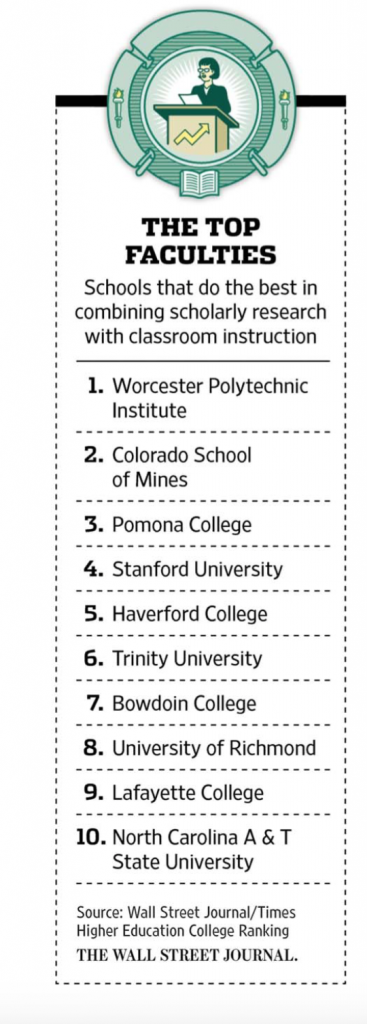
Pomona, Haverford, Trinity, Bowdoin, Richmond, and Lafayette are all LACs.
WSJ did a study comparing research publications per faculty mentor and student satisfaction about faculty accessibility/opportunities for research & learning, creating a ranking termed "Where Great Research Meets Great Teaching". WSJ articles are unfortunately behind a paywall, but the top 10 are below:
Pomona, Haverford, Trinity, Bowdoin, Richmond, and Lafayette are all LACs.
Anonymous
01/18/2018 15:30
Subject: Colleges to Look At Suggestions - Biology major
Quick correction to the above - Stanford + Harvard have 13700 undergrads, not 15500. The point doesn't change, though.
Anonymous
01/18/2018 15:26
Subject: Colleges to Look At Suggestions - Biology major
Anonymous wrote:But her recommendations (and observations) are more credible than the conclusions you’re drawing from bizarrely- aggregated data.
In terms of absolute numbers, significantly more PhDs earn their BAs or BSs at major research universities than at LACs. NSF adopted the yield ratio (number of PhD recipients divided by number of BA recipients in the same (broadly defined) field) as a secondary measure because LACs weren’t showing up at all in the top 50 producers of S&E PHDs. Which didn’t seem a fair representation of their role in science education. Basically, you need both pieces of data (as well as more data about subfield representation at specific LACs) to make an intelligent choice as to where your DC should go to college if s/he hopes to pursue a science PhD.
And depth and breadth of research opportunities on campus is definitely something to focus on.
Why wouldn't it be a fair representation? Do you realize how tiny LACs are, yet how much of a weight they pack as a collective force?
https://www.nsf.gov/statistics/infbrief/nsf13323/ has absolute numbers listed. Let's compare UC Berkeley (30000 undergrads), which yielded 3406 bachelor's students who went onto receive STEM PhDs, to LACs in the top 20:
Harvey Mudd (800 undergrads, 359 recipients), Reed (1400, 374), Swarthmore (1600, 472), Carleton (2000, 555), Grinnell (1800, 366), Pomona (1650, 345), Haverford (1200, 269), Williams (2000, 451), Bryn Mawr (1700, 245). Collectively, this amounts to 3436 PhD recipients at a population of 14,150. These 9 LACs are producing more STEM PhDs on an ABSOLUTE scale than UC Berkeley, which has more than double the undergraduate population. You can compare against Stanford + Harvard as well- 15500 undergraduates total, 3153 receiving PhDs. Do you see the issue? If your point is that these LACs are not significant, then your point is also that UC Berkeley or Harvard + Stanford are not significant for leading undergraduates to PhDs.
Your argument was:
1) Research is non-existent at LACs lacking research faculty (which isn't even a thing among the top LACs- virtually all science professors do some form of research). This is incorrect, LAC graduates are the most likely of all classifications of colleges to have done research with a faculty member- by far (the national average is 23%, no other classification comes close).
2) You are far more likely to get "real research" (whatever that means) at a larger school. Given that research experience/letters of references are one of the most important aspects of getting admitted to PhD programs, if these LACs are disproportionately represented, their graduates seem to do just fine in obtaining the necessary experiences.
Is your point that LAC graduates aren't getting into the best PhD programs? What's your proof of that? At the top LACs, it seems that a significant cohort goes off to the top graduate schools each year. Williams lists Harvard, Yale, and Columbia as the top 3 destinations for students going onto a PhD program. Swarthmore lists UPenn, Harvard, Yale, Cornell, Columbia, MIT, UChicago, Oxford, Stanford, and Princeton as its top 10, and the biggest percent of their alumni group is scientists at 18%.
Anonymous
01/18/2018 13:15
Subject: Colleges to Look At Suggestions - Biology major
But her recommendations (and observations) are more credible than the conclusions you’re drawing from bizarrely- aggregated data.
In terms of absolute numbers, significantly more PhDs earn their BAs or BSs at major research universities than at LACs. NSF adopted the yield ratio (number of PhD recipients divided by number of BA recipients in the same (broadly defined) field) as a secondary measure because LACs weren’t showing up at all in the top 50 producers of S&E PHDs. Which didn’t seem a fair representation of their role in science education. Basically, you need both pieces of data (as well as more data about subfield representation at specific LACs) to make an intelligent choice as to where your DC should go to college if s/he hopes to pursue a science PhD.
And depth and breadth of research opportunities on campus is definitely something to focus on.
In terms of absolute numbers, significantly more PhDs earn their BAs or BSs at major research universities than at LACs. NSF adopted the yield ratio (number of PhD recipients divided by number of BA recipients in the same (broadly defined) field) as a secondary measure because LACs weren’t showing up at all in the top 50 producers of S&E PHDs. Which didn’t seem a fair representation of their role in science education. Basically, you need both pieces of data (as well as more data about subfield representation at specific LACs) to make an intelligent choice as to where your DC should go to college if s/he hopes to pursue a science PhD.
And depth and breadth of research opportunities on campus is definitely something to focus on.
Anonymous
01/18/2018 11:45
Subject: Re:Colleges to Look At Suggestions - Biology major
Anonymous wrote:Cite whatever statistics you'd like. It doesn't change my recommendation. If you want to major in a lab science like chem or bio, you will have a huge leg up in grad school admissions, med school admissions or job opportunities if you have spent significant time in a lab doing research. You will do even better if you have several publications in peer reviewed journals. These opportunities don't exist ar non-research universities. Those students usually get any research experience they can by doing a single NSF REU (National Science Foundation Research Experience For Undergraduates) or the equivalent the summer between their junior and senior year. This isn't enough. Those students don't have the publications or connections to get into top grad programs. They don't have enough experience to know what sort of research they ultimately want to study. My guess is most of them go to med school (though publications really help with that admission too) or move into other fields. I don't recall a single student from any of those LAC schools in my grad program.Anonymous wrote:Anonymous wrote:If your daughter is interested in majoring in a lab science (e.g., chemistry or biology) then she needs to start doing research in a lab ASAP, preferably as a freshman (if not before). This can be hard to do at big state schools where faculty are less engaged with undergrads. It's impossible to do at small liberal arts colleges without research faculty. Look for a school in the middle--big enough for real research opportunities, but which emphasizes undergrad education.
Signed, organic chemistry PhD who mentored plenty of premeds
http://nsse.indiana.edu/2017_institutional_report/pdf/HIPTables/HIP.pdf
Percent of seniors at "Baccalaureate Colleges: Arts & Sciences Focus" (the classification for LACs) who did research with faculty: 48%
Percent of seniors at "R1: Doctoral Universities - Highest research activity" who did research with faculty: 26%
https://www.swarthmore.edu/sites/default/files/assets/documents/institutional-research/Doct%20Rates%20Rankings%20by%20Broad%20Disc%20Field-Summary%20to%202015.pdf
LACs in the top 30 for producing life science PhDs: Reed, Swarthmore, Grinnell, Carleton, Haverford, Harvey Mudd, Pomona (former all in the top 10), Earlham, Allegheny, College of the Atlantic, Bowdoin, Bard, Kalamazoo, Mount Holyoke
LACs in the top 30 for producing physical science PhDs: Harvey Mudd, Reed, Carleton, Swarthmore, Grinnell, Haverford (former all in the top 10), College of Wooster, Lawrence, Allegheny, Wabash, Williams, Bryn Mawr, Kalamazoo, Whitman, Franklin & Marshall, Knox, Juniata, Centre
The students who did the best in grad school were those with tons of research experience from places like Carnegie Mellon or Case Western. Mid sized schools with research faculty. Look there.
The plural of your anecdotes is not data.
Anonymous
01/18/2018 10:40
Subject: Colleges to Look At Suggestions - Biology major
and I'm going to add, of course UVA is the top choice however if she's not a shoe-in for UVA in-state she's not likely to get top-enough grades there for med school, or frankly med school anywhere. You need to consider that the biology major will lead somewhere other than med school.