Anonymous
 08/20/2025 12:15
Subject: AP Language
08/20/2025 12:15
Subject: AP Language
Anonymous wrote:Anonymous wrote:Anonymous wrote:Anonymous wrote:Anonymous wrote:Anonymous wrote:Parent of a rising Junior in FCPS/ Langley... AP's are totally different now than "when I was in school." My son is planning to graduate w/ something like 12 AP classes. He's a great student, but it's honestly just that the system has evolved since I was in school. For example, AP Physics I takes the places of 11th grade advanced Physics (no calculus required.) Basically, the College Board does really well by monetizing every class that they can.
Unbeknownst to you and your child, a politically driven analysis is carried out. It concludes that your child’s hard work has created an “achievement gap” with another student who chose to devote their time to the soccer field or basketball court. The flawed political system decides that you are to blame for this gap in academic performance—yet the gap in athletic performance is totally ok.
Not to be argumentative, but not at all my point. My point was that 20+ years ago, taking 12 AP classes wasn't anywhere in the realm of possible. The OP had some pre-conceived notions of AP classes based on their own past experience and those should be updated.
Agreed. I graduated in 1989, there were some APs at my school but no where near the number today. AP Lit, AP World, AP US, AP Bio, AP Chem, AP Physics, AP Calc (I am not sure if it was AB and BC then). Strong students took 1-2 a year and that was it. The school I attended before we moved didn’t have AP classes at all.
I would guess my child will end up with 10-12 AP classes when he finishes. It seems like a lot.
Agree. So, these classes are easier than we were kids, right? They have to be. The kids I see work hard but not necessarily much harder than a high achieving kid in the 90s with 1-2 APs a year, on their way to an Ivy or similar. Now, even some of these kids with 10+ APs head to a relatively lower level school. Not that the level matters, just that everyone is taking and mostly doing ok in AP classes now, when there was more gatekeeping then.
The reason there are more kids with APs headed to "lower level" schools is demographics. Far more kids vying for essentially the same number of spots that were there when we went to college. And international kids taking some of those spots as well. It's not a reflection on the difficulty of the AP courses. My daughter took the easiest AP course available last year as a freshman, and it was not an easy course. She is taking 3 this year (one of which is a combined course and has 2 AP exams), and as of Day 3, she has to be a lot more organized and on top of things than I ever had to be.
Harvard has international students now has almost full 30% overall and class of 2028 was about 18% of its undergrad. Graphs show 10% increase in last 20+ years and last link below is Crimson article talking about only being 36 int’l students undergrad in 1994. So yes, more kids applying and less US spots.
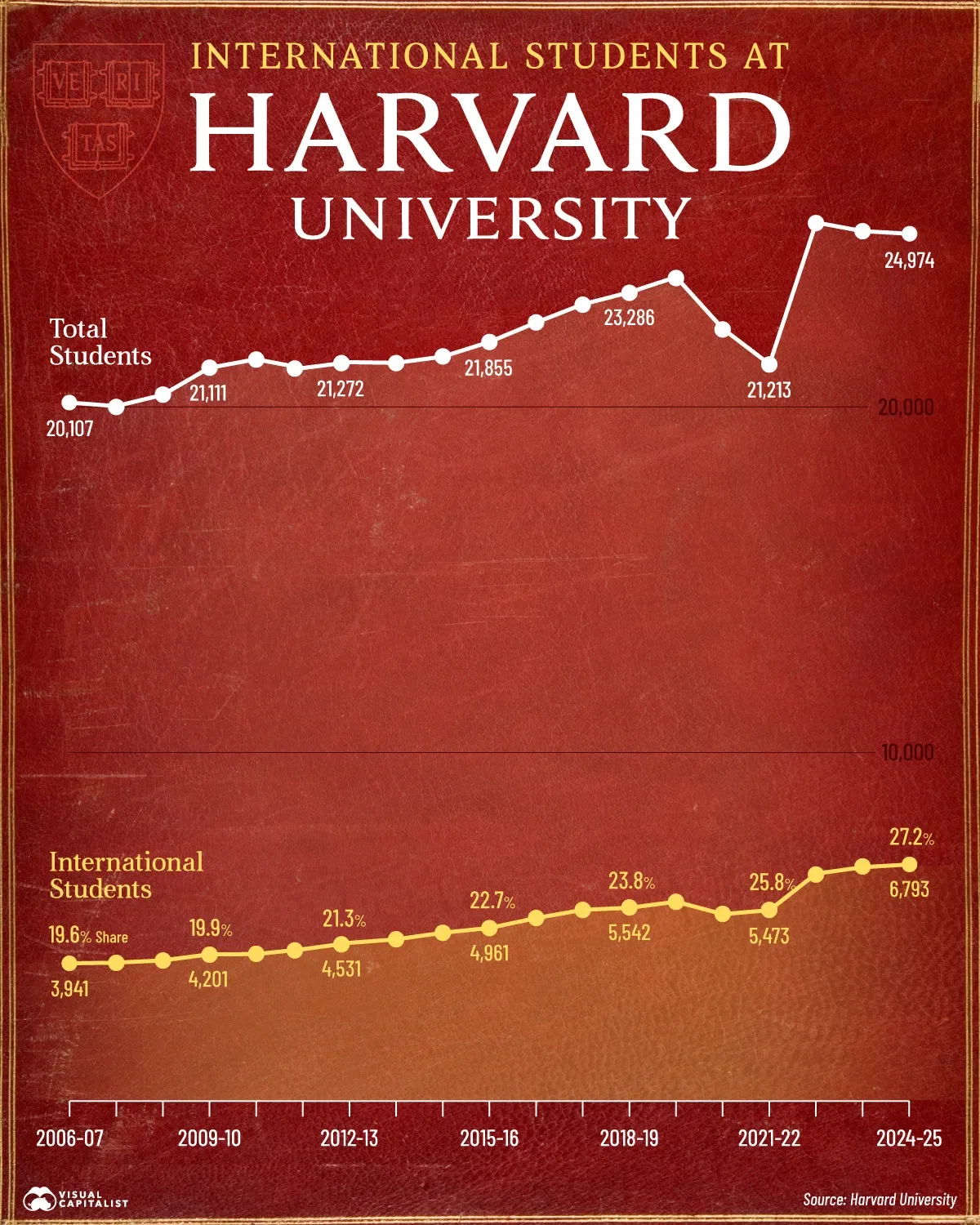

https://oneworld.worldwide.harvard.edu/international-students-at-harvard/
Source for 18% class of 2028-https://college.harvard.edu/admissions/admissions-statistics
Class of 1994: https://www.thecrimson.com/article/1990/11/21/the-myth-of-diversity-pbhbarvard-university/

Anonymous
08/20/2025 08:32
Subject: AP Language
Anonymous wrote:Anonymous wrote:Anonymous wrote:Anonymous wrote:Anonymous wrote:Parent of a rising Junior in FCPS/ Langley... AP's are totally different now than "when I was in school." My son is planning to graduate w/ something like 12 AP classes. He's a great student, but it's honestly just that the system has evolved since I was in school. For example, AP Physics I takes the places of 11th grade advanced Physics (no calculus required.) Basically, the College Board does really well by monetizing every class that they can.
Unbeknownst to you and your child, a politically driven analysis is carried out. It concludes that your child’s hard work has created an “achievement gap” with another student who chose to devote their time to the soccer field or basketball court. The flawed political system decides that you are to blame for this gap in academic performance—yet the gap in athletic performance is totally ok.
Not to be argumentative, but not at all my point. My point was that 20+ years ago, taking 12 AP classes wasn't anywhere in the realm of possible. The OP had some pre-conceived notions of AP classes based on their own past experience and those should be updated.
Agreed. I graduated in 1989, there were some APs at my school but no where near the number today. AP Lit, AP World, AP US, AP Bio, AP Chem, AP Physics, AP Calc (I am not sure if it was AB and BC then). Strong students took 1-2 a year and that was it. The school I attended before we moved didn’t have AP classes at all.
I would guess my child will end up with 10-12 AP classes when he finishes. It seems like a lot.
Agree. So, these classes are easier than we were kids, right? They have to be. The kids I see work hard but not necessarily much harder than a high achieving kid in the 90s with 1-2 APs a year, on their way to an Ivy or similar. Now, even some of these kids with 10+ APs head to a relatively lower level school. Not that the level matters, just that everyone is taking and mostly doing ok in AP classes now, when there was more gatekeeping then.
I was never applying to a top tier school for college, I had LDs and my teachers were shocked I was applying to any four-year college. We moved in between sophomore and junior year. My first school did not have AP classes but I took Honors World History and US History. I took AP Lit at my second school. I was in regular math and science classes, although I only took 3 math and 3 science classes. I was looking at SLAC, not Ivys. But yes, I had to take a screener to be placed in AP English and there would have been requirements for AP US History or World History.
The kids who went to the top schools had 4-5 AP exams. I don't remember anyone discussing rigor or there being much pressure. I also know that kids were going to community college and many into trades. I lived in a MC/UMC area. It does seem like there are more kids going to college now and that there is a lot more competition for spots. I do think that kids who take regular classes with a few AP classes will land at good SLACs and some good state schools and be just fine. The people on this board are more focused on top schools and I think that drives the conversation.
I graduated with highest honors from my SLAC and went directly into a PhD program, which I completed. Shocked everyone because kids with LDs were not supposed to go to college. The world has changed in a lot of ways, I am not sure that the pressure we put on kids in school is great. DS has top tier STEM schools in his sight, he is in 8th grade, so we will point to the classes he needs to have any shot at those schools. I will happily let him know that there are many great schools that require less stress and let him choose. I don't think he will care about the AP classes in math and science, he is going to be less thrilled with the English, History, and Government options.
Anonymous
08/20/2025 08:24
Subject: AP Language
OP, you need to forget about what happened 20-30 years ago. And wait until you learn how things have changed with college admissions. Your experience there is equally irrelevant to today’s landscape. Nothing is like it was for you with regards to college admissions.
Anonymous
08/20/2025 08:20
Subject: AP Language
Anonymous wrote:Anonymous wrote:Anonymous wrote:Anonymous wrote:Anonymous wrote:Parent of a rising Junior in FCPS/ Langley... AP's are totally different now than "when I was in school." My son is planning to graduate w/ something like 12 AP classes. He's a great student, but it's honestly just that the system has evolved since I was in school. For example, AP Physics I takes the places of 11th grade advanced Physics (no calculus required.) Basically, the College Board does really well by monetizing every class that they can.
Unbeknownst to you and your child, a politically driven analysis is carried out. It concludes that your child’s hard work has created an “achievement gap” with another student who chose to devote their time to the soccer field or basketball court. The flawed political system decides that you are to blame for this gap in academic performance—yet the gap in athletic performance is totally ok.
Not to be argumentative, but not at all my point. My point was that 20+ years ago, taking 12 AP classes wasn't anywhere in the realm of possible. The OP had some pre-conceived notions of AP classes based on their own past experience and those should be updated.
Agreed. I graduated in 1989, there were some APs at my school but no where near the number today. AP Lit, AP World, AP US, AP Bio, AP Chem, AP Physics, AP Calc (I am not sure if it was AB and BC then). Strong students took 1-2 a year and that was it. The school I attended before we moved didn’t have AP classes at all.
I would guess my child will end up with 10-12 AP classes when he finishes. It seems like a lot.
Agree. So, these classes are easier than we were kids, right? They have to be. The kids I see work hard but not necessarily much harder than a high achieving kid in the 90s with 1-2 APs a year, on their way to an Ivy or similar. Now, even some of these kids with 10+ APs head to a relatively lower level school. Not that the level matters, just that everyone is taking and mostly doing ok in AP classes now, when there was more gatekeeping then.
The reason there are more kids with APs headed to "lower level" schools is demographics. Far more kids vying for essentially the same number of spots that were there when we went to college. And international kids taking some of those spots as well. It's not a reflection on the difficulty of the AP courses. My daughter took the easiest AP course available last year as a freshman, and it was not an easy course. She is taking 3 this year (one of which is a combined course and has 2 AP exams), and as of Day 3, she has to be a lot more organized and on top of things than I ever had to be.
Anonymous
08/20/2025 06:42
Subject: AP Language
Anonymous wrote:Anonymous wrote:Anonymous wrote:Anonymous wrote:Parent of a rising Junior in FCPS/ Langley... AP's are totally different now than "when I was in school." My son is planning to graduate w/ something like 12 AP classes. He's a great student, but it's honestly just that the system has evolved since I was in school. For example, AP Physics I takes the places of 11th grade advanced Physics (no calculus required.) Basically, the College Board does really well by monetizing every class that they can.
Unbeknownst to you and your child, a politically driven analysis is carried out. It concludes that your child’s hard work has created an “achievement gap” with another student who chose to devote their time to the soccer field or basketball court. The flawed political system decides that you are to blame for this gap in academic performance—yet the gap in athletic performance is totally ok.
Not to be argumentative, but not at all my point. My point was that 20+ years ago, taking 12 AP classes wasn't anywhere in the realm of possible. The OP had some pre-conceived notions of AP classes based on their own past experience and those should be updated.
Agreed. I graduated in 1989, there were some APs at my school but no where near the number today. AP Lit, AP World, AP US, AP Bio, AP Chem, AP Physics, AP Calc (I am not sure if it was AB and BC then). Strong students took 1-2 a year and that was it. The school I attended before we moved didn’t have AP classes at all.
I would guess my child will end up with 10-12 AP classes when he finishes. It seems like a lot.
Agree. So, these classes are easier than we were kids, right? They have to be. The kids I see work hard but not necessarily much harder than a high achieving kid in the 90s with 1-2 APs a year, on their way to an Ivy or similar. Now, even some of these kids with 10+ APs head to a relatively lower level school. Not that the level matters, just that everyone is taking and mostly doing ok in AP classes now, when there was more gatekeeping then.
Anonymous
08/20/2025 06:39
Subject: AP Language
Anonymous wrote:Anonymous wrote:Parent of a rising Junior in FCPS/ Langley... AP's are totally different now than "when I was in school." My son is planning to graduate w/ something like 12 AP classes. He's a great student, but it's honestly just that the system has evolved since I was in school. For example, AP Physics I takes the places of 11th grade advanced Physics (no calculus required.) Basically, the College Board does really well by monetizing every class that they can.
Unbeknownst to you and your child, a politically driven analysis is carried out. It concludes that your child’s hard work has created an “achievement gap” with another student who chose to devote their time to the soccer field or basketball court. The flawed political system decides that you are to blame for this gap in academic performance—yet the gap in athletic performance is totally ok.
Can you say more? I don’t understand what you’re saying at all. Of course kids who don’t take as many AP classes will have less knowledge. I won’t say gap as I’m not sure there is an agreed upon set knowledge base for someone who graduates high school.
Anonymous
08/20/2025 06:28
Subject: AP Language
Anonymous wrote:Anonymous wrote:Anonymous wrote:Parent of a rising Junior in FCPS/ Langley... AP's are totally different now than "when I was in school." My son is planning to graduate w/ something like 12 AP classes. He's a great student, but it's honestly just that the system has evolved since I was in school. For example, AP Physics I takes the places of 11th grade advanced Physics (no calculus required.) Basically, the College Board does really well by monetizing every class that they can.
Unbeknownst to you and your child, a politically driven analysis is carried out. It concludes that your child’s hard work has created an “achievement gap” with another student who chose to devote their time to the soccer field or basketball court. The flawed political system decides that you are to blame for this gap in academic performance—yet the gap in athletic performance is totally ok.
Not to be argumentative, but not at all my point. My point was that 20+ years ago, taking 12 AP classes wasn't anywhere in the realm of possible. The OP had some pre-conceived notions of AP classes based on their own past experience and those should be updated.
Agreed. I graduated in 1989, there were some APs at my school but no where near the number today. AP Lit, AP World, AP US, AP Bio, AP Chem, AP Physics, AP Calc (I am not sure if it was AB and BC then). Strong students took 1-2 a year and that was it. The school I attended before we moved didn’t have AP classes at all.
I would guess my child will end up with 10-12 AP classes when he finishes. It seems like a lot.
Anonymous
08/19/2025 21:49
Subject: AP Language
Anonymous wrote:Anonymous wrote:Parent of a rising Junior in FCPS/ Langley... AP's are totally different now than "when I was in school." My son is planning to graduate w/ something like 12 AP classes. He's a great student, but it's honestly just that the system has evolved since I was in school. For example, AP Physics I takes the places of 11th grade advanced Physics (no calculus required.) Basically, the College Board does really well by monetizing every class that they can.
Unbeknownst to you and your child, a politically driven analysis is carried out. It concludes that your child’s hard work has created an “achievement gap” with another student who chose to devote their time to the soccer field or basketball court. The flawed political system decides that you are to blame for this gap in academic performance—yet the gap in athletic performance is totally ok.
Not to be argumentative, but not at all my point. My point was that 20+ years ago, taking 12 AP classes wasn't anywhere in the realm of possible. The OP had some pre-conceived notions of AP classes based on their own past experience and those should be updated.
Anonymous
08/17/2025 09:42
Subject: AP Language
I think the AP growth has more to do with:
1) people like jay Mathews who started rating schools based on how many APs the kids took
2) the trend towards removing curriculum discretion from teachers and the challenges in getting teachers that have the time or ability to develop good curriculum. The big school districts are totally incapable of developing high level corricyla and so the AP provides a decent mechanism to establish a standardized decently challenging curriculum. I took AP classes in the 80s and my kids take them now—I don’t think they are any worse or easier than they were in the 80s, although there are a lot more ways for kids to get the info spoon fed to them (YouTube videos) which might lead to them doing less work to learn it and potentially not as good retention over the long term.
1) people like jay Mathews who started rating schools based on how many APs the kids took
2) the trend towards removing curriculum discretion from teachers and the challenges in getting teachers that have the time or ability to develop good curriculum. The big school districts are totally incapable of developing high level corricyla and so the AP provides a decent mechanism to establish a standardized decently challenging curriculum. I took AP classes in the 80s and my kids take them now—I don’t think they are any worse or easier than they were in the 80s, although there are a lot more ways for kids to get the info spoon fed to them (YouTube videos) which might lead to them doing less work to learn it and potentially not as good retention over the long term.
Anonymous
08/17/2025 03:08
Subject: AP Language
Anonymous wrote:Parent of a rising Junior in FCPS/ Langley... AP's are totally different now than "when I was in school." My son is planning to graduate w/ something like 12 AP classes. He's a great student, but it's honestly just that the system has evolved since I was in school. For example, AP Physics I takes the places of 11th grade advanced Physics (no calculus required.) Basically, the College Board does really well by monetizing every class that they can.
Unbeknownst to you and your child, a politically driven analysis is carried out. It concludes that your child’s hard work has created an “achievement gap” with another student who chose to devote their time to the soccer field or basketball court. The flawed political system decides that you are to blame for this gap in academic performance—yet the gap in athletic performance is totally ok.
Anonymous
08/17/2025 00:46
Subject: AP Language
Parent of a rising Junior in FCPS/ Langley... AP's are totally different now than "when I was in school." My son is planning to graduate w/ something like 12 AP classes. He's a great student, but it's honestly just that the system has evolved since I was in school. For example, AP Physics I takes the places of 11th grade advanced Physics (no calculus required.) Basically, the College Board does really well by monetizing every class that they can.
Anonymous
08/09/2025 14:58
Subject: AP Language
Anonymous wrote:Anonymous wrote:Anonymous wrote:AP language covers the 11th grade English standards, just at a college level. A student who has taken 11th grade English and AP Lang hasn’t covered the 12th grade standards.
I am in MD, so the sequence for other subjects is different, but in MD US Government is a 10th grade course. If you take AP Gov in 10th you can substitute it. You can take it in 12th, but in that case you also needed to take regular or honors Gov in 10th.
Thanks for explaining it this way. This makes sense. But it also sounds like AP has just become honors+, like another level. It used to be that taking an AP class was a big deal. I am still wrapping my head around this evolution, but what you’re saying makes sense in that context. If someone had taken 4+ APs in one year when we were kids, that would have been insane, at least in the schools I’m familiar with. Sounds like it happens regularly now.
Most APs have been watered down post pandemic. With SAT facing existential threat that it primarily benefits high-achieving students and under pressure to promote diversity, the College Board wanted to avoid similar attacks on AP program at large and quickly lowered the bar on AP exams to increase the number of passing scores, and broaden the demographics.
https://www.edweek.org/teaching-learning/heres-why-more-students-have-passed-ap-exams-in-recent-years/2024/08#:~:text=Between%202022%20and%20this%20spring,college%20credit%20in%20nine%20subjects.
It all catches up eventually. More than half of undergrad college students take 6 or more years to finish a four-year degree, even though the minimum overall GPA required to graduate is just a 2.0, C average.
Anonymous
08/09/2025 11:58
Subject: AP Language
Anonymous wrote:Maybe you should expect more from your child?
Even my kid with special needs went to AP Lit. It's the only course in public school that studies the classics in any kind of depth, and it's very valuable for intellectual growth. I'm a scientist, and I loved my advanced literature classes. You seem to operate under the delusion that it's either/or. Wrong. Scientists can appreciate literature. Literary types can be interested in science and math. You can be both.
Sadly; day I started reading was the day I graduated with my MS. Arrogantly - STEM people look down on non-stem. So decades later still reading enough to have a BA in Lit. The new kids come out of college - their required reading are chapters from selected books. I can't imagine how st**pid I'd be if I didn't read. I'd parrot the same dribble on the talk shows. Think how unbelievably ignorant the other side was - if they only could hear the parroted talk show logic. Yet my items to have never read is growing.
Now you even have youtube channels that read the sentences to you and explain what it means. Imagine reading Shakespeare that way back in the day. Easy A. Just no one wants to put in the effort.
Anonymous
08/07/2025 18:41
Subject: AP Language
Maybe you should expect more from your child?
Even my kid with special needs went to AP Lit. It's the only course in public school that studies the classics in any kind of depth, and it's very valuable for intellectual growth. I'm a scientist, and I loved my advanced literature classes. You seem to operate under the delusion that it's either/or. Wrong. Scientists can appreciate literature. Literary types can be interested in science and math. You can be both.
Even my kid with special needs went to AP Lit. It's the only course in public school that studies the classics in any kind of depth, and it's very valuable for intellectual growth. I'm a scientist, and I loved my advanced literature classes. You seem to operate under the delusion that it's either/or. Wrong. Scientists can appreciate literature. Literary types can be interested in science and math. You can be both.