Anonymous
 06/07/2023 14:35
Subject: Bathroom Humidity - Solutions Needed
06/07/2023 14:35
Subject: Bathroom Humidity - Solutions Needed
You must have an HVAC vent in there. Run the fan when A/C / Heat isn't running to continue exchanging air.

Anonymous
06/07/2023 14:23
Subject: Bathroom Humidity - Solutions Needed
Anonymous wrote:I have this problem, too, but no real solutions.
I can kind of control the problem when it's cold out if I make sure heat is on when I take a shower. The bathroom is small and the heat vent is close to the ceiling. I think it really helps dry the air out. Not even the mirror steams up if the heat is on.
But now that it's warm, I get condensation again. I have a larger window and leave it open when showering, but it doesn't really help.
It's not that the heat dries the air out, it's that running the heat replaces the air in the room with air from the rest of the house. Usually in the winter the air in the rest of the house is dry enough that simply dissipating the humidity from a shower around the house is enough. It may also be that running the heat causes a slight positive pressure in the bathroom which causes more air to leak out through the walls and get replaced with outdoor air, which in the winter is going to have a much lower moisture content.
Anonymous
06/07/2023 11:34
Subject: Re:Bathroom Humidity - Solutions Needed
Anonymous wrote:Anonymous wrote:Another thought -- what is located above the bathroom? Attic? Another level? If moisture is literally dripping from the ceiling, the temperature of the ceiling has to be below the dew point. Do you keep your space very cool? If your walls are cold and you pump a bunch of moist warm air into the space, you will get condensation.
The "eat in kitchen" part of the kitchen sits directly above. Where we live (coastal Southern California) the temps don't usually get above 80* and usually hover around 70*. I've never thought about the temp of the walls or ceiling but those walls probably are pretty cold given that it's an exterior wall. We live in a beach cottage where the entry level/1st floor houses 2 bedrooms, 1 bathroom, the laundry room, and garage. The 2nd level is the main living area.
I'm going to do the TP test right now....will report back in a few!
TP test results: Positive. The TP stayed attached to the vent. Also I checked the temp of the ceiling, it's not cold, nor warm. It's on the cooler side but nothing extreme. Feels like a normal temp to me.
Anonymous
06/07/2023 11:28
Subject: Re:Bathroom Humidity - Solutions Needed
Anonymous wrote:Another thought -- what is located above the bathroom? Attic? Another level? If moisture is literally dripping from the ceiling, the temperature of the ceiling has to be below the dew point. Do you keep your space very cool? If your walls are cold and you pump a bunch of moist warm air into the space, you will get condensation.
The "eat in kitchen" part of the kitchen sits directly above. Where we live (coastal Southern California) the temps don't usually get above 80* and usually hover around 70*. I've never thought about the temp of the walls or ceiling but those walls probably are pretty cold given that it's an exterior wall. We live in a beach cottage where the entry level/1st floor houses 2 bedrooms, 1 bathroom, the laundry room, and garage. The 2nd level is the main living area.
I'm going to do the TP test right now....will report back in a few!
Anonymous
06/07/2023 11:09
Subject: Re:Bathroom Humidity - Solutions Needed
I agree with the others that say something else is going on. This seems to be quite an extreme!
An electrician showed me how to test the exhaust by turning it on and putting a toilet paper square on it. If the toilet paper sticks to the fan, it is drawing air in. If it falls, then the exhaust isn’t actually drawing air in strongly enough.
Also, make sure to take the cover off the exhaust fan and clean it / vacuum the fan regularly.
An electrician showed me how to test the exhaust by turning it on and putting a toilet paper square on it. If the toilet paper sticks to the fan, it is drawing air in. If it falls, then the exhaust isn’t actually drawing air in strongly enough.
Also, make sure to take the cover off the exhaust fan and clean it / vacuum the fan regularly.
Anonymous
06/07/2023 11:02
Subject: Re:Bathroom Humidity - Solutions Needed
Another thought -- what is located above the bathroom? Attic? Another level? If moisture is literally dripping from the ceiling, the temperature of the ceiling has to be below the dew point. Do you keep your space very cool? If your walls are cold and you pump a bunch of moist warm air into the space, you will get condensation.
Anonymous
06/07/2023 10:21
Subject: Bathroom Humidity - Solutions Needed
I have this problem, too, but no real solutions.
I can kind of control the problem when it's cold out if I make sure heat is on when I take a shower. The bathroom is small and the heat vent is close to the ceiling. I think it really helps dry the air out. Not even the mirror steams up if the heat is on.
But now that it's warm, I get condensation again. I have a larger window and leave it open when showering, but it doesn't really help.
I can kind of control the problem when it's cold out if I make sure heat is on when I take a shower. The bathroom is small and the heat vent is close to the ceiling. I think it really helps dry the air out. Not even the mirror steams up if the heat is on.
But now that it's warm, I get condensation again. I have a larger window and leave it open when showering, but it doesn't really help.
Anonymous
06/07/2023 10:19
Subject: Bathroom Humidity - Solutions Needed
Anonymous wrote:OP -- have you done an incense stick test? See if the exhaust fan is actually working properly? If the smoke doesn't get cleared, you will know that the problem is improper exhaust. I will second the poster who indicated that bath fans should be vented by rigid duct (ideally out through the roof). Based on what you are describing (dripping), adding a bigger dehumidifier will not eliminate the moisture fast enough to prevent metal corrosion and mold growth.
We have not done this sort of test, just checked to see if air was exhausting out - see my post above. In terms of a rigid duct, I have no idea. There's is a very short distance between the exhaust, and the exterior wall where the duct is. The shower is on an exterior wall.
Anonymous
06/07/2023 10:15
Subject: Bathroom Humidity - Solutions Needed
Anonymous wrote:Something else is going on.
Let's say it's a big bathroom and it's 200 square feet. With eight foot ceilings that's 1600 cubic feet. A minimal exhaust fan will exhaust 100 cubic feet per minute, so in 16 minutes it will completely exchange the air in that room. Changing the air should get rid of all the humidity.
My bet is the exhaust fan isn't actually working. It happens all the time that the exhaust gets blocked, the vent on the outside gets painted shut by painters or the hose gets pinched in the wall or something builds a nest in it. It also happens all the time that it was never hooked up properly to begin with. It can also happen that the fan blade breaks and even though the motor is turning it's not moving any air. If you light an incense stick under it it should easily suck all of the smoke out of the room.
The other possibility is there's another source of humidity other than the shower -- most likely a plumbing leak somewhere. But I'd check the fan first.
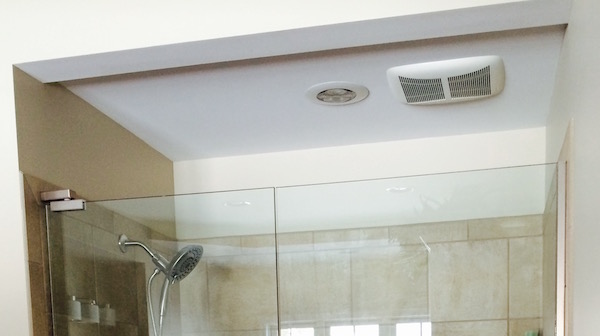
DH and I checked on whether or not it was actually working. The exhaust butts up against an exterior wall, so we went to the back of the house where the exhaust "exhausts" out, we could feel the air coming out. It felt quite surprising how much air was coming out, it felt like a fan.
The bathroom is about 125-150 sqft. The window is inside the actual shower stall, as is the new exhaust fan. Just like in this image:
Anonymous
06/07/2023 10:15
Subject: Bathroom Humidity - Solutions Needed
OP -- have you done an incense stick test? See if the exhaust fan is actually working properly? If the smoke doesn't get cleared, you will know that the problem is improper exhaust. I will second the poster who indicated that bath fans should be vented by rigid duct (ideally out through the roof). Based on what you are describing (dripping), adding a bigger dehumidifier will not eliminate the moisture fast enough to prevent metal corrosion and mold growth.
Anonymous
06/07/2023 10:10
Subject: Re:Bathroom Humidity - Solutions Needed
Anonymous wrote:Leave the bathroom door wide open at all times except when occupied.
We already do this, plus we leave the exhaust fan running 24/7 and we keep the window open for the entire day closing it only at night.
Anonymous
06/07/2023 10:09
Subject: Bathroom Humidity - Solutions Needed
Anonymous wrote:Anonymous wrote:I don’t think those small portable humidifiers do anything. Get a real one and it will make a big difference, but it will take up some space. Great in the winter though because you don’t lose all the heat.
I used a small one and it sucked up a lot of water, seemed to do something.
But I agree, OP could try a larger one.
OP here - yes this is the conclusion we've come to. We need a larger one, as clunky as it will be. It's okay because it's not the main bathroom in the house.
Anonymous
06/07/2023 09:47
Subject: Re:Bathroom Humidity - Solutions Needed
Our house is pretty tight. The exhaust fan works a lot better if a window is cracked a bit.
Anonymous
06/07/2023 05:49
Subject: Re:Bathroom Humidity - Solutions Needed
Leave the bathroom door wide open at all times except when occupied.
Anonymous
06/07/2023 01:25
Subject: Bathroom Humidity - Solutions Needed
Something else is going on.
Let's say it's a big bathroom and it's 200 square feet. With eight foot ceilings that's 1600 cubic feet. A minimal exhaust fan will exhaust 100 cubic feet per minute, so in 16 minutes it will completely exchange the air in that room. Changing the air should get rid of all the humidity.
My bet is the exhaust fan isn't actually working. It happens all the time that the exhaust gets blocked, the vent on the outside gets painted shut by painters or the hose gets pinched in the wall or something builds a nest in it. It also happens all the time that it was never hooked up properly to begin with. It can also happen that the fan blade breaks and even though the motor is turning it's not moving any air. If you light an incense stick under it it should easily suck all of the smoke out of the room.
The other possibility is there's another source of humidity other than the shower -- most likely a plumbing leak somewhere. But I'd check the fan first.
Let's say it's a big bathroom and it's 200 square feet. With eight foot ceilings that's 1600 cubic feet. A minimal exhaust fan will exhaust 100 cubic feet per minute, so in 16 minutes it will completely exchange the air in that room. Changing the air should get rid of all the humidity.
My bet is the exhaust fan isn't actually working. It happens all the time that the exhaust gets blocked, the vent on the outside gets painted shut by painters or the hose gets pinched in the wall or something builds a nest in it. It also happens all the time that it was never hooked up properly to begin with. It can also happen that the fan blade breaks and even though the motor is turning it's not moving any air. If you light an incense stick under it it should easily suck all of the smoke out of the room.
The other possibility is there's another source of humidity other than the shower -- most likely a plumbing leak somewhere. But I'd check the fan first.