Anonymous
 01/15/2023 11:38
Subject: Picture of Mohammed
01/15/2023 11:38
Subject: Picture of Mohammed
Apparently, the President of Hamline is doubling down on the stupid. This isn’t going to end well for that school.

Anonymous
01/15/2023 10:26
Subject: Picture of Mohammed
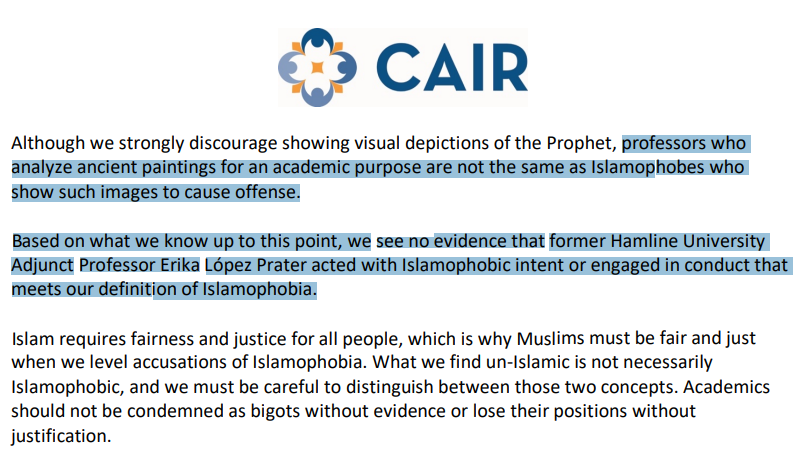
^^^ the CAIR statement from Sanchez' mastodon post.
Anonymous
01/15/2023 10:25
Subject: Re:Picture of Mohammed
Anonymous
01/14/2023 22:56
Subject: Picture of Mohammed
Anonymous wrote:Muslims cannot inflict their beliefs on others. I happily show pictures of Mohammad in my art history classes.
Why so gleeful? That happiness to offend comes from an ugly place.
Anonymous
01/14/2023 18:37
Subject: Picture of Mohammed
jsteele wrote:Anonymous wrote:Anonymous wrote:Anonymous wrote:Anonymous wrote:Anonymous wrote:Anonymous wrote:Anonymous wrote:Anonymous wrote:Anonymous wrote:Anonymous wrote:Apparently this is terribly offensive. Why is that? The oldest pictures are Muslim?
And how can we tell more Americans so they don't accidentally upset people?
So, I'm not going to show a picture just to try to upset people, but this isn't that case and I can't believe the university fired this professor.
So much for moderate Muslims.
Actual, I've read several Muslims condemning the university and supporting the teacher.
The president of the Muslim Student Association is the one who got the ball rolling on her dismissal
The Hamline University MSA doesn't speak for all Muslims.
Which ones doesn't it speak for? I haven't seen any Muslim complain
The NY Times article somebody linked to above quotes a Muslim complaining. There's even a photo of him with his painting of Mohammed that he smuggled out of Iran during the revolution.
Interestingly, this was an online class. Making it even easier for the student to look away after being warned. Some in the NY Times comments section are comparing this to entrapment: the student was given multiple warnings but chose to remain and then criticize the prof after the fact.
The bigger issue is, should we stop teaching and testing kids about evolution so as not to offend creationists in all religions? Where does it end?
of course, that same article quotes the executive director of the Minnesota chapter of the Council on American-Islamic Relations as supporting the dismissal. As far as where does it end, probably with a tiny school that is already struggling having an even harder time convincing students to attend.
That's the same CAIR another poster claims is nuanced
That was the Minnesota CAIR. The national spokesperson was more nuanced.
FYI:
I cannot see the end of the tweet.
Anonymous
01/14/2023 17:15
Subject: Picture of Mohammed
Muslims cannot inflict their beliefs on others. I happily show pictures of Mohammad in my art history classes.
jsteele
01/13/2023 17:28
Subject: Picture of Mohammed
Anonymous wrote:Anonymous wrote:Anonymous wrote:Anonymous wrote:Anonymous wrote:Anonymous wrote:Anonymous wrote:Anonymous wrote:Anonymous wrote:Anonymous wrote:Apparently this is terribly offensive. Why is that? The oldest pictures are Muslim?
And how can we tell more Americans so they don't accidentally upset people?
So, I'm not going to show a picture just to try to upset people, but this isn't that case and I can't believe the university fired this professor.
So much for moderate Muslims.
Actual, I've read several Muslims condemning the university and supporting the teacher.
The president of the Muslim Student Association is the one who got the ball rolling on her dismissal
The Hamline University MSA doesn't speak for all Muslims.
Which ones doesn't it speak for? I haven't seen any Muslim complain
The NY Times article somebody linked to above quotes a Muslim complaining. There's even a photo of him with his painting of Mohammed that he smuggled out of Iran during the revolution.
Interestingly, this was an online class. Making it even easier for the student to look away after being warned. Some in the NY Times comments section are comparing this to entrapment: the student was given multiple warnings but chose to remain and then criticize the prof after the fact.
The bigger issue is, should we stop teaching and testing kids about evolution so as not to offend creationists in all religions? Where does it end?
of course, that same article quotes the executive director of the Minnesota chapter of the Council on American-Islamic Relations as supporting the dismissal. As far as where does it end, probably with a tiny school that is already struggling having an even harder time convincing students to attend.
That's the same CAIR another poster claims is nuanced
That was the Minnesota CAIR. The national spokesperson was more nuanced.
FYI:
Anonymous
01/13/2023 08:34
Subject: Re:Picture of Mohammed
Anonymous wrote:Anonymous wrote:Anonymous wrote:Anonymous wrote:This prohibition on images of the prophet is not in the Koran anywhere and yet Islamic scholars are extremely dogmatic about the righteousness of this position.
First : sources and evidence for holding this level of academic certitude?
Second: is there any intellectual freedom for Islamic academics to explore validity of commonly held Islamic ideas?
Third: is it possible to find a middle ground for promoting tolerance of a religion and culture that clashes so badly with western culture and values (heavy restrictions on freedom of women/ non separation of church and state/ anti homosexuality and gender fluidity)?
I don’t understand this post. Islamic scholars are quite divided on this discussion.
From bbc article on history of Islamic image ban that is linked on previous page of posts
“The Koran itself doesn't say anything," Dr Azzam Tamimi, former head of the Institute of Islamic Political Thought told the BBC, "but it is accepted by all Islamic authorities that the Prophet Muhammad and all the other prophets cannot be drawn and cannot be produced in pictures because they are, according to Islamic faith, infallible individuals, role models and therefore should not be presented in any manner that might cause disrespect for them."
He is not convinced by the argument that if there are medieval depictions of Muhammad that suggests there is no absolute prohibition. "Even if it were that would have been condemned by the scholars of Islam."
Ah so you mean authorities not scholars. That makes more sense.
I meant both really - given the last sentence of Dr Amimi.
Anonymous
01/13/2023 07:12
Subject: Re:Picture of Mohammed
Anonymous wrote:Anonymous wrote:Anonymous wrote:This prohibition on images of the prophet is not in the Koran anywhere and yet Islamic scholars are extremely dogmatic about the righteousness of this position.
First : sources and evidence for holding this level of academic certitude?
Second: is there any intellectual freedom for Islamic academics to explore validity of commonly held Islamic ideas?
Third: is it possible to find a middle ground for promoting tolerance of a religion and culture that clashes so badly with western culture and values (heavy restrictions on freedom of women/ non separation of church and state/ anti homosexuality and gender fluidity)?
I don’t understand this post. Islamic scholars are quite divided on this discussion.
From bbc article on history of Islamic image ban that is linked on previous page of posts
“The Koran itself doesn't say anything," Dr Azzam Tamimi, former head of the Institute of Islamic Political Thought told the BBC, "but it is accepted by all Islamic authorities that the Prophet Muhammad and all the other prophets cannot be drawn and cannot be produced in pictures because they are, according to Islamic faith, infallible individuals, role models and therefore should not be presented in any manner that might cause disrespect for them."
He is not convinced by the argument that if there are medieval depictions of Muhammad that suggests there is no absolute prohibition. "Even if it were that would have been condemned by the scholars of Islam."
Ah so you mean authorities not scholars. That makes more sense.
Anonymous
01/13/2023 07:10
Subject: Re:Picture of Mohammed
Anonymous wrote:Anonymous wrote:This prohibition on images of the prophet is not in the Koran anywhere and yet Islamic scholars are extremely dogmatic about the righteousness of this position.
First : sources and evidence for holding this level of academic certitude?
Second: is there any intellectual freedom for Islamic academics to explore validity of commonly held Islamic ideas?
Third: is it possible to find a middle ground for promoting tolerance of a religion and culture that clashes so badly with western culture and values (heavy restrictions on freedom of women/ non separation of church and state/ anti homosexuality and gender fluidity)?
I don’t understand this post. Islamic scholars are quite divided on this discussion.
From bbc article on history of Islamic image ban that is linked on previous page of posts
“The Koran itself doesn't say anything," Dr Azzam Tamimi, former head of the Institute of Islamic Political Thought told the BBC, "but it is accepted by all Islamic authorities that the Prophet Muhammad and all the other prophets cannot be drawn and cannot be produced in pictures because they are, according to Islamic faith, infallible individuals, role models and therefore should not be presented in any manner that might cause disrespect for them."
He is not convinced by the argument that if there are medieval depictions of Muhammad that suggests there is no absolute prohibition. "Even if it were that would have been condemned by the scholars of Islam."
Anonymous
01/13/2023 07:06
Subject: Re:Picture of Mohammed
Anonymous wrote:This prohibition on images of the prophet is not in the Koran anywhere and yet Islamic scholars are extremely dogmatic about the righteousness of this position.
First : sources and evidence for holding this level of academic certitude?
Second: is there any intellectual freedom for Islamic academics to explore validity of commonly held Islamic ideas?
Third: is it possible to find a middle ground for promoting tolerance of a religion and culture that clashes so badly with western culture and values (heavy restrictions on freedom of women/ non separation of church and state/ anti homosexuality and gender fluidity)?
I don’t understand this post. Islamic scholars are quite divided on this discussion.
Anonymous
01/13/2023 07:05
Subject: Picture of Mohammed
Anonymous wrote:Now the President of the school is saying she sticks by the firing for the safety of the student body. So now they are just caving to the extremists. Terroristic threats of violence works.
Same reason they let the Republican terrorists storm the Capitol.
Anonymous
01/13/2023 07:02
Subject: Re:Picture of Mohammed
Anonymous wrote:This prohibition on images of the prophet is not in the Koran anywhere and yet Islamic scholars are extremely dogmatic about the righteousness of this position.
First : sources and evidence for holding this level of academic certitude?
Second: is there any intellectual freedom for Islamic academics to explore validity of commonly held Islamic ideas?
Third: is it possible to find a middle ground for promoting tolerance of a religion and culture that clashes so badly with western culture and values (heavy restrictions on freedom of women/ non separation of church and state/ anti homosexuality and gender fluidity)?
Intellectual freedom is a western value.
Anonymous
01/13/2023 07:01
Subject: Picture of Mohammed
Anonymous wrote:Anonymous wrote:Anonymous wrote:Anonymous wrote:Anonymous wrote:I don’t think many non Muslim Americans are randomly creating pictures of Mohammed.
Until I read this news story, I would have had no idea that this was offensive at all.
So were you planning on drawing or displaying a big pic of Mohammed this weekend and now that’s cancelled?
No. But it's the kind of mistake I could make easily
Because you randomly think "Let me draw a picture of Mohammed"? Like WHEN would you do that? Also what would be your point of reference since hes basically the JD Salinger of prophets?
Don't you ever doodle randomly?
Anonymous
01/13/2023 05:07
Subject: Re:Picture of Mohammed
This prohibition on images of the prophet is not in the Koran anywhere and yet Islamic scholars are extremely dogmatic about the righteousness of this position.
First : sources and evidence for holding this level of academic certitude?
Second: is there any intellectual freedom for Islamic academics to explore validity of commonly held Islamic ideas?
Third: is it possible to find a middle ground for promoting tolerance of a religion and culture that clashes so badly with western culture and values (heavy restrictions on freedom of women/ non separation of church and state/ anti homosexuality and gender fluidity)?
First : sources and evidence for holding this level of academic certitude?
Second: is there any intellectual freedom for Islamic academics to explore validity of commonly held Islamic ideas?
Third: is it possible to find a middle ground for promoting tolerance of a religion and culture that clashes so badly with western culture and values (heavy restrictions on freedom of women/ non separation of church and state/ anti homosexuality and gender fluidity)?