Anonymous
 10/23/2021 06:25
Subject: U.S. Church Membership Falls Below Majority for First Time
10/23/2021 06:25
Subject: U.S. Church Membership Falls Below Majority for First Time
Wokeness & covid extremism are the new religion for many.

Anonymous
10/23/2021 06:03
Subject: U.S. Church Membership Falls Below Majority for First Time
Anonymous wrote:Anonymous wrote:Anonymous wrote:I fear we'll very likely see increasing effects in the areas of charitable giving and volunteerism as religious affinity weakens. Our society is just not developing enough civic-mindedness in secular individuals to make up the difference and the government sure isn't either.
http://marripedia.org/effects_of_religious_practice_on_charity
Too bad that you think people's generosity is so tied to the hope for eternal life that people won't be generous with their time or money unless they believe it will assure them a place in heaven.
Well, church-going conservatives give more to charity than atheist liberals, so I'd say that's a fair assessment.
"Religious practice is the behavioral variable most consistently associated with generous giving. Charitable effort correlates strongly with the frequency with which a person attends religious services. Evangelical Protestants and Mormons in particular are strong givers. Compared to Protestant affiliation, both Catholic affiliation and Jewish affiliation reduce the scope of average giving, when other influences are held constant.
Finer-grain numbers from the PSID show that the faithful don’t just give to religious causes; they are also much more likely to give to secular causes than the non-religious. Among Americans who report that they “never” attend religious services, just less than half give any money at all to secular causes. People who attend services 27-52 times per year, though, give money to secular charities in two thirds of all cases. (See page 1138.)
Sociologist Robert Putnam has chronicled the many pro-social and philanthropic overflow effects of religious practice. Not only is half of all American personal philanthropy and half of all volunteering directly religious in character, but nearly half of all associational membership in the U.S. is church-related. Religious practice links us in webs of mutual knowledge, responsibility, and support like no other influence.
Indeed, faith is as important as basic financial success in increasing giving. And religious conviction is often what separates one sub-group from another when it comes to charitable practice. For instance, African Americans, who are generally more religious than whites, are consequently 18 percent bigger givers when households of the same income, region, education, and so forth are compared."
https://www.philanthropyroundtable.org/almanac/statistics/who-gives
Just raise taxes. You don’t need religion.
Anonymous
10/22/2021 22:44
Subject: U.S. Church Membership Falls Below Majority for First Time
Anonymous wrote:Anonymous wrote:I fear we'll very likely see increasing effects in the areas of charitable giving and volunteerism as religious affinity weakens. Our society is just not developing enough civic-mindedness in secular individuals to make up the difference and the government sure isn't either.
http://marripedia.org/effects_of_religious_practice_on_charity
Too bad that you think people's generosity is so tied to the hope for eternal life that people won't be generous with their time or money unless they believe it will assure them a place in heaven.
Well, church-going conservatives give more to charity than atheist liberals, so I'd say that's a fair assessment.
"Religious practice is the behavioral variable most consistently associated with generous giving. Charitable effort correlates strongly with the frequency with which a person attends religious services. Evangelical Protestants and Mormons in particular are strong givers. Compared to Protestant affiliation, both Catholic affiliation and Jewish affiliation reduce the scope of average giving, when other influences are held constant.
Finer-grain numbers from the PSID show that the faithful don’t just give to religious causes; they are also much more likely to give to secular causes than the non-religious. Among Americans who report that they “never” attend religious services, just less than half give any money at all to secular causes. People who attend services 27-52 times per year, though, give money to secular charities in two thirds of all cases. (See page 1138.)
Sociologist Robert Putnam has chronicled the many pro-social and philanthropic overflow effects of religious practice. Not only is half of all American personal philanthropy and half of all volunteering directly religious in character, but nearly half of all associational membership in the U.S. is church-related. Religious practice links us in webs of mutual knowledge, responsibility, and support like no other influence.
Indeed, faith is as important as basic financial success in increasing giving. And religious conviction is often what separates one sub-group from another when it comes to charitable practice. For instance, African Americans, who are generally more religious than whites, are consequently 18 percent bigger givers when households of the same income, region, education, and so forth are compared."
https://www.philanthropyroundtable.org/almanac/statistics/who-gives
Anonymous
10/22/2021 21:27
Subject: Re:U.S. Church Membership Falls Below Majority for First Time
Makes sense!
I attended church for my entire life, had Billy Graham over for dinner, considered being a missing doc, etc., until an employee of a large United Methodist church in NoVa taught my preschool kids how sex works. Pastor supported the employee so we had no choice but to leave so that nothing else happened.
Never going to look at a church the same again.
I’m so glad to hear that church attendance is dropping!
Anonymous
10/22/2021 21:11
Subject: U.S. Church Membership Falls Below Majority for First Time
Atheist pp here. It is not that I think churches are necessary for social bonds, helping others etc. Of course not. But they have been one of the primary ways in which this has happened. We are becoming increasingly atomized as a society. The decline of organized religion will likely exacerbate that, and I am not sure that is to be celebrated.
Anonymous
10/22/2021 21:03
Subject: U.S. Church Membership Falls Below Majority for First Time
Anonymous wrote:I fear we'll very likely see increasing effects in the areas of charitable giving and volunteerism as religious affinity weakens. Our society is just not developing enough civic-mindedness in secular individuals to make up the difference and the government sure isn't either.
http://marripedia.org/effects_of_religious_practice_on_charity
Too bad that you think people's generosity is so tied to the hope for eternal life that people won't be generous with their time or money unless they believe it will assure them a place in heaven.
Anonymous
10/22/2021 20:36
Subject: U.S. Church Membership Falls Below Majority for First Time
I fear we'll very likely see increasing effects in the areas of charitable giving and volunteerism as religious affinity weakens. Our society is just not developing enough civic-mindedness in secular individuals to make up the difference and the government sure isn't either.
http://marripedia.org/effects_of_religious_practice_on_charity
http://marripedia.org/effects_of_religious_practice_on_charity
Anonymous
10/22/2021 14:44
Subject: U.S. Church Membership Falls Below Majority for First Time
Anonymous wrote:Anonymous wrote:There is hope after all.
I don't know. I am an atheist myself, but some of these churches do a lot of good: fostering social connections, helping the poor etc.
I think it is mainly the mainstream protestant and catholic churches that are losing members, the crazy anti-vaccine pro-Trump gospel of prosperity ones are doing fine...
And what are we replacing the church-going with? How do we form the social bonds that we need to stop polarization and isolation?
Well, you, an atheist, should be able to answer some of these questions yourself. How do you do form social bonds, etc. without believing in an invisible supernatural being and whatever story that goes along with it??
Anonymous
10/22/2021 12:55
Subject: U.S. Church Membership Falls Below Majority for First Time
Anonymous wrote:Anonymous wrote:Anonymous wrote:There is hope after all.
I don't know. I am an atheist myself, but some of these churches do a lot of good: fostering social connections, helping the poor etc.
I think it is mainly the mainstream protestant and catholic churches that are losing members, the crazy anti-vaccine pro-Trump gospel of prosperity ones are doing fine...
And what are we replacing the church-going with? How do we form the social bonds that we need to stop polarization and isolation?
Like other nations do - with government safety nets. Subsidized daycares for everyone, not just piecemeal stuff for people connected to a church. Universal health care instead of Go-fund-mes and church meal trains. Parental leave for mothers and fathers instead of getting someone at church to watch your first kid while you're in the hospital giving birth to your second kid.
The USA is so backward in this social area.
On the topic of social bonds and community building, I'd argue to the atheist PP (I'm agnostic) that we're already seeing that we don't need to churches/mosques/synagogues to foster social connections or push involvement in service to the community or help raise children with a good sense of morals.
Growing up in the 80s, 90s, 00s etc - I'm seeing more than ever that the precepts we relied on to say 'humans would be evil without this' are wrong. You don't need to learn the Ten Commandments of God to appreciate the difference between right and wrong or social obligation to help your fellow human or not to kill.
It's called being an inherently good person.
I've also seen more non-religious affirmations of community worth - fundraising, bake sales, firefighter volunteers, people rushing to help the wounded - than I have religious in the past decades.
A big example of that happened during Hurricane Harvey when mega-church pastor Joel Osteen locked the doors of his building rather than shelter the people forced from their homes. But the city opened the Astrodome without hesitation.
Anonymous
10/22/2021 12:21
Subject: U.S. Church Membership Falls Below Majority for First Time
Anonymous wrote:Anonymous wrote:There is hope after all.
I don't know. I am an atheist myself, but some of these churches do a lot of good: fostering social connections, helping the poor etc.
I think it is mainly the mainstream protestant and catholic churches that are losing members, the crazy anti-vaccine pro-Trump gospel of prosperity ones are doing fine...
And what are we replacing the church-going with? How do we form the social bonds that we need to stop polarization and isolation?
Like other nations do - with government safety nets. Subsidized daycares for everyone, not just piecemeal stuff for people connected to a church. Universal health care instead of Go-fund-mes and church meal trains. Parental leave for mothers and fathers instead of getting someone at church to watch your first kid while you're in the hospital giving birth to your second kid.
The USA is so backward in this social area.
Anonymous
10/22/2021 12:13
Subject: U.S. Church Membership Falls Below Majority for First Time
I was raised Catholic, but I've watched how the church systematically hushed up child abuse. I'd never trust them with my kid.
Anonymous
10/22/2021 12:10
Subject: U.S. Church Membership Falls Below Majority for First Time
Anonymous wrote:There is hope after all.
I don't know. I am an atheist myself, but some of these churches do a lot of good: fostering social connections, helping the poor etc.
I think it is mainly the mainstream protestant and catholic churches that are losing members, the crazy anti-vaccine pro-Trump gospel of prosperity ones are doing fine...
And what are we replacing the church-going with? How do we form the social bonds that we need to stop polarization and isolation?
Anonymous
10/22/2021 12:04
Subject: U.S. Church Membership Falls Below Majority for First Time
There is hope after all.
Anonymous
10/22/2021 12:03
Subject: U.S. Church Membership Falls Below Majority for First Time
The pandemic sealed for me that I'm never returning to church. Was a begrudging goer before for family harmony. No more.
Anonymous
10/22/2021 12:00
Subject: U.S. Church Membership Falls Below Majority for First Time
For the first time in U.S. history, more than 50% of Americans is Agnostic, Atheist, or Non-practicing.
Americans' membership in houses of worship continued to decline last year, dropping below 50% for the first time in Gallup's eight-decade trend. In 2020, 47% of Americans said they belonged to a church, synagogue or mosque, down from 50% in 2018 and 70% in 1999.
https://news.gallup.com/poll/341963/church-membership-falls-below-majority-first-time.aspx
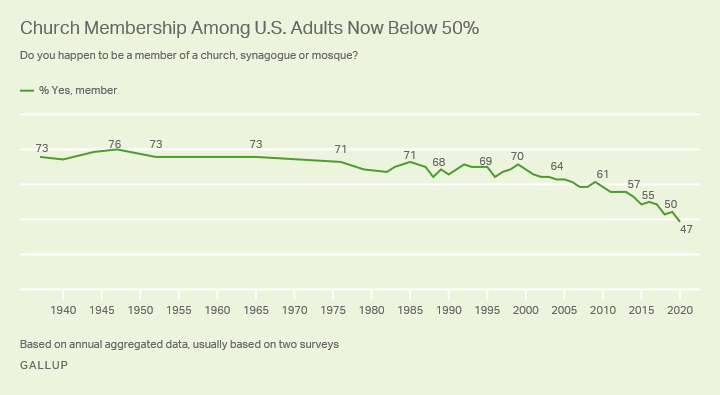
Americans' membership in houses of worship continued to decline last year, dropping below 50% for the first time in Gallup's eight-decade trend. In 2020, 47% of Americans said they belonged to a church, synagogue or mosque, down from 50% in 2018 and 70% in 1999.
https://news.gallup.com/poll/341963/church-membership-falls-below-majority-first-time.aspx